
The worst mistake IMGs make between Step 2 and ERAS is wasting the only months when US clinical experience still changes their outcome.
You’re not “done” after Step 2. You’re on the clock. And what you do in the 8–16 weeks after that score posts can decide if you look like a strong, US-ready applicant or another generic CV in the stack.
Here’s how to use that gap—week by week—to lock in US clinical experience (USCE) that actually helps you match.
Big Picture: Your Gap Timeline at a Glance
First, zoom out. Assume a standard ERAS cycle aiming to start residency July 1, 2026.
Key anchors:
- Step 2 CK latest recommended date: end of June 2025
- ERAS Application opens for editing: June 2025
- Programs start receiving applications: September 2025
- Interview season: roughly October 2025 – January 2026
Your “gap” is the period from Step 2 CK completion to ERAS submission (and in many cases, through interview season).
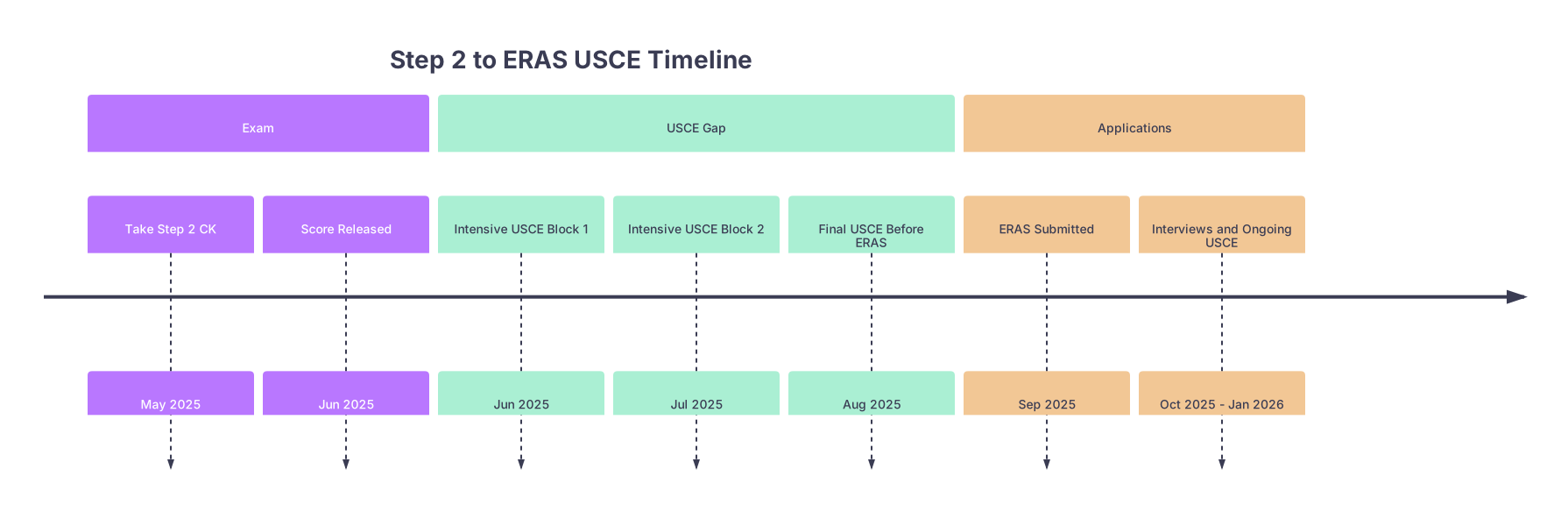
| Period | Event |
|---|---|
| Exam - Take Step 2 CK | May 2025 |
| Exam - Score Released | Jun 2025 |
| USCE Gap - Intensive USCE Block 1 | Jun 2025 |
| USCE Gap - Intensive USCE Block 2 | Jul 2025 |
| USCE Gap - Final USCE Before ERAS | Aug 2025 |
| Applications - ERAS Submitted | Sep 2025 |
| Applications - Interviews and Ongoing USCE | Oct 2025 - Jan 2026 |
At each phase, your priorities shift:
- 4–6 months before Step 2: Secure USCE spots.
- 0–4 weeks after Step 2: Start or continue rotations, get seen, get evaluated.
- 4–12 weeks before ERAS submission: Maximize letters and concrete, documentable US experience.
- Post-ERAS, during interviews: Use ongoing USCE strategically for updates and networking.
Now let’s build the timeline you should be following.
6–4 Months Before Step 2: Pre‑Exam, But USCE Planning Starts Now
At this point you should stop pretending you’ll “figure out USCE after exams.” The competitive IMGs you’re up against are booking rotations 4–9 months ahead.
Your goals in this phase
Define your target specialty.
Internal medicine vs FM vs neurology vs psych. This matters because:- Programs want recent, specialty‑relevant USCE.
- A medicine program doesn’t care that you observed in dermatology all summer.
Decide your USCE mix:
- Hands‑on (most valuable):
- Sub‑internships, externships, hands‑on electives, inpatient rotations
- Direct patient contact, order entry, notes, presentations.
- Observerships (better than nothing, but weaker):
- Shadowing only. No orders, no notes, limited responsibility.
- Hands‑on (most valuable):
If you can get even 8–12 weeks of hands‑on USCE in your target specialty, you’re ahead of most IMGs.
Concrete action checklist (6–4 months before Step 2)
At this point you should:
Build a USCE target calendar:
- Example:
- June–July: Inpatient IM externship
- August: Outpatient IM or subspecialty
- September: One more IM or sub‑specialty block (if you can stay in the US)
- Example:
Identify programs/platforms:
- University- or hospital-based electives (for students)
- Structured IMG externships (e.g., teaching hospitals that accept graduates)
- Private preceptor observerships if nothing else is available
Start contacting:
- Program coordinators
- IMG‑focused externship providers
- Faculty with a track record of writing letters for IMGs
You want formal confirmations (emails, acceptance letters) for rotations that fall:
- Directly after Step 2, and
- At least one block that ends by late August, so it appears complete and documented in ERAS at submission.
2 Months Before Step 2: Lock In Dates, Protect Your Score
You are now close to Step 2; this is where people get sloppy and either:
- Overload with USCE and tank their exam, or
- Over‑correct and have nothing by ERAS.
At this point you should:
Freeze rotation dates.
Confirm:- Start/end dates
- Site addresses
- Supervisor names and titles
- Whether evaluations/letters are standard
Protect your Step 2 study window.
If you’re IM or FM bound, a Step 2 CK in the 240s+ range is still more valuable than an extra month of observership. If you have to choose:- Prioritize the exam score,
- But don’t let all your USCE drift past ERAS submission.
Try to keep the 4 weeks immediately before Step 2 mostly rotation‑free (or very light).
Week 0: Step 2 CK Done – Now the Real USCE Window Starts
You walk out of your Step 2 exam. From this day until ERAS submission, you’re in your highest‑impact clinical window.
Week 0–1: Transition Week
At this point you should:
Take 2–3 actual rest days. You’ll function better on the wards afterwards.
Confirm every upcoming rotation again by email:
- “Looking forward to starting on [date]. Just confirming start time, location, and any onboarding tasks.”
Prepare a concise introduction you’ll say 50 times:
- Who you are
- Your med school and year (or graduate)
- Target specialty and Step status (Step 1/2 done).
Weeks 1–4 After Step 2: First Intensive USCE Block
This is often your first full‑time US clinical block after exams. It’s your first real chance to prove you can work like a US intern.
At this point you should:
Choose the right setting (if you still have flexibility).
- Priority order for impact:
- University‑affiliated inpatient rotation
- Large community teaching hospital
- Private practice with strong teaching and letter culture
- Pure observerships at any of the above
- Priority order for impact:
Behave like an intern, not a tourist.
- Show up before the team.
- Know every patient’s overnight events, labs, imaging.
- Volunteer to present, write mock notes, communicate plans.
Identify your letter writers early.
By the end of Week 2, you should have 1–2 attendings in mind who:- See you consistently
- Have seen you present, reason, follow up
- Actually know your name without looking at your badge
Then your internal script becomes: “I need to convince this person in the next 2 weeks that I’d be a safe, hard‑working intern here.”
Weeks 4–8: Second USCE Block & Letter Extraction Phase
This second block is where you turn “USCE experience” into ERAS‑ready documentation.
At this point you should:
1. Secure Letters of Recommendation (LoRs)
By the end of Week 6–7 after Step 2, you need:
- At least 2 specialty‑specific US LoRs
- Ideally:
- 1 from an academic or teaching hospital
- 1 from someone who knows you very well and actually writes detailed letters
Time your ask:
- Ideal moment: End of Week 3–4 of that rotation
- Approach:
- Ask in person, directly:
“Dr. X, I’m applying to internal medicine this September. Would you feel comfortable writing me a strong letter of recommendation based on my work this month?”
- Ask in person, directly:
If they hesitate, do not push. Pick a different writer. A lukewarm letter is worse than none.
2. Capture Documentation for ERAS
You want to ensure:
- The rotation will provide:
- A completion letter or evaluation, with:
- Your full name
- Exact dates
- Site name
- Specialty (e.g., Internal Medicine – Inpatient)
- A completion letter or evaluation, with:
- You understand how the letter will be submitted:
- ERAS LoR Portal
- Institutional upload
- Or email to your dean’s office (if you’re still a student)
3. Decide What Goes in Your Personal Statement
These weeks often give you:
- A defining patient encounter
- A real sense of US team structure
- Some “I saw how fragmented outpatient care can be…” type insight
Write down:
- 2–3 specific cases you followed
- One challenge you faced and solved
- One moment where an attending praised you
That becomes gold for your personal statement and interviews.
Weeks 8–12: Final Pre‑ERAS USCE & CV Polishing
You’re now 2–8 weeks from ERAS submission.
This is often where people waste time on rotations that look good on Instagram but do nothing for their application.
At this point you should:
Prioritize Rotations That Help the Actual Application
Your best moves:
Finish at least one USCE block by mid‑August
So it appears as “completed” with dates and supervisor in your ERAS when you hit submit in September.If you still have a gap in:
- US inpatient experience
- Target specialty experience
- Or US letters
then this is the last realistic window to plug it.
Decide What You’ll List on ERAS
Anything ongoing by September can still be listed as:
- “Planned” or “In progress” with end dates in the future.
But “Completed” experience with clear start/end dates looks better.
You should have, by ERAS submission:
- USCE Summary:
- 8–12 weeks USCE total is respectable
- 12–16+ weeks is strong for many IMGs
- Types:
- At least 1–2 inpatient blocks in your target specialty
- 1 outpatient/subspecialty is fine, but not your whole portfolio
| Type of USCE | Duration | Priority for IMGs |
|---|---|---|
| Inpatient core specialty | 8–12 weeks | Highest |
| Outpatient same specialty | 4 weeks | High |
| Subspecialty observership | 4 weeks | Moderate |
| Unrelated specialty | 4+ weeks | Low |
September: ERAS Submission – How USCE Fits In
On ERAS opening / submission week, here’s what should be true of your USCE.
At this point you should:
List all completed and in‑progress USCE clearly:
- Role: Extern, visiting student, observer
- Setting: Inpatient vs outpatient
- Specialty: “Internal Medicine – Inpatient Ward,” not just “Clinical rotation”
Cross‑check with your LoRs:
- Each US letter should link to a real, described experience in your application.
- If you did an inpatient IM externship and your letter comes from that, the rotation entry and letter should match dates and site.
Use USCE strategically in your personal statement:
- 1–2 specific examples of:
- How you adapted to the US system
- How your clinical reasoning or communication improved
- What you learned about patient care here vs at home
- 1–2 specific examples of:
Remember, for IMGs, USCE isn’t optional “nice to have.” It’s the only proof you can function in the US workplace.
Programs use it to answer:
- Can this person handle EPIC/Cerner, sign‑out, cross‑cover?
- Do they understand US documentation/med‑legal culture?
- Have they seen the volume and pace here?
If your USCE doesn’t answer those questions, you didn’t use your gap well.
October–January: Interview Season – Ongoing USCE as an Asset
You submitted ERAS. That doesn’t mean USCE stops mattering.
At this point you should:
1. Continue USCE if possible
If you have rotations in October–December:
- Mention them in updates to programs (especially if they’re strong, hands‑on roles).
- Use them to:
- Refine your US communication
- Generate more cases and stories for interviews
- Get last‑minute informal advocates (“I’ll email my residency PD about you” – I’ve watched this happen)
2. Use USCE Stories in Interviews
Your answers are stronger when they sound like:
- “On my inpatient IM rotation in July at [Hospital], I managed a panel of 6 patients under supervision and presented daily on rounds. One case that stands out is…”
Versus:
- “I observed in a hospital and learned a lot.”
The gap months after Step 2 are where you earn those real, detailed stories.
What If You Have a Very Short Gap?
Some of you are in a tighter situation:
- Step 2 in July
- ERAS in September
- Visa or financial constraints limit total time in the US
You don’t get to complain; you get to optimize.
For short gaps (6–10 weeks maximum), at this point you should:
- Prioritize one strong, 4–8 week inpatient USCE block in your target specialty.
- Accept that observerships are lower value; still do them if that’s all that’s available, but don’t pretend they’re equivalent to hands‑on work.
- Aggressively seek one standout letter from that block and supplement with:
- Home country letters (strong, detailed)
- Academic letters from your school
The rule is simple:
If you can’t have quantity, you must have quality and specificity.
Common Pitfalls in the Step 2–ERAS Gap (and How to Avoid Them)
Let me be blunt about what I see every year.
At this point you should avoid:
Random, scattershot observerships.
- Four different specialties in three months looks unfocused.
- Programs assume you’re undecided or just chasing visas.
Rotations ending after mid‑September with no prior USCE.
- “Planned” USCE is weaker than “Completed.”
- If your first US rotation starts in October and you apply in September, you’re essentially applying with zero USCE.
Not asking for letters.
- Many IMGs wait for attendings to “offer.” They almost never do.
- Learn to ask professionally. Your competition already does.
Overloading with USCE and underperforming on Step 2.
- If your Step 2 suffers, some specialties will not care how pretty your USCE is.
Visual Snapshot: When Most IMGs Cram USCE
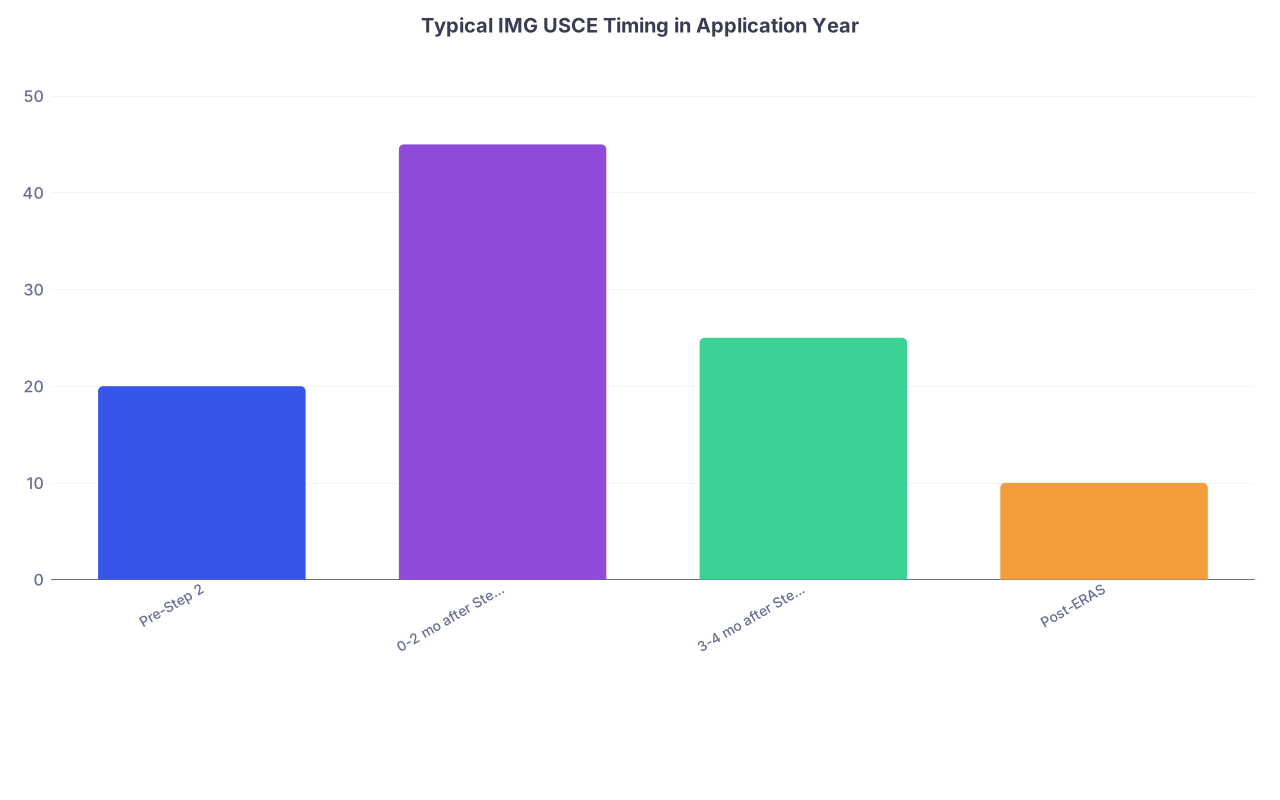
| Category | Value |
|---|---|
| Pre-Step 2 | 20 |
| 0-2 mo after Step 2 | 45 |
| 3-4 mo after Step 2 | 25 |
| Post-ERAS | 10 |
The majority cram USCE into the 0–2 month window after Step 2. You’re trying to be in the smarter minority who:
- Books early
- Targets the right specialty
- Finishes at least one solid block by ERAS submission
Quick Reference Timeline: What You Should Be Doing When
| Time Relative to Step 2 | At This Point You Should... |
|---|---|
| -6 to -4 months | Choose specialty, book USCE blocks, confirm sites |
| -2 months | Finalize dates, protect Step 2 study time |
| Week 0–1 | Rest, reconfirm rotations, prepare intros |
| Weeks 1–4 | First USCE block, identify potential letter writers |
| Weeks 4–8 | Second USCE block, secure and upload LoRs |
| Weeks 8–12 | Final pre-ERAS USCE, polish ERAS entries |
| Post-ERAS | Continue USCE, use for updates and interview stories |
FAQ (Exactly 2 Questions)
1. Is observership‑only USCE in the Step 2–ERAS gap still worth it for IMGs?
Yes, but with realistic expectations. Observership‑only experience:
- Shows you’ve seen US practice
- Helps you talk more concretely in interviews
But it doesn’t prove you can function as an intern the way hands‑on externships or electives do. If all you can get is observerships, aim for: - Longer duration (4–8 weeks at one site instead of 1 week here and there)
- A single specialty focus that matches your application
- Strong letters that at least highlight professionalism, clinical reasoning in discussions, and communication
2. How “recent” does US clinical experience need to be by the time I apply?
For IMGs, within 12 months of ERAS submission is ideal, within 24 months is usually still acceptable. The closer to application year, the better. That’s why the Step 2–ERAS gap is prime time:
- Do at least one rotation that ends in the same calendar year you’re applying.
- Try to avoid a situation where all your USCE is older than 18–24 months. Programs look at recency because they want proof you’re still clinically sharp and accustomed to current US practice patterns.
Key points:
- The months between Step 2 and ERAS are not “free time”; they’re your highest‑leverage window to earn meaningful USCE and letters.
- At each phase—pre‑Step 2, immediate post‑exam, and pre‑ERAS—you should know exactly which rotations, which attendings, and which letters you’re targeting.
- If you treat this gap casually, you’ll look generic on paper; if you treat it like a second job, you’ll look like someone programs can confidently rank.