
The way most IMGs talk about “US clinical experience” is naïve. Attendings do not rank it the way advisors and forums tell you they do.
Let me tell you how it actually works when your application hits a faculty member’s screen and they see those magic letters: USCE, observership, externship, research assistant, “hands-on” in bold.
They do not treat all of that as equal. Not even close.
What “US Clinical Experience” Really Signals To Attendings
Here’s the uncomfortable truth: for attendings and PDs, USCE is less about your medical knowledge and more about risk management.
We are asking:
“Can this person safely function in my hospital, in my system, with my patients, without becoming my next major headache?”
Your USCE is proof-of-concept. It answers four questions we absolutely care about and almost never say outright:
- Has anyone in the US system already watched this person work, day after day, and not thrown any red flags?
- Do they know basic US workflow: notes, orders, sign-out, paging etiquette, EMR hygiene, HIPAA, what not to say in front of a patient?
- Are they socially fluent enough in English and US culture to not offend patients, nurses, or families?
- Is there at least one US physician who will put their name on the line in a strong letter for this person?
If your “US clinical experience” doesn’t convince us on those four points, it’s background noise.
And that’s where most IMGs fall into a trap. They chase the wrong type of experience. They think any USCE box is better than no box. On the PD side, we’re sorting experiences into very different mental buckets.
The Hidden Hierarchy of USCE (How Attendings Actually Rank It)
Anyone who tells you “all USCE is good” has never sat in a rank meeting fighting over who to interview.
Behind closed doors, we put your experience into an unspoken hierarchy. Let me lay it out the way attendings actually think about it.
| Rank | Type of US Experience |
|---|---|
| 1 | US residency or internship (prior GME) |
| 2 | Hands-on sub-internship/acting internship |
| 3 | Structured IMG-focused externship |
| 4 | Formal US clerkship during med school |
| 5 | Inpatient observership with strong LOR |
| 6 | Outpatient-only observership |
Now, detail. This is what those categories really mean and how we react to them.
1. Prior US GME (Residency, Preliminary Year, or Internship)
If you’ve already done a US residency year, transitional year, or prelim internal medicine/surgery — you are not “USCE level,” you’re past it. You’re in “we already know this person can function in the system” territory.
Attendings reading your file think:
- They’ve written orders. Carried a pager. Got yelled at by nursing. Survived nights.
- They’ve already been credentialed, completed hospital onboarding, passed some level of competency evals.
- Someone already took the risk. And was not burned badly enough to fire them.
This is gold, especially if you’re switching specialties (e.g., from prelim surgery to internal medicine). The only caveat: we want to know why you left that program and what your PD said about you. That can help you or destroy you.
2. True Sub-I / Acting Internship (With Real Responsibility)
This is the highest-level USCE for students who haven’t done prior GME.
Key features attendings look for:
- Direct patient care: writing notes, presenting on rounds, proposing plans.
- Being on the call schedule or night float with at least some autonomy.
- A US letter from the attending or clerkship director explicitly saying:
“This student functioned at or near intern level.”
If your letter uses phrases like “functioned as an integral member of the team,” “independent data gathering,” “reliable and accurate clinical judgment for their level,” that grabs our attention. It’s the closest proxy we have to imagining you as an actual intern.
When you label something as a “sub-I” but the letter sounds like passive shadowing, we notice. And we do not like that mismatch. It makes us distrust the rest of your application.
3. Structured Externships for IMGs (Paid or Unpaid)
These IMG-focused externships are a mixed bag. Attendings and PDs know the game: many are profit centers. So we scrutinize them differently than you think.
We ask:
- Is this externship affiliated with a teaching hospital or residency program?
- Does the supervising physician hold an academic title? Are they part of a residency faculty?
- Does the letter sound like they actually supervised you? Or like a template plus your name?
Here’s the blunt truth: a good externship can help a lot. But only if:
- You had real responsibilities (even if limited): H&Ps, daily notes under supervision, case presentations.
- The letter is specific, narrative, and concrete, not generic fluff.
- It’s in the specialty you’re applying for, or at least adjacent.
A generic line like “worked diligently, showed interest, was punctual” is garbage to us. That’s minimum-tolerable behavior, not an endorsement.
4. Official US Clerkships During Medical School
If you’re still a student and your school arranged a US rotation that appears in your official transcripts, we like this better than a random observership, but less than a strong externship or sub-I.
Why? Because we’ve all seen US “clerkships” where the international student is essentially shadowing 80% of the time.
We look for:
- Whether the school has a real affiliation with that US hospital.
- Whether you were graded or evaluated like other students.
- Whether the letter compares you to US students:
“On par with or above the level of our US 4th-year students.”
If the letter writer never compares you to a reference group, we assume they weren’t fully comfortable doing so. That’s a soft negative.
5. Inpatient Observerships (Hospital-Based, No Direct Orders)
This is where a lot of IMGs have their hearts broken.
From the applicant side, an inpatient observership at a big-name hospital looks like a trophy. Cleveland Clinic. Mayo. Hopkins. You wear the badge, follow rounds, maybe present to your supervising attending.
From our side, here’s the unfiltered assessment:
- No order-writing privileges, no note-writing, no call → you haven’t actually proven you can function as a resident.
- If your biggest role was “observed patient care and discussed cases,” that’s preclinical-level engagement.
Is it useless? No. But attendings mentally put this in the “exposure, not competence” bucket.
It matters far more who writes your letter and what they say than where the observership was.
- A detailed letter from a mid-tier but teaching-heavy community program where you were present daily and the attending clearly knows you → strong plus.
- A name-brand hospital letter that reads like it’s been used 40 times: “Dr. X was a pleasure to have in our observership and demonstrated good knowledge base” → weak.
6. Outpatient-Only Observerships
This is the bottom rung for most core specialties, especially medicine, surgery, EM.
We know these are common because they’re easy to arrange — private practice clinics love a free extra body. But clinically, they tell us very little about your ability to handle inpatient workflow or acute care.
For outpatient-heavy specialties (psych, family, PM&R), this can still help, but it’s nowhere near as persuasive as inpatient work. For internal medicine or surgery, outpatient-only observerships without any inpatient anchor barely move the needle.
They may check a minimum “USCE present” box for some programs. But they rarely become the reason we choose you over someone else.
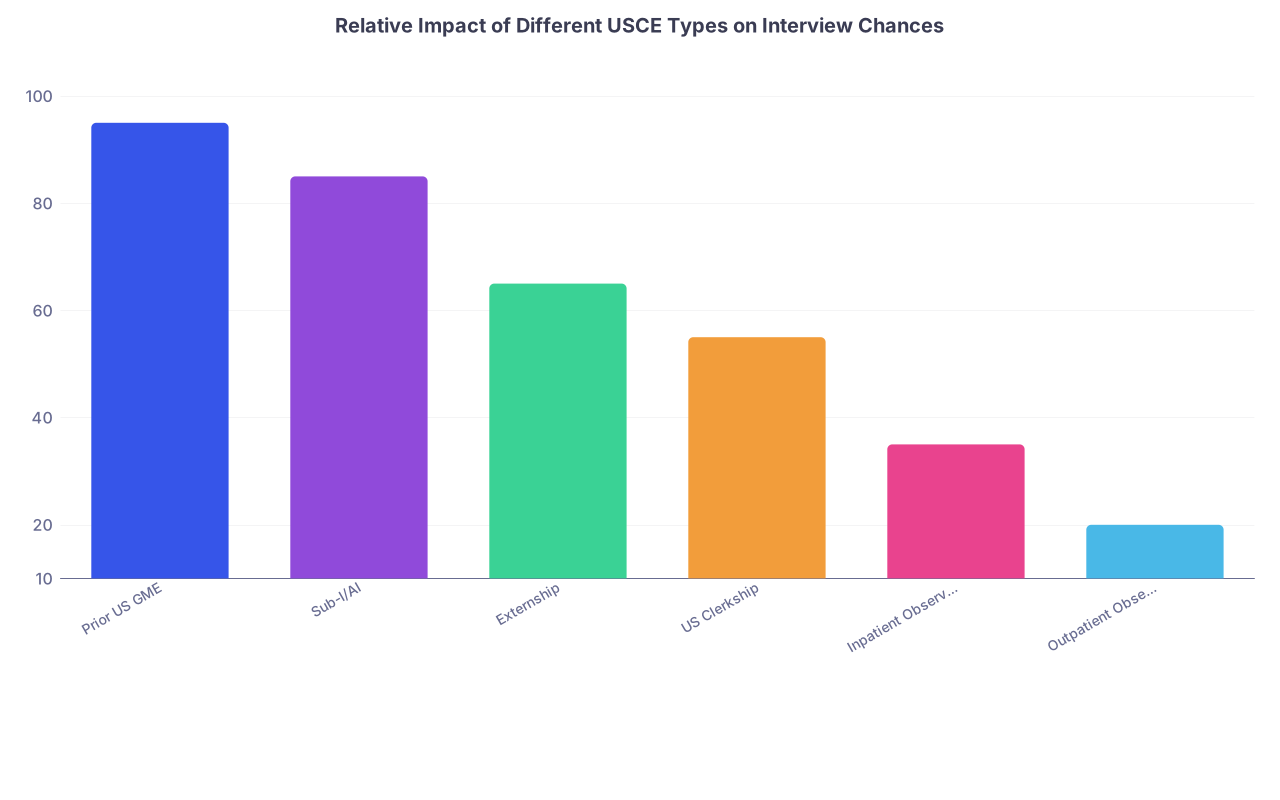
| Category | Value |
|---|---|
| Prior US GME | 95 |
| Sub-I/AI | 85 |
| Externship | 65 |
| US Clerkship | 55 |
| Inpatient Observership | 35 |
| Outpatient Observership | 20 |
Those numbers aren’t literal. But the ranking reflects how many attendings I know actually weight these categories when we’re trying to decide who looks “safe” and “worth the risk.”
How Attendings Read USCE on Your ERAS – The Real Thought Process
I’ve been in the room while applications are sorted into “interview”, “maybe”, and “no”. The process is less polished than you imagine.
It usually goes something like this:
- Faculty or PD opens ERAS.
- Glances at: Step scores, YOG (year of graduation), country of school.
- Eyes go straight to “Experience” and “Letters of Recommendation.”
- They scan for US institutions and familiar program names.
Here’s the internal monologue when we hit your USCE entries:
“Okay, observership with Dr. Smith, community hospital, 4 weeks. Letter attached.”
Click. Skim. One of three reactions:
- “This is a detailed, thoughtful letter. They clearly worked with this person. Mentions reliability, communication with nurses, cultural adjustment. Good.”
- “This is generic and vague. They barely know this applicant. Next.”
- “Red flag language: ‘with continued supervision,’ ‘improving,’ ‘communication can be a challenge.’ Hard pass.”
Concrete example:
If your letter says:
“X was always on time, behaved professionally, and is eager to learn” – that is damning with faint praise. That letter might make you feel good. To us, it screams: “I had nothing substantive to say.”
But if it says:
“On our inpatient medicine service, X independently gathered histories, performed physical exams, and presented plans during rounds. Their documentation was clear and improved rapidly with feedback. Nurses consistently described them as approachable and responsive. I would welcome them as an intern in our program.”
That one gets quoted in rank meetings.
The Stuff Attendings Care About That No One Tells You
There are several hidden variables that completely change how we interpret your USCE. These are the parts your dean’s office never explains.
Continuity and Depth Beat Random Badges
Three random 2-week observerships at three shiny names do less for you than one solid 8–12 week block with a strong letter writer at a mid-tier teaching hospital.
When I see:
- 2 weeks Cardiology shadowing – Clinic
- 2 weeks Pulmonology shadowing – Clinic
- 2 weeks GI shadowing – Clinic
I think: “This person collected experiences, they did not sink deeply into a team.”
But if I see:
- 8 weeks Internal Medicine – Inpatient – Community Teaching Hospital
- 4 weeks ICU – Same hospital
And one of the letters reads like the attending actually knows you? That’s more convincing than hopping cities every 10 days.
Alignment With Your Specialty Matters More Than You Think
For psychiatry, a 3-month US psych rotation with strong letters is infinitely better than a hodgepodge of internal medicine observerships.
For internal medicine, three months of US psych and one week of IM clinic is not impressive. It makes your story feel incoherent.
Attendings quietly ask:
“Does this person actually know what this specialty looks like in the US?” If all your USCE is in something else, we doubt it.
Nurses and Residents Are Your Secret Evaluators
PDs talk to their own residents and even charge nurses about observers and externs. You probably do not know it happens, but it does.
Typical hallway consultation:
“How was that IMG observership guy from Cairo? The tall one.”
“Really nice, asked good questions, but he kept disappearing when tasks needed to be done.”
That single comment will color our reading of your letter forever.
If a faculty member senses any friction with nursing or residents during your time there, that usually doesn’t show up in the letter directly. It shows up in how strong the letter is. Or whether they even agree to write one.
So when you’re on USCE, understand: everyone is silently scoring you. You are on a month-long interview.
Common IMG Mistakes With US Clinical Experience
I’ve watched smart, capable IMGs sabotage their applications with bad USCE strategy. Same patterns over and over.
Chasing Big Names Over Real Work
You’d be shocked how often I see this: an applicant with 3 months of pure observership at a brand-name quaternary center and not a single note written.
The applicant thinks: “I did USCE at [elite hospital]. I’m competitive now.”
On our side: “They watched medicine. Did they practice it at all?”
A smaller, scrappier community teaching hospital where you’re allowed to write notes (even if they don’t go in the chart) and present on rounds is much more predictive of your ability to succeed as an intern.
Not Understanding Weak vs Strong Letters
IMGs routinely overestimate the strength of their letters. Just because it’s on letterhead and complimentary doesn’t mean faculty rank it as “good.”
Tell-tale signs of a weak letter from our perspective:
- Overly short, one paragraph, generic statements.
- No direct comparison to other trainees.
- No mention of specific clinical scenarios.
- Recycled language we’ve seen from that same faculty member on 10 other letters.
When we read a truly strong IM or surgery letter from USCE, it feels like this:
- Story or example: “On one difficult night, when we had a rapid response and a new admission back-to-back…”
- Concrete behaviors: “Completed thorough H&Ps, followed up results, communicated plans.”
- Comparative statements: “Among the top X% of international students I have worked with.”
If your USCE doesn’t generate that kind of letter, its value drops dramatically.
Treating Observerships as a Travel Itinerary
I’ve seen CVs that look like a tourist map: New York, Miami, LA, Chicago – each with 2-week observerships at different clinics.
You think it shows diversity. We think it shows you never embedded in a real team long enough to be tested.
How Much USCE Is “Enough” For IMGs?
This is the question you really care about, so I’ll stop being coy.
For many mid-tier community internal medicine programs that regularly take IMGs, an unofficial threshold has formed:
- At least 2–3 months of US clinical experience.
- At least half of that in inpatient settings.
- At least one, ideally two, strong US letters from faculty in the specialty.
For more competitive academic or university programs, expectations go up:
- Sub-I or robust externship with verifiable responsibility.
- Letters from recognizable institutions or colleagues the PD actually knows.
- Sometimes explicit language like “we would strongly consider this candidate for our own residency.”
Psych, FM, and some community IM programs can be slightly more flexible. But the pattern holds: one anonymous 4-week outpatient observership isn’t enough anymore.
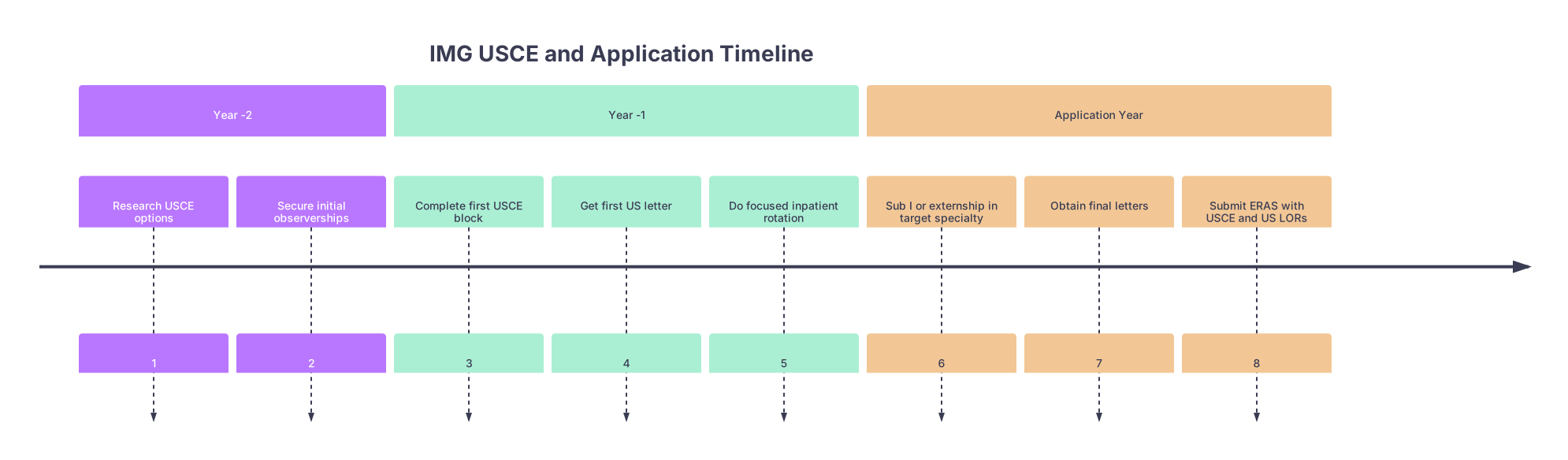
| Period | Event |
|---|---|
| Year -2 - Research USCE options | 1 |
| Year -2 - Secure initial observerships | 2 |
| Year -1 - Complete first USCE block | 3 |
| Year -1 - Get first US letter | 4 |
| Year -1 - Do focused inpatient rotation | 5 |
| Application Year - Sub I or externship in target specialty | 6 |
| Application Year - Obtain final letters | 7 |
| Application Year - Submit ERAS with USCE and US LORs | 8 |
How To Make Your USCE Actually Matter
You do not need infinite money or a stack of observership certificates. You need strategic experience that answers the question every attending is silently asking:
“Will this person survive July 1st on my service?”
So aim for this:
- Fewer but deeper rotations.
- Inpatient-heavy if your specialty cares about it.
- Supervisors who actually watch you work and are willing to put their name behind you.
- Clear specialty alignment.
On the ground, while you’re on USCE:
- Show up early. The “IMG who is already in the workroom reviewing labs at 6:30” gets remembered.
- Volunteer for unsexy tasks: calling families with the resident, following up imaging, drafting discharge summaries (even if unofficial).
- Ask for feedback early, not in the last week. Then implement it visibly.
- Make at least one attending think: “I could hand this person a pager and they wouldn’t implode.”
If you accomplish that, the letter you get will carry more weight than the hospital name ever will.