
Last fall, a PD I know in New York scrolled through another IMGs application, sighed, and muttered, “Here we go again: four ‘observer’ gigs, zero real work.” On paper, that applicant had eight months of “USCE.” On the rank list, he never made it past the first screen.
You see “US Clinical Experience” as a box to fill. Program directors see it as a stress test: can you actually function in the U.S. system, or are you going to fall apart the first week of residency?
Let me walk you through what they’re really reading when they look at that section. Because they’re not just reading the words you typed. They’re reading between the lines. Aggressively.
The hierarchy PDs never say out loud
Start here: not all “clinical experience” is created equal. You know that. PDs know that. The difference is they rank it in their heads within five seconds.
Here’s the unspoken pecking order that rarely makes it into official websites:
| Type of Experience | Rough PD Value Tier |
|---|---|
| US MD/DO core/sub‑internship | Highest |
| US hands-on elective (orders, notes) | Very high |
| US hands-on externship | High |
| Research + limited clinical duties | Medium |
| Pure observership (good hospital) | Low |
| Paid “USCE package” observerships | Very low |
Now, for IMGs, most of you are not getting U.S. core clerkships. So PDs mentally adjust the scale for you—but the order doesn’t change.
When they click open your “US Clinical Experience” entries, this is what’s running in the back of their mind:
- Can this person write a note, carry a patient, and not get lost in Epic?
- Has any U.S. physician trusted them with decisions beyond “stand in the corner and watch”?
- Did they do this at a real training environment, or a storefront operation built to milk IMGs?
They don’t ask those questions out loud. They infer them from your wording, your duties, and your site.
What “hands-on” really means to a PD
Every IMG writes “hands-on clinical experience.” PDs read that phrase like a red flag unless your description proves it.
Let me be blunt: most PDs don’t believe you’re “hands-on” just because you examined a patient with an attending in the room. That’s not what they mean by hands-on.
Hands-on, in PD language, includes at least some of:
- You wrote notes in the chart (even if they were “student notes”)
- You presented patients on rounds
- You formulated assessments and plans, not just “observed discussions”
- You reviewed labs/imaging and made recommendations
- You interacted independently with patients (even briefly)
If your description says:
“Observed inpatient rounds, attended clinics, and participated in discussions of cases”
They translate that as:
“Observer. No responsibility. No proof this person can function as a PGY‑1.”
Now compare that to:
“Managed a panel of 4–6 patients daily under supervision, performed H&Ps, drafted daily progress notes in the EMR, and presented patients on multidisciplinary rounds.”
Same time frame. Completely different message.
The four questions PDs silently ask when they read your USCE
There’s a mental checklist that experienced PDs run without even realizing it. I watched this happen year after year sitting in selection meetings.
When they hit your USCE section, they’re asking:
- Is this real or purchased?
- Did anyone actually trust this person with patient care?
- Can they survive my EMR, my workflow, my expectations?
- Does this explain their letters, or make their letters suspicious?
Let me break each one down.
1. “Is this real or purchased?”
This is uglier than people admit. Huge number of IMGs now go through paid “USCE” programs that are basically shadowing with a fancy brochure.
PDs know the repeat offenders. Certain company names and clinic addresses trigger eye rolls in faculty rooms.
Here’s how they sniff out “paid filler”:
- Tiny private clinics doing everything – “internal medicine / cardiology / vascular / sleep / weight loss / aesthetics.” That’s not a teaching site; that’s a billing machine.
- Rotations all in the same strip-mall multi-specialty office with different “departments.” Looks like you bought a package.
- Generic titles + no concrete duties – “Clinical extern,” “observer,” “associate” with descriptions that could fit any clinic on Earth.
- No residents mentioned anywhere – If you never mention residents, teaching rounds, team structure, they assume this wasn’t a real academic environment.
What raises their confidence?
- Recognizable hospitals, especially ones that actually have ACGME programs
- Affiliation with a U.S. medical school
- Rotation descriptors that match what their own MS3/MS4s do
- A supervising physician who writes strong, specific letters that echo your described duties
You don’t have to be at Mayo or Hopkins. But you do need the experience to look like actual clinical training, not a tourism package.
2. “Did anyone actually trust this person with patient care?”
This is the single most important subtext.
PDs are not trying to see if you’ve racked up hours. They’re checking whether any U.S. clinician looked at you and thought, “I can let this person carry real responsibility.”
Your description either proves that or it doesn’t.
Watch the difference in wording:
Weak:
“Observed patient encounters, assisted with documentation, and attended educational conferences.”
They read:
“Shadowed. Maybe scribbled on paper. Nobody depended on them.”
Stronger:
“Conducted initial patient interviews in clinic, performed focused physical exams, and presented findings with differential diagnoses to the attending. Drafted notes that were reviewed and edited in the EMR.”
There, they see trust. Responsibility. The beginning of autonomy.
Even if your role was technically “observer,” if the attending actually let you function at a higher level, you can describe that—truthfully and specifically. If they trusted you to:
- Call consults
- Update families
- Titrate meds with close supervision
- Follow up abnormal labs
Those details matter. That’s what PDs are hunting for.
3. “Can they survive my system and EMR?”
You want the ugly truth? A good chunk of the anxiety about IMGs has nothing to do with intelligence. It’s about how long you’ll take to ramp up.
Dragging a resident through “This is how you write an order, this is how you pend a note, this is how you put in a consult” for weeks costs the program real money and real service coverage.
So when they read your USCE, they’re specifically looking for signals that you’ve touched:
- A real inpatient service
- A real EMR (Epic, Cerner, Meditech, anything)
- A real resident/attending workflow
If you never mention:
- “Epic,” “Cerner,” “EMR documentation”
- “Sign-out,” “handoff,” “progress notes,” “discharge summaries,”
- “Interdisciplinary rounds,” “case management,” “nursing coordination”
They assume you watched from the doorway while U.S. students learned the actual job.
That’s why “inpatient” carries more weight than it seems. Not because outpatient is useless—far from it—but because inpatient is where they feel the greatest pain if you’re slow.
You want your description to quietly say: “I’ve seen your world before. I won’t drown on day 1.”
4. “Do these experiences match the letters and the story?”
Here’s where a lot of IMGs accidentally nuke their credibility.
PDs put your USCE entries side-by-side with:
- Your letters of recommendation
- Your personal statement
- Your CV timeline
When they see mismatch, they start doubting everything.
Example they notice immediately:
- You list a 2-month internal medicine USCE at “Major Academic Hospital.”
- The letter from that rotation is a lukewarm, generic form letter.
- Your description claims heavy responsibility and advanced duties.
In the room, someone says: “If they were really that involved, why is this letter so bland?”
Or:
- You describe an ambulatory rotation as “managed 10–12 patients per day, independently adjusted medication regimens, and coordinated care.”
- The letter never once mentions any independent management, only “observed and discussed cases.”
Now your whole application smells embellished.
On the flip side, when your descriptions and the letter line up—same types of patients, same EMR, same role—PDs relax. Consistency breeds trust.
How PDs judge amount and recency of USCE
They don’t just care what you did. They care when, and how long.
There’s a quiet calculus that goes like this:
- Less than 4 weeks total: “Barely exposed. Will need heavy orientation.”
- 8–12 weeks: “Reasonable for an IMG. I can work with this.”
- 16+ weeks: “Ok, this person invested. Probably serious about U.S. training.”
But more is not always better if it’s all low-value.
Six months of low-quality observerships in suspicious clinics will not beat two strong, recent, hospital-based rotations with clear responsibilities.
Recency matters ruthlessly. Experience from 4–5 years ago, before a long gap, might as well be a different lifetime for PDs. That’s especially true in fast-evolving fields like EM or critical care.
If you graduated in 2018 and your only USCE was in 2019, they’re going to ask themselves: “Where has this person been clinically for the last five years?”
If instead they see a solid internal medicine USCE 8 months ago, plus ongoing home-country practice, the story changes.
Signals that scream “filler” to a PD
I’ve seen PDs reject otherwise decent applications because this whole section looked fake, lazy, or inflated.
There are patterns that reliably turn them off:
- Copy-paste descriptions across 3–4 different rotations with only the hospital name changed
- Ridiculous patient volume claims (“Managed 25 patients independently per day”) that don’t match any reasonable student role
- Overly grandiose language – “Led the team,” “managed the entire ICU,” “oversaw junior trainees” as a visiting student or observer
- Strange gaps – 2‑3-year holes wrapped in a vague “research/clinical” label without detail
- Too many micro-rotations – five different one-week “rotations.” That looks like you were collecting letters, not learning.
PDs are remarkably good at spotting exaggeration. They’ve read thousands of these. If your description sounds like a brochure, not like a normal day, they tune out.
What a strong USCE entry actually looks like
Let me show you how a PD-friendly description reads. This is the kind of thing that calms their anxiety instead of raising it.
Weak, vague version:
“Clinical externship in internal medicine. Observed inpatient rounds, assisted with documentation, and participated in patient care and discussions. Gained exposure to U.S. healthcare system.”
Stronger, credible version:
“Hands-on internal medicine externship on a hospitalist service at a community teaching hospital affiliated with [X] University. Carried 4–6 patients under supervision, performed H&Ps, and drafted daily progress notes in Epic for attending review. Presented patients on morning rounds, followed up on labs and imaging, and participated in multidisciplinary discharge planning with case managers and nursing staff.”
Everything there is plausible. Concrete. It shows:
- Setting (hospitalist service, community teaching hospital, affiliation)
- Scope (4–6 patients)
- Specific tasks (H&Ps, notes, follow-up)
- System familiarity (Epic, multidisciplinary team)
This is what PDs want: proof you’ve done the building blocks of residency, under supervision, without pretending you were an intern.
How they read between the lines of where you did USCE
Not all settings speak the same language to a PD.
Here’s how typical sites get interpreted:
- University hospital with residency programs – Strong signal. You’ve seen how real teams function.
- Community teaching hospital with residents – Very acceptable, often more hands-on for IMGs.
- Big-name private hospital with no residency – Mixed. Good exposure, but PDs wonder how much teaching structure you saw.
- Solo/small private clinic – Ok if it’s 1–2 experiences, especially if outpatient-primary-care heavy. Red flag if that’s all you have.
- “Institute” or “center” that only exists on IMG forums – Dangerous. Seasoned PDs recognize the usual suspects.
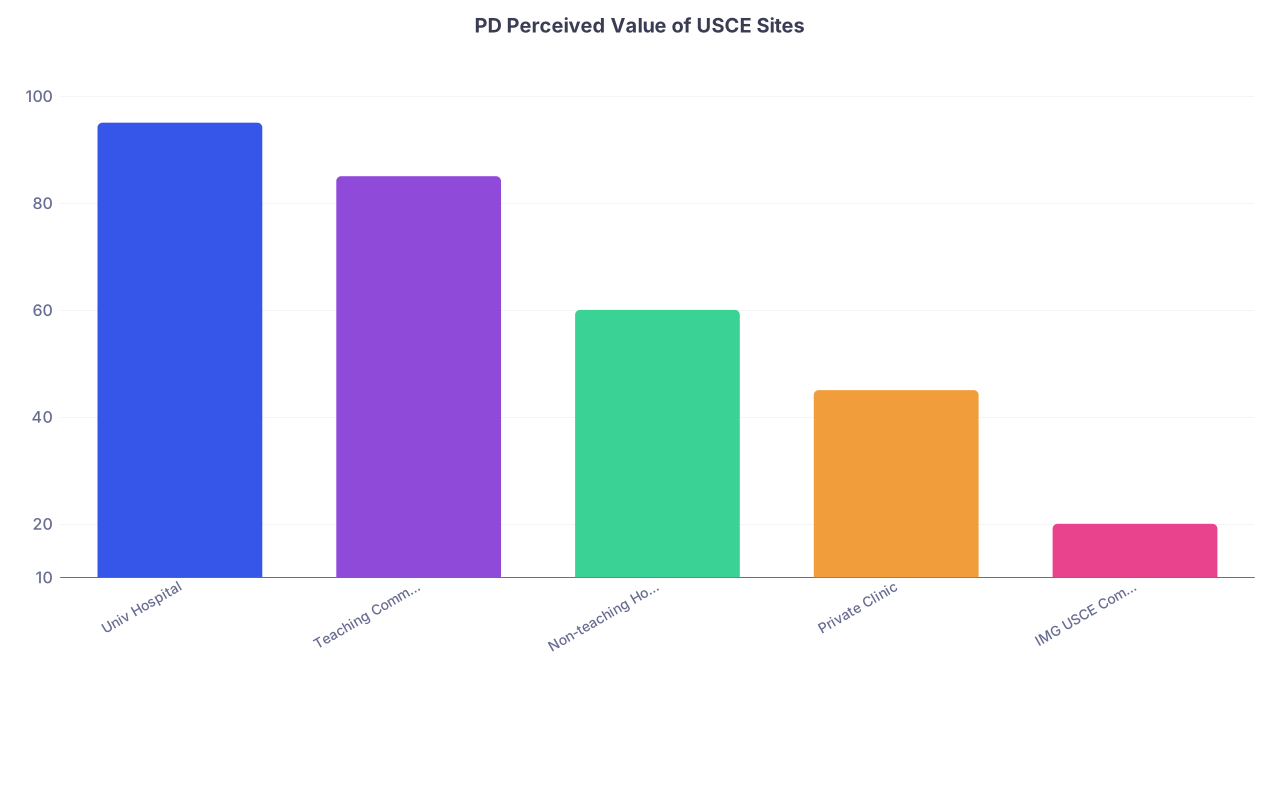
| Category | Value |
|---|---|
| Univ Hospital | 95 |
| Teaching Community | 85 |
| Non-teaching Hospital | 60 |
| Private Clinic | 45 |
| IMG USCE Company | 20 |
They don’t need you to have a brand-name badge. They need you to show that actual teaching and team-based care happened around you.
If all your USCE is clinic-based, you counterbalance by emphasizing:
- Longitudinal care
- Chronic disease management
- Coordination with outside services
- Detailed outpatient documentation
If you have at least one solid inpatient month, highlight what you did on the wards. That’s their pain point.
How many rotations is “enough” for an IMG?
This is the part no one will tell you plainly.
For most IMGs applying to IM, FM, peds, neuro, psych, here’s how PDs roughly categorize you:
- 0 weeks USCE – “Hard pass at most programs unless insane scores + strong research + special connection.”
- 4–8 weeks – “Borderline but acceptable if everything else is strong and hands-on is real.”
- 12–16 weeks – “This person did their homework. Reasonable to expect smoother transition.”
- 20+ weeks – “Clearly serious about U.S. training. Now we look at quality, not just quantity.”
But again: I’ve seen an IMG with 3 months of high-quality, recent USCE at solid teaching hospitals outrank someone with 9 months of low-yield observer work at sketchy clinics.
If you’re still building your profile, one or two strong, well-structured rotations will do more for you than five flimsy ones.
The hidden narrative your USCE tells about you
When a PD steps back and looks at your whole USCE section, they’re reading a story, not just dates and places.
They’re asking:
- Does this look planned or random?
- Does it match the specialty they’re applying to?
- Does it show development over time—growing responsibility, more advanced environments?
- Does it align with their personal statement and the type of program they’re applying to?
If you’re applying to internal medicine but:
- You have pediatrics, anesthesia, neurosurgery, dermatology, and one random internal medicine observership in an office—
they see someone who decided too late, or who is simply chasing any slot.
If instead:
- You’ve got 2–3 IM-focused USCE experiences, maybe one in outpatient, one inpatient, one related field (cardiology, ID, heme-onc), all in the last 1–2 years—
they see intention. Focus. Someone they can picture as a categorical IM resident.
That coherence, more than the raw number of weeks, pushes you up the rank list.
A quick sanity-check of your own USCE section
Before you submit, read your US Clinical Experience section the way a mildly skeptical PD would.
Ask yourself, honestly:
- Does this look like real work or curated tourism?
- Could I defend every claim, in detail, under questioning in an interview?
- Do my letters and personal statement back up the level of responsibility I’m implying?
- If someone familiar with U.S. hospitals read this, would they nod or raise an eyebrow?
If there’s even a bit of “hm, this might sound like exaggeration,” tone it down and sharpen the specifics instead.
You’re not trying to impress with drama. You’re trying to convince with credibility.

| Step | Description |
|---|---|
| Step 1 | Open USCE Section |
| Step 2 | Check Duties and EMR Use |
| Step 3 | Check For Filler or Paid USCE |
| Step 4 | Align With Letters and Specialty |
| Step 5 | Label As Observership Only |
| Step 6 | Positive Impact on Interview Odds |
| Step 7 | Neutral Impact |
| Step 8 | Negative Impact |
| Step 9 | Type of Site |
| Step 10 | Hands On? |
| Step 11 | Recent and Sufficient Duration? |
FAQ – 3 questions most IMGs quietly ask
1. If my USCE was technically an “observership,” can I still present it as valuable?
Yes, but you cannot magically turn an observership into an externship. What you can do is be precise about what you actually did: “conducted patient interviews under supervision,” “obtained histories,” “participated in bedside teaching,” “assisted in drafting notes that were not part of the legal chart.” Concrete, believable tasks beat inflated titles. And if you had multiple observerships, emphasize progression—later ones where you were trusted a bit more.
2. Will having only outpatient USCE hurt my chances for inpatient-heavy specialties like IM?
It doesn’t automatically kill your chances, but it does leave a gap in the PD’s mental picture. Several IMGs have matched with mainly outpatient USCE, but they wrote their experiences in a way that highlighted EMR use, chronic disease management, and real responsibility, and they had strong, detailed letters. If you can add even a single good inpatient month, do it; if not, make sure your outpatient descriptions show real ownership of patient care and familiarity with U.S. systems.
3. How recent does my USCE need to be to still matter?
Most PDs start mentally discounting USCE that’s older than 3–4 years, especially if you haven’t been in consistent clinical practice since. The ideal window is within the last 1–2 years before application. If your USCE is older, you need something else current—ongoing clinical work in your home country, recent research with clinical exposure, or a fresh short U.S. rotation if you can possibly arrange it. Freshness isn’t a formality; it’s their way of asking, “Can this person still function in a modern clinical environment?”
Key takeaways:
PDs are not counting your weeks; they’re judging your function. Your wording, your sites, and your letters must all quietly say the same thing: “I’ve already started doing the building blocks of residency, under supervision, in your system.”
Get that right in your US Clinical Experience section, and you stop looking like a risk and start looking like a safe, trainable investment.