
The way faculty read your US clinical experience is brutal, predictive, and almost never explained honestly to applicants.
Let me tell you what really happens: attendings and program directors are using your USCE not just to decide if you “know the system.” They’re using it as a stress test—trying to predict exactly how you’ll behave at 2 a.m. in July when a septic patient rolls in and you are the weakest link on the team.
You think you’re there to “learn” and “get exposure.” They think you’re there as a live simulation of your intern year.
What “US Clinical Experience” Actually Signals to Faculty
First truth: faculty do not care equally about all USCE. They rank it in their heads whether they say so or not.
Here’s the mental tier list I’ve heard attending after attending use behind closed doors:
| USCE Type | Faculty Trust Level |
|---|---|
| US ACGME residency-affiliated inpatient sub-I/acting intern | Very High |
| US core clerkships at MD/DO school | High |
| US audition rotation at community residency site | High |
| US inpatient observership with real team integration | Moderate |
| Outpatient observership/shadowing only | Low |
| “Tele-rotations” / remote case discussions | Very Low |
No one tells you this clearly. But in rank meetings, I’ve literally heard: “He has three months of USCE… oh, it’s two tele-rotations and one clinic observership. So basically none.”
Here’s the key: faculty are not asking “Did this person do USCE?” They’re asking, “Has anyone I trust seen this person function in something resembling an intern role?”
That’s why the sacred phrase on an IMG letter is: “This student functioned at the level of an intern.”
When you see that, understand what it really means: that attending is vouching that you won’t melt down when the pager explodes.
The 7 Things Faculty Are Really Measuring During Your USCE
Nobody writes this in the official evaluation form. But this is exactly what attendings and program directors talk about when they sit in a room and decide if your “US clinical experience” predicts a safe, functional intern.
1. Can you actually carry patients?
Not “shadow.” Not “observe.” Carry.
In practice, that means during a real inpatient rotation they’re looking for:
- Can you handle a minimum load of 3–5 simple patients, keep track of their meds, labs, vitals, notes, and follow-up tasks without dropping anything?
- Do your progress notes get done before rounds—or are you hunting for computers and finishing them at 4 p.m.?
- When something changes (new fever, lab abnormality), do you notice on your own or only after the resident points it out?
One PD said this almost verbatim: “If an IMG has done two solid US inpatient rotations and still can’t organize 3 patients, I assume they’ll drown with an intern’s list of 8–10. They go to the bottom of my rank list.”
This is why pure observerships are weak currency. If you never had to own a list and track tasks, they simply cannot forecast your intern capacity from that experience alone.
2. How do you handle chaos and interruption?
Intern year is constant interruption: pages, nurses at the door, new admits, social work issues, family questions.
So faculty watch what you do the moment the day stops being linear. For example:
You’re writing a note. Nurse calls—patient is hypotensive. Resident says, “Go check 412 and then meet us in 416 for a family meeting.”
Do you:
- Pause, write down “412 hypotension,” walk quickly, check vitals, talk to nurse, alert resident if needed, then actually show up to the family meeting?
Or do you:
- Nod, walk slowly, forget the room number, or get flustered and return 10 minutes later saying, “What did you want me to do again?”
I’ve seen attendings decide in a single day: “Great knowledge, but totally disorganized when things got busy. I would not trust them on nights in July.”
They’re not just rating your “professionalism.” They’re running a mental simulation: “It’s 3 a.m., four pages in 10 minutes. Will this person freeze?”
3. Can you be safely left unsupervised for 20 minutes?
You won’t be left alone with life-or-death decisions as a student, but attendings deliberately test soft independence:
- “Can you go see Ms. X and get a focused history and exam for her shortness of breath? Then come back and tell me what you think.”
- “Update the family on the plan we just discussed, and let me know how they respond.”
What they’re really testing:
- Do you come back with a coherent, structured presentation, or a rambling story that makes them pull teeth for basic details?
- Do you recognize when you’re out of your depth and call for help appropriately?
- Do you accidentally promise things you shouldn’t? (“The doctor will discharge you today.”)
I’ve heard this line many times: “She can be safely unsupervised for short periods” in an LOR. That is gold. It’s code for: “She won’t create fires that the resident has to put out constantly.”
4. How fast do you adapt to the US system?
Program directors know IMGs come from wildly different systems. They’re not demanding perfection on day one. They’re watching your trajectory.
Here’s what they quietly chart in their head across a 4-week rotation:
Week 1: Confused, slow, needs step-by-step instructions. Week 2: Starting to anticipate labs, imaging, and note structure. Fewer prompts needed. Week 3: Can “run” simple parts of the day. Presents concisely. Starts suggesting reasonable plans. Week 4: Feels like an extra sub-I, not a shadow.
When an IMG is still at “week 1” level on day 18, that rotation kills their application. I’ve seen faculty say: “Nice person, but after 3 weeks they still needed everything explained. We cannot teach that from scratch in July.”
This is why doing multiple, longer, real US rotations is so powerful for IMGs. It lets you demonstrate growth, not just a 2-week snapshot where you were jet-lagged and lost.
5. Are you emotionally stable under pressure?
This part never appears in your evaluations as written, but it absolutely appears in conversations.
Faculty watch:
- Do you get visibly flustered when pimped or corrected on rounds?
- When a patient yells at you (it will happen), do you withdraw, become defensive, or stay calm and professional?
- When you make a mistake—and you will—can you absorb feedback and adjust, or do you crumble?
I sat in a rank meeting for Internal Medicine where an attending said of an IMG: “Very sharp, probably the smartest on the team, but every time we gave feedback she teared up. Nights will break her. I don’t want to be responsible for that.”
It sounds harsh, but remember: their main fear is not that you’ll be a mediocre intern. It’s that you’ll be an unsafe or unstable one under real pressure.
6. Can you work within a hierarchy without becoming passive?
US training is hierarchical but expects independent thought. This is a huge culture shock for many IMGs.
Attending minds are scanning for this balance:
- Do you follow instructions and respect the chain of command?
- But also: Do you speak up when something looks wrong? Do you suggest plans rather than just writing orders mechanically?
An ideal IMG on USCE sounds like this on rounds:
“I’d like to start ceftriaxone for this suspected pyelonephritis because of her fever, flank pain, and UA with WBCs. If you’re okay with that, I’ll also order a renal ultrasound given her obstruction history.”
A weak one sounds like this, every day, for 4 weeks:
“I’m not sure. What do you think? What would you like to do?”
Program directors translate that into: “Will need to be spoon-fed as an intern.” Those applicants drop.
7. Do nurses and residents like working with you?
You want the quiet truth? Program directors often trust resident and nurse feedback more than attending comments.
I’ve watched this scenario at multiple programs:
- Resident: “Honestly, he was more work than help. Always disappearing when there were admissions. Very sensitive to criticism.”
- Nurse: “She was kind, but asked me to teach her basic things over and over. I don’t think she’s ready to be an intern.”
The attending’s written eval might say: “Hard-working, enthusiastic, needs to continue improving efficiency.” That sounds neutral. The behind-the-scenes interpretation, after hearing the nurses and residents, is not neutral.
Your daily behavior with residents, nurses, case managers—that’s your real audition.
How USCE Predicts Intern-Year Performance on the PD Side
Let’s shift to the program director viewpoint explicitly.
When PDs look at an IMG file, they’re basically asking three questions:
- Will this person be safe?
- Will they increase or decrease resident workload?
- Will they embarrass the program in front of patients, nurses, or administration?
USCE is one of the only hard data points they trust for IMGs, especially when Step 1 is pass/fail and school reputation is unknown.
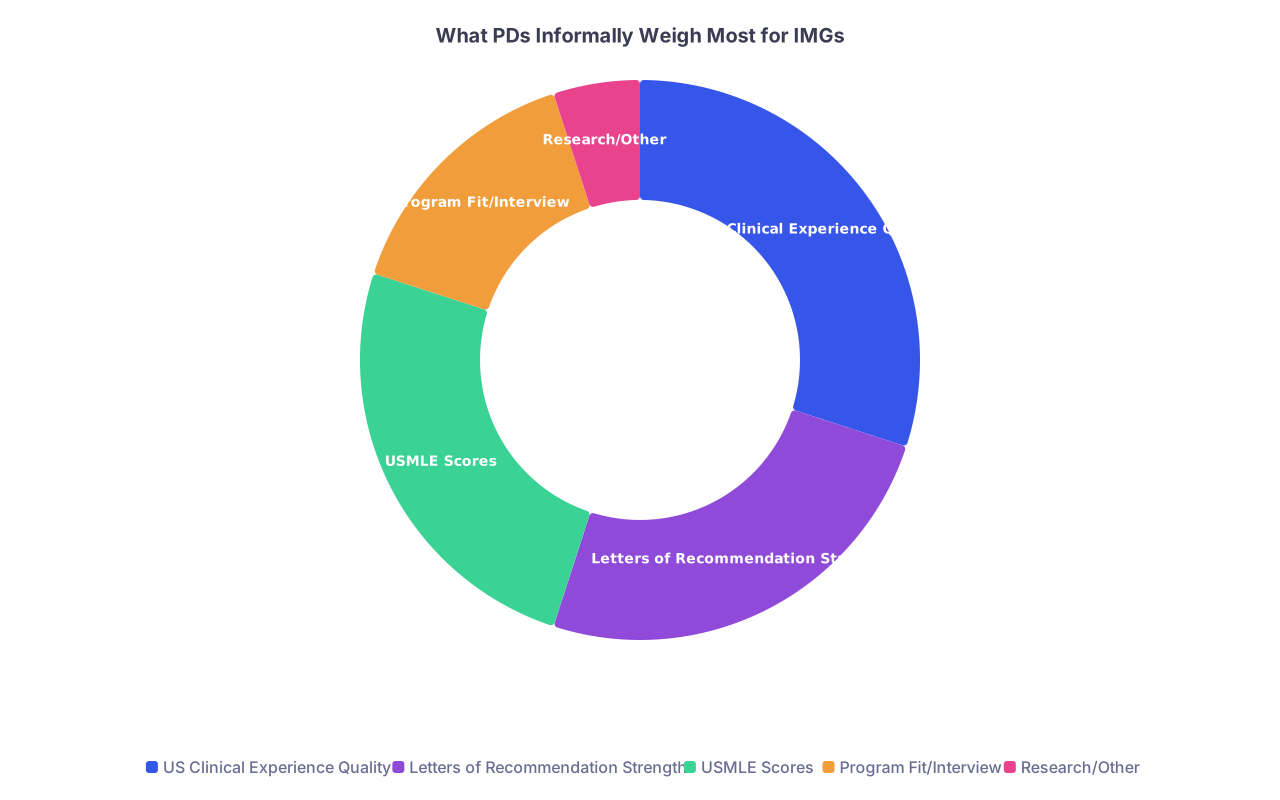
| Category | Value |
|---|---|
| US Clinical Experience Quality | 30 |
| Letters of Recommendation Strength | 25 |
| USMLE Scores | 25 |
| Program Fit/Interview | 15 |
| Research/Other | 5 |
Notice: not “whether you did USCE,” but “quality” of it.
Behind closed doors, here’s how PDs connect your USCE to intern-year risk:
- Strong sub-I / inpatient USCE with specific praise → “Low risk. Probably will function like our average US grad.”
- Vague clinic observerships + generic letters → “Unknown risk. We’re guessing. In a competitive pool, that’s often a no.”
- Negative comments or faint praise from USCE → “High risk. This person will generate complaints and extra work.”
And here’s the part IMGs underestimate: a single strong, specific USCE letter from a respected US faculty member can outweigh a lot of other weaknesses.
I’ve seen this repeatedly: an IMG with average scores, mid-tier school, but a letter from a well-known attending at a US academic center saying, “This student is in the top 5% of all students I’ve worked with, including US grads, and I would rank them highly at my own program.”
That applicant gets interviews. And matches.
What Makes a USCE Letter Predictive (and Powerful)
Faculty know PDs are reading between the lines. So over time, a sort of code has evolved in letters.
Here’s how PDs decode your USCE letter language, especially for IMGs.
| Letter Phrase | PD Interpretation |
|---|---|
| "Pleasure to work with, very polite and eager" | Personality OK; no real data on performance |
| "Functioned at the level of an intern" | Strong endorsement of readiness |
| "Needed some guidance but improved rapidly" | Acceptable; growth trajectory positive |
| "Given appropriate supervision, will do well" | Red flag; they do not trust independent work |
| "I would be happy to have them in our program" | Real endorsement; counts heavily |
The killer phrase for an IMG is: “I would rank this applicant highly in my own residency program.”
Faculty do not write that lightly. When they do, PDs listen.
What faculty notice to write those lines
They’re not basing this on one clever differential diagnosis you gave in week 3. They’re watching patterns:
- You consistently show up prepared for rounds with notes, vitals, and a plan.
- When on call, you volunteer to see new patients with the resident, not hide in the call room.
- You respond well when they say, “That’s not quite right—try thinking about it this way,” and next time you’ve adjusted.
- At the end of the rotation, you ask for feedback and then actually implement it during those final days.
I’ve heard faculty say: “I was on the fence, but when she came back the next day after some hard feedback and had fixed almost every issue, that’s when I decided I could trust her as an intern.”
That’s what turns into those coveted, predictive phrases in your letter.
Why Some IMGs with “Tons of USCE” Still Don’t Match
You’ve probably met them: IMGs who did 6–12 months of USCE and still didn’t match. PDs know exactly why when they read the file.
Common patterns faculty see and quietly talk about:
All rotations are low-impact observerships
No direct patient care, no responsibility, no notes, no call. That’s like shadowing someone drive a car and calling it “driving experience.”Letters are generic across the board
You might have 4–5 US letters, but each one reads: “Hard-working, punctual, respectful, good fund of knowledge.” No specifics, no superlatives, no “intern-level” language. PDs read that as: nobody was willing to truly vouch for you.No clear upward trajectory
If your early rotations and later ones look identical in terms of feedback—still “needs to improve efficiency, struggles with US system”—that’s a problem. PDs want to see multiple attendings independently describing growth.Poor interview matching the letters
This one is deadly. If your letters say you’re an excellent communicator and team player, but in the interview you’re rigid, overly formal, or cannot hold a fluid conversation, PDs question all your evaluations.
I’ve heard PDs say bluntly: “If someone has done 10 months of USCE and nobody is screaming from the rooftops in a letter, there’s a reason.”
Quantity without quality is just proof that multiple people saw you and didn’t feel compelled to strongly endorse you.
How to Act in USCE if You Want Faculty to Bet on Your Intern Year
This is where you have some control. Stop thinking of USCE as hoop-jumping. Think of it as a month-long job interview where the only real question is: “Would I trust you with my patients when I’m not on the floor?”
A few concrete behaviors that faculty actually remember:
Owning tasks without drama
When you say, “I’ll follow up on that CT and let you know,” then do it—every time, without needing reminders—residents notice. This is intern behavior.Writing usable notes
Not perfect, not fancy. But structured, accurate, and on time. PDs know that an intern who can’t write a decent note on day 1 is a nightmare.Presenting clearly
“Ms. X is a 64-year-old with CHF who presented with…” Faculty use your oral presentations as a direct proxy for how you’ll give sign-out and call consults as an intern.Showing up when it’s hard
Staying late once in a while to finish a note or see a new admission with the team. Coming in early when you’re on call days. Faculty remember who disappears at 3:45 p.m. every day.Asking for—and using—feedback
The most impressive IMGs I’ve seen don’t just ask “Do you have any feedback?” They ask, “What is the one thing I should fix to be closer to intern level?” Then you can show that change within days.
That’s how you convert a month of USCE into a strong, predictive endorsement for your intern year.

| Step | Description |
|---|---|
| Step 1 | USCE Rotation |
| Step 2 | Daily Performance |
| Step 3 | Faculty Impression |
| Step 4 | Letter Content |
| Step 5 | Resident and Nurse Feedback |
| Step 6 | PD File Review |
| Step 7 | Rank Higher |
| Step 8 | Middle or No Rank |
| Step 9 | Do Not Rank |
| Step 10 | Intern Risk Level |

Common Misconceptions IMGs Have About USCE
Let me quickly kill a few myths that waste a lot of time and money.
“Any USCE is good USCE.”
False. Faculty discount low-level observerships heavily. A single strong, inpatient, responsibility-heavy rotation can be more valuable than six weak ones.
“If I don’t make any mistakes, they’ll rank me highly.”
Wrong. A quiet, invisible, mistake-free but also initiative-free student often gets a lukewarm letter. PDs prefer someone who tried, learned, and clearly grew.
“I must impress the attending only.”
Resident and nurse comments absolutely shape how attendings frame their letters and how PDs interpret your file.
“Research can compensate for weak USCE.”
Not for predicting intern performance. Research may help at academic programs, but if your USCE is poor or absent, PDs view you as untested clinically.

FAQ (Exactly 5 Questions)
1. I only have outpatient observerships. Are they useless?
Not useless, but weak as predictive tools. Faculty cannot assess how you’ll handle intern-level inpatient tasks from clinic shadowing alone. If at all possible, add at least one US inpatient rotation with real responsibilities—notes, follow-up, daily patient ownership. That single month can change how PDs view your readiness.
2. What specific phrases should I hope to see in my USCE letters?
You want language like “functioned at the level of an intern,” “required minimal supervision by the end of the rotation,” “top X% of students I’ve worked with, including US graduates,” and “I would be very happy to have them in our own program.” Those are the phrases PDs treat as high-confidence predictions of your intern performance.
3. Does it matter if my USCE is at a big-name academic center versus a community hospital?
Both can be valuable. Academic centers carry name recognition, but community hospitals with ACGME residencies often give you more hands-on responsibility. PDs care more about what you did and what the letters say than the logo on your badge. A glowing, detailed letter from a community program director beats a generic “nice student” from a big-name place.
4. How many months of USCE do I actually need as an IMG?
There’s no magic number, but most PDs I’ve worked with become comfortable around 2–4 months of solid, recent (within 1–2 years) USCE that includes at least one inpatient rotation. Beyond that, extra months don’t help much if the quality and letters aren’t strong. Three great months beats eight mediocre ones.
5. I’m shy and struggle to speak up. Will that sink me even if I work hard?
Being introverted is fine. Being invisible is not. Faculty need to see how you think, how you present, how you handle tasks and feedback. You don’t have to be loud or charismatic, but you must be reliably present in discussions, volunteer for work, and show progressive independence. Otherwise your letters will read as bland, and PDs won’t have the confidence to bet on you as an intern.
Key points: Faculty use your USCE as a live simulation of your intern year, not a sightseeing tour. What counts is not that you “did USCE,” but whether someone can credibly write that you functioned like a safe, growing, near-intern. Align your behavior on every rotation with that single goal—and your odds of matching as an IMG change dramatically.