
The fastest way for an IMG to tank a promising application is to “upgrade” from observer to team member the wrong way.
You want responsibility. You need strong US letters. Programs are tired of passive observers. All true. But if you cross the line into unsupervised care, falsified roles, or scope creep, you are one email away from being unmatchable anywhere in the United States.
Let me show you how to do this right—how to move from observer to true contributing team member, build real clinical value, and still stay 100% safe and compliant.
1. Get Crystal Clear On What You Are Legally Allowed To Do
Most IMGs get into trouble because they never defined the box they must stay in.
There are four basic buckets you need to understand:
| Experience Type | Legal Patient Care Role |
|---|---|
| Pure Observership | No hands-on care |
| Shadowing | No independent care; may assist under direct supervision |
| Hands-on Externship | Limited direct care under supervising physician license |
| Research / QI Role | No clinical care unless separately authorized |
If you are not licensed in a US state, you do not practice medicine. You participate in patient care under someone else’s license. That is the entire game.
Here is the safe baseline:
You may:
- Take histories under supervision
- Perform parts of physical exams with explicit permission and direct oversight
- Present cases
- Help write notes that are clearly labeled as student/observer notes and co-signed
- Join rounds, discuss plans, suggest ideas
- Help with logistics: follow up on labs, call consults after the attending/resident has initiated and authorized
You absolutely may not:
- Independently order labs, imaging, or medications in the EMR
- Write unsigned notes that look like physician documentation
- Prescribe anything
- Perform procedures without direct supervision and documentation as “learner”
- Tell patients you are “their doctor” or “their resident”
If your current “observer” setup expects any of those prohibited actions, that is not an upgrade—that is a liability trap.
2. The Real Goal: Upgrade Your Function, Not Your Title
Stop chasing labels like “externship” or “sub-internship” if they are just marketing.
Programs do not care what your experience is called.
They care about:
- What you actually did
- Who supervised you
- How strongly that person will defend you in a letter
- Whether your role looks honest and compliant
When I read applications, I see the same nonsense phrases over and over:
- “Acted as an intern”
- “Functioned as a resident”
- “Took full responsibility for patient management”
Those statements make reviewers suspicious immediately because:
- They are almost always exaggerated
- They suggest unsupervised practice, which is a red flag
- They raise legal and ethical questions about the host site
Your target upgrade is this:
From:
“I observed rounds and listened to discussions.”
To:
“I pre-rounded on assigned patients, obtained interval histories, performed focused exams under direct attending supervision, presented plans on rounds, and documented student notes used by the team.”
Big difference. Safe. Legitimate. Impressive.
3. Step‑By‑Step: How To Safely Expand Your Clinical Role
You do not get more responsibility by silently working harder. You get more by negotiating for it clearly and professionally.
Here is the concrete playbook.
Step 1: Know your program’s formal rules
Before you ask for anything:
- Read the observership/externship program description you signed.
- Check:
- Are you allowed to touch patients?
- Are student notes permitted?
- Are you endorsed by a hospital, a private practice, or a third-party company?
- Identify the strictest limitation and assume that is your boundary.
If documentation says “no hands-on care,” do not start doing bedside procedures because you feel confident. You fix that mismatch by changing programs, not by ignoring rules.
Step 2: Deliver perfect basic performance first
You earn expanded responsibilities by being flawless at the basics for 1–2 weeks:
- Show up early. Always ready before rounds.
- Know every patient in detail: vitals, labs, imaging, meds.
- Pre‑read about common diagnoses on your service (CHF, COPD, sepsis, etc.).
- Never slow the team down.
Once the attending and residents trust you are reliable and low-maintenance, then you ask for more.
Step 3: Ask explicitly for upgraded tasks
Use direct language. No hinting.
You might say to the attending:
“Dr Smith, I would like to be as useful as possible while staying within the program rules. Would you be comfortable if I start:
- Obtaining interval histories before rounds and presenting
- Performing focused exams under your direct supervision
- Writing student notes that you can review and co-sign
If there is anything here that is not permitted at this hospital, I want to be sure I stay within policy.”
That one speech does three things:
- Signals initiative
- Shows you respect regulation and safety
- Gives the attending a clear menu to choose from
Most decent attendings will give you at least one upgrade immediately.
Step 4: Use the “ask once, show value, ask again” cycle
You do not jump from observer to near-intern in a day. Use incremental steps:
- Week 1:
- Take interval histories
- Present succinctly
- Week 2:
- Add focused physicals under supervision
- Write student notes
- Week 3–4:
- Call consults or families after attending has outlined talking points
- Help update orders as “pending” for the attending or resident to sign
Each time the team seems satisfied:
“Is there anything more I can safely take on to help the team?”
This repeating question is your quiet lever for expansion.

4. How To Document Your Expanded Role Without Lying
You can do everything right clinically and still damage your application by describing your work poorly.
Here is the rule:
Describe what you did. Do not upgrade your title.
Bad:
“Intern in internal medicine”
“Resident equivalent”
“Primary provider for patients”
Good, specific, believable phrases you can safely use:
- “Pre‑rounded on assigned patients and obtained interval histories.”
- “Performed focused cardiovascular and pulmonary exams under direct supervision.”
- “Prepared student notes that informed the attending’s documentation.”
- “Presented new admissions on morning rounds and discussed assessment and plan.”
- “Participated in family discussions with the attending and answered questions within my role as a supervised trainee.”
These sound real because they are real.
How to write this on your CV
Use a structure like this:
Clinical Observer / Extern – Internal Medicine
XYZ Medical Center, New York, NY
06/2025 – 08/2025
- Participated in inpatient rounds on a 20–25 bed internal medicine teaching service under Dr John Doe.
- Obtained interval histories and performed focused physical examinations on assigned patients under direct attending supervision.
- Presented new admissions and overnight events during daily rounds, contributed to assessment and management discussions.
- Drafted student notes in the EMR that were reviewed and incorporated into attending documentation.
- Attended multidisciplinary meetings and coordinated with nursing, case management, and consulting services under supervision.
No lies. Plenty of substance. Any attending could easily confirm this.
5. What “Hands‑On” Actually Means For IMGs (Without Crossing Lines)
A lot of IMGs obsess over “hands-on experience” because they think programs will automatically reject “observerships.”
That is exaggerated. Here is the real picture.
What program directors actually care about
Program leadership wants to know:
- Have you seen US hospital workflow?
- Can you function on a team?
- Are you safe around patients?
- Did someone we trust see you do real clinical thinking?
If your observership is rich in interaction, teaching, and supervised patient contact, it is far more valuable than a so-called “externship” where you just sit in a corner clinic writing fake notes.
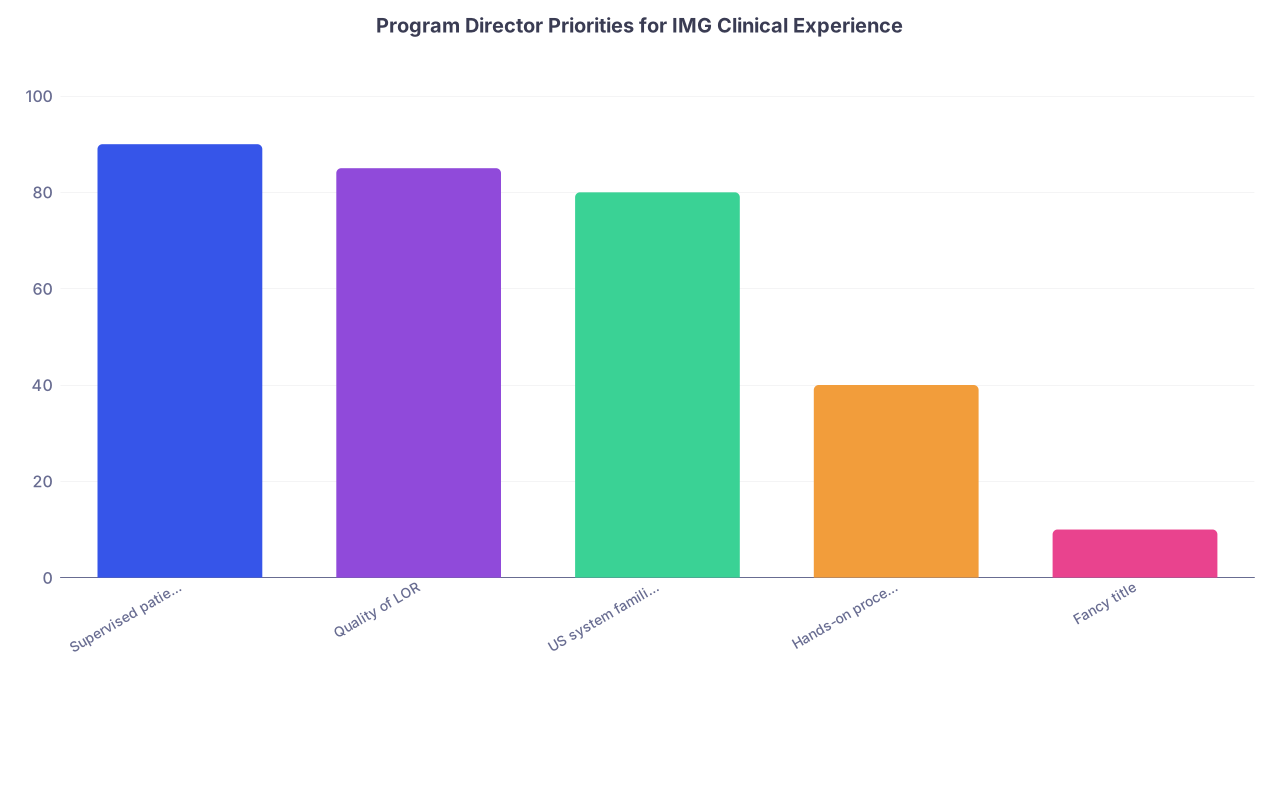
| Category | Value |
|---|---|
| Supervised patient interaction | 90 |
| Quality of LOR | 85 |
| US system familiarity | 80 |
| Hands-on procedures | 40 |
| Fancy title | 10 |
Safe ways to be “hands-on”
Here are activities that count as “hands-on” in the eyes of most interviewers, if done legally:
- Taking HPI and ROS directly from patients (attending knows and approves).
- Doing focused physical exams with attending in the room or immediately re‑checking.
- Assisting in simple procedures:
- Placing EKG leads
- Preparing and draping for minor procedures
- Helping with wound care while supervised
- Calling the lab or radiology to clarify results (after discussing with team).
- Explaining plans to patients only after they were outlined by the physician.
Each of those is meaningful. You do not need to be independently ordering morphine to prove you had real clinical exposure.
6. Avoid the Three Big Career Killers
If you remember nothing else from this article, remember this list. These are the moves that quietly destroy IMG applications.
1. Practicing medicine without a license
Examples I have personally seen:
- IMG “extern” writing and signing progress notes as if they were the physician.
- Calling in prescriptions under the attending’s name without direct permission.
- Performing procedures (paracentesis, central lines) with only another student watching.
When this comes out—and it does—no program wants the liability of training someone who ignores legal boundaries.
2. Misrepresenting your role on your CV or ERAS
Program directors hate one thing more than a weak profile: dishonesty.
Red-flag phrases:
- “Acted as a sub‑intern” when there is no official affiliation.
- “Responsible for patient care” with no US license or training.
- “Managed” or “treated” without clarifying supervision.
Fix it by adding a simple qualifier:
- “Assisted in management of…”
- “Participated in care of…”
- “Contributed to…”
You still sound useful. You no longer sound reckless.
3. Getting involved with shady for-profit “hands-on” mills
You know the ones. $4–6k per month, promises of “full hands-on experience,” always in vague clinics with no residency affiliations.
Red flags:
- No hospital affiliation listed.
- No clear description of supervising physician credentials.
- No institutional email addresses.
- Guarantees of “LOR to match in the USA.”
Do not gamble your match prospects on a place that might end up in an OPSC or ECFMG investigation file.

| Step | Description |
|---|---|
| Step 1 | Start as Observer |
| Step 2 | Master Basics |
| Step 3 | Ask for Defined Tasks |
| Step 4 | Supervised HPI and Exams |
| Step 5 | Write Student Notes |
| Step 6 | Assist with Calls and Coordination |
| Step 7 | Strong LOR and Credible Experience |
7. Turn Your Role Into Strong Letters Of Recommendation
Upgrading your role is useless if it does not translate into a powerful LOR.
You want your attending to be able to honestly say things like:
- “I directly supervised Dr X obtaining histories and performing physicals.”
- “Dr X functioned as an integral member of the rounding team.”
- “I would rank Dr X in the top 10–20% of international graduates I have worked with.”
Here is how you engineer that outcome.
Be intentional from week 1
On day 2 or 3, tell your attending:
“My goal is to apply for internal medicine residency this cycle. I hope that by the end of this rotation, if I meet your expectations, you might feel comfortable writing a detailed letter for me. I know that will depend on my performance, so I welcome any feedback along the way.”
Now they are watching you with that lens. Good.
Give them material
Near the end of the rotation, after you have expanded your role safely:
- Send a short CV and personal statement.
- Include a bullet list of concrete things you did:
- “Pre-rounded on 3–5 patients daily, presented on rounds.”
- “Performed supervised cardiac and pulmonary exams.”
- “Drafted EMR notes on new admissions for your review.”
- Do not script their letter. Just remind them what they actually saw.
That list nudges them to mention that you were more than a wallflower observer—without asking them to lie.

8. If Your Current Rotation Is Useless, Here Is How To Fix It
Some of you are stuck in dead rotations:
- No patient contact
- Attending barely shows up
- No chance for a real LOR
Do not waste 3–4 months just because you already paid a fee.
Step 1: Honestly assess the ceiling
Ask yourself:
- Can I reasonably expand my role here if I ask directly?
- Is the attending even interested in teaching?
- Is there any institutional structure, or is this one person in a random clinic?
If the answers are no, cut your losses. Money is expensive. But losing one match cycle is much more expensive.
Step 2: Pivot to better-structured experiences
Look for:
- Hospital-affiliated observerships with defined educational activities: conferences, morning reports, etc.
- Programs that explicitly allow:
- Student notes
- Case presentations
- Limited supervised patient interaction
- Places where previous IMGs have matched and are willing to share honest feedback.
Step 3: Use parallel roles to show initiative
If your clinical exposure is limited, add:
- Research in the same department:
- QI projects
- Retrospective chart reviews (under IRB and supervision)
- Volunteer roles:
- Patient liaison
- Interpreter (if bilingual)
- Clinic flow assistant
You then present your story in applications as:
- “I built a combined clinical and research experience at X institution, where I contributed to patient care discussions and QI projects.”
Better than:
“I watched for months and learned a lot” (which every reviewer reads as “I could not get anything better”).
9. How To Talk About Your Upgraded Role In Interviews
Interviewers will test whether your CV descriptions are real.
Expect questions like:
- “Tell me about your US clinical experience.”
- “What was your specific role on the team?”
- “How did supervision work?”
Answer with precise, boring truth. That is what sounds credible.
Example response:
“In my inpatient medicine observership at ABC Medical Center, I initially started purely observing. After the first week, with my attending’s permission, I began obtaining interval histories and performing focused exams on 3–4 patients each morning under direct supervision.
I would present these patients during rounds, discuss assessment and plan with the team, and then draft student notes in the EMR which my attending reviewed and incorporated into their documentation. I was not entering orders or independently documenting, but I was able to participate meaningfully in clinical decision making and follow patients day to day.”
That level of detail tells the interviewer:
- You know your scope
- You are honest
- You actually showed up and did the work
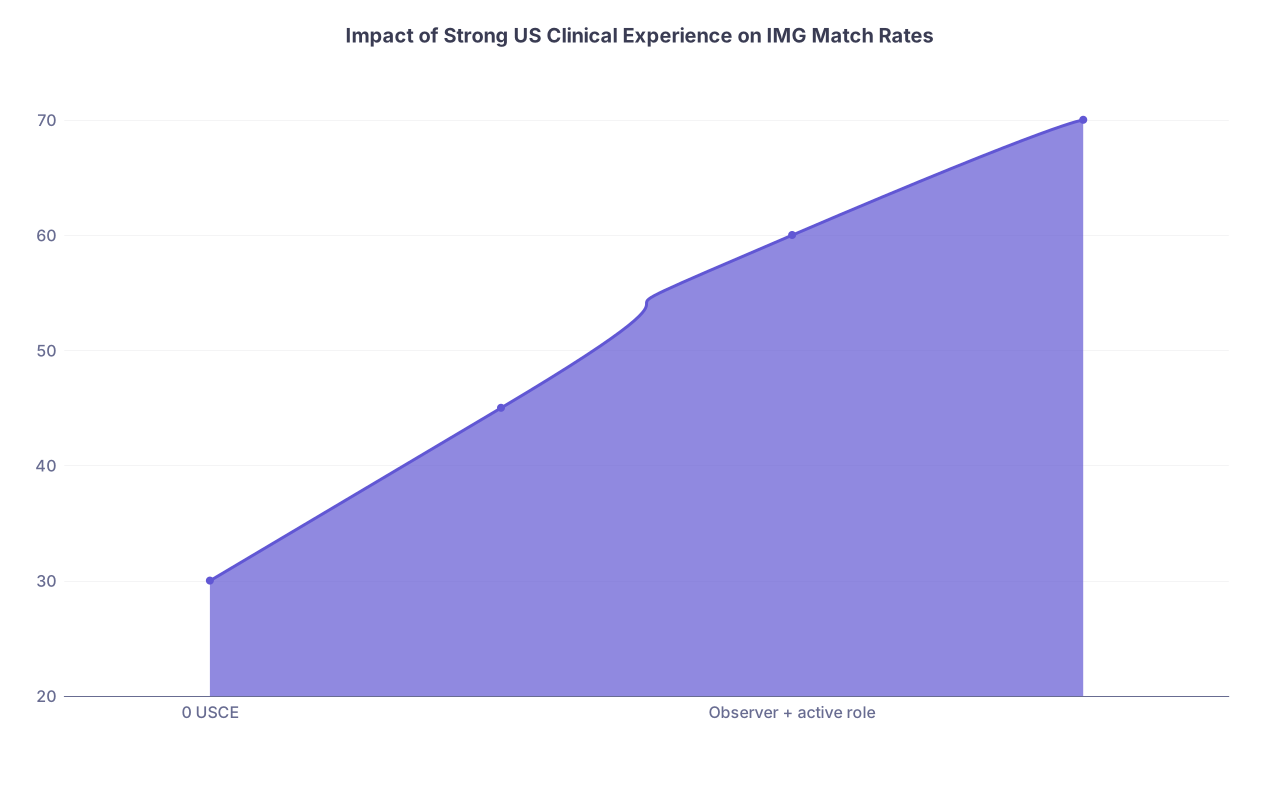
| Category | Value |
|---|---|
| 0 USCE | 30 |
| Observer only | 45 |
| Observer + active role | 60 |
| Hands-on externship + strong LOR | 70 |
10. A Concrete Action Plan For The Next 8–12 Weeks
You want a script. Here it is.
Week 1–2
- Show up early, know every patient.
- Ask attending for permission to:
- Present on rounds
- Take interval histories
- Clarify program rules about:
- Physical exams
- Student notes
- EMR access
Week 3–4
- Start performing focused exams under direct supervision.
- Start drafting student notes labeled as student/observer notes.
- Ask for feedback on your presentations and notes.
Week 5–8 (or next rotation)
- Ask to:
- Call consults after scripts agreed with attending.
- Communicate simple plan elements to patients, with attending present or immediately available.
- Identify 1–2 interesting cases to discuss or present in a brief case presentation to the team.
- Mention your desire for a detailed LOR if performance remains strong.
Parallel tasks
- Keep a logbook:
- Number of patients followed
- Cases you presented
- Procedures you observed or assisted
- Use this log to:
- Update your CV with specific, honest bullet points
- Provide your letter writer with accurate details
If you follow this, you will finish with:
- One or two rotations where you were clearly more than a passive observer.
- At least one strong, defensible, detailed LOR.
- No legal or ethical landmines lurking in your file.
FAQ (Exactly 3 Questions)
1. Do I really need “hands-on” US clinical experience to match as an IMG?
No, not in the exaggerated sense many people mean. You need meaningful, supervised clinical involvement in the US system. A well-structured observership where you take histories, perform supervised exams, present patients, and get a detailed letter can be just as valuable as a so‑called “externship.” Programs care more about the quality and credibility of your experience than the marketing term.
2. My current observership does not allow any patient contact. Should I still list it on ERAS?
Yes, but be honest and specific. Emphasize what you actually gained: exposure to US rounding structure, multidisciplinary care, EMR systems, and common inpatient pathologies. At the same time, if it is purely observational with no interaction, you should actively seek at least one additional experience where you can contribute more directly under supervision. One minimal observership is fine; a whole portfolio of them is weak.
3. How late is too late to change to a better clinical experience before applying?
You can improve your application even with rotations completed 2–4 months before submission. Program directors care more about recency than perfection. A strong, recent, supervised clinical experience with a powerful letter—even if it is your only robust one—can shift your profile. If you are more than 6–8 months from your intended ERAS submission, you still have time to pivot to better rotations rather than staying stuck in useless ones.
Key points to walk away with:
- Upgrade your function, not your title—take on more supervised responsibility without pretending to be a resident.
- Protect your future by staying strictly within legal and institutional rules while expanding your role through explicit, negotiated tasks.
- Convert every upgraded responsibility into concrete, honest CV bullets and strong, detailed letters that program directors can trust.