
The way program directors read “US Clinical Experience” is ruthless and rarely explained to you honestly. They are not just asking, “Do you have it?” They are asking, “What does this really say about who you are, how you work, and whether you are going to be a problem in my program?”
Let me walk you through what they are actually thinking—because I’ve sat in those rooms, I’ve heard the comments, and I know exactly what gets silently inferred from a single line like “Observer, Internal Medicine, Community Hospital, 3 months.”
Most IMGs think USCE is a checkbox. Program directors treat it like an X-ray: they see right through your application with it.
First Filter: Type of USCE = Type of Applicant (In Their Heads)
Nobody on the residency selection committee reads “USCE” and moves on. They decode it. Instantly.
They distinguish between four broad categories, even if they never say it out loud:
| USCE Type | Typical Value in PD Eyes |
|---|---|
| ACGME-accredited US residency externship / sub-I | Very High |
| Hands-on US electives as a student | High |
| Paid or structured externship with orders/notes | Moderate |
| Pure observership (shadowing only) | Low |
And here’s what they infer from each.
Hands-on US electives / sub-internships
If you have a sub-I or real elective in an ACGME-affiliated teaching hospital, program directors are assuming:
You got through some level of screening.
You were trusted to have some responsibility, even if limited.
You saw real EMR, real sign-out, real pages, real chaos.
What they actually think:
- “This person has at least been in the US system long enough not to be completely lost on day one.”
- “They had to show up on time, write something in the chart, and interact with residents. Someone would have complained if they were weird or unsafe.”
- “If this is at a decent place (say, Cleveland Clinic, Mayo, a major university), someone took a risk letting them do this. That’s a soft signal.”
If your LOR from that rotation is strong and specific, you basically just translated yourself from “unknown foreigner” to “known quantity in this system.” That is massive.
Structured externships (paid or unpaid, but hands-on)
Programs are split on these. I’ve heard both:
- “Externships are the only realistic option for many IMGs; I don’t hold it against them.”
- “Some of these are glorified shadowing dressed up as externships—need to read the letter carefully.”
What they infer:
- “Motivated enough to find something hands-on in the US.”
- “Probably did more than just stand in the corner, but not sure how much.”
- “Need the letter to prove they actually functioned like part of the team.”
If your experience includes: admitting notes, progress notes, presenting, calling consults under supervision, dealing with EMR—this pushes you up a tier in their minds. If it looks vague (“exposed to patient care,” “observed a high-volume clinic”), they assume it was mostly passive.
Pure observerships
This is where people get hurt and they don’t realize it.
A 1-month observership at a private cardiologist’s office in New Jersey? That tells a program director:
- You want US experience, but you did not (or could not) access more structured pathways.
- You’ve seen American patients, but you haven’t proven you can function in the US hospital workflow.
- You may never have written a US-style H&P or note, never touched Epic or Cerner, never been paged at 3 am.
Do some PDs still consider you with observerships only? Yes. Especially in community programs, lower-tier IM, FM, psych. But do not kid yourself: they know this is weak compared to hands-on rotations.
And if every single one of your US experiences is an observership at a solo practitioner’s office? They infer isolation, lack of team interaction, and absolutely no proof you can be a resident tomorrow.
Duration and Timing: What Your Timeline Says About You
PDs don’t just look at what you did. They look at when and how long. And they make assumptions.
Long USCE vs. “month here, month there”
If you’ve done:
- 4–6 months of consistent USCE in the same specialty, especially clustered in recent years
They think:
- “This person has had real exposure. They know what they are getting into.”
- “They’re not going to quit when they see how hard residency is. They’ve already seen the grind.”
Contrast that with three separate 2-week observerships sprinkled over three years:
- “This looks like visa tourism, not real immersion.”
- “I have zero evidence they can handle actual continuity or progressive responsibility.”
Recent vs. ancient USCE
Here’s a harsh truth most IMGs learn too late: USCE ages.
If your only USCE is from 2017 and you’re applying in 2025, many PDs quietly file that under “essentially none.” I’ve heard on committees: “This was 8 years ago; I care way more about what they’ve done recently.”
What they infer from recent USCE (within last 1–3 years):
- You’re updated on current practice patterns.
- You’ve probably seen post-COVID changes, telehealth, new EMR features.
- You’re still “plugged in” enough that letters from that period might be meaningful.
What they infer from very old USCE:
- Either you couldn’t sustain access to the system.
- Or there was a long US gap where you weren’t doing much clinically relevant work in the US.
They might still value it, but far less.
Site and Setting: Where You Rotated = Where You Fit
Here’s another unspoken rule: the setting of your USCE signals your likely comfort zone and ceiling.
University hospital vs. community hospital
A rotation at a major academic center tells them:
- You’ve at least seen complex patients and multi-layered teaching structures.
- You are less likely to crumble when faced with sick ICU cases, complicated social dynamics, long documentation templates.
But don’t over-romanticize this. Many academic centers treat visiting IMGs like ghosts on the ward. I’ve seen rotations where the IMG was physically present but never allowed to write a single note.
Program directors know this. So they cross-check the letter.
If your LOR from that big-name place is generic and bland, it screams “peripheral observer.” If your community-hospital letter is concrete and detailed, that often carries more weight. I’ve watched PDs say: “I don’t care that the letter is from Podunk Community; this attending obviously knows this applicant.”
Inpatient vs. outpatient
Programs hiring for internal medicine, surgery, OB, EM care deeply about inpatient exposure. If all your USCE is outpatient clinic, especially in private practices, they infer:
- You may struggle with night float, rapid codes, admit volume.
- You’ve never truly experienced the tempo and chaos of an inpatient service in the US.
For FM and psych, outpatient heavy USCE is fine, but even then, a PD prefers at least some exposure to continuity, EMR, and multidisciplinary team interaction.
You want at least one inpatient-heavy experience on your CV for any hospital-based specialty. It signals you’ve seen the pace and still want the job.
Specialty Match: Your USCE Either Confirms or Contradicts Your Story
Program directors are constantly checking one thing: “Does this application tell a coherent story?”
Your USCE can either reinforce that story—or blow it up.
Consistent specialty exposure = maturity and commitment
If you’re applying to internal medicine and you’ve done:
- 2–3 months of USCE in IM wards / ICU / clinics
- Maybe 1 month in cardiology or nephrology
They infer:
- You understand what IM really looks like here.
- Your interest is not a last-minute shift because IM is “easier to match.”
Same for psych, FM, peds. When your USCE lines up cleanly with your chosen specialty, you come across as serious and self-aware.
Inconsistent or scattered USCE
Now look at this pattern:
- 1 month US cardiology
- 1 month US surgery
- 1 month US radiology observership
- Applying to psychiatry
The committee reaction? I’ve literally heard this: “Are they applying to us because it’s the only thing left?”
They infer:
- Lack of clarity.
- Possibly someone who chased any spot they could get rather than targeted planning.
- Letters from surgeons or radiologists that say nothing about your suitability for psychiatry.
Can you still match with a scattered pattern? Yes. But then your personal statement and interview need to clean up that story. Most applicants never do that properly. So the default narrative becomes: “Unclear or opportunistic.”
Letters from USCE: What They Reveal Between the Lines
The true value of USCE to a program director is not the bullet point. It’s the letter that should come out of it.
When they see “USCE: 3 months, community IM hospital,” they immediately flip to your letters. And they’re looking for specific signals.
What strong USCE letters tell them
A powerful USCE letter does three things that PDs care about:
Places you in the resident context.
Phrases like “performed at the level of an intern” or “indistinguishable from our US graduates in day-to-day work” turn heads.Documents specific behaviors.
Concrete examples: “took responsibility for follow-up on abnormal labs,” “initiated contact with social work for safe discharge,” “stayed late to see admissions when the team was short-staffed.”Shows trust and endorsement.
Things like: “I would gladly accept this applicant into our residency” or “we would be fortunate to have them in our program.”
What they infer from that:
- This person has lived in the US medical culture enough to internalize expectations.
- They are not just technically adequate; they are socially and professionally safe.
- If another US attending was willing to stick their neck out this far, they’re lower risk.
Weak, vague USCE letters
Here’s where many IMGs get quietly filtered out.
Letters that say:
- “X was a nice observer and seemed very interested.”
- “She attended clinic regularly and was punctual.”
- “He is polite and respectful and will make a good physician.”
These are death in competitive pools. I’ve seen PDs scan those in 20 seconds and say, “No evidence of clinical function. Next.”
They infer:
- The attending either didn’t see enough of you to judge your work.
- Or they didn’t trust you enough to give real responsibility.
- Or you didn’t stand out. At all.
And if that letter is from your “strongest” USCE? That undermines every word you say about being hardworking and clinically strong.
Professionalism, Culture Fit, and Red Flags Hidden in Your USCE
Most IMGs think PDs use USCE to test clinical skills. That’s only half of it. The other half is professionalism and cultural adaptation.
Can you function in US hospital culture?
From your USCE and letters, PDs infer:
- Do you understand hierarchy? Not in a submissive way—just whether you know when to escalate, who to call, and how not to bypass the chain for every small thing.
- Can you communicate clearly in English with nurses, patients, consultants? Vague mentions of “good communication” mean less than specific examples.
- Do you know baseline expectations—calling back pages promptly, answering patient questions without drifting into false reassurance, documenting appropriately?
If a letter mentions:
- “Sometimes struggled with punctuality.”
- “Needed repeated reminders about documentation completeness.”
- “Improved over time but required close supervision.”
That triggers a discussion in the room: “Do we have the bandwidth to fix this?”
What gaps in USCE can signal
No or minimal USCE, especially for an IMG several years out of graduation, triggers assumptions:
- “They either couldn’t secure USCE or they didn’t prioritize it.”
- “They may be clinically rusty or never truly tested in the US environment.”
- “If I have 500 applications, why would I risk it when 200 have at least some decent USCE?”
Is it always fair? No. Is it how many PDs triage? Yes.
The “Grit Factor”: What Your USCE Pathway Says About Your Character
One thing that rarely gets verbalized out loud in front of applicants: PDs infer toughness and resilience from how you built your USCE.
If they see:
- Repeated trips to the US over several years.
- Progressive responsibility (observer → extern → sub-I).
- Geographic moves, visas, financial challenges, yet you kept coming back.
They infer:
- You are stubborn. In a good way.
- You are capable of sacrificing comfort to get where you want.
- You won’t collapse the first time a night shift goes badly or an attending tears into you.
I’ve heard variations of this exact line in meetings: “Look at what they did to get here. They’ll survive residency.”
Of course, this only works if the experiences are solid and your letters back it up. Ten observerships with generic letters are not grit; they’re noise.
What Different Types of Programs Read into USCE
Not every program director reads USCE the same way. There are patterns.
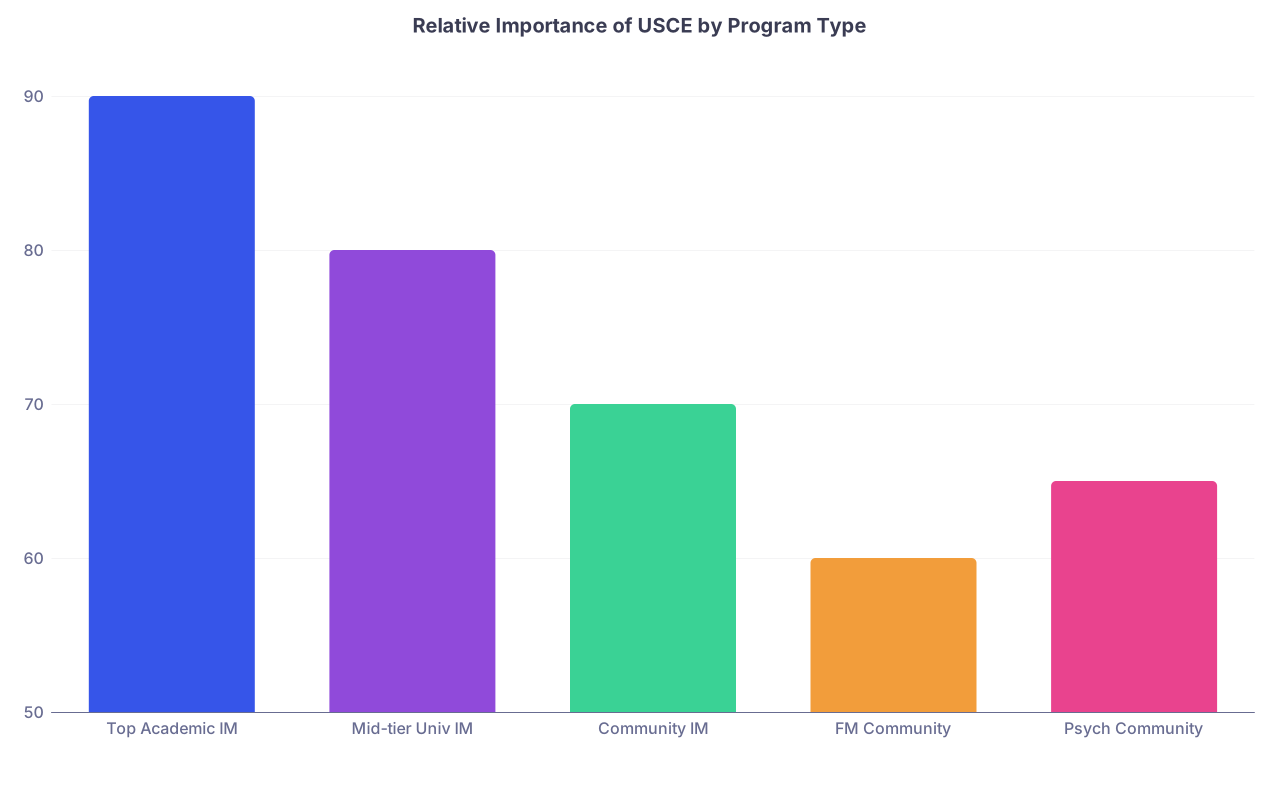
| Category | Value |
|---|---|
| Top Academic IM | 90 |
| Mid-tier Univ IM | 80 |
| Community IM | 70 |
| FM Community | 60 |
| Psych Community | 65 |
Highly competitive academic IM / subspecialties
At these places, USCE is almost a screening device for seriousness.
They infer:
- No solid USCE in IM? You’re not even considered unless your research is stratospheric.
- Observership-only with no meaningful letters? They assume you’re not ready.
- Strong university-based electives with strong letters? Now they’ll look at your research, scores, and the rest.
Mid-tier university and strong community IM
Here USCE is a risk control tool.
- They use it to predict: are you going to struggle with documentation, EMR, inpatient pace?
- If your Step scores are OK and you have solid USCE with decent letters, you move into the “safe to interview” pile.
- Weak or no USCE? You go into “maybe if we have leftover spots after interviews.”
FM, psych, peds, less competitive fields
They still care about USCE. But the focus shifts a bit:
- In FM: broad outpatient exposure, continuity, communication with families, teamwork.
- In psych: communication skills, understanding of US mental health resources, multidisciplinary coordination.
- In peds: comfort with families, patient interaction, cultural sensitivity.
But make no mistake—they still infer all the same things about professionalism, adaptability, and risk from your USCE.
How Program Directors Use USCE to Predict Your First Month
The real question every PD is asking is simple: “What will this person look like on July 1st?”
When they read your USCE, they mentally project you into:
- A night float shift with 15 cross-cover patients.
- Morning sign-out in a crowded conference room.
- A demanding attending asking you for a coherent, 3-minute, structured case presentation.
- A nurse calling you three times about a patient’s blood pressure.
From your USCE they infer:
- Will you even know how to open the chart, where to find labs/imaging, how to put in orders?
- Will you freeze when someone expects you to “just handle” three new admissions in a row?
- Will you recognize social work, case management, PT/OT as part of the team—or act like you’re working alone?
If your USCE is robust, recent, and hands-on—with strong letters loaded with specific examples—they imagine you functioning, maybe slowly at first, but safely.
If your USCE is thin, old, or purely observational, they imagine spending July and August training you on things they can’t afford to teach from scratch anymore. In 2024+ era, with duty hours, patient caps, and burnout, many simply will not take that risk when the applicant pool is huge.
The Hard Truth: What You Can and Cannot “Fake” with USCE
You can fake interest. You can fake enthusiasm on paper. You can’t fake patterns.
Program directors are extremely good at reading patterns of behavior from the structure of your USCE:
- Coherent, specialty-aligned, progressive, reasonably long USCE = mature, committed, adaptable, likely safe.
- Scattered, very brief, all observational, or obviously last-minute = uncertain, underexposed, potentially risky.
They will not say this to you during an info session. No program wants to be quoted on Reddit as “hating observerships.” So they use polite language: “We prefer hands-on US clinical experience” or “Strong US letters are very helpful.”
Behind closed doors, the discussion is much sharper. I’ve heard things like:
- “If after four years they couldn’t find one good US rotation that can write a meaningful letter, why should we believe they’ll function as interns here?”
- “I’m tired of teaching EMR to people who’ve never touched it before. We have enough applicants who’ve actually used it.”
That’s the real filtering logic.
If You’re Still Building USCE: How to Make It Say the Right Things
You can’t change what PDs infer. You can control the signal you send.
When you choose or build US clinical experience, you should be thinking:
- “Will this give me a specific, detailed letter that places me in the context of residents?”
- “Does this align with the specialty I claim to love?”
- “Can I get at least one inpatient-heavy, team-based experience?”
- “Is it recent enough that it speaks to who I am right now?”
And when you are on those rotations, you need to behave like someone who understands what’s really being judged:
- Reliability, not just raw knowledge.
- Communication and teamwork, not just exam scores.
- Your ability to function here, not just your past achievements abroad.
That’s what program directors are reading into your US clinical experience. Not just “Does it exist?” but “Does it prove you’re the kind of person we can safely hand a pager to on July 1?”
If you remember nothing else, remember this:
- Program directors use USCE as a risk assessment tool, not a simple checkbox. Hands-on, recent, specialty-aligned experience with strong, specific letters screams “low risk.”
- The pattern of your USCE—type, duration, timing, and setting—tells a story about your maturity, adaptability, and realism about the specialty you’re entering.
- Weak, purely observational, or scattered USCE doesn’t just fail to help you; it actively makes PDs question whether you’ll survive the first month of residency without drowning.