
The dirty secret is this: to most US program directors, “shadowing” barely counts. Continuity clinic does.
If you are an IMG and you’re stacking shadowing hours thinking it will impress anyone, you’re playing the wrong game. The people who actually sit in the ranking meeting care about one thing above all: can you function as a junior resident in the real US system, with real patients, over real time. Continuity clinics scream “yes.” Shadowing whispers “maybe.”
Let me walk you through what really happens behind those closed-door meetings, and why continuity clinic experience changes how your entire application is read.
What PDs Actually See When They Read “Shadowing”
First, understand how the term “shadowing” lands in a PD’s brain.
They’ve seen thousands of applications. When they see:
- “Shadowed Dr. X in cardiology clinic, 120 hours”
- “Observership in internal medicine, 4 weeks (shadowing only)”
- “Shadowing experience – emergency department, 80 hours”
what they actually think is:
- “Stood in a corner, watched, smiled politely.”
- “No orders. No notes. No responsibility.”
- “Probably never touched the EMR.”
- “Might still freeze when the MA asks, ‘Can you room this patient?’”
Too harsh? I’ve heard PDs say this out loud.
In one IM program I worked with, the APD literally said during file review: “Shadowing doesn’t move the needle for me at all unless it’s attached to a letter from someone I know.” That was it. 200+ hours of watching meant less than a single solid letter from a continuity clinic attending.
Now compare that to how they read:
- “Ongoing continuity clinic participation, 6 months, 2 half-days per week, internal medicine.”
- “Longitudinal primary care clinic experience in the US, 9 months.”
That triggers a very different set of assumptions.
What “Continuity Clinic” Signals To Program Directors
Continuity clinic means you didn’t just show up for a few days, nod your head, and disappear. It means you embedded yourself into a system. Over time.
When PDs see continuity clinic on an IMG’s CV, here’s what usually fires in their minds:
- You understand outpatient flow in the US.
- You can show up reliably over months, not just “observership vacation” style.
- You’ve seen the same patients more than once and followed a plan.
- Someone in the US trusted you enough to keep you around.
And that last one matters more than you think.
I’ve watched attendings argue for an IMG simply because of how they behaved and grew in continuity clinic. They’ll say things like:
- “She started off just observing, but by month three she was pre-charting, presenting succinctly, and anticipating my questions.”
- “He learned how to adjust insulin regimens, follow-up labs, and call patients with results appropriately.”
That kind of longitudinal growth story is only possible in a continuity setting. Shadowing is inherently short, fragmented, and passive. Continuity is long, integrated, and active—even if you’re “observer-only” on paper.
The Behind-the-Scenes Reality: Who Gets Remembered
Here’s something you won’t find on any ERAS tip sheet.
During rank meetings, faculty aren’t quoting your shadowing hours. They’re telling stories.
The IMG who shadowed in three specialties for a combined 500 hours? Nobody remembers them unless:
- They had a killer letter, or
- They did research with the physician and produced something tangible.
But the IMG who stuck with one primary care clinic for 6–12 months? That person gets stories attached to their name:
“Remember the applicant Dr. S used to talk about—the one who came to clinic every Thursday for almost a year and followed the diabetic patient who finally got their A1c from 11 to 7? That one’s on my ‘yes’ list.”
That continuity patient you followed? You have no idea how often that anecdote gets used in your favor without you being there.
Shadowing produces generic fluff: “hardworking, punctual, observed patient care.” Continuity clinic produces specific, gritty, memorable evidence: “She adjusted antihypertensive meds with appropriate follow-up, recognized concerning lab patterns, and communicated clearly with patients.”
Program directors don’t trust generic. They trust specific.
Continuity Clinic vs Shadowing: How PDs Actually Rank Them
Let me put it in the blunt hierarchy I’ve heard in multiple PD rooms across IM, FM, and even some peds programs.
| Experience Type | Typical PD Value Tier |
|---|---|
| Longitudinal continuity clinic (6+ mo) | Very High |
| Short-term structured clinic rotation | Medium–High |
| Single-specialty observership (active) | Medium |
| Classic “shadowing” (passive) | Low |
| Purely online/virtual shadowing | Near zero |
Nobody writes this on their website. But this is how it’s talked about in selection meetings.
Continuity clinic is the closest you can get to being a PGY-1 in a US outpatient setting without breaking licensing laws. Shadowing is the closest you can get to being furniture in the room without being a chair.
That’s the gap you’re dealing with.
Why “Continuity” Specifically Matters So Much
It’s not the word “clinic” that has magic. It’s the word “continuity.”
Residency is all about:
- Showing up.
- Following through.
- Owning patients over time, not just in the moment.
Continuity clinic tells PDs:
- You know how to see a patient, create a plan, and then live with the consequences of that plan at follow-up.
- You’ve seen real-world US medicine: no time, too many patients, picky EMR, insurance nonsense.
- You’re not just chasing letters—you committed to one place long enough that your behavior was actually observed, not just your introduction.
In continuity, you see:
- The newly diagnosed diabetic who comes back with worse numbers because they didn’t understand the diet advice.
- The hypertension patient whose BP is fine in clinic but trash at home because of adherence issues.
- The depressed teen who misses appointments and requires outreach.
When you mention these kinds of cases in your personal statement or during interviews, faculty instantly recognize you’ve seen more than just “classic teaching cases.” You’ve seen the messy, ugly, barely-managed reality of US outpatient care. That reads as authentic and credible.
The Documentation Difference: What You Can Actually Put on Paper
Let’s talk application details.
Shadowing bullets on a CV tend to look like this:
- Observed patient care in internal medicine clinic
- Witnessed various disease presentations
- Learned about patient-doctor communication
You and 3,000 other people. Indistinguishable.
Now look at what continuity clinic allows you to honestly write (even if you were technically “observing,” you can frame your activities more concretely):
- Participated in a longitudinal internal medicine continuity clinic for 9 months (2 half-days/week) with focus on chronic disease management.
- Pre-charted patient encounters, reviewed prior labs/imaging, and generated preliminary assessment and plan drafts for attending review.
- Tracked panel of patients over multiple visits, including diabetes, hypertension, and heart failure, and updated problem lists and follow-up needs in collaboration with supervising physician.
That’s a completely different level. It sounds like what interns do. And PDs want interns, not tourists.
Now layer on letters of recommendation.
Shadowing letters almost always sound like this:
- “I had the pleasure of having Dr. X shadow me.”
- “He was eager to learn and asked good questions.”
- “She demonstrated professionalism and arrived on time.”
Continuity clinic letters can sound like this:
- “Over 8 months in my continuity clinic, I observed Dr. X evolve from a passive observer into someone who could structure a full patient presentation.”
- “He routinely followed up on lab results, brought them to my attention, and suggested reasonable next steps that reflected a strong understanding of guidelines.”
- “My patients knew her by name and asked about her when she was not present. That’s rare for an IMG observer and speaks to her communication skills and empathy.”
Which applicant do you think gets flagged for interview?
The US Clinical Experience Market: What Nobody Tells IMGs
Let me be brutally clear: the “USCE industry” makes a lot of money selling you high-priced “observerships” that are, in reality, glorified shadowing.
They know PDs don’t care about passive shadowing. They won’t say that out loud. But they know.
Here’s the test: any program or “experience” that:
- Won’t let you return long-term.
- Cycles you through multiple clinics in 2–4 weeks.
- Sells itself primarily on its big-name hospital brand, not the nature of your work.
is likely giving you short-term, low-impact exposure.
Continuity clinics, especially in community or academic-affiliate settings, get far less marketing hype but yield far more real value. They’re often:
- At community internal medicine or family medicine practices.
- Run by attendings who precept residents/NPs/PA students.
- Part of residency program networks (even if offsite).
I’ve seen PDs at mid-tier IM and FM programs say, “I’d rather see 8 months of real longitudinal clinic work at a community practice than 4 weeks at [big-name hospital] where they just watched.”
And they mean it.
How Continuity Clinic Experience Plays During Interviews
Faculty don’t grill you on whether you shadowed cardiology vs GI. They’re listening for something else entirely.
When an IMG says in an interview, “During my continuity clinic in the US…” faculty ears perk up.
Because then you can say things like:
- “There was one patient with uncontrolled diabetes I followed for five visits…”
- “In continuity clinic, I got used to reviewing labs before the visit and adjusting meds together with my attending…”
- “I learned how to manage time when three patients showed up late and we were already behind schedule…”
Those are resident problems. Speaking like that makes you sound like someone who’s already operating in the same universe.
Contrast that with the classic shadowing answer:
“I shadowed in cardiology clinic and saw many interesting cases like heart failure and arrhythmias. I learned about the importance of patient-doctor communication.”
Faculty nod politely. Then forget you 3 minutes later.
You want to sound like someone who’s already living in the US outpatient trenches. Continuity clinic gives you the content to do that without faking anything.
How to Structure a Continuity Clinic Experience That Actually Counts
Not all “continuity” is equal. PDs can smell fake continuity from a mile away.
What they respect:
- At least 4–6 months, ideally 6–12.
- Consistent schedule (e.g., every Monday and Thursday afternoon).
- Clear role: pre-charting, sitting in room, case discussion, following a mini “panel.”
- A supervising attending who is willing to write a detailed letter.
- “Continuity” on paper that was really 4 weeks of clinic and then nothing.
- Lots of clinics, each 2–3 weeks, branded as “continuity modules.”
- No mention of specific responsibilities or cases in your PS/interview.
If you’re already in a clinic but it’s chaotic, ask to formalize your role a bit:
“Would it be okay if I pre-charted for your afternoon patients and we briefly reviewed my notes before each encounter? It would help me learn to think like a resident.”
Most attendings love that. And then they can honestly describe you as someone who functioned close to an intern level of preparation.
What This Means for IMGs Planning Their US Experience
If you have to choose between:
- Four separate 4-week “shadowing” rotations in fancy places, or
- One solid 6–9 month continuity clinic in a less glamorous community setting,
for pure Match value, the second option usually wins. Every time I’ve seen PDs discuss this trade-off, continuity wins.
You need at least some recognizable US experience for optics, fine. But beyond that baseline, more shadowing becomes diminishing returns. Continuity keeps compounding.
Also, continuity clinic is where you learn small but crucial US-system details:
- How refills, prior authorizations, and referrals actually happen.
- What “return in 3 months” really means in a busy practice.
- How to talk to patients at a 6th-grade literacy level without sounding patronizing.
- How to work alongside MAs, nurses, and front desk staff without stepping on toes.
None of that shows up in shadowing. All of that shows up in how you talk about cases and systems during interviews.
A Quick Reality Check: Continuity Clinic Won’t Fix Everything
Let’s be honest. Continuity clinic is not magic.
If your Step 2 is 205, you have weak English communication, and no letters from US physicians, 12 months of continuity clinic won’t save you at top-tier IM programs. PDs are not sentimental.
But among IMGs with roughly similar scores, similar schools, and similar timelines, the one with strong continuity clinic experience, plus a solid letter describing that longitudinal work, will almost always be ranked higher than the one with random shadowing across specialties.
Think of continuity clinic as a force multiplier. It amplifies:
- Your letters (more specific, more credible).
- Your personal statement (more concrete stories).
- Your interviews (more real, grounded answers).
Shadowing… mostly just fills a checkbox called “saw US patients at some point.”
Simple Guideline: How PDs Distinguish Shadowing vs Continuity Depth
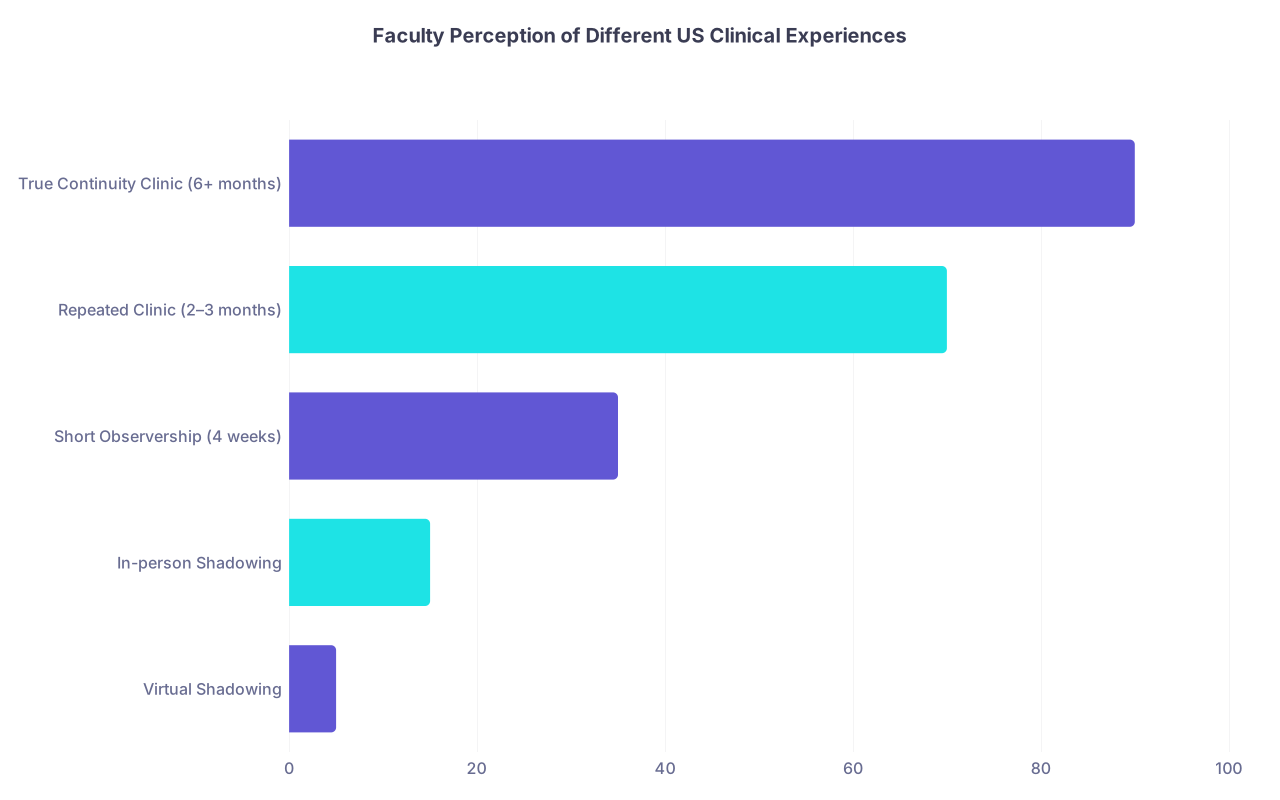
Here’s the unofficial mental checklist I’ve heard faculty use over and over:
| Category | Value |
|---|---|
| Virtual Shadowing | 5 |
| In-person Shadowing | 15 |
| Short Observership (4 weeks) | 35 |
| Repeated Clinic (2–3 months) | 70 |
| True Continuity Clinic (6+ months) | 90 |
They’re not running numbers literally. But that’s the rough weighting.
If you can tell a PD, “I spent 8 months in Dr. X’s continuity clinic, came twice weekly, and followed approximately 40–50 patients over multiple visits,” you’re operating in that 70–90 value range.
If you tell them, “I shadowed in different clinics for 200 hours,” you’re down near the 15–35 range.
That’s the insider math.
How To Talk About Continuity Clinic on Your Application
Do not bury continuity clinic under vague language. Highlight it aggressively and clearly.
On ERAS experiences, use phrases like:
- “Longitudinal internal medicine continuity clinic, [Dates]”
- “Primary care continuity clinic – chronic disease management focus”
- “Repeated outpatient clinic experience over 9 months, 2 sessions/week”
In your duties/descriptions, emphasize:
- Pre-charting and follow-up.
- Repeated visits with the same patients.
- Participation in management plans and interval reassessments.
- Any QI or small projects you did related to that clinic.
Then in your personal statement, choose one or two continuity patients and tell the story. Not the Step 1 style, “71-year-old male with X, Y, Z.” The actual lived story of following someone over time and how your understanding deepened.
That’s the kind of detail that makes PDs think, “This one has actually done the work.”
Visualizing a Strong IMG Prep Path (With Continuity at the Center)
To put it together, here’s what a smart IMG pathway often looks like when continuity clinic is used correctly:

| Step | Description |
|---|---|
| Step 1 | Finish Core Rotations Abroad |
| Step 2 | Step 1 or OET/English |
| Step 3 | Short US Observership 4-6 weeks |
| Step 4 | Secure Continuity Clinic Spot |
| Step 5 | 6-12 Months Longitudinal Clinic |
| Step 6 | Strong US Letters From Clinic |
| Step 7 | Apply ERAS With Continuity Highlighted |
The short early US observership gives you initial exposure and helps you get that first contact. The continuity clinic is what turns you from an outside observer into a credible future intern.
One Last Insider Point: PDs Talk to Each Other
Here’s one more truth from the back room.
If you do a continuity clinic tied to a residency program or its faculty, those attendings talk directly to the PD or APD. Not just in the letter. In hallways. In meetings. At preclinic conference.
I’ve sat in a room where the PD asked, “Hey, you’ve had this IMG in your continuity clinic all year—ready for primetime?” That’s it. A one-sentence endorsement at that moment can push you onto the interview list or push you up the rank sheet.
No one will ever do that for someone who shadowed them three mornings in cardiology clinic a year ago.
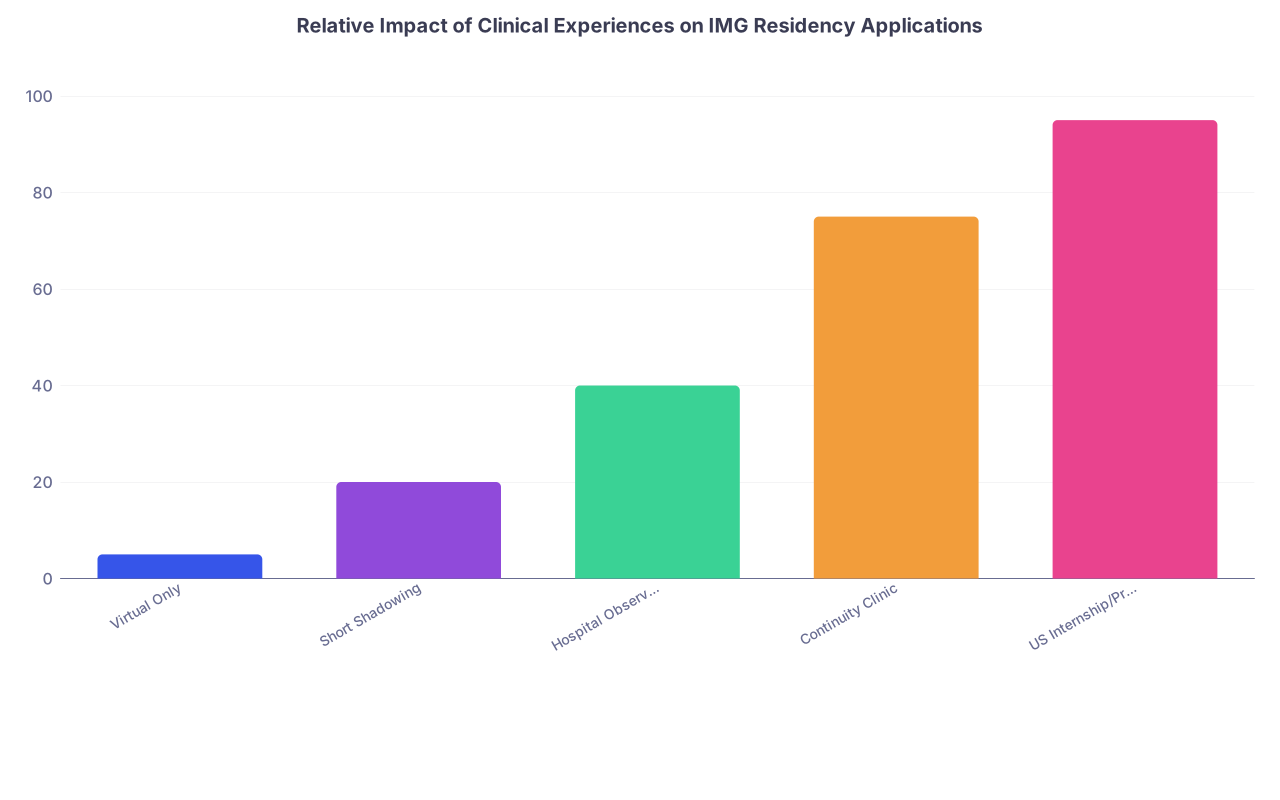
Continuity makes you real to them. Shadowing keeps you background noise.

| Category | Value |
|---|---|
| Virtual Only | 5 |
| Short Shadowing | 20 |
| Hospital Observership | 40 |
| Continuity Clinic | 75 |
| US Internship/Prelim | 95 |