The advice that IMGs should “just do more research” is overrated. For most IMGs, strong, recent, hands-on US clinical experience is more valuable than another abstract or poster.
That’s the core answer. Now let’s unpack it in a way you can actually use.
The Short Answer: What Should You Prioritize?
If you’re an IMG aiming for residency in the US and you’re choosing between:
- A solid hands-on US clinical experience (clerkship, sub-I, externship, acting internship)
vs. - A research-only position with no or minimal patient contact
then you should almost always prioritize the hands-on US clinical experience, especially if:
- You’re targeting internal medicine, family medicine, pediatrics, psychiatry, neurology
- You have average or slightly above-average scores
- You do not already have strong US letters of recommendation from clinical work
Research becomes more competitive than clinical experience only if:
- You’re aiming for highly academic or hyper-competitive specialties (derm, plastics, neurosurgery, radiation oncology, sometimes academic internal medicine)
- You already have excellent US clinical letters and are now trying to stand out scientifically
- You’re working with a big-name PI whose letter and connections will actually move the needle
But if you’re asking this question, chances are you’re not already loaded with US clinical letters and a giant research CV. So you need to build the foundation first.
Why Hands-On US Clinical Experience Matters More Than You Think
Here’s how program directors actually think, stripped of the nice PR language.
1. They need proof you can function in a US hospital tomorrow
Programs are asking themselves:
- Can this person see patients on Day 1 of intern year?
- Have they used US-style documentation (SOAP notes, EMR, discharge summaries)?
- Will they understand the culture: pages, consults, cross-cover, sign-out, handoffs?
Hands-on US clinical experience answers those questions. Research does not.
Concrete ways hands-on USCE helps you:
- You learn US expectations: punctuality, documentation style, note templates, EMR use, billing basics
- You practice clinical communication: giving concise presentations, calling consults, sign-outs
- You understand team dynamics: working with nurses, pharmacists, case managers, social work
- You see US guidelines and standards in action: not just what UpToDate says, but what attendings actually do
That’s why PDs often literally write in ranking notes:
“2 months US IM clinical. Good team player. Would function well as intern.”
That kind of line gets you ranked. A random abstract from a minor journal rarely does.
2. Clinical experience produces the letters that matter
The most powerful element of your application after your exam scores: high-quality, specific, US letters from attendings who saw you work clinically.
A strong clinical LOR usually includes:
- “I directly supervised Dr. X on the inpatient internal medicine service for 4 weeks.”
- “They saw 6–8 patients daily, independently evaluated, wrote notes, and presented on rounds.”
- “Excellent work ethic, outstanding clinical reasoning, and strong communication with patients and staff.”
- “I would be happy to have Dr. X as a resident in our program.”
That is gold.
Research letters, unless from a major name, often sound like this:
- “Dr. X worked in my lab on a retrospective chart review project.”
- “They are hardworking and completed data collection and assisted with a manuscript.”
- “I believe they will be successful in a residency program.”
Nice, but not nearly as convincing as: “I watched this person function like an intern on my team.”
If you have to choose where to get your letters: choose clinical.
When Research Actually Matters a Lot
I’m not anti-research. I’m anti-research-as-a-substitute-for-clinical-experience.
Research is powerful in certain situations:
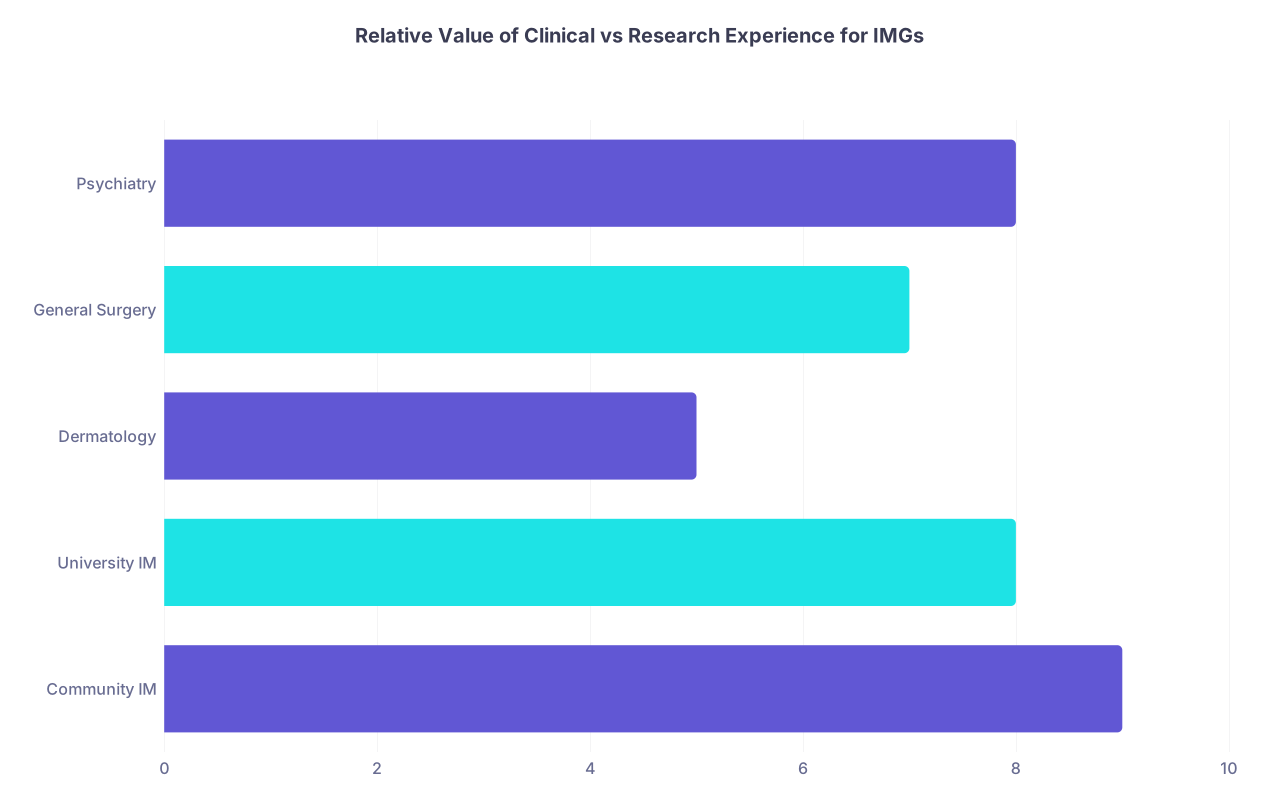
| Category | Value |
|---|---|
| Community IM | 9 |
| University IM | 8 |
| Dermatology | 5 |
| General Surgery | 7 |
| Psychiatry | 8 |
(Think of 10 as “absolutely critical” and 1 as “nice but not essential.” Clinical is closer to 9–10 for most primary specialties, while research jumps for super-competitive fields.)
Research becomes a priority when:
You want a strongly academic career or academic program.
Large university programs — especially those with a research mission — like to see some scholarly productivity. Not because they want everyone to be a full-time scientist, but because it signals:- You can look at data critically
- You understand methodology
- You can finish long-term projects
You’re applying to very competitive specialties.
For derm, plastics, neurosurgery, ENT, ortho, competitive radiology, etc., research is closer to mandatory, especially for IMGs. Multiple first-author papers, big-name mentors, and heavy involvement can be the difference between “ignored” and “interviewed.”You already have good USCE locked in.
If you’ve done 3–4 months of strong hands-on US experience with good letters, then extra time can sensibly go toward research to climb a tier.
So the sequence for most IMGs should be:
- Secure hands-on USCE + letters
- Once that is solid, add research on top, not instead
Types of US Clinical Experience: What Actually Counts
Programs are not stupid. They can tell the difference between:
- Observership: You watch. No orders, no notes, barely talk to patients.
- Shadowing: Even more limited.
- Hands-on externship / sub-I / clerkship: You see patients, take histories, write notes, present, participate as part of the team.
If you’re aiming for residency, prioritize:
| Type | Hands-On? | Value for Match |
|---|---|---|
| Observership | No | Low–Moderate |
| Shadowing | No | Low |
| Externship | Yes | High |
| Sub-internship | Yes | Very High |
| Elective rotation | Often | High |
If all you can get is an observership, fine, it’s better than nothing. But if you have a choice between:
- 3 extra months of purely observerships
vs. - 2 months of true hands-on externship + 1 month of research
Take the externship every time.
Practical Decision Framework: How You Should Choose
Here’s how I’d advise you if we were on a Zoom call and you shared your real stats.
Step 1: Be brutally honest about your profile
Look at:
- USMLE Step 1 / Step 2 CK (or equivalent)
- Years since graduation
- Specialty interest
- Any red flags (fails, leaves of absence, long gaps)
Then ask:
- Do I have zero or weak US clinical letters?
- Am I >3 years out of graduation with no recent clinical work?
- Am I targeting a moderately competitive or community-based specialty (IM/FM/psych/peds/neurology)?
If you said yes to any of those: clinical experience first.
Step 2: Decide using a simple rule
Use this:
- If you lack recent, hands-on USCE → prioritize hands-on USCE
- If you already have 3+ months of strong USCE + good letters → consider adding research
- If you’re going for hyper-competitive specialties → you probably need both (but clinical still cannot be zero)
Here’s a quick scenario table.
| Scenario | Priority |
|---|---|
| No USCE, no US letters, average scores | Hands-on USCE |
| 2–3 months USCE, decent letters, no research | Add research |
| Strong home-country clinical, no USCE | Hands-on USCE |
| Aiming for derm/plastics with some USCE | Heavy research |
| Older grad (>5 years) with gaps | Recent USCE first |
| Strong scores, 1–2 US letters, no pubs | Balanced, but USCE |
How Many Months of US Clinical Experience Is “Enough”?
More is not always better. There’s a point of diminishing returns.
For most IMGs going for IM/FM/psych/peds:
- 2–3 months of solid, hands-on USCE (with strong performance) is the minimum reasonable target
- 3–4 months looks solid on paper and gives you room for multiple letters
- Going beyond 6–8 months of nothing but rotations without research or other growth starts to look odd, especially if spread out over several years with no real progression
You want depth, not just quantity. One excellent 4-week rotation with a stellar letter beats three months of “quiet, polite, and forgettable.”
When a Research Position Can Quietly Include Clinical Exposure
There’s a middle ground that people often miss.
Some research positions at big US academic centers (e.g., research fellowships in cardiology, oncology, neurology) give you:
- Chart review and data work
- Clinic observation with your PI
- Some involvement in clinical conferences, tumor boards, case discussions
- Occasional patient interaction (depending on hospital policies)
If you can find a research gig that:
- Is at a reputable institution
- Allows you to attend clinics, rounds, or conferences regularly
- Comes with a PI who’s well-known and willing to write a strong letter
then that can function as a hybrid: research + clinical context + networking. That’s far better than being locked in a basement with Excel and no patient contact.
But don’t kid yourself. If the position is 100% data entry and no clinical visibility, don’t pretend it’s “kind of clinical.” Programs can smell the difference when they read your letters and your description.
How Programs Actually Rank Clinical vs Research
Here’s the real order of importance for most IMGs, for standard internal medicine/family medicine/psych/peds:
- Step scores / exam performance
- Recency of graduation and recent clinical experience
- Strong US clinical letters (from hands-on work)
- Evidence you can function in a US system (USCE, not just observerships)
- Communication skills and professionalism (reflected in letters and interviews)
- Research, publications, posters, QI projects
Research is icing. Clinical competence is the cake.
For academic heavy internal medicine at big-name centers, the list shifts slightly:
- Step scores (especially Step 2 CK)
- US clinical letters, preferably from academic attendings
- Fit with academic culture + at least some research
- Medical school reputation / record
- Then everything else
You’ll notice clinical letters and performance never fall far down the list.
Visualizing a Smart Strategy for IMGs
Here’s a simple path many successful IMGs follow:

| Step | Description |
|---|---|
| Step 1 | Assess profile and specialty |
| Step 2 | Get 2 to 3 months hands-on USCE |
| Step 3 | Secure strong US letters |
| Step 4 | Apply for next cycle |
| Step 5 | Add focused research with good mentor |
| Step 6 | Get research output and letter |
| Step 7 | Any US clinical letters? |
| Step 8 | Target academic or competitive specialty? |
You don’t have to copy this exactly. But if your plan is “two years of unpaid research and zero clinical involvement,” you’re setting yourself up for trouble unless you’re in a very specific, high-level, strategic environment.
FAQs
1. I can only afford one: a paid research job or an unpaid hands-on externship. Which should I pick?
If your finances allow even a short unpaid period, I’d do at least 4–8 weeks of hands-on USCE, then move into a paid research role. But if it’s strictly one or the other, and you have zero US clinical letters, you should seriously consider a shorter, intense hands-on rotation that gives you a strong letter, even if it’s unpaid, before locking into long-term research.
2. Do observerships count as US clinical experience for IMGs?
They “count” in the weakest sense: they show you were physically in a US hospital. But they do not carry the same weight as true hands-on experience. Programs know the difference. Observership + strong home clinical work is OK if that’s all you can get, but if you have the option, choose an externship/sub-I/elective where you actually see and present patients.
3. I already have 3 publications from my home country. Do I still need US research?
Not necessarily. Home-country research shows scholarly ability. Most community and many university IM programs will be satisfied with that, especially if your clinical side is strong. US-based research becomes more relevant if you’re chasing very academic places or highly competitive subspecialties. But even then, it shouldn’t replace USCE; it should sit on top of it.
4. How recent does my US clinical experience need to be?
Aim for within 1–3 years of the application. If you graduated 6 years ago and your last real clinical work (US or home country) was 5 years back, that’s a problem. In that situation, recent clinical experience (even in your home country) matters a lot, and USCE becomes critical to show you’re “current” and ready.
5. What if my only option for US clinical time is in a specialty different from the one I’m applying to?
Still do it. A month of hands-on USCE in, say, family medicine can absolutely help for internal medicine or psychiatry. Letters can emphasize your teamwork, communication, and clinical skills, which are transferable. Just make sure at least some of your experience and letters logically align with your chosen specialty if possible.
6. Does research ever compensate for low scores?
Rarely. Strong research can open doors if you’re closely mentored by a powerful name who is willing to advocate for you personally, and if your scores are borderline, not catastrophic. But as a rule, no amount of generic research makes up for very low exams. If your scores are weak, you should invest heavily in: recent clinical work, excellent letters, and realistic specialty/program targeting before you chase more research.
Key points to walk away with:
- For most IMGs, hands-on US clinical experience with strong letters is a higher priority than extra research.
- Research is valuable, but it should add to, not replace, proof that you can function as an intern in a US hospital.
- The smartest path: get 2–4 months of real USCE, secure excellent letters, then layer in research if your goals and time allow.