
The type of US clinical experience matters more than the duration—by a lot.
If you are an IMG obsessing about “3 months vs 6 months” but not obsessing about what kind of experience you are getting, you are focusing on the wrong variable.
Let me walk you through how program directors actually think about this, what counts, what’s fluff, and how to build a strategy that gets you interviews instead of just more “experience hours” on your CV.
1. How Program Directors Really See US Clinical Experience
Most residency programs do not count US clinical experience in hours or months. They bucket it.
Here’s roughly how it looks in their heads:
- “Strong, meaningful USCE – will trust this person on day one”
- “Decent exposure – helpful but not decisive”
- “Tourist medicine / observer – not useless, but not convincing”
- “Paper-only, no USCE – riskier; needs compensating strengths”
They care about:
- Setting: inpatient vs outpatient, academic vs community
- Role: hands-on vs observer
- Supervisor: US-licensed attending vs non-US, non-clinical
- Output: strong letters vs generic “they showed up” letters
They do not care whether you logged 8 vs 16 weeks of the same low-yield observership.
If you force me to choose:
- 8 weeks of high-quality, hands-on, inpatient USCE with 2 strong letters
beats - 6–9 months of scattered office observerships with no responsibility and weak letters
every single time.
2. Types of US Clinical Experience: Ranked by Impact
Here’s the blunt hierarchy. This is what I’ve actually seen matter in Match decisions.
| USCE Type | Impact Level |
|---|---|
| ACGME-affiliated sub-internship (acting intern) | Very High |
| Hands-on US externship (direct patient care) | High |
| Inpatient, structured observership | Moderate |
| Outpatient, well-supervised observership | Low–Moderate |
| Pure “shadowing” with minimal interaction | Low |
Let’s break this down.
1. Sub-internship / Acting Internship (AI)
Gold standard for IMGs if you can get it.
- You function (almost) like an intern: write notes, present patients, call consults under supervision.
- Typically at an ACGME-accredited teaching hospital.
- You are seen in real-time under the same pressure US grads face.
Programs love this because:
- It proves you can handle US hospital systems, EMR, pages, sign-out, and rounding.
- It generates powerful letters: “They functioned at the level of our US fourth-year students / interns.”
This is the single most valuable “type” of USCE you can have—often more valuable than accumulating 6–12 months of weaker experiences.
2. Hands-on US Externship
Not all externships are equal. Some are glorified observerships. Others are genuinely hands-on.
High-yield externships usually include:
- Writing notes (even if they are “drafts” in the EMR).
- Presenting patients to an attending.
- Participating in call or inpatient management.
- Direct patient interaction (H&P, counseling, follow-up).
Programs see this as: “They have real US experience, not just hallway time.”
If I had to choose:
- 2 months of a true hands-on externship
6 months of outpatient shadowing where you never touched a chart or spoke in rounds.
3. Inpatient Observership (Structured, Teaching-Focused)
Yes, observerships can matter—if structured well.
Signs it’s a decent observership:
- You attend daily teaching rounds.
- You’re invited to morning report, noon conference, M&M.
- You can present what you’ve read or observed.
- You have regular feedback and a formal evaluation.
It’s still not hands-on, but for programs it signals:
- You understand US inpatient workflow.
- You’re motivated enough to learn even without full responsibility.
- You’ve been seen over time in a medical context, not just a day here and there.
4. Outpatient Observership / Clinic-Only
Better than nothing, but it hits a ceiling fast.
Fine if:
- You’re aiming for primary care–heavy specialties like family medicine or outpatient-focused internal medicine.
- You need some USCE to avoid having “0” on the application.
Weak if:
- It’s your only USCE and you’re applying to inpatient-heavy fields (IM, surgery, OB, etc.).
- You stack 6–9 months of low-yield clinics with no strong letters.
5. Shadowing Only (No Role, No Documentation)
This is where IMGs waste time.
- You follow a physician around.
- You’re not really part of the team.
- No charting, no formal teaching, maybe a weak letter: “X observed in my clinic.”
Programs see this as: “Exposure? Sure. Evidence they can function here? Not really.”
You’re better off with a shorter, structured, letter-producing month than a long but vague “shadowing” era.
3. Duration: How Much Is “Enough” Once Type Is Right?
Once you’re in the right type of experience, you only need enough time to:
- Be observed reliably
- Take on increasing responsibility
- Earn serious letters of recommendation
For most IMGs, this looks like:
- 2–3 months of strong, type-1 or type-2 USCE (sub-I / externship)
- Plus maybe 1–2 additional months of good observership/clinic exposure
Not 12 months. Not 2 years. Stop trying to brute-force this with length.
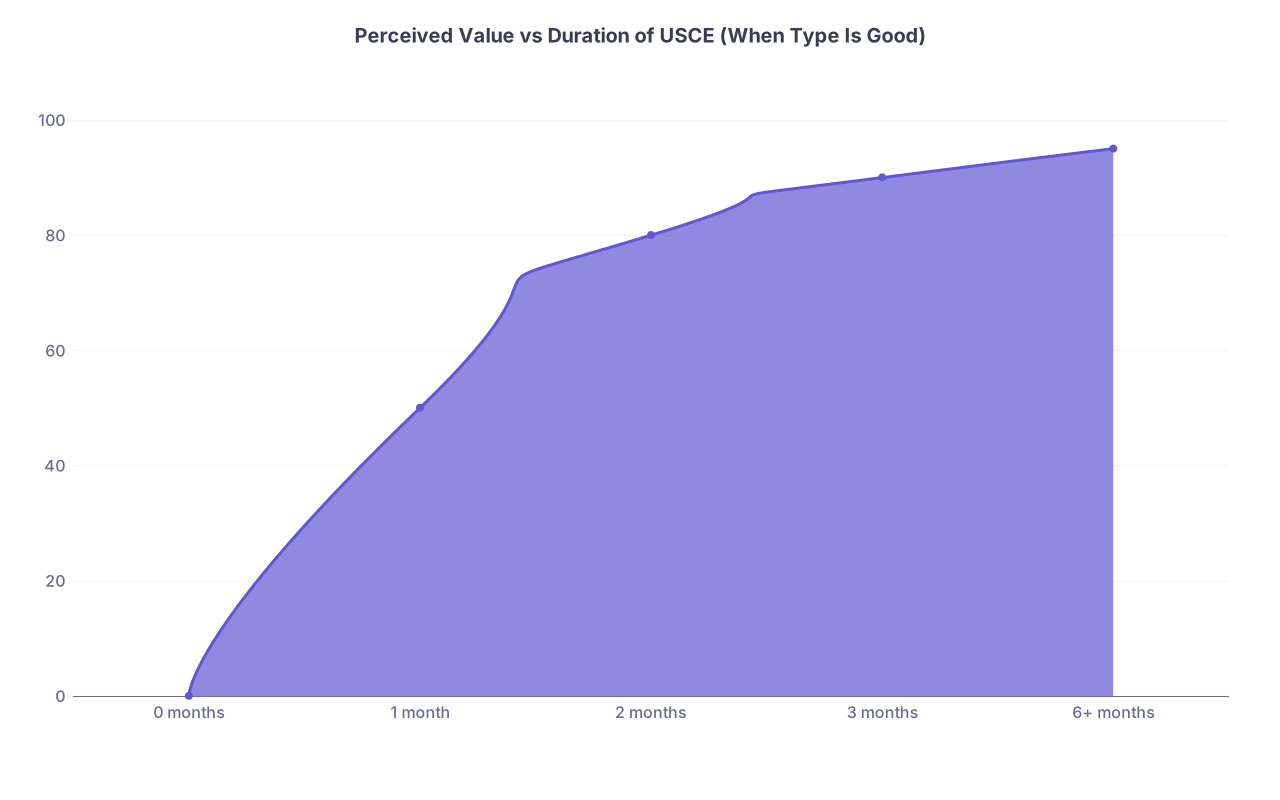
Here’s how programs actually interpret duration:
| Category | Value |
|---|---|
| 0 months | 0 |
| 1 month | 50 |
| 2 months | 80 |
| 3 months | 90 |
| 6+ months | 95 |
- 1 month: “OK, some exposure, might be enough for one letter.”
- 2–3 months: “We’ve seen you function over time; decent signal.”
3–4 months of the same level: marginal benefit, unless each month is different setting/attending producing distinct letters.
What does justify longer duration?
- You’re switching specialties and need fresh recent USCE in the new field.
- You did early low-yield stuff and want 2–3 high-yield months closer to application.
- You want multiple letters from different attendings/hospitals.
But stacking 4 similar low-responsibility observerships just because they’re cheap? Not a smart trade.
4. How Letters of Recommendation Tie Everything Together
Programs don’t really “see” your USCE; they see your letters.
Type of USCE determines the quality of letters you can get.
A powerful letter usually:
- Comes from a US-licensed attending in your chosen specialty.
- Mentions your level of responsibility: notes, presentations, follow-up.
- Compares you explicitly: “At least as strong as our US grads” or “in the top 10% of students I’ve worked with.”
- References specific behaviors: reliability, communication, clinical reasoning.
A weak letter sounds like:
- “They were punctual, polite, and interested in learning.”
- “They observed patient care in my clinic for x weeks.”
- “They will make a good addition to a residency program.”
Here’s the real link:
Better USCE type → more responsibility → more to write about → stronger, more specific letter.
If you’re comparing offers, ask yourself:
“Which experience is more likely to result in a strong, specific letter from someone programs respect?”
That is your tie-breaker.
5. Strategy: How to Choose the Right USCE Mix as an IMG
You don’t need perfection. You need a coherent, defensible story.
Step 1: Decide on your specialty
You should match your USCE type to your target:
- Internal medicine: Aim for at least 1 inpatient rotation (sub-I or strong externship).
- Family medicine: Combination of outpatient continuity clinic + some inpatient if possible.
- Psychiatry: Outpatient psych is OK, but inpatient psych or consult-liaison is stronger.
- Surgery: Inpatient, OR-exposed, highly structured rotations are critical.
Step 2: Prioritize type over length
Given a choice like:
- 4 months of generic outpatient “observership” in random offices
vs - 2 months of structured inpatient externship + 1 month of good teaching clinic in your field
You pick the second. Every time.
Step 3: Avoid the “CV padding” trap
I’ve seen too many CVs like this:
- Jan–Mar: Observership, private cardiology clinic
- Apr–Jun: Observership, private GI clinic
- Jul–Sep: Observership, private endocrinology clinic
- Letters: All generic, none ACGME-affiliated, no inpatient exposure
That looks like you were busy. It does not look like you’re ready for residency.
A better CV:
- Mar–Apr: IM sub-internship, university hospital, inpatient
- May: IM externship, community teaching hospital
- Jun: FM clinic with strong teaching, structured evaluation
- Letters: 2 from IM attendings (inpatient), 1 from FM program-affiliated faculty
Same or less total time. Way more convincing.
Step 4: Time it close to application when possible
Recent USCE (within 1 year of application) carries more weight.
If you have to choose:
- Doing your best-type USCE a year or two before you apply vs right before application—you want at least some strong USCE close to ERAS season.
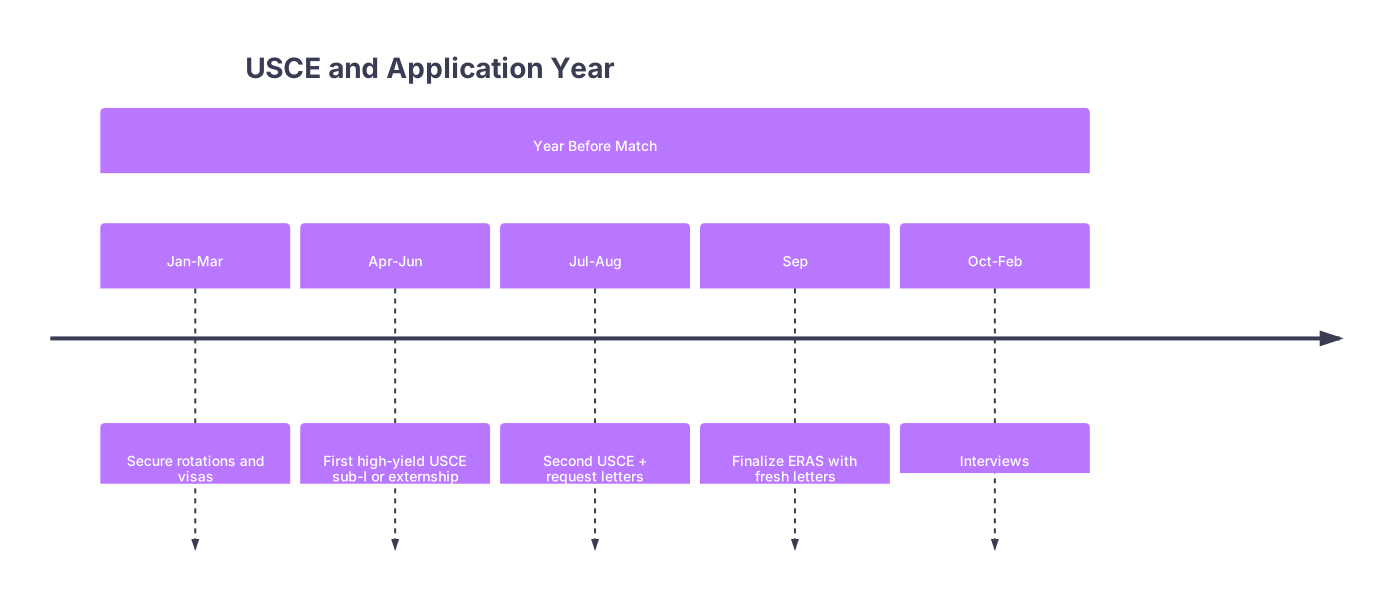
A simple timeline for an IMG planning one application year:
| Period | Event |
|---|---|
| Year Before Match - Jan-Mar | Secure rotations and visas |
| Year Before Match - Apr-Jun | First high-yield USCE sub-I or externship |
| Year Before Match - Jul-Aug | Second USCE + request letters |
| Year Before Match - Sep | Finalize ERAS with fresh letters |
| Year Before Match - Oct-Feb | Interviews |
6. Red Flags and Overrated Experiences
Let me be blunt about what does not impress most programs.
Red flags:
- “USCE” where your supervisor is not a practicing clinician (just research or admin).
- Experiences with no clear dates, roles, or setting.
- Rotations at non-teaching, non-affiliated “clinics” that exist largely to sell IMG rotations and provide no real team integration.
Overrated:
- Very long observerships in the same small private clinic.
- “Research observerships” labeled as clinical.
- Experiences with no clear path to a credible US letter.
If in doubt, ask the organizer one question:
“Will this rotation allow me to work closely enough with an attending that they can write a detailed, comparative letter for residency programs?”
If they hesitate, you have your answer.
7. Putting It All Together: Type vs Duration, Final Verdict
If we had to simplify to a decision frame:
- First: Maximize the clinical relevance and responsibility level of your USCE.
- Second: Ensure it can produce strong, specific letters from US attendings in your specialty.
- Third: Accumulate enough months (usually 2–4) to show consistency and get 2–3 solid letters.
Do not reverse that order.
Here’s a clean comparison:
| Priority | What to Optimize First | Why It Matters More |
|---|---|---|
| #1 | Hands-on level / role | Drives trust and strong letters |
| #2 | Setting (inpatient, teaching) | Matches residency environment |
| #3 | Supervisor credibility | Program directors trust the source |
| #4 | Duration (months) | Only needed to support #1–3 |
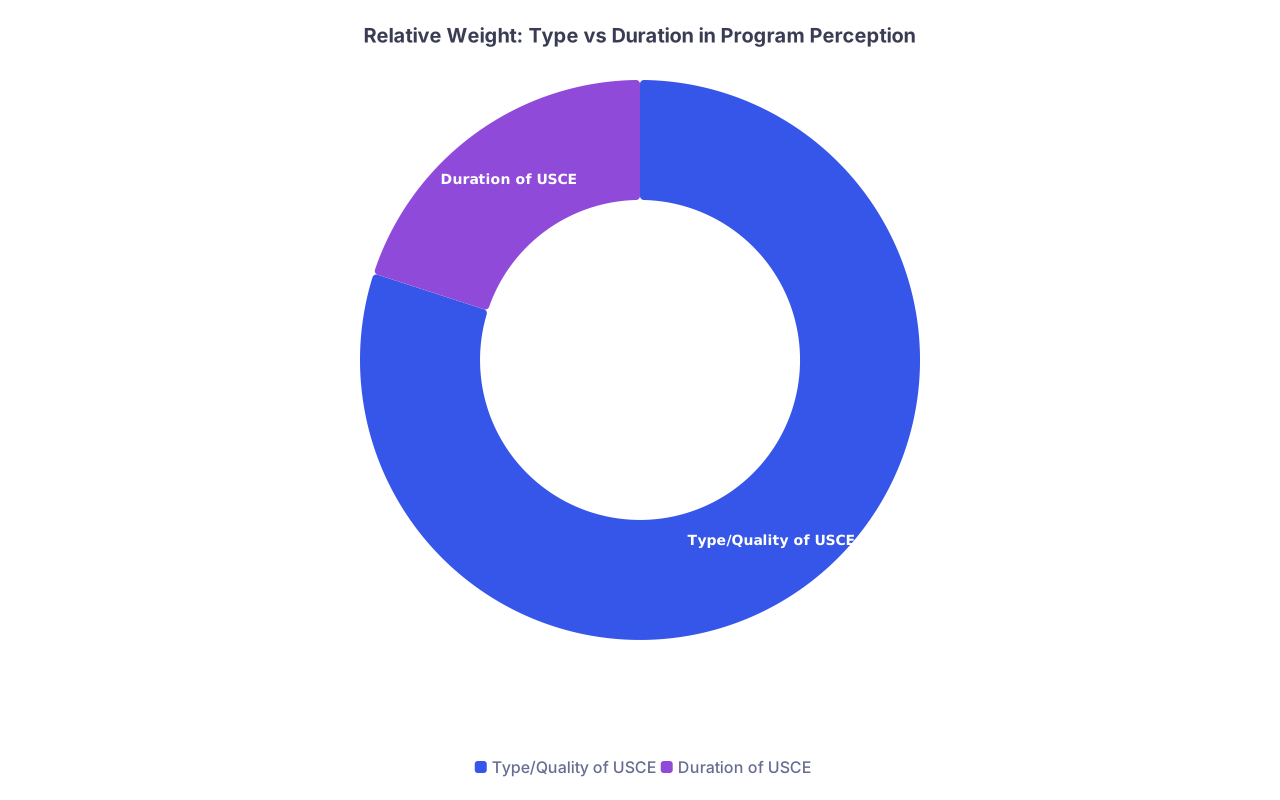
And a quick visual of how often programs care more about type vs duration in your favor:
| Category | Value |
|---|---|
| Type/Quality of USCE | 80 |
| Duration of USCE | 20 |

FAQ: US Clinical Experience for IMGs (7 Key Questions)
Is 1 month of strong inpatient USCE enough?
For some applicants, yes—especially if you already have strong home-country experience and good scores. But for most IMGs, 2–3 months of high-quality USCE (sub-I or externship plus maybe one additional rotation) is a safer target to get multiple solid letters.Do programs count observerships as USCE?
Some do, some don’t. Even when they “count” them, observerships rank lower than hands-on externships or sub-internships. If you only have observerships, make them structured, inpatient if possible, and get the best letters you can. But don’t pretend they’re equivalent to an acting internship.Are US externships from private companies worth it?
Depends on the structure. If they place you in ACGME-affiliated hospitals with real team involvement and letter potential, they can be valuable. If you’re sitting in a corner of a clinic watching quick visits all day, they’re mostly an expensive line on your CV. Ask detailed questions about role and responsibilities before paying.How recent should my US clinical experience be?
Ideally within 1 year of applying. Up to 2–3 years can still be acceptable, especially if combined with continuous clinical work elsewhere. But if your only USCE is 5 years old and you’ve been out of clinical work, that’s a problem. You’d want at least one fresh US rotation.Do I need USCE in multiple specialties?
No. Depth beats random variety. You want most of your USCE aligned with the specialty you’re applying to—especially for internal medicine, family medicine, psychiatry, pediatrics. One or two rotations in related fields (like cardiology for IM, EM for FM) are fine, but don’t scatter.Which matters more: US research or US clinical experience?
For most IMGs applying to primary care fields and internal medicine, US clinical experience is more critical than US research. Research helps more for competitive academic programs or specialties like dermatology, radiology, or competitive subspecialty-focused IM, but even then, someone with no credible USCE is a risk.I already have 6+ months of low-yield observerships. Should I still chase a sub-I or externship?
Yes—if you can afford it and are still serious about matching. One good sub-I or true externship that generates a powerful letter can do more for you than everything you have so far. You can explain past experiences as “early exposure,” but you need at least one rotation where you truly functioned as part of a US team.
Bottom line:
- The type and quality of your US clinical experience matters far more than the sheer number of months.
- Hands-on, inpatient, teaching-hospital roles that produce strong letters will move your application; long, vague observerships will not.
- Build your USCE plan around responsibility and letters first, and let duration support that—not the other way around.