
The usual advice IMGs hear about letters of recommendation is vague. “Get strong letters.” “US letters are better.” That’s not enough. You need numbers and a strategy.
Here’s the answer you’re actually looking for: most IMGs should aim for 3–4 US clinical letters of recommendation, with at least 2 being solid, recent US inpatient clinical letters in the specialty they’re applying to.
Now let’s break that down so you can stop guessing and start planning.
1. The Real Target: How Many US Clinical Letters Do You Actually Need?
ERAS lets you upload up to 4 letters per program per application, but programs don’t require all 4 to be US letters. Still, as an IMG, US clinical letters are your currency.
Here’s the simple rule:
- Ideal target:
- 3–4 total letters
- At least 2 US clinical letters in your target specialty
- 1 additional US clinical letter (same specialty or related)
- 0–1 non-US or non-clinical letter if and only if it’s genuinely strong and relevant
If you want it even cleaner:
Minimum competitive set for most IMGs:
- 3 letters total
- 2 US clinical (inpatient or substantial outpatient)
- 1 more letter (US or home country, but actually strong)
Stronger / safer set (what I recommend you aim for):
- 4 letters total
- 3 US clinical (2 in specialty, 1 in related field or strong US experience)
- 1 optional (research / home institution / department chair)
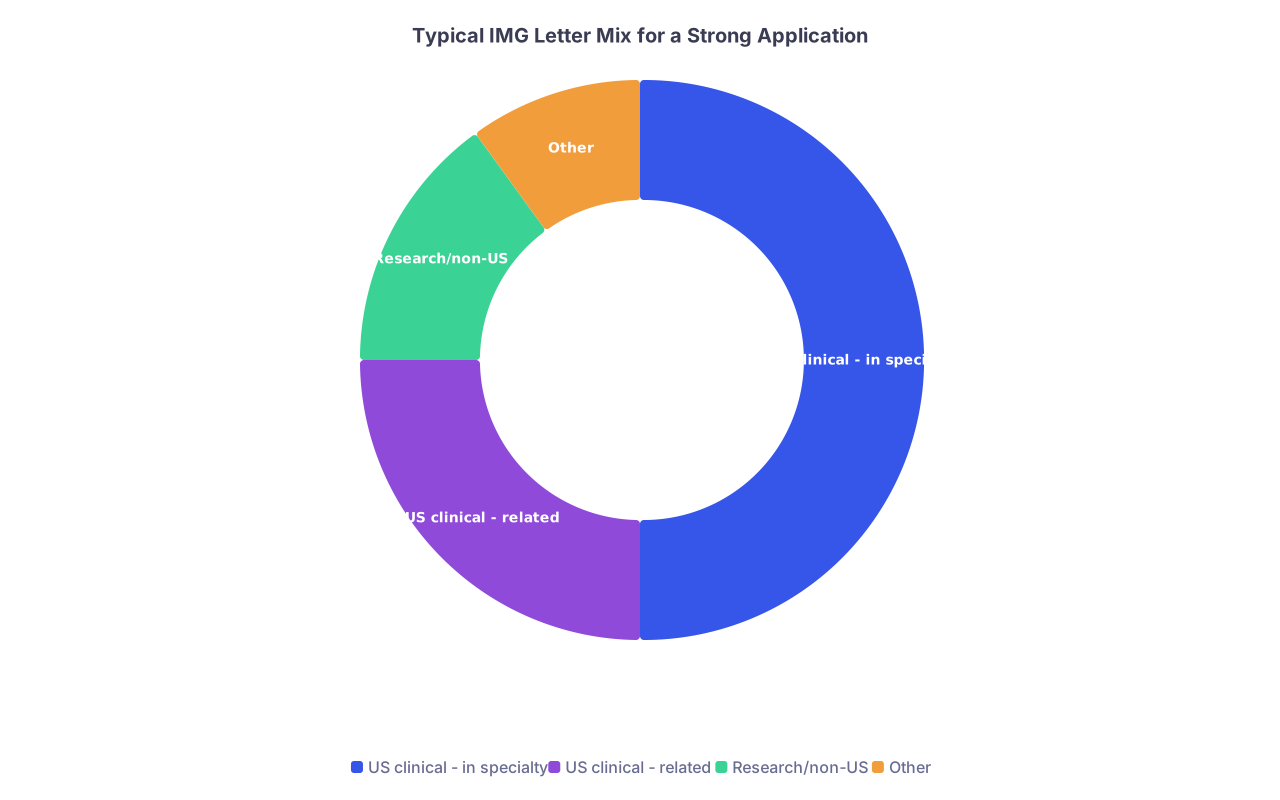
| Category | Value |
|---|---|
| US clinical - in specialty | 50 |
| US clinical - related | 25 |
| Research/non-US | 15 |
| Other | 10 |
Could you match with fewer than 2 US letters? Yes. People do. But you’re making life harder for yourself, especially in competitive years and in internal medicine, surgery, or anything even moderately selective.
Think of it this way: US clinical letters are direct proof you can function in the US system. That’s what PDs are buying when they offer you an interview.
2. What “Counts” as a US Clinical Letter for IMGs?
Not all “US letters” are equal. Programs care a lot more about what kind of US experience the writer saw you in than just the country name in the header.
Priority order, from strongest to weakest, usually looks like this:
US inpatient clinical letters in your specialty
Example: Internal medicine residency – a letter from a US hospitalist or IM faculty who supervised you on wards, ICU, or consult service.US outpatient clinical letters in your specialty
Especially if it’s a well-structured clinic where you actually saw and presented patients.US clinical letters in a closely related field
- Internal Medicine applicant: cards, nephro, heme-onc, hospitalist, FM with heavy adult inpatient
- Psychiatry applicant: IM with psych comorbidity focus, neurology, addiction med
- Pediatrics: NICU, PICU, peds subspecialty clinic
US research letters with some clinical exposure mixed in
If the attending also saw you interacting with patients, presenting cases, or participating in clinical decision-making.Pure research letters with no clinical interaction
Good as a “fourth” letter. Bad if it replaces clinical letters.
If you have to choose, I’d take a strong, detailed inpatient letter over a generic research letter every time for most IMGs.
3. Why IMGs Need More US Clinical Letters Than US Grads
US grads can get away with 2 letters from their home med school and a chair letter that says “they’re fine.” IMGs don’t have that luxury.
Here’s the harsh truth:
Programs are asking themselves, “Can this person handle US patients, US EMR, US communication, and US team culture… starting July 1?”
US clinical letters answer that question directly. They show:
- You can present cases in expected US style
- You understand US documentation / EMR basics
- You work well on a US multidisciplinary team
- You can communicate clearly with patients in English
- You show up, on time, and don’t disappear mid-rotation
Your letters are not just recommendations. They’re risk assessments in the eyes of PDs.
So no, 1 US letter and 2 generic home-country letters is usually not enough for a borderline IMG profile.
4. How Many Rotations Do You Need to Get Those Letters?
Here’s where planning matters. You can’t just “collect” 4 letters from one month.
Realistically:
- Good letters come from 4–6 weeks of working with someone
- Some attendings don’t write letters at all
- Some will say yes and then never submit
- Some will write a letter, but it’ll be 3 sentences of nothing
So you need redundancy.
A practical plan that works for most IMGs:
- 3–4 US clinical rotations total (each 4 weeks)
- Aim to secure 1 letter per rotation, but go in knowing that 1–2 might fall through.
- Target: walk away with 3 solid US clinical letters you’re comfortable using.
Where to get them?
| Experience Type | Rotation Length | Expected Strong Letters |
|---|---|---|
| Inpatient core rotation | 4 weeks | 1–2 |
| Outpatient specialty | 4 weeks | 0–1 |
| Research with light clinic | 8–12 weeks | 1 |
| Observership only | 2–4 weeks | 0–1 (often weak) |
If you’re using observerships only with limited patient contact, set your expectations: letters from those may be more generic. Better than nothing, but not a substitute for true hands-on electives or externships.
5. Timing: When Should Your US Letters Be Dated?
Programs like recent letters. That means:
- Dated within 12 months of application is ideal
- 12–24 months is acceptable if you’ve had no gap or you stayed clinically active
- Older than 2 years starts to look stale, unless it’s a big-name mentor with an ongoing relationship
If you’re applying this September:
- Prioritize US rotations from January to August of the same year
- Get letters requested before you leave each rotation, not months later
- Use ERAS’s LoR portal and give attendings clear deadlines
If you did an amazing US rotation 2–3 years ago and have nothing newer? Still use the letter. Better an older strong US clinical letter than a brand-new but weak generic one.
6. Choosing Which Letters to Upload Where
You can only send 4 letters max per program, even if you have more uploaded to ERAS. So you need a simple selection rule.
For a typical IMG applying to internal medicine, for example, your priority stack might look like this:
- Strong US inpatient IM letter (wards or ICU)
- Second strong US IM letter (inpatient or heavy clinic)
- US letter from related field (cards, nephro, hospitalist, or strong outpatient)
- Research or home-country letter (only if strong and says something unique)
Don’t overcomplicate it. If a letter is:
- Generic (“hardworking, punctual, pleasant”)
- Written by someone who barely knew you
- Very short (half a page, vague)…
…it should not take one of your four slots unless you have no better options.
7. How Program Directors Actually Read Letters
Most PDs and faculty skim, not dissect.
They’re looking for a few key things in your US clinical letters:
- Level of responsibility: Did you actually see patients? Present? Document?
- Comparison: Did the writer compare you to other students/residents? (“Top 10% of students I’ve supervised.” That line matters.)
- Specific behaviors: Clear examples of clinical reasoning, communication, work ethic.
- Any red flags: Concerns, faint praise, or obvious template language.
The reality: two strong, detailed US clinical letters can do more for you than four mediocre ones. But your odds of getting two truly excellent letters go up if you aim for 3–4 US letters total.
8. Quick Scenarios: What Should You Aim For?
Scenario 1: Fresh grad IMG, no US experience yet
You should aim for:
- 3–4 US clinical rotations (preferably in your target specialty)
- Goal: 3 US clinical letters + 1 strong home-country letter
Scenario 2: Older grad, strong home CV, limited US exposure
You’re higher risk to programs. You need US proof.
- Aim for at least 2 inpatient US rotations
- Goal: 2 US letters in specialty + 1 related + 1 best non-US letter
Scenario 3: Research-heavy IMG with a year in a US lab
Don’t lean on only research letters.
- 2–3 months research is fine, but add 2–3 months of US clinical
- Goal: 2 US clinical letters + 1 research letter + 1 strong non-US
Scenario 4: Reapplicant IMG who didn’t match
If you applied previously with weak or few US letters, fix that first.
- Add at least 1–2 new US rotations this cycle
- Replace old generic or weak letters with new, specific US clinical letters

| Step | Description |
|---|---|
| Step 1 | Start |
| Step 2 | Plan 3 to 4 US rotations |
| Step 3 | Add 1 to 2 more US rotations |
| Step 4 | Get 1 more strong letter from best source |
| Step 5 | Prioritize 3 to 4 best letters in ERAS |
| Step 6 | Apply with 3 to 4 strong letters |
| Step 7 | Any US clinical experience? |
| Step 8 | At least 2 US clinical letters in specialty? |
| Step 9 | Total letters >= 3? |
9. Common Mistakes IMGs Make With Letters
I’ve watched people tank their cycle over avoidable letter decisions. Here are the usual offenders:
Relying on 3 home-country letters and 1 US research letter
Looks like you’ve barely functioned in US clinical care.Sending 4 letters to every program regardless of quality
One weak, generic letter can drag down the whole impression.Not asking early and clearly
Attendings are busy. If you ask for a letter 2 months later via a vague email, expect crickets.Choosing “big names” over people who really know you
A famous name with a generic paragraph is worse than a mid-level faculty with rich, specific praise.Ignoring specialty fit
Applying to psych with zero psych letters when you could have arranged at least one? Programs notice.
FAQ: Letters from Clinical Experience for IMGs
1. Is 1 US clinical letter enough if the others are strong home-country letters?
For many IMGs, 1 US clinical letter is not enough to be broadly competitive, especially in internal medicine, surgery, or other moderately competitive fields. You should push hard to get at least 2 US clinical letters, ideally 3, so programs see multiple independent attestations that you can work in the US system.
2. Are observership letters useful, or do they “not count”?
They can help, but they’re usually weaker than true hands-on elective or externship letters. If an observership is all you can get, still do it and aim for a detailed letter that focuses on your work ethic, clinical reasoning in discussions, and professionalism. Just don’t expect an observership letter to carry the same weight as an inpatient elective where you actively saw and presented patients.
3. Do I need a department chair letter as an IMG?
Not usually. Most community and many academic programs don’t insist on a chair letter, especially for IMGs. A detailed letter from an attending who worked closely with you clinically is almost always more valuable than a brief, formulaic chair letter from someone who barely knows you. If your specialty specifically recommends a chair letter (e.g., some surgery programs), then try to get one—but not at the expense of strong clinical letters.
4. Should I waive my right to see the letter (FERPA waiver)?
Yes. Waive your right. Programs expect that. Non-waived letters can look suspiciously like you edited or pressured the writer. When you ask for a letter, say something like, “I’ll be waiving my right to view the letter, and I’d really appreciate your honest assessment of my performance.” That signals maturity and trust.
5. What if an attending seems unsure or lukewarm when I ask for a letter?
Take that seriously. If someone responds with, “I can write you a letter if you need one,” in a hesitant tone or says something like, “It might be a bit generic,” that’s a red flag. You want, “Yes, I’d be happy to write you a strong letter.” If you don’t hear that confidence, thank them politely and try to secure letters from attendings who seem genuinely enthusiastic.
Open a notes app or document right now and make a simple table with four rows labeled “Letter 1–4” and columns for “Source,” “Type (US inpatient/outpatient/research),” and “Status (planned/requested/received).” Fill it in honestly. If you can’t confidently list at least 3 planned or secured US clinical letters, your next step is clear: arrange the rotations or contacts you need to get there.