
The worst mistake IMGs make with US clinical experience is not quality. It is timing. Strong applicants are thinking in years before graduation, not months before ERAS.
You want a residency spot in the United States. That means your graduation year locks you into a very specific clock. At each point on that clock, there are things you must already have done, not things you are “starting to think about”.
I am going to walk you through that clock by graduation year, then zoom into month‑by‑month and week‑by‑week planning. So you can see, very clearly, if you are on time, slightly late, or already in trouble.
Big Picture: How Early Should IMGs Start USCE Planning?
At this point you need a mental model, not hand‑wavy advice.
For most IMGs, you should start planning US clinical experience 18–30 months before your desired Match. Not before arrival. Not before ERAS opens. Before the Match year you are targeting.
Here is what that actually looks like:
| Grad Year | First Target Match | Ideal USCE Planning Start | Risk If Later |
|---|---|---|---|
| 2026 | 2027 | Early 2025 | Compressed, risky |
| 2025 | 2026 | Early 2024 | High risk, limited spots |
| 2024 | 2025 | Early 2023 | Scramble for any USCE |
| 2023 or earlier | 2025–2026 | 2022 or earlier | Need aggressive catch‑up |
If you remember nothing else:
You do not “get” USCE. You schedule it 6–12 months before it starts, and then you apply another 6–12 months after you complete it.
Step Zero: Anchor Yourself to the Match Calendar
Before we go year by year, you must align to reality: the US residency calendar is fixed. You cannot negotiate with it.
Key anchors (for a typical Match year):
- ERAS opens for applicants: mid‑June
- Programs can review applications: early September
- Interview season: October–January
- Rank list deadline: late February
- Match week: mid‑March
- Residency start: July 1
Now connect that to USCE:
Programs strongly prefer recent USCE within 12 months of application.
For a September 2026 application, your “golden” USCE window is roughly:- August 2025 – August 2026
USCE rotations (externships, electives, observerships) are often booked:
- 6–9 months in advance at university hospitals
- 3–6 months in advance at many community sites
This means:
- You plan USCE 9–18 months before ERAS submission
- You complete USCE 0–12 months before ERAS submission
Now let’s walk this through by graduation year.
If You Graduate in 2026
You are still early. Which is good. You can do this right.
Assume you want to start residency July 2027 (2027 Match).
Overall Targets
- ERAS submission: September 2026
- Ideal USCE window: August 2025 – August 2026
- USCE planning start: January–June 2025
At this point (early 2025), you should:
- Decide your target specialties (e.g., Internal Medicine vs Family vs Pediatrics)
- Decide how many USCE months you want (2–4 is typical for competitive IMGs)
- Map your home‑country clinical rotations vs USCE to avoid conflicts
Month‑by‑Month: 2025 (When You Are MS3/MS4 or Final Year)
January–March 2025 (≈18 months before Match)
This is the planning quarter.
You should:
- Finalize:
- Which months you can travel to the US
- Which cities you can afford (housing is not trivial)
- Build a list of:
- University programs that take IMGs for electives (if still a student)
- Community hospitals / private groups that offer:
- Hands‑on externships
- Observerships and possibly research + clinic combos
- Start emailing / filling out portals for rotations beginning:
- August 2025 – January 2026
If by March 2025 you have not:
- Collected your immunizations, titers, TB test
- Renewed your passport
- Started conversations with at least 5–10 potential USCE providers
…you are already drifting late.
April–June 2025 (≈15 months before Match)
This is your booking quarter.
You should:
- Lock in at least:
- 1 core IM USCE month
- 1 backup specialty or second IM month
- Submit:
- Required documents (transcripts, dean’s letters, proof of enrollment or diploma)
- Background checks, drug screens when needed
- Block your calendar:
- Exams at home
- Visa appointments
- Housing search window
If by June 2025 you do not have any confirmed USCE spots for late 2025 / early 2026, you are in trouble. You can still recover, but you will:
- Be pushed into observerships rather than hands‑on externships
- Likely pay more for last‑minute spots
July–December 2025 (≈9–14 months before Match)
This is execution and refinement.
- You should be:
- Completing your first USCE or traveling to start it
- Observing how attendings evaluate IMGs
- Asking for mid‑rotation feedback
- By end of each month:
- Decide whether to request a LOR from that attending
- Draft bullet points for them about your performance
January–June 2026 (≈3–9 months before Match)
At this point you should:
- Have at least:
- 2 strong US LORs “in progress” or already uploaded
- 1–3 completed USCE months
This is where smart IMGs:
- Fill gaps:
- If you discovered you dislike IM → consider FM
- If your first USCE was weak (bad supervisor fit), schedule another before ERAS
- Polish your story:
- Tie your USCE experiences to your personal statement themes
- Collect concrete cases you saw to mention in interviews
July–September 2026 (ERAS season)
Your USCE work should be largely done. No frantic last‑minute scramble. You are:
- Uploading US LORs that came from:
- Rotations completed within the last 6–12 months
- Writing:
- “During my November 2025 inpatient IM rotation at X Hospital…” in your essays, confidently
If You Graduate in 2025
You have less room. Planning mistakes start to hurt here.
Assume you want to start residency July 2026 (2026 Match).
Overall Targets
- ERAS submission: September 2025
- Ideal USCE window: August 2024 – August 2025
- Planning start: January–April 2024 (yes, before graduation)
At this point (early 2024), you should already be doing paperwork, not just “thinking about the US.”
Month‑by‑Month: 2024–2025
January–March 2024 (≈18 months before Match, pre‑graduation)
You should:
- Decide graduation date and:
- When you can take Step 1 / Step 2 CK
- When you can realistically travel to the US
- Start:
- Researching student electives (if your school allows final‑year electives abroad)
- Or, if you will be graduated: searching for externships that explicitly accept IMG graduates
- Begin:
- Collecting vaccination records, financial proof for visa, any home‑country permissions
If by March 2024 you have not opened a single US program website or contacted any coordinator, you are behind.
April–June 2024 (≈15 months before Match)
You should be:
- Submitting applications for:
- Late 2024 and early 2025 USCE
- Prioritizing:
- At least one inpatient month in your target specialty
- Sites known for writing usable LORs
July–December 2024 (≈9–14 months before Match)
By this point you should:
- Have at least 1 confirmed rotation, ideally 2
- Have set a clear path:
- Finish med school → take Step 2 CK → travel for USCE
If you are already graduated mid‑2024 and still have no USCE booked for the rest of 2024, you are in the red zone.
Let me be blunt: you will likely either delay your Match year or apply with weak/no USCE.
January–June 2025 (≈3–9 months before Match)
Here is where many IMGs panic.
At this point, you should:
- Be in, or just finishing, your key USCE rotations:
- So that LORs can be written and uploaded by August
- Have:
- At least 2 solid US letters confirmed
- Specific experience in your specialty (for IM/FM: inpatient ward month is gold)
If you are still trying to book your first USCE in March–April 2025, there is no polite way to say this: you are late. You can still salvage a cycle with:
- Short observerships in May–July 2025
- Aggressive targeting of community programs that accept weaker CVs
But this is not an optimal path.
July–September 2025 (ERAS season)
Executions only:
- Upload LORs
- Use USCE stories in personal statement and experiences
- No more big shifts in your US experience profile. That needed to happen months earlier.
If You Graduated in 2024
Now we are in retroactive planning. The timing window is tight.
Assume target: 2025 Match (residency start July 2025).
Overall Targets
- ERAS submission: September 2024
- Ideal USCE window: August 2023 – August 2024
- Planning start (ideal): early 2023
- Planning start (realistic now): immediate catch‑up
At this point (already graduated or graduating 2024), you should accept one fact:
If you have no USCE yet, you will either:
- Apply in 2024 with weak USCE for 2025 Match, or
- Push your realistic target to 2026 Match and build a proper profile
I usually recommend option 2 unless you have unique strengths (very high scores, strong home research, prior US degrees).
Emergency Timeline if You Still Target 2025 Match
You are late, so the question shifts from “ideal” to “least damaging.”
January–March 2024
You should:
- Apply for any USCE you can get in:
- April–August 2024
- Accept that you might:
- Pay more
- End up in less prestigious sites
But speed now matters more than prestige.
April–August 2024
You must be:
- Actively doing USCE
- Pushing for:
- Strong relationships with attendings
- 1–2 US LORs before August
If by August 2024 you still have zero USCE completed, your 2025 Match application will be very weak for most core specialties. Some FM and IM community programs may still consider you, but you are climbing uphill.
September 2024 – March 2025
At this point, USCE planning is less about the ERAS application and more about:
- Having ongoing US involvement
- Showing programs you are:
- Not clinically idle
- Staying within 1–2 years of graduation with active practice or observerships
If You Graduated in 2023 or Earlier
This is where a lot of IMGs finally wake up. You are 2+ years out. The clock is louder.
Programs start asking hard questions:
- How long have you been out of school?
- What have you done clinically since graduation?
- Any recent USCE?
You cannot rewind your graduation year. But you can control how recent and how continuous your US clinical involvement looks.
Strategic Reality
At this point you should:
- Aim for 2026 or 2027 Match, not next cycle by default
- Plan USCE as part of a multi‑year rehabilitation of your profile:
- 2–4 months of USCE over 12–18 months
- Parallel consistent clinical work at home (not a long gap)
Example Recovery Timeline (Graduated 2022–2023, Target 2026 Match)
- 2024:
- Secure 1–2 USCE months late 2024 / early 2025
- Continue working clinically at home
- 2025:
- Complete USCE
- Collect US letters
- Maybe add 1 extra month for another letter/refresher
- September 2025:
- Apply with:
- Multiple recent USCE months
- No major clinical gaps
- Convincing late‑graduate narrative
- Apply with:
Hands‑On vs Observership: When Each Fits in the Timeline
At this point you might be thinking: “But my school does not allow US electives” or “I am already graduated; I can only find observerships.”
Here is how timing interacts with type of USCE:
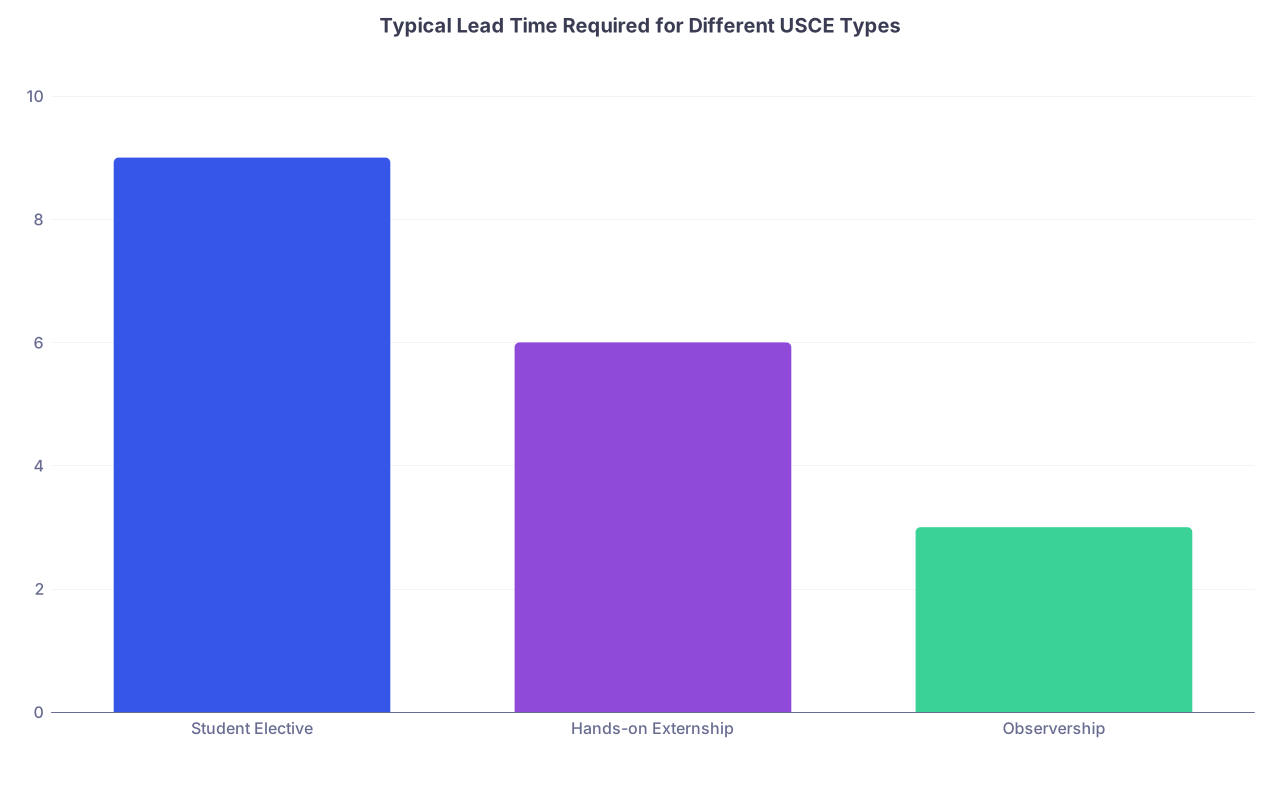
| Category | Value |
|---|---|
| Student Elective | 9 |
| Hands-on Externship | 6 |
| Observership | 3 |
Student electives (while still enrolled)
- Need:
- 6–12 months lead time
- Active student status
- Best for:
- Those 1–2 years before graduation
- If you are 2026 grad:
- You should be applying for electives right now for late 2025
Hands‑on externships (post‑graduate, often paid)
- Need:
- 3–9 months lead time
- Best for:
- Recent grads (0–3 years out)
- Those with Step scores done
- If you are 2025 grad targeting 2026 Match:
- You should book externships by late 2024 for early 2025
Observerships
- Need:
- 1–6 months lead time (wide range)
- Best for:
- Older graduates
- Those needing “something rather than nothing” in a late timeline
- They will not fix very weak applications alone, but:
- They can fill gaps
- They can still produce a usable letter if you impress people
Practical Planning Timeline: 18 Months Before Match to ERAS Submission
Let me lay this out as a generic 18‑month template. You adjust based on your graduation year.
Assume: Target 2027 Match (ERAS September 2026, residency July 2027).
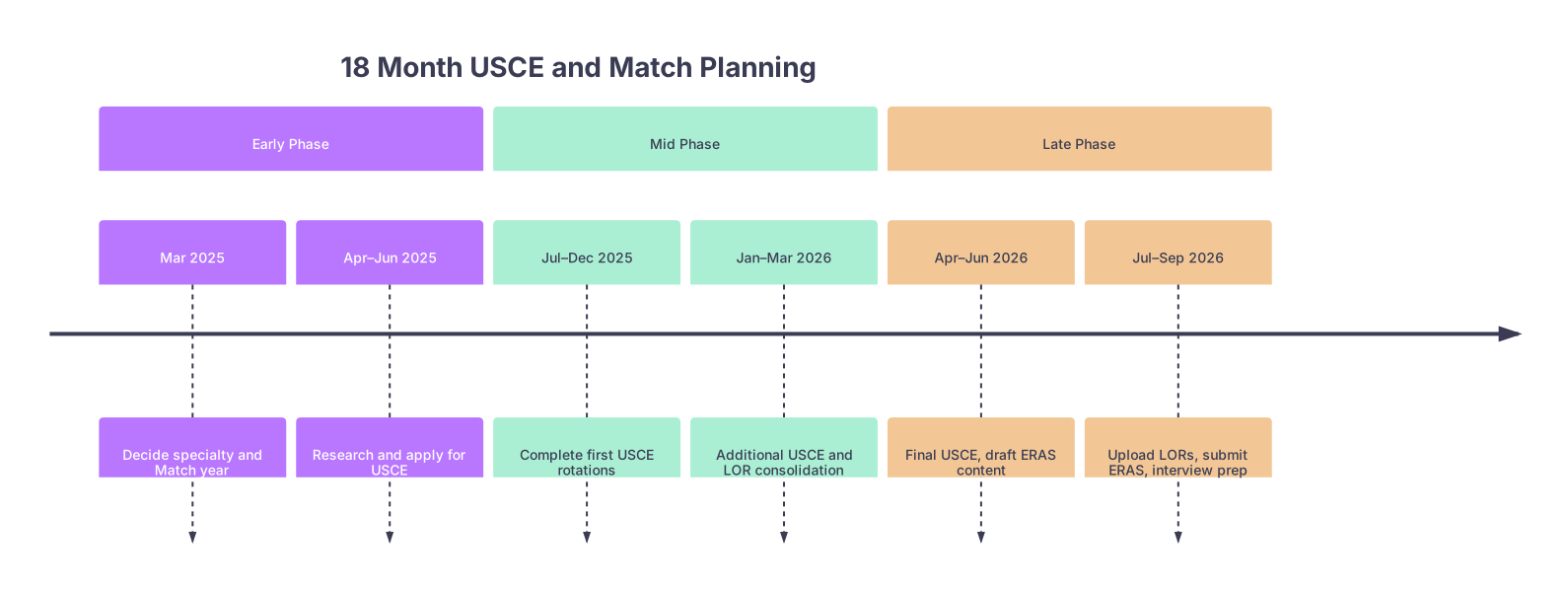
| Period | Event |
|---|---|
| Early Phase - Mar 2025 | Decide specialty and Match year |
| Early Phase - Apr–Jun 2025 | Research and apply for USCE |
| Mid Phase - Jul–Dec 2025 | Complete first USCE rotations |
| Mid Phase - Jan–Mar 2026 | Additional USCE and LOR consolidation |
| Late Phase - Apr–Jun 2026 | Final USCE, draft ERAS content |
| Late Phase - Jul–Sep 2026 | Upload LORs, submit ERAS, interview prep |
15–18 Months Before ERAS
At this point you should:
- Fix:
- Match year
- Target specialties
- Build:
- Shortlist of USCE providers (electives/externships/observerships)
- Begin:
- Document collection
- Emails / applications to programs
9–15 Months Before ERAS
You should:
- Be:
- Booking and confirming USCE slots
- Start:
- Planning travel, visas, housing
- If this window closes and you still have no confirmed USCE:
- You are sliding into high‑risk territory
3–9 Months Before ERAS
You should:
- Actively:
- Do USCE
- Request LORs
- Track:
- Which attendings agreed to write
- When they expect to upload
0–3 Months Before ERAS
At this point:
- USCE planning is mostly done
- You are:
- Ensuring letters are uploaded
- Aligning your application messaging with your actual US clinical history
Risk Checkpoints by Time
To keep this brutally clear, check yourself against these timepoints.
| Time Before ERAS | What You Should Have | Risk Level if Missing |
|---|---|---|
| 18 months | Clear Match year + specialty plan | Medium |
| 12 months | At least 1 USCE rotation booked | High |
| 9 months | Travel/visa plan + 1–2 bookings | Very High |
| 6 months | Actively in USCE or start date set | Critical |
| 3 months | 1–2 LORs requested from USCE | Severe |
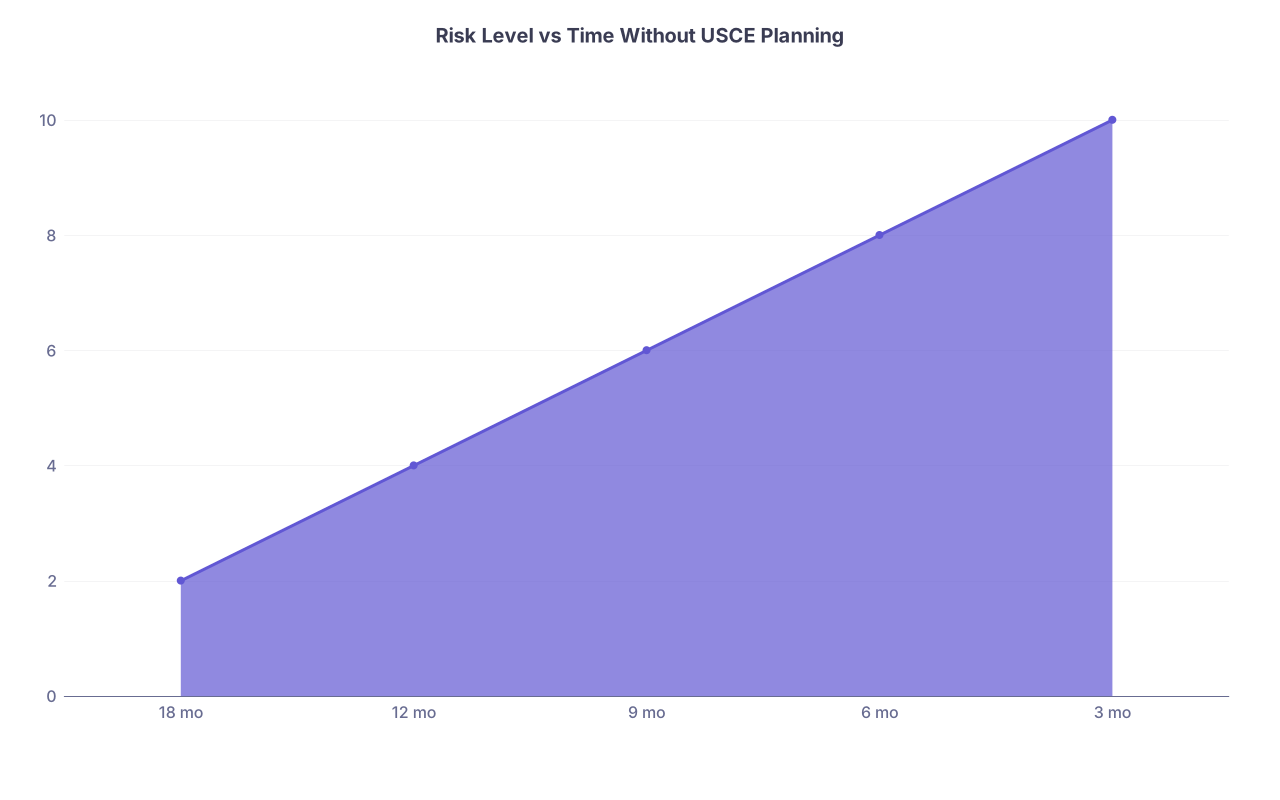
| Category | Value |
|---|---|
| 18 mo | 2 |
| 12 mo | 4 |
| 9 mo | 6 |
| 6 mo | 8 |
| 3 mo | 10 |
Common Bad Timelines (And How to Fix Them)
You will recognize yourself in at least one of these.
Scenario 1: “I will do USCE after I graduate, then immediately apply.”
Bad plan.
Reality:
- You graduate June 2025
- You start looking for USCE July 2025
- Earliest rotation you find is January 2026
- That rotation ends February 2026
- LOR uploaded April 2026
- ERAS for 2026 Match was September 2025. You already missed it.
Fix:
- Either:
- Start USCE planning before graduation
- Or accept that your realistic Match target moves one full year later
Scenario 2: “I will book a USCE month in July, just before ERAS in September.”
Half‑bad plan.
Reality:
- If your July rotation is strong:
- An attending might still write a LOR by late August
- But:
- You give them almost no time
- Many will not feel comfortable writing from a 4‑week relationship
Better:
- Latest truly safe USCE month for ERAS letters:
- April–May before September ERAS
- Use June–August rotations as extra depth, not your only hope for letters
Quick Specialty Considerations
Some specialties care more about how much and what kind of USCE you have.

- Internal Medicine / Family Medicine
- 2–4 months USCE is common among matched IMGs
- Inpatient IM month is very valuable
- Pediatrics
- US peds experience strongly preferred
- Psychiatry
- US psych exposure is often requested; at least 1 month ideal
- Surgery
- Hard for IMGs; US surgical electives during student years are best
- Observerships alone are usually not enough
If you are late in your planning, aim for IM/FM first unless you have exceptionally strong reasons and support for more competitive specialties.
Week‑by‑Week Example: Booking Your First USCE (12 Months Before ERAS)
Let us say ERAS is September 2026. You are now in September 2025. You need to lock your first USCE.
At this point you should run a focused 4‑week sprint:
Week 1
- List:
- 15–20 possible USCE sites (mix of elective offices, externship providers, private practices)
- Triage:
- Which accept your status (student vs graduate)
- Which have openings in your time window
Week 2
- Submit:
- 5–10 complete applications with documents attached
- Email:
- Coordinators to confirm receipt
- Begin:
- Visa information gathering, especially if you need B‑1/B‑2
Week 3
- Follow up:
- On non‑responses
- Adjust:
- Expand to less popular cities or smaller hospitals if needed
Week 4
- Aim to:
- Have at least 1 confirmed slot
- Reserve housing search time on your calendar
- If still zero confirmations:
- Add paid externship services as backup (yes, more expensive, but the clock is ruthless)

| Step | Description |
|---|---|
| Step 1 | Week 1 - Build site list |
| Step 2 | Week 2 - Submit applications |
| Step 3 | Week 3 - Follow up and expand |
| Step 4 | Week 4 - Confirm at least one spot |
| Step 5 | If no spot, add paid options |
Final Checkpoints by Graduation Year
At this point, here is what you should walk away knowing.
If you graduate in 2026:
You should start serious USCE planning in early 2025. By mid‑2025 you want at least one rotation booked for late 2025 / early 2026.If you graduate in 2025:
You must already be planning during 2024, not “after I graduate.” Aim for USCE in late 2024 and early 2025, so your letters are ready by September 2025.If you graduated in 2024 or earlier:
Stop pretending the next Match will magically work without a plan. Either build an aggressive 12–18 month USCE + clinical‑work timeline and target a realistic Match year, or accept that your chances will be sharply limited.
Three key points.
- USCE planning for IMGs starts 18–24 months before your target Match, not months before ERAS.
- Your graduation year sets how much margin you have. The further out you are, the more you must prove with recent, continuous clinical work.
- If you are already behind, stop hesitating. The only way out is a clear, date‑based USCE plan tied to a specific Match cycle—then executing it week by week.