
The worst myth IMGs believe before Match is that “it’s too late to do anything meaningful.” It is not. You can still move the needle with the right kind of last‑minute US clinical experience—if you stop chasing the wrong things.
I am going to walk you through what is still worth doing in the final 6–8 weeks before rank lists lock, broken down by month, week, and even day. No fluff. Just actions that programs actually care about at this stage.
First, Be Ruthless: What Still Matters vs. What Is Dead Weight
At this point in the cycle (interview season through rank list submission), not all “USCE” is equal. Some things still influence decisions. Others are a waste of energy.
Here is the quick hierarchy:
| Activity Type | Impact Level |
|---|---|
| Direct, hands-on inpatient sub-I | Very High |
| EMR-based outpatient rotation | High |
| Tele-rotations with real responsibility | Moderate |
| Shadowing with documentation/notes | Moderate |
| Pure observer-only shadowing | Low |
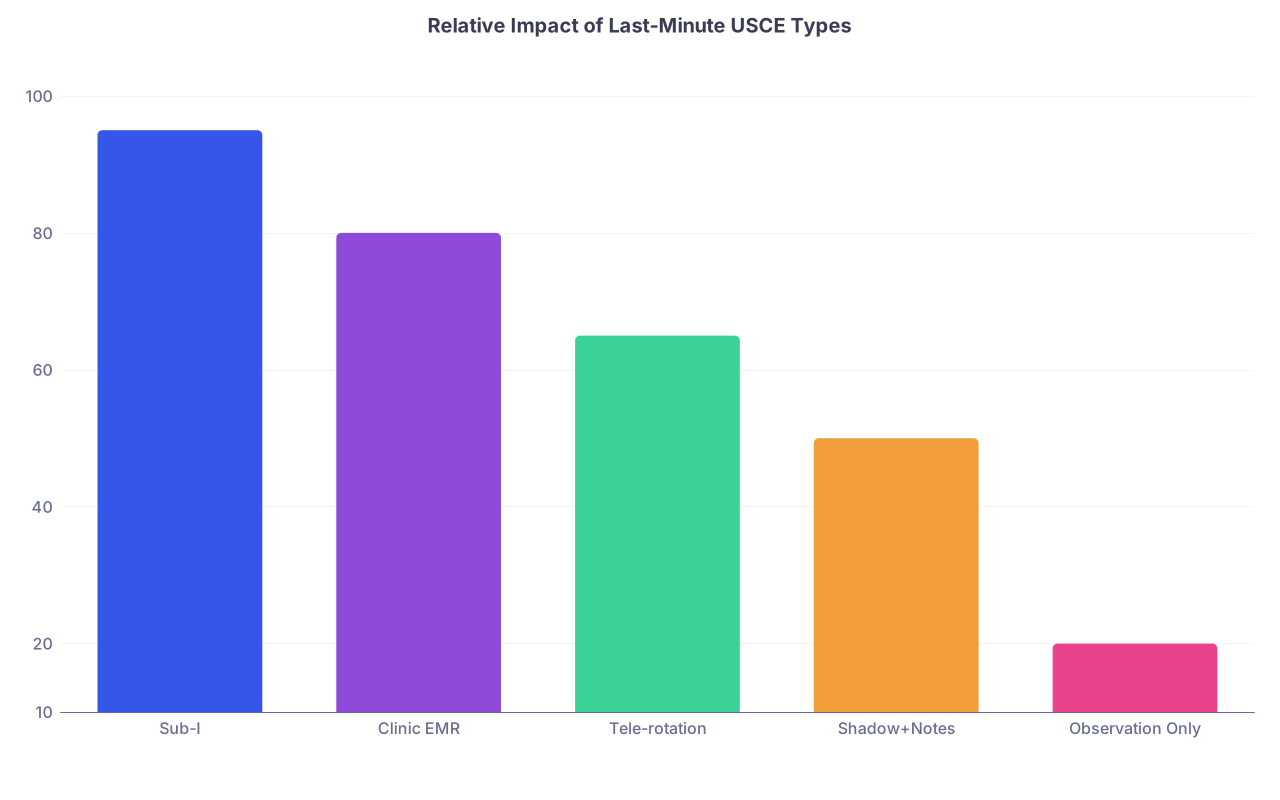
| Category | Value |
|---|---|
| Sub-I | 95 |
| Clinic EMR | 80 |
| Tele-rotation | 65 |
| Shadow+Notes | 50 |
| Observation Only | 20 |
If you remember only one rule, remember this:
At this point, anything that generates:
- Concrete, recent talking points for interviews
- A US letter of recommendation update
- Clear documentation of “US system readiness”
…is still worth doing.
Anything that is:
- Passive, observer-only, no note writing
- So short you cannot build relationships (1–2 days)
- Completely disconnected from your applied specialty
…is mostly cosmetic.
Now, let’s build the timeline.
8–6 Weeks Before Rank List Deadline: Big Moves Only
Assume you are somewhere between early December and early January. Interviews have started. ERAS is submitted.
At this point, you should be asking: “What can I start this month that programs might still see, feel, or hear about before they submit rank lists?”
At This Point You Should…
1. Decide Your Target: Interviews or Damage Control
You fall into one of two buckets:
- Bucket A – You already have some interviews
- Bucket B – You have few or no interviews
Your USCE strategy is slightly different.
Bucket A (Some Interviews): Your goal is to:
- Sound current and confident in interviews
- Show that you have ongoing US clinical engagement
- Provide an updated LOR or a post-interview communication point
Bucket B (Few/No Interviews): Your goal is to:
- Salvage future cycles (backup plan)
- Show clear trajectory and commitment
- Possibly influence late invites or SOAP decisions
In both cases, last‑minute USCE is not wasted. But your expectations must be honest. I have seen late January rotations lead to:
- Updated LORs that strengthened SOAP chances
- PDs sending a quick “How is this IMG doing?” email to your supervisor
- A stronger PGY-1 prelim or transitional position the next year
Not a miracle. But real.
6–8 Weeks Out: What To Start This Month
Priority 1: Secure Any Rotation That Gives You EMR Access + Note Writing
If you can still book something in:
- A community hospital
- A teaching hospital’s affiliate clinic
- A reputable private hospitalist or outpatient practice with EMR
…do it.
Non-negotiables at this stage:
- Direct patient interaction
- Ability to write notes (even drafts)
- Attendance at team rounds or huddles
Ask directly when inquiring:
“Will I have EMR access and be able to write draft notes or assessments that my preceptor reviews?”
If the answer is no and they describe pure observation from the corner of the exam room, you move them to Plan B.
Priority 2: Align with Your Target Specialty
For example:
- Applying to Internal Medicine? Aim for hospitalist or IM subspecialty (cards, GI, ID).
- Applying to Family? Outpatient primary care, FQHC, or community-based clinics.
- Applying to Psych? Outpatient psych, inpatient units, or consult-liaison if possible.
Last-minute specialty match makes your story coherent in interviews:
- “I spent January on the inpatient medicine service at X Hospital, managing…”
- “Currently I am in a community psych clinic seeing…”
That sounds much better than, “I have been waiting at home for emails.”
Priority 3: Confirm LOR Potential Before You Start
Before agreeing to anything, you should ask one specific question:
“If I perform well during this rotation, are you comfortable writing a strong letter of recommendation for residency, possibly even during this application cycle?”
You are not begging. You are clarifying. If they hesitate or give a vague “we’ll see” with no structure, that may still be fine—but you prioritize attendings used to writing LORs for IMGs.
4–5 Weeks Before Rank List Deadline: Execution and Documentation
By this time, ideal situation: you have a 4-week rotation starting or already underway. If not, you may have a shorter 2-week or a tele-rotation. That is still workable.
At This Point You Should…
1. Front-Load Your Performance (First 7–10 Days)
Attendings form their core impression early. So in the first 7–10 days, you:
- Arrive early. Consistently.
- Volunteer to present first on rounds once you know the system.
- Ask for 1–2 patients to follow continuously and present updates.
Your target is to make them think by Day 5: “This IMG is above average, engaged, and safe.”
That mental label becomes your LOR foundation.
2. Get Specific Feedback by End of Week 2
By Day 10–12, you should request a short, focused feedback conversation:
- “I want to be as useful as possible on the team. Are there 1–2 areas you think I should improve over the next couple of weeks?”
Then you actually address them. Later, that gives your attending content for your letter:
- “Initially, she struggled with concise assessments, but she actively sought feedback and improved significantly…”
That growth narrative reads very well in January/February letters.
3. Decide Whether to Request an “Immediate” LOR
Timing matters. Programs will finalize rank lists roughly February to early March. If you want an LOR to possibly be read this cycle, you need it:
- Uploaded to ERAS by late January–mid February at the latest
So by the end of Week 2, if things are going well, ask:
- “If I continue at this level, would you be comfortable writing a strong letter for my residency file by the end of this month?”
Many attendings say yes. Some will even email PDs they know, especially in community or smaller programs.
3–4 Weeks Before Rank List Deadline: Tactical Communication
This is the time window where last-minute USCE crosses into interviews and ranking decisions.
At This Point You Should…
1. Update Your ERAS and CV with Current USCE
Even if your rotation will not finish before rank lists, partial information still helps.
Add:
- “US Clinical Experience – In Progress”
- Location, specialty, start date, expected end date
- 1–2 bulleted responsibilities (patient volume, EMR, team role)
Programs can see this if they revisit your file. And some do—especially smaller programs still sorting their lists in February.
2. Use Ongoing USCE in Interview Answers
When an interviewer asks:
- “What are you doing currently?”
- “Tell me about your recent clinical experience.”
You want to sound like this:
“Right now I am rotating on the inpatient medicine service at XYZ Community Hospital. I manage 3–5 patients daily under supervision. I write draft notes in Epic, present on rounds, and follow up on labs and imaging. The most challenging case this week was a patient with…”
That is infinitely more convincing than:
“I had a US rotation last June. Since then, I have been preparing, reading, and waiting.”
The gap hurts you. Ongoing, specific work rescues that narrative.
3. Consider One Targeted Post-Interview Email per Program
Do not spam everyone. But for 3–5 top programs, if you start a strong USCE late in the season, you can send something like:
“I wanted to send a brief update since our interview. I have begun a 4-week inpatient internal medicine rotation at XYZ Hospital where I am writing notes in Epic and presenting patients on rounds. This recent experience has further confirmed my interest in community-based internal medicine similar to your program’s patient population.”
Short. Concrete. No desperation. Just updated data.
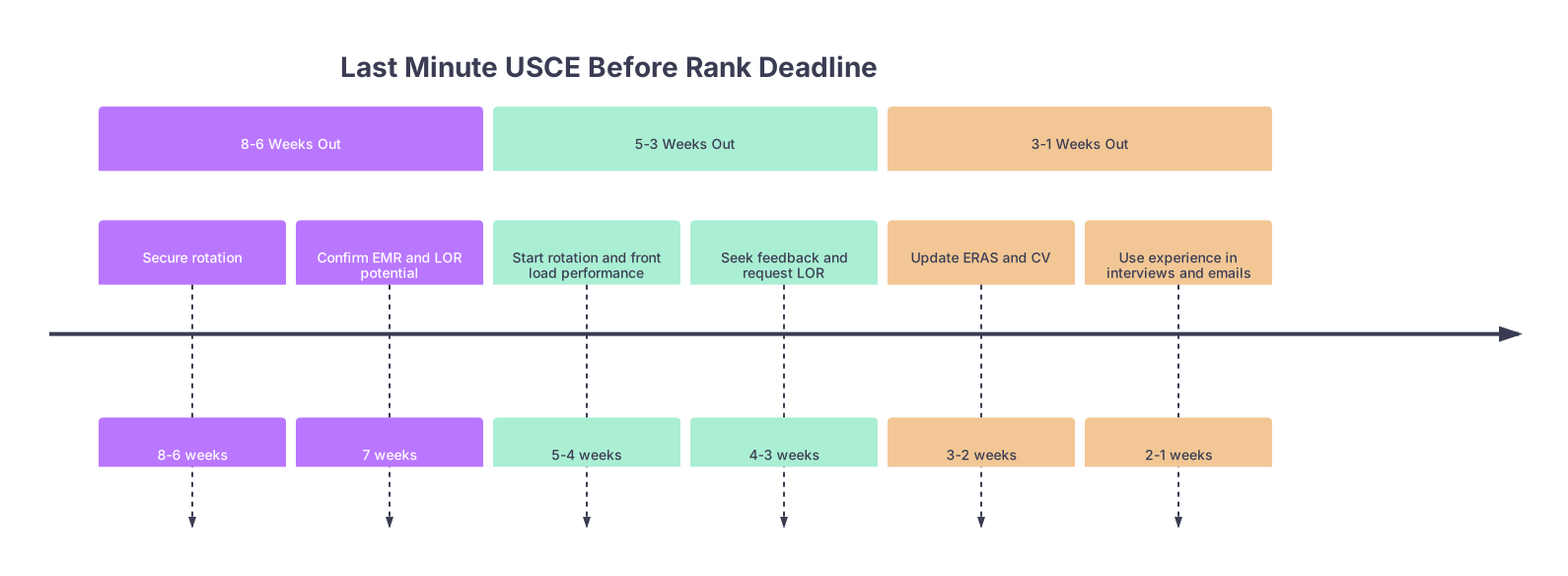
| Period | Event |
|---|---|
| 8-6 Weeks Out - Secure rotation | 8-6 weeks |
| 8-6 Weeks Out - Confirm EMR and LOR potential | 7 weeks |
| 5-3 Weeks Out - Start rotation and front load performance | 5-4 weeks |
| 5-3 Weeks Out - Seek feedback and request LOR | 4-3 weeks |
| 3-1 Weeks Out - Update ERAS and CV | 3-2 weeks |
| 3-1 Weeks Out - Use experience in interviews and emails | 2-1 weeks |
2–3 Weeks Before Rank List Deadline: Micro-Experiences That Still Help
Maybe you could not lock a full 4-week rotation. Fine. You still have options that are not totally useless.
At This Point You Should…
1. Use Short, High-Intensity Experiences Wisely (7–14 Days)
If a clinic or physician offers:
- A 1–2 week mini-rotation
- With EMR access or structured shadowing with case discussion
- And a real chance to interact with patients
It can still strengthen:
- Your comfort with US-style documentation and vocabulary
- Your confidence in behavioral-type interview questions
- Your answers about “most recent clinical decision” or “systems-based practice”
Focus your energy on:
- Seeing as many patients as possible
- Practicing concise oral presentations
- Understanding workflow, discharge planning, and interdisciplinary communication
You are building stories, not just hours.
2. Tele-rotations: When Are They Worth It This Late?
Pure tele-shadowing with 20 students on Zoom? Useless now.
However, certain structured tele-rotations can still help if they include:
- One-on-one or small group case presentations
- Chart review, documentation exercises, or SOAP note practice
- Direct feedback from US attendings who understand the Match
These are especially valuable if:
- You are already planning to reapply next year
- You need US references who actually know your thinking process
Do not lie to yourself though: this will not magically produce 10 interviews in February.
1–2 Weeks Before Rank List Deadline: Squeezing Out Every Bit of Value
We are now in late February or very early March. Rank list certification is imminent.
No, you cannot magically fix your entire application in 10 days. But you can do two very practical things.
At This Point You Should…
1. Solidify and Document Your Performance
If you are on a rotation:
- Ask your attending for a brief written evaluation (even if not a formal LOR yet).
- Request a short email summarizing your strengths that you can keep for future cycles.
- Take detailed notes on patient cases you handled, systems you used, and procedures you observed.
Why? Because you will absolutely forget details later. And future personal statements and interviews live off these specifics.
2. Plan for SOAP or Next Cycle with Clarity
If your interview count is dangerously low and you anticipate SOAP:
- Ask current supervisors whether they would be willing to take a 5-minute call or send a brief email if a PD asks about you during SOAP.
- Get their updated contact info stored and organized.
- Clarify which type of programs (community vs academic, location, patient population) they think you fit best. Sometimes they will be surprisingly honest.
- Structure your next 6 months of USCE deliberately: longer rotations, inpatient + outpatient mix, stronger LOR writers, earlier in the cycle.
This is where last-minute experience feeds into a longer-term rescue plan.

What Is NOT Worth Starting Last-Minute
Let me be blunt about a few things people still ask:
Pure observer-only hospital “rotations” where you stand in the back.
They do not change PD minds in February. They might pad a future CV slightly, but not enough to justify high fees at this late stage.Expensive “USCE packages” that promise interviews.
No credible attending will guarantee that. If anyone does, run.Unstructured “research volunteering” you join for 2 weeks.
You will not get a paper or a meaningful letter in that time. Focus on clinical readiness instead, unless the research is already ongoing and nearly complete.
Putting It All Together: A Sample Last-Minute 6-Week Plan
To make this concrete, here is a realistic six-week timeline for an IMG who gets a January start date for an Internal Medicine inpatient rotation.
| Week | Main Focus | Key Actions |
|---|---|---|
| 1 | Start rotation, observe system | Learn EMR, follow 1–2 patients |
| 2 | Increase responsibility | Present daily, seek feedback |
| 3 | Consolidate performance | Request LOR if going well |
| 4 | Build stories and examples | Track cases for interview use |
| 5 | Communicate updates | Update ERAS/CV, targeted emails |
| 6 | Capture value for future | Save evals, refine future plan |
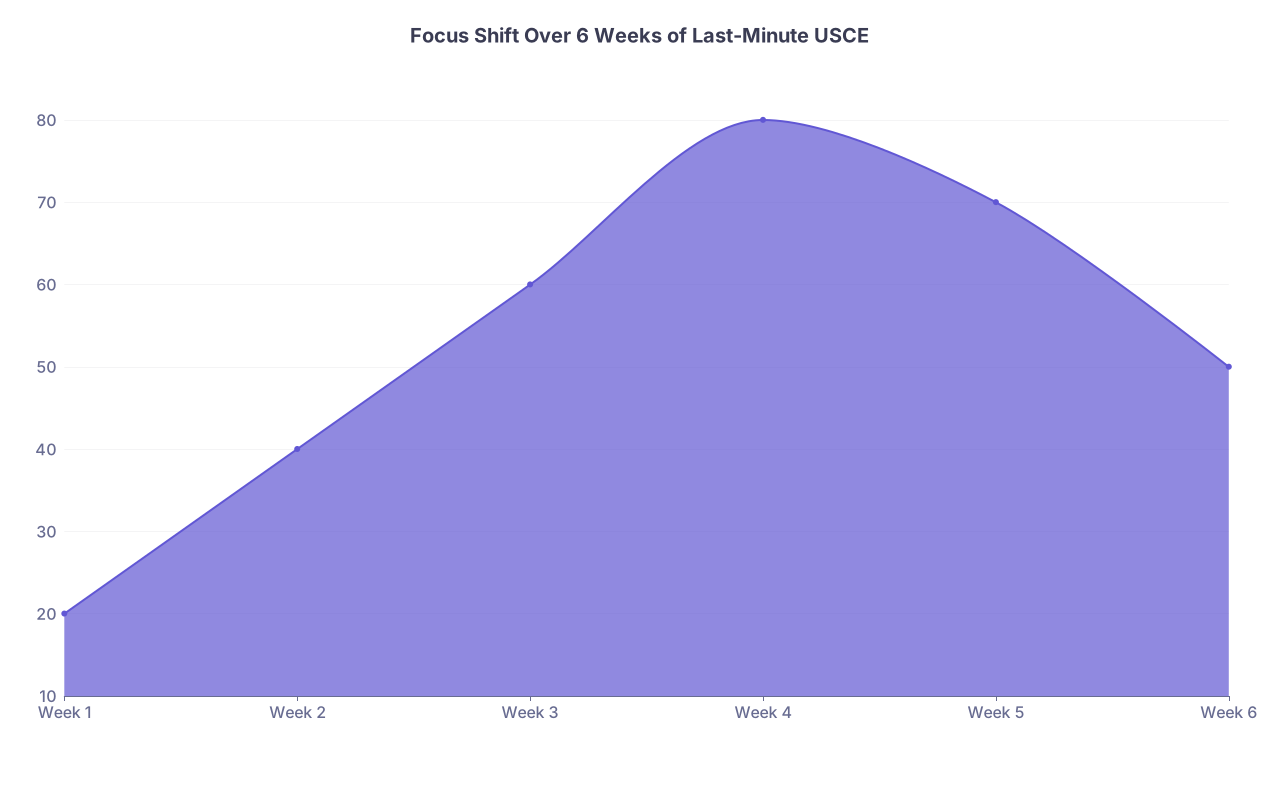
| Category | Value |
|---|---|
| Week 1 | 20 |
| Week 2 | 40 |
| Week 3 | 60 |
| Week 4 | 80 |
| Week 5 | 70 |
| Week 6 | 50 |
Notice the trend:
- Early weeks: orientation + impression-building
- Middle: performance + documentation
- Late: communication + future-proofing
This is how last-minute USCE stops being cosmetic and becomes strategic.

If You Are Completely Out of Time and Options
Some of you will read this in late February with:
- No available rotations
- No meaningful tele-rotation offers
- No current USCE at all
At this point you should stop wasting energy on fantasy fixes and do two things:
Prepare ruthlessly for every remaining interview or SOAP conversation.
- Build 3–4 strong clinical stories from your prior experiences (even home country)
- Translate them into US-style language (SBAR, SOAP, “interdisciplinary team,” “safety,” “throughput”)
- Practice explaining how you will hit the ground running despite time away from clinical practice
Lock in concrete USCE starting right after Match (whether you match or not).
- Negotiate May–August clinical slots now with a clear structure and LOR potential
- Aim for longer (8–12 weeks cumulative) rather than multiple tiny rotations scattered randomly
- Build relationships with faculty who understand IMGs and are willing to advocate
Even if it is “too late” for this exact cycle, it is not too late to rescue the next one.

Your Next Step Today
Open your email right now and send three messages:
To any US contact you have (prior preceptor, IMG friend, coordinator):
- Ask directly about any last-minute inpatient or EMR-based outpatient spot in the next 4–6 weeks.
To yourself (yes, literally):
- Write down the earliest date you can start a rotation after Match if needed, and block those months on your calendar.
To one potential attending or clinic you find online today:
- A short, professional inquiry asking specifically about EMR access, note writing, and LOR potential.
Do those three emails, and you are no longer “waiting helplessly.” You are running a timeline.