
The wrong US clinical experience will quietly kill your application—and no one will tell you it’s the reason.
Let me show you the red flags program directors and faculty trade stories about in conference rooms, on Zoom ranking meetings, and over late-night pizza when they finally start saying what they actually think about IMGs’ “USCE.”
You’ll never see this written on a website. But it’s absolutely affecting who gets interviews and who gets ranked.
What PDs Really Mean When They Say “US Clinical Experience”
You already know you “need USCE.” But here’s the part applicants do not understand:
Program directors are not just counting months.
They’re reading the pattern of your US experience as a proxy for your professionalism, supervision, risk, and whether you’ll be safe on their floors at 2 a.m.
At every rank meeting I’ve sat in, there’s always a moment like this:
- Coordinator: “Applicant 1438 – 6 months of US clinical experience.”
- PD: “What kind?”
- Coordinator: “Two observerships, two externships… and a tele-rotation.”
- Faculty: “Where?”
- Coordinator: “Private clinic in New Jersey… community hospital in Texas… tele-rotation with a for-profit company…”
- PD: (scrolls, frowns) “Letters from a ‘Medical Director’ I’ve never heard of. Pass.”
Same “6 months” that look fine on a spreadsheet. Dead on arrival in the room.
So let’s talk about the specific red flags that make your “USCE” either reassuring or radioactive.
Red Flag #1: The Wrong Type of Experience (That You Bought Online)
The most common—and most damaging—pattern: purely paid, low-supervision experiences in no-name settings that exist primarily to sell “USCE” to IMGs.
Here’s what PDs notice and say out loud:
- A stack of observerships in small, for-profit clinics with generic names
- Rotations arranged only through IMG agencies with no academic affiliation
- Vague descriptions: “Hands-on US clinical experience, worked closely with attending physicians” with no specifics
The unspoken translation in the room:
“You paid for shadowing with someone who writes 300 LORs a year.”
I’ve seen PDs pull up Google Maps on screen during ranking meetings to see what these “hospitals” and “institutes” actually look like. A townhouse with a banner and five 5-star Google reviews from “patients” with one review each? You’re not getting ranked.
The worst offenders
The most infamous red flag setups:
- “Institutes” that are really outpatient billing machines
- “Research + clinical” combos where “research” is just chart review with no IRB, no publication track
- Rotations staffed almost entirely by IMGs cycling through month by month, with canned LOR templates
No one will email you and say, “Your USCE is fake-appearing and that’s why we didn’t interview you.” They’ll just click “Reject” and move on.
Red Flag #2: No Real Supervision, No Real Responsibility
Here’s a conversation I’ve heard in three different programs:
- Faculty: “USCE? It’s all observerships.”
- PD: “So… they’ve never written a note?”
- Faculty: “Apparently not.”
- PD: “We’re drowning. I cannot teach someone to use the EMR from scratch in July.”
This is the core fear: taking someone who has never touched a US chart or order system and dropping them into an intern role.
The experience that raises suspicion:
- Pure shadowing with no mention of documentation, presentations, or direct responsibilities
- Letters that describe “great observership,” “enthusiastic learner,” “asked good questions,” but never mention clinical tasks
If your LOR sounds like a polite Yelp review—“very eager, punctual, pleasant”—PDs read that as: nice person, zero proven function in a US healthcare workflow.
They want to see that you’ve:
- Written at least draft notes
- Presented patients on rounds
- Participated in clinical decision-making conversations
- Seen real inpatient or ED care, not just outpatient hypertension follow-up
If all your USCE is office-based, slow-paced, or purely shadowing, programs whisper the same thing: “They will drown on our wards.”
Red Flag #3: Sketchy Letters of Recommendation
Letters from USCE can either save a marginal application or destroy a strong one. PDs absolutely read between the lines.
Here’s what quietly raises red flags:
Letters from attendings no one has ever heard of, in places no one recognizes
Especially when that’s your only US letter. In the room, someone will ask, “Anyone know this person?” Silence = instant doubt.Letters with exact same phrases as others from same site
PDs and coordinators see patterns over years. When three different applicants have an almost copy-paste letter from “Dr. X, Medical Director, Y Institute”? The whole pipeline gets mentally blacklisted.Over-the-top praise with no concrete evidence
“One of the best students I have ever worked with” without examples, patient complexity, or actual tasks turns PDs off. They know real faculty usually support big praise with specifics: “She managed a 12-patient panel on our general medicine service…”Letters from “titles” that aren’t real academic roles
“Chief Medical Officer at Z Clinic,” “CEO of W Institute,” “Medical Director at such-and-such Heart Center” with no academic appointment. The question that comes up: “If this was such a serious clinical environment, where’s the hospital affiliation?”
What PDs love? A clear, specific paragraph like:
“During his four-week inpatient internal medicine elective at ABC University Hospital, Dr. Singh carried 4–6 patients daily under my supervision, wrote draft notes in Epic, presented on rounds, and demonstrated sound clinical reasoning…”
Concrete. Measurable. Sounds like a real US rotation.
Red Flag #4: Too Many Rotations, Too Long in Limbo
There’s a quiet threshold where “lots of USCE” stops impressing people and starts worrying them.
Example: Applicant with 12+ months of USCE across random states, no residency yet.
Here’s the whisper in the room:
- “Why so many months?”
- “Why are they still not matched?”
- “Are they just drifting from observership to observership?”
PDs know what endless rotations often mean: the applicant has been trying to match multiple cycles and keeps failing. Maybe for reasons that don’t show up on paper (communication, social awareness, professionalism).
Too many low-tier, disconnected rotations feel like:
“I’m living in the US, trying anything, but no one has fully committed to me.”
What looks better:
- 2–4 high-quality, well-chosen experiences in relevant specialties
- Ideally at least one in the region or type of program you’re targeting
- Demonstrating progression: maybe one outpatient, then one inpatient, then a sub-I type role
Quantity does not beat quality. Past a certain point, more months of mediocre USCE are actually a negative signal.
Red Flag #5: Timing That Exposes You
Another thing no one tells IMGs: the timing of your USCE sends messages about your trajectory.
PDs notice:
- USCE that’s all several years old
- USCE that’s all crammed in right before ERAS with letters dated weeks apart from three cities
- USCE done long after graduation with no clear explanation
What they say to each other:
- “Why did they wait two years after graduation to get any US exposure?”
- “What were they doing all that time?”
- “Is this desperation right before application?”
If your US clinical experience is:
- Very old (5+ years)
- Very compressed (3 rotations all in July–September of the application year)
- Or only shows up after multiple prior failed match cycles
…you need to know that PDs will assume gaps, failures, or visa and communication issues unless you explain it clearly in your application and interviews.
USCE is not just “Have you done it?” but “Does this show you’ve been steadily engaged in clinical medicine, not disappearing for years?”
Red Flag #6: Misrepresented Scope—You Exaggerated
This one really annoys attendings.
When your ERAS or personal statement claims:
- “Managed patients independently”
- “Performed procedures such as central lines and lumbar punctures”
- “Admitted patients and placed orders”
…and then the rotation was officially an observership or externship with legal limits and no malpractice coverage for you?
In ranking meetings, someone will say:
- “I’ve supervised in that hospital. Observers cannot place orders. Why is this applicant saying that?”
- “If they exaggerate here, what else are they exaggerating?”
Nothing kills trust faster than discovering an IMG inflated “wrote drafts of orders and notes under supervision” into “placed orders and ran the team.” Faculty talk. Sometimes the attending you name knows someone on that committee. It’s not rare.
You can be impressive without lying. Instead of fiction, write:
- “Prepared draft H&Ps and daily progress notes in Epic for attending review”
- “Developed assessment and plan which we then discussed and modified together”
- “Assisted with procedures as appropriate, including patient positioning and sterile setup”
Grounded, believable, and PDs know exactly what it means.
Red Flag #7: Programs and Attending Names That Trigger Eye-Rolls
There are specific clinics, so-called hospitals, and “institutes” that have become jokes in certain specialties. The kind of places that show up on dozens of IMG CVs each year.
I’ve heard things like:
- “Another letter from that New Jersey ‘institute’? Trash.”
- “We’ve never seen a strong trainee out of that Chicago clinic pipeline.”
- “This attending writes letters for everyone. They’re meaningless.”
No one publishes a blacklist. But unofficially, people remember:
- Rotations that send many underprepared candidates
- Attendings who mass-produce overinflated letters
- Sites with poor documentation or unsafe care where someone’s gotten burned before
If you stack multiple experiences from these kinds of places, you inherit their reputation. You become “another one from that group.”
By contrast, even a single month at a respected community hospital or lower-tier university program can carry more weight than 6 months at questionable clinics.
Red Flag #8: No Specialty Coherence
PDs scan your USCE looking for a story. Are you serious about their specialty, or did you just collect random checkboxes?
Imagine an internal medicine PD sees:
- 1 month family medicine clinic
- 1 month psychiatry observership
- 1 month neurology tele-rotation
- 1 month “USCE” in a pain clinic
And zero real inpatient internal medicine work.
You know what they say?
“They haven’t actually tested themselves in real internal medicine. Hard pass.”
The same for psych programs seeing only medicine and surgery. Or FM programs seeing only cardiology subspecialty clinics and no primary care context.
Your USCE should:
- Match the specialty you’re applying to
- Show at least one rotation that resembles the actual work of that specialty in a US setting (inpatient for IM, continuity clinic for FM, etc.)
- Build a coherent narrative: “I explored X, then focused on Y, and here’s why.”
Random rotations with no thematic link just tell PDs you followed availability, not intention.
Red Flag #9: Tele-Rotations and Remote Observerships
Tele-rotations exploded during COVID. PDs tolerated them for a cycle or two. That patience is basically gone.
Here’s the blunt consensus I’ve heard:
- “Tele-rotation is not clinical experience.”
- “Fine as exposure, but not a substitute.”
- “I will not trust a tele-rotation LOR for clinical skills.”
Tele-anything raises questions:
- Did you actually interact with patients, or just watch on Zoom?
- Were you genuinely part of the care team, or just a bystander?
- How can that attending credibly comment on your bedside manner, physical exam, or teamwork?
Use tele-rotations as a tiny bonus, not your USCE foundation. If your only USCE is remote, PDs will rank you far below someone with even a single solid in-person inpatient month.
Red Flag #10: No Evidence You Learned the System
This one is subtle, but very real. PDs want IMGs who already understand basic US hospital culture so they are not dangerous or totally lost in July.
They look for signs in your USCE descriptions or LORs that you:
- Used a major EMR (Epic, Cerner, Meditech, etc.) even in “view only” or draft mode
- Learned about US documentation, handoffs, paging, HIPAA, duty hours, team hierarchy
- Functioned on a team with residents, nurses, pharmacists
If your experience was all in tiny offices, or you never mention the system—just “saw patients with attending”—it reads like you have no idea what a US residency day actually looks like. That’s frightening to a PD already struggling with burnout and safety issues.
A line like “actively participated in multidisciplinary rounds, including presentations to attending, residents, and nursing staff” goes a long way.
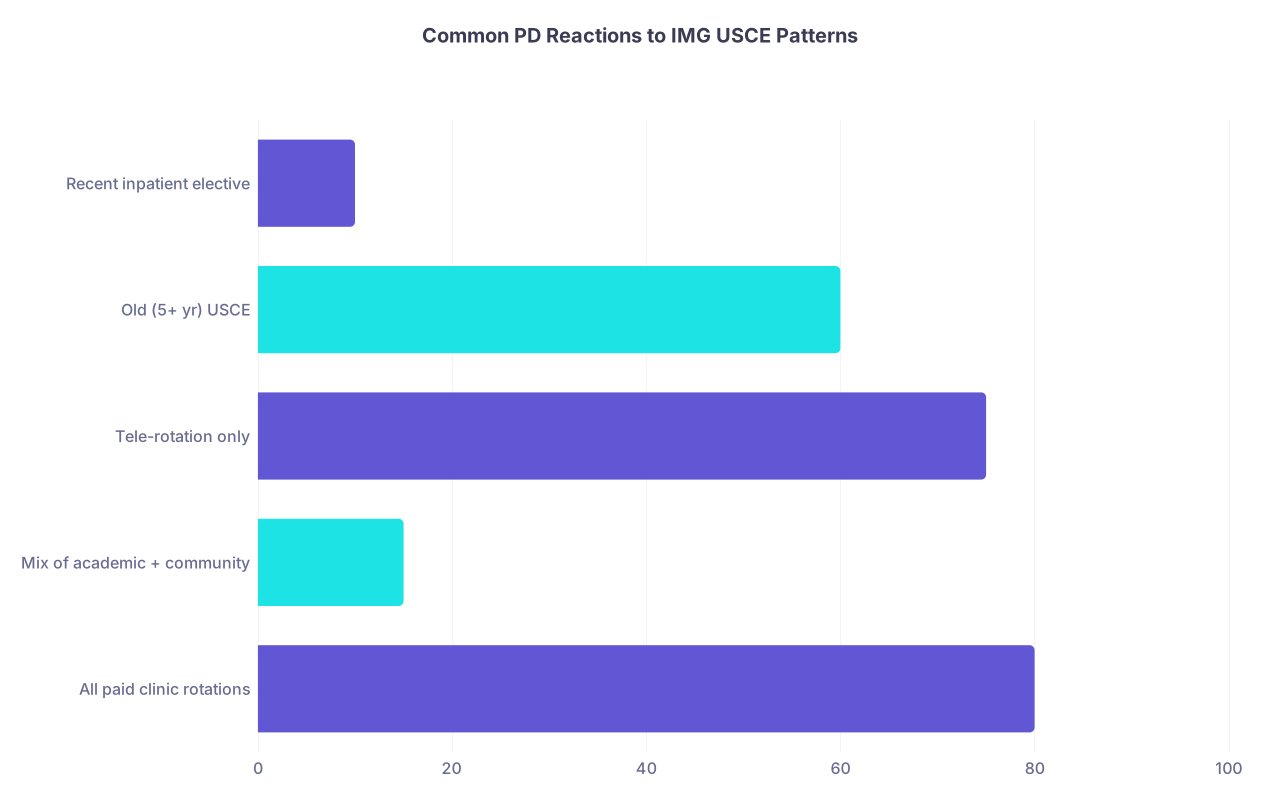
| Category | Value |
|---|---|
| All paid clinic rotations | 80 |
| Mix of academic + community | 15 |
| Tele-rotation only | 75 |
| Old (5+ yr) USCE | 60 |
| Recent inpatient elective | 10 |
(Values approximate % of PDs who view that pattern negatively, based on informal discussions. Not a formal study—but very close to reality.)
How PDs Actually Use USCE in Ranking Meetings
Let me pull back the curtain on how this plays out when your name is on the screen.
Picture a mid-tier internal medicine program. Interview season is over. Ranking meeting.
- Applicant 1: US MD, standard rotations, no USCE discussion. Easy.
- Applicant 2: Caribbean grad, 3 months USCE – 2 inpatient IM electives at decent university-affiliated hospitals, 1 outpatient IM clinic. Good LORs, specific tasks. Faculty: “Felt like a ready intern.” They get ranked high.
Then you:
- IMG, 6 months “USCE” in clinics: “X Heart Center,” “Y Primary Care Institute,” “Z Tele-rotation,” all for-profit, all observerships.
Conversation sounds like:
- Faculty A: “Anybody know these places?”
- Faculty B: “I’ve seen letters from X before. Very generic.”
- PD: “Any inpatient?”
- Coordinator: “No.”
- PD: “We have dozens of applicants with real inpatient electives. I do not have time to train from zero. Move them down.”
You might still land on the list—way down. Then when they hit their quota, you’re gone.
That’s the real function of USCE: not just a checkbox to get interviews, but a filter for risk during ranking.

What Strong, Low-Red-Flag USCE Actually Looks Like
To be clear, PDs are not expecting every IMG to have a prestigious sub-I at Harvard. They just want something clean and believable that lowers their anxiety.
A strong, non-sketchy USCE profile usually has:
- 1–2 months at a real hospital (community or academic), ideally inpatient, clearly documented
- At least one LOR from a faculty member with an institutional email and known affiliation
- Concrete roles spelled out: notes, presentations, daily follow-up
- Experiences that are recent (within 1–2 years of application) and specialty-aligned
- Minimal reliance on tele-rotations or pure observerships in shady clinics
The bar is not impossibly high. It’s just more specific than the consultants and course sellers tell you.
| Pattern Type | How PDs Generally See It |
|---|---|
| 1 month inpatient at community hospital + 1 month outpatient | Generally positive, shows range |
| 3 months all in tele-rotations | Weak, often discounted |
| 4 months all in small for-profit clinics | High suspicion, “paid shadowing” |
| 2 months at uni-affiliated hospital (any rank) | Strong, credible signal |
| 8+ months of random observerships over years | Questionable, “what is going on?” |

| Step | Description |
|---|---|
| Step 1 | Review USCE section |
| Step 2 | Seen as lower value, more questions |
| Step 3 | Trust increases, lower risk |
| Step 4 | Google check, mild suspicion |
| Step 5 | Letters read with more weight |
| Step 6 | Letters seen as possibly inflated |
| Step 7 | Higher on rank list |
| Step 8 | Lower on rank list |
| Step 9 | Inpatient experience? |
| Step 10 | Recognizable hospital or affiliation? |

How to Clean Up or Counteract Red Flags (If You Already Have Them)
Maybe you’re reading this and thinking, “Too late. I already did those rotations.”
It’s not completely hopeless. But you need to be strategic.
Add at least one legit hospital-based experience, even if short.
One honest month in a real inpatient setting can change how PDs interpret your older, weaker USCE. It shows progression and effort to get closer to real practice.Be brutally honest in how you describe your role.
If something was shadowing, call it observership. Emphasize what you actually learned and observed about the US system rather than inventing tasks you never did.Use your personal statement and interviews to explain weird timing.
Long gaps before USCE? Multiple cycles of applying? Address it directly but calmly. “I realized my earlier US experience was mostly outpatient and not sufficient; that’s why I deliberately pursued an inpatient elective at X.”Stop accumulating more low-quality rotations.
After 2–3 months of questionable USCE, doing 3 more at similar places just digs the hole deeper. Shift focus to research, exams, language skills, or one targeted, better-quality rotation.Get at least one letter from someone respected and specific.
Even at a modest community hospital, if a core faculty member truly supervises you, knows you, and writes a detailed, concrete letter, that one letter can be worth more than four generic ones from “Medical Directors.”
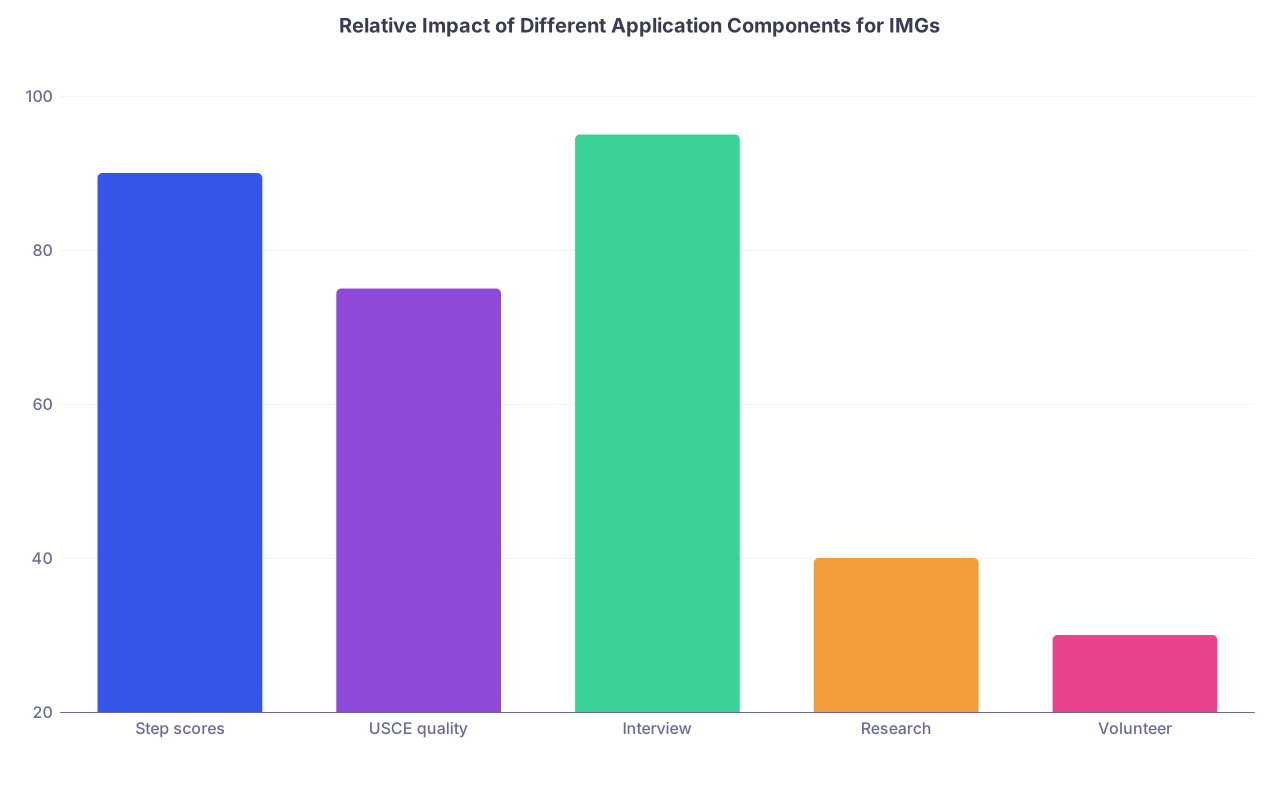
| Category | Value |
|---|---|
| Step scores | 90 |
| USCE quality | 75 |
| Interview | 95 |
| Research | 40 |
| Volunteer | 30 |
(Approximate relative importance on decisions for IMGs from PD conversations—not exact science, but this is the hierarchy you’re competing in.)
FAQ – The Questions IMGs Ask Me in DMs
1. Is any USCE better than none?
No. Bad USCE can be worse than none.
One or two rotations at low-credibility, obviously commercial clinics will not help you and may raise questions. If your only option is a dubious “institute” with no real hospital ties, I would rather see you invest that time in Step 2, language fluency, or trying harder to secure even a single month at a decent community hospital.
2. Are observerships useless?
Not useless, but limited.
Observerships at real hospitals with real teams can help you understand system culture and can be a neutral-light positive if the letter is honest and specific. But an observership will rarely outweigh a hands-on elective, and shadowing in private offices or tele-observerships has very little weight. If all your USCE is observership, expect PDs to question your readiness.
3. How many months of USCE do I actually need?
If it’s good quality, 2–3 months is usually enough.
One strong inpatient month in your target specialty plus one additional month (inpatient or outpatient) in a related setting can be perfectly adequate. More than 4–5 months starts to look suspicious unless it’s structured (e.g., a formal clinical scholars program) or clearly tied to research or degrees. Quality, supervision, and setting matter far more than raw duration.
Key takeaways:
USCE is not a simple checkbox; PDs dissect where, how, and with whom you trained.
Shady clinics, tele-rotations as your only USCE, and generic letters are glaring red flags in closed-door discussions.
A small amount of honest, supervised, hospital-based experience—described accurately and supported by specific letters—beats a long list of paid, low-quality rotations every single time.