
The biggest mistake IMGs make is doing the right things in the wrong order. Right exam, wrong timing. Right US experience, wrong type. That’s how strong applicants end up unmatched.
You need a roadmap. Month by month. Step by step. No magical thinking, no “I’ll see how it goes.”
Below is the order I’d use if you told me: “I’m an IMG, I want to match in the US, tell me exactly what to do and when.”
1. Big-Picture Timeline: Where You’re Standing Right Now
First, anchor yourself. You fall into one of three broad starting points:
- Still in med school (clinical years, 3rd–5th year equivalent)
- Just graduated (0–2 years out)
- Older grad (3+ years out, with or without practice experience)
At this point you should be brutally honest about three things:
- Year of graduation – Programs notice.
- English and communication – Not “good enough,” but excellent or not.
- Money and visa reality – You don’t buy a dozen US electives on hope.
Here’s the high-level match-year timeline most IMGs should target:
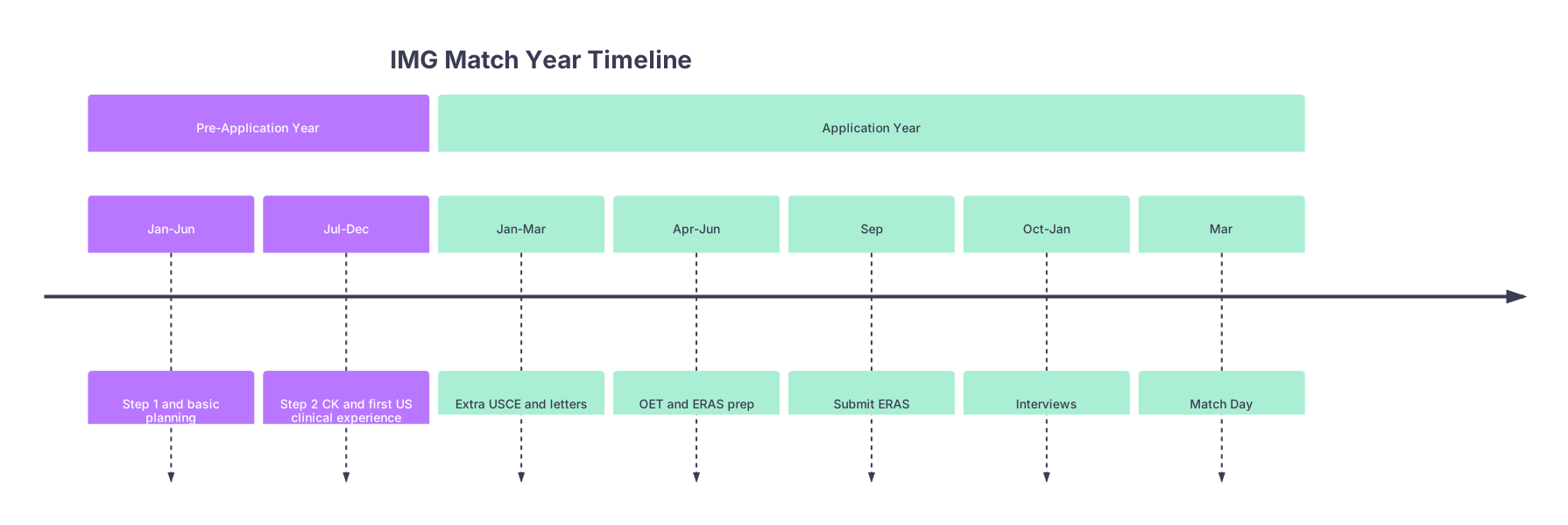
| Period | Event |
|---|---|
| Pre-Application Year - Jan-Jun | Step 1 and basic planning |
| Pre-Application Year - Jul-Dec | Step 2 CK and first US clinical experience |
| Application Year - Jan-Mar | Extra USCE and letters |
| Application Year - Apr-Jun | OET and ERAS prep |
| Application Year - Sep | Submit ERAS |
| Application Year - Oct-Jan | Interviews |
| Application Year - Mar | Match Day |
2. Years −3 to −2 Before Match: Foundation and Strategy
I’ll assume you’re aiming for a specific Match year (say March 2028). Count backward.
Months 1–3: Decide Specialty + Reality Check
At this point you should:
- Choose one realistic primary specialty (e.g., Internal Medicine, Family Medicine, Pediatrics).
- Decide if you’ll also prepare a backup (often FM or Psych).
- Research your profile vs competitiveness.
Concrete tasks (over 3 months):
- Look up NRMP Charting Outcomes data for IMGs.
- Talk to 2–3 IMGs who matched in your desired specialty.
- Decide: “I’m targeting IM in 2028 with ~220+ Step 2, 3+ months USCE.” Put it on paper.
If your graduation will be >5 years at time of Match, you need more and stronger US experience and absolutely no wasted time.
Months 4–9: Step 1 (Yes, It’s Pass/Fail. Still Matters.)
Pass/Fail doesn’t mean “laissez-faire.” A fail here kills a lot of doors.
At this point you should:
- Lock down 4–6 months for Step 1 dedicated.
- Build a realistic schedule around obligations back home.
Rough 6‑month plan:
- Months 1–2: Content review (UWorld, Boards & Beyond / similar).
- Months 3–4: Heavy question banks, NBME self-assessments.
- Months 5–6: Weakness targeting + 2–3 full-length practice exams.
Do not:
- Take Step 1 “just to see.” If you’re scoring borderline on NBMEs, delay. A fail is worse than a 2–3 month delay.
While prepping Step 1, you do not need to be in the US. Focus on getting the pass in the bag.
3. Years −2 to −1 Before Match: Step 2 CK + First US Experience
Once Step 1 is passed, the real game starts. Step 2 CK + USCE is the core of your application.
Months 1–2 After Step 1: Bridge and Planning
At this point you should:
- Take 2–4 weeks to rest and reset. You’re not a machine.
- Sketch when you’ll be physically in the US for rotations (visa, funds, availability).
- Align Step 2 timing so your score is back before ERAS opens in your application year (June).
For example, for a 2028 Match:
- Target Step 2 CK: by May 2027 at the latest.
Months 3–8: Step 2 CK Dedicated Prep
You treat this like your golden ticket. Because for IMGs, it is.
Rough 4–6 month plan:
- Step 2 study while still in your home country. Save US time for USCE, not for sitting alone in an Airbnb doing UWorld.
- Aim for competitive scores for IMGs:
- IM / FM / Peds: 230+ keeps many options open.
- More competitive specialties need higher; if you are not trending there, adjust the plan early.
At this point you should:
- Do full-length practice exams every 3–4 weeks.
- Only schedule the real exam once NBME scores are consistently in your target range.
Do not waste your first US trip on exam prep. Bad trade.
Months 6–12: First US Clinical Experience (USCE) – Observerships/Electives
Now we finally talk “US experience.” The order matters.
What counts as legitimate USCE?
- Hands-on electives/sub-internships (for final year students or very recent grads)
- Hands-on externships (formal programs for IMGs)
- High-quality observerships in ACGME‑accredited hospitals, ideally with residents and attendings in your target specialty
Research observership vs hands-on quickly:
| Type | Patient Contact | EMR Access | Best For |
|---|---|---|---|
| Elective | Yes | Often | Final year students |
| Externship | Yes | Often | Recent grads |
| Observership | No | No | Older grads / first USCE |
| Research | Indirect | Variable | Building academic profile |
At this point you should aim for:
- 1–2 months of USCE on your first US trip
- In your target specialty (e.g., IM for IM match).
- In teaching hospitals with residency programs where LORs carry weight.
Ideal sequence:
- Finish Step 2 CK.
- Within the next 3–6 months, come for your first USCE block.
- Use this time to:
- Learn US rounding structure and communication.
- Impress attendings for US letters of recommendation (LORs).
- Test your English in real-time clinical conversations.
4. Application Year −1 (The Calendar Year Before You Apply): Consolidating USCE + Letters
Now we’re about 12–18 months before your ERAS submission. This is where IMGs either get strategic or drift.
Quarter 1 (Jan–Mar): Second USCE Round + Stronger LORs
At this point you should:
- Plan another 1–2 months of USCE, ideally:
- At a different institution than your first trip.
- Still in your target specialty.
- With attendings who are active in residency selection.
During these rotations:
- Ask explicitly for feedback halfway through: “How can I improve?”
- In the last week, if feedback has been positive, ask for a strong LOR. Use that word.
- Provide a CV and short summary of your goals.
End goal by March:
- At least 2 solid US letters, ideally 3, from:
- US academic IM/FM/Peds/etc attendings
- Preferably PDs, associate PDs, or core faculty
Quarter 2 (Apr–Jun): Research, Gaps, and Document Preparation
If you’re not on rotations now, you’re not on vacation. This quarter is for tightening every loose screw before the application year hits.
At this point you should:
- Fill any big gaps:
- If you have >3 years since graduation, add either:
- Research in your specialty
- A home-country clinical role that clearly aligns with your US goals
- If you have >3 years since graduation, add either:
- Prepare your OET (if required) and ECFMG documentation.
Administrative checklist (do this by June):
- USMLE transcripts set up for release.
- ECFMG certification tracking (if you already passed Step 1 + Step 2 CK + OET).
- CV updated with complete dates, no mysterious empty years.
Use this window for research if possible:
1–2 projects, even retrospective chart reviews or case reports, at a US site help your application and show continuity.

5. Application Year (The Cycle You Apply): Month-by-Month
Here’s where being organized pays off. You’re no longer in the planning fantasy stage.
Let’s assume you apply in September 2027 for the 2028 Match.
January–March: Final USCE Push + Last Letters
At this point you should:
- If you still lack strong letters, schedule one more month of USCE now.
- Prefer to rotate at a program that actually takes IMGs. Look at current residents; if no IMGs, do not expect miracles.
During rotations:
- Show up early. Write notes if allowed. Present clearly.
- Make your personality easy to recommend: reliable, teachable, not arrogant, not passive.
Goal by end of March:
- 3–4 letters lined up:
- 2–3 US specialty-specific LORs
- 1 additional US or strong home-country academic letter if needed
April–May: ERAS Skeleton and Personal Statement Draft
Now it’s pure application prep. If you start in August, you’re already behind.
At this point you should:
Build your ERAS activities list in a simple document first:
- Jobs, research, leadership, volunteering, teaching.
- Clear bullet points of what you did and what changed because of you.
Draft your personal statement for your primary specialty:
- One page.
- Clear narrative: where you’re from, why this specialty, what you bring, and what you want.
If you’re serious about a backup specialty, write a separate PS for that specialty now.
June: Exam Status and ECFMG Certification Check
Critical month.
At this point you should:
- Have Step 1 and Step 2 CK scores back.
- Be done with OET (if required).
- Be on track for ECFMG certification before rank list deadline (usually February of Match year).
If Step 2 CK is weak (borderline for your specialty):
- Decide if you’re:
- Still applying broadly to same specialty but more community programs.
- Or pivoting to a more realistic backup this cycle.
No fantasy applications. Programs see your numbers instantly.
July: ERAS Polishing and LOR Uploads
ERAS usually opens in June for data entry. Programs start viewing in September. July is build month.
At this point you should:
- Enter all ERAS data accurately: dates, experiences, publications.
- Decide which three or four letters to assign as your core set.
- Check that letter writers have uploaded to ECFMG/ERAS. Ping them (politely) if not.
By end of July, ERAS should be 90% ready.
August: Target List and Final Review
Now you stop tweaking sentences and start thinking strategy.
At this point you should:
- Build a program list that reflects your reality:
- Mix of university-affiliated and community programs.
- A significant number of IMG-friendly programs.
- Avoid programs that explicitly say “No IMGs” or “US grads only.”
Use data:
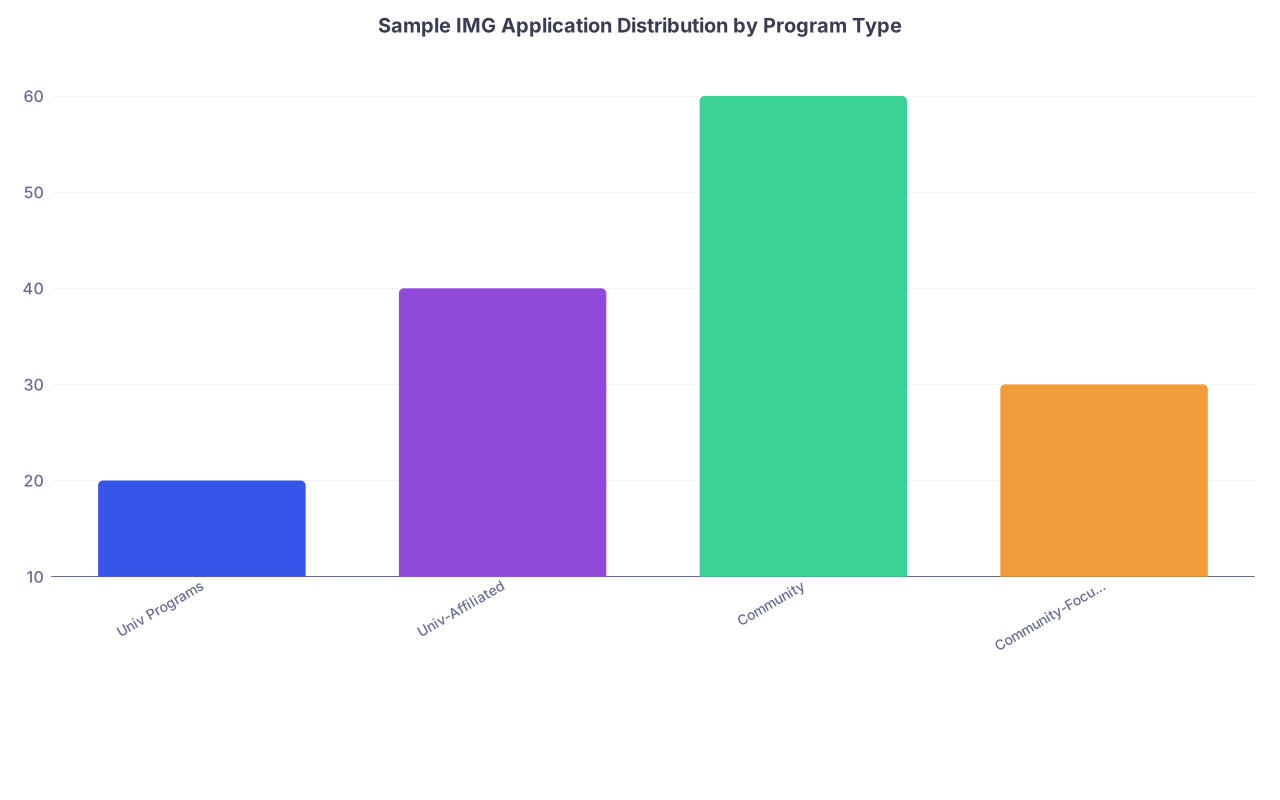
| Category | Value |
|---|---|
| Univ Programs | 20 |
| Univ-Affiliated | 40 |
| Community | 60 |
| Community-Focused IMG | 30 |
- Double-check:
- No unexplained gaps in your CV.
- All USCE clearly described (type, location, dates, role).
- Personal statement free of clichés and random childhood epiphanies.
September: Submit Early. Not Fashionably Late.
ERAS submission day is not a suggestion for IMGs. It’s a deadline.
At this point you should:
- Submit ERAS on the first possible submission date or within 48 hours.
- Send all USMLE and ECFMG documents.
- Monitor MyERAS and email for any red flags or missing items.
Don’t drip applications. Programs do most of their screening early.
6. Post-Submission: Interviews and Extra US Experience
You’re not done just because you clicked submit.
October–January: Interview Season
At this point you should:
- Be checking your email daily for invites.
- Respond within hours, not days. Interview spots vanish fast.
- Schedule interviews in clusters if you need to travel.
Before each interview:
- Review that program’s structure, their IMGs, and any specific tracks.
- Have 2–3 sharp questions ready that show you understand community vs university realities.
If interviews are sparse by late November:
- Consider a brief email campaign to programs where you rotated or where your letter writers have influence.
- Have mentors send short advocacy emails if appropriate.
Ongoing: Strategic US Experience During Interview Season
If you’re not working or in training back home, this is when some IMGs do short targeted observerships:
- Not to get more letters (too late for this cycle usually)
- But to:
- Stay clinically active.
- Have something current to say at interviews.
- Demonstrate persistence and relevance.
Do not disappear into a 4‑month “break” with Netflix. Programs notice inactivity.
7. Rank List and Match Week: Final Moves
February: Rank List Logic
At this point you should:
- Rank programs in true preference order, not fantasy prestige order.
- Avoid over-ranking places where:
- You felt hostility toward IMGs.
- You have clear evidence of poor training or resident burnout.
If you have a backup specialty:
- Make a single combined rank list (you don’t submit separate lists).
- Decide your real priority: specialty vs simply matching in the US.
March: Match Week and Next Steps
Two paths.
If You Match
At this point you should:
- Immediately complete any onboarding tasks.
- Lock in visa steps and relocation plans.
- Use the months before July 1 to refresh core clinical knowledge in your matched specialty.
If You Don’t Match
Unpopular truth: many IMGs waste the next 12 months “processing.” You cannot afford that.
Within the first 4 weeks post-unmatched, you should:
- Analyze:
- Number of interviews
- Feedback from interviewers
- Any obvious red flags (scores, gaps, communication issues)
Then decide:
- Reapply next cycle with:
- Additional targeted USCE
- Research or clinical work that fills gaps
- Better program list strategy
- Or reframe goals if your profile is fundamentally misaligned (very old graduate, multiple exam failures, no interviews despite broad applications).
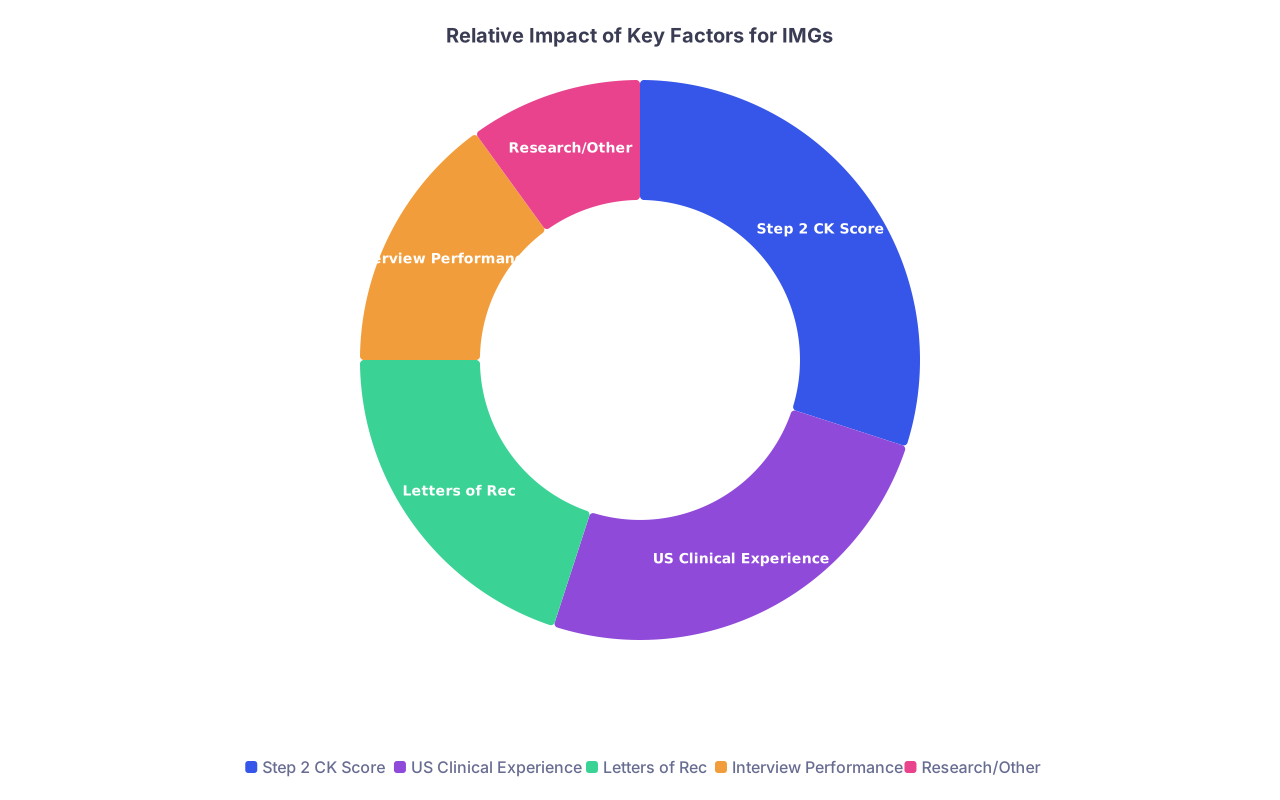
| Category | Value |
|---|---|
| Step 2 CK Score | 30 |
| US Clinical Experience | 25 |
| Letters of Rec | 20 |
| Interview Performance | 15 |
| Research/Other | 10 |
8. Putting It All Together: Ideal Order of Exams, USCE, and Apps
Let me give you the clean, “if I could do it again” sequence in one place, assuming a 3‑year runway.
Year −3 to −2 (Foundation):
- Choose specialty and Match year.
- Study and pass Step 1.
Year −2 to −1 (Core Build):
- Study and take Step 2 CK (aim competitive).
- Do your first USCE trip (1–2 months in target specialty).
- Start or continue small research or meaningful clinical role back home.
Year −1 (Pre‑Application Year):
- Do second USCE (and third if needed) targeted to IMG‑friendly, teaching hospitals.
- Collect 3–4 strong US LORs.
- Take OET and complete ECFMG requirements.
- Begin ERAS skeleton, CV, and personal statement drafts.
Application Year:
- Jan–Mar: Final USCE or research; make sure letters are uploaded.
- Apr–Aug: Finish ERAS, build intelligent program list.
- Sep: Submit early.
- Oct–Jan: Interview season + optional short observerships if idle.
- Feb–Mar: Rank, Match, and either prepare for residency or rebuild strategically if unmatched.
Final 3 Takeaways
- The order matters: exams first, then targeted USCE for letters, then application polish.
- US experience is about quality and timing, not just total months—aim for 2–4 months in your specialty at real teaching sites before the application year.
- Every 3‑month block should have a clear purpose; if you can’t state what a given quarter does for your Match chances, you’re wasting time.