
The biggest reason strong IMGs don’t match is not scores. It’s a messy, incoherent US clinical story.
Programs are not just asking, “Can you pass the boards?” They’re asking, “Does your clinical path make sense in the US system, for this specialty, right now?” If your clerkships, gaps, observerships, and LORs feel random, you lose.
You need a narrative. And you need 12 months to build it properly.
Below is your month‑by‑month countdown. If you’re planning to apply in September of Year 2, this timeline starts in October of Year 1 (T‑12 months).
Big Picture: What You’re Actually Building
Before we go month-by-month, you need to know the endpoint. By the time ERAS opens, your US clinical narrative should clearly show:
- Progressive exposure to the US system (not one random observership from 3 years ago)
- Increasing responsibility over time (within what’s allowed for IMGs)
- Clear specialty focus (or a believable pivot explained by your experiences)
- Multi-angle credibility:
- US-based LORs from your chosen specialty
- At least one letter from someone who saw you over time (not 3 days)
- Evidence you understand workflow, EMR, handoffs, team culture
- No unexplained black holes (long gaps with nothing clinical or academic)
That’s what we’re working backward from.
12–10 Months Before Application: Foundation and Recon
At this point you should stop guessing and start mapping.
Month 12: Commit and Clarify
You’re 12 months out. No more “maybe surgery, maybe family med, maybe psych.” That indecision kills coherence.
At this point you should:
Lock (or narrow) your specialty choice
- You need at least a primary target, e.g. Internal Medicine, Pediatrics, Psychiatry.
- If you’re torn, pick 2 at most and accept you’ll need a hybrid narrative (e.g., IM + Neuro with heavy IM base).
Audit your current profile
- How many recent (within 2 years) clinical experiences do you have?
- Any US-based experience at all? Dates, settings, specialties?
- Existing LORs: who, when, where, specialty, strength?
Identify your gaps Typical IMG gaps:
- Only observerships, no hands-on experience
- All experience in home country, nothing US-based
- All US exposure in WRONG specialty for what you plan to apply to
- No long-term mentor in the US
Write down your gaps explicitly. If you avoid this step, you’ll waste months doing the wrong rotations.
- Start a simple “Narrative Tracker” document
- One page. Three columns:
- Date/Duration
- Experience
- Story/Takeaway (how this fits my specialty story)
- You’re going to fill this continuously; it will feed your personal statement and interviews.
- One page. Three columns:
Month 11: Program Research and Strategy
This is where most IMGs get lazy. They skim a few websites, see “IMG friendly” lists, and call it a day. That’s not strategy.
At this point you should:
Define your target program types
- University vs community vs hybrid
- “IMG-friendly” is not enough; look at:
- Recent IMG residents?
- Do they value home-country research?
- Do they mention “US clinical experience required” or “preferred”?
Map what type of US clinical experiences they like Pull 10–15 programs you might actually apply to. You’re looking for patterns:
- Do they mention:
- “US hands-on clinical experience required”?
- Limits on year of graduation (YOG)?
- Preference for US LORs?
Keep a simple table:
- Do they mention:
| Program Type | USCE Requirement | YOG Limit | IMG-Friendly Signal |
|---|---|---|---|
| University A | 3 months hands-on | 5 years | 30% current IMGs |
| Community B | Observership ok | 7 years | 50% current IMGs |
| University-Assoc C | 2 months USCE | 5 years | States IMGs welcome |
Roughly plan your clinical blocks Using what you learned, sketch the year:
- 3–4 months: Core specialty (e.g., IM wards, continuity clinic)
- 1–2 months: Related subspecialties (cardiology, GI, etc.)
- 1–2 months: Optional “secondary” specialty if needed (e.g., Neuro if you’re IM+Neuro curious)
- 1–2 months: Research or quality-improvement project
You’re not booking everything yet. You’re sketching a coherent story.
Identify key cities/regions
- Clusters where you can do multiple rotations back-to-back without flying every month.
- Places with several potential LOR writers in your field.
10–7 Months Before Application: Build the Spine of Your Narrative
Now you stop planning and start locking dates.
Month 10: Secure Rotations and LOR Opportunities
This month is about near-aggressive logistics.
At this point you should:
Book your first 2–3 core rotations
- Prioritize:
- Settings that offer LORs from faculty in your specialty
- Hospitals where IMGs actually matched from past cohorts
- Examples:
- For IM: inpatient wards, academic-affiliated community hospital
- For Psych: inpatient psych unit, outpatient clinic with strong documentation culture
- Prioritize:
Email potential mentors early Example email structure:
- Introduce yourself (IMG, YOG, step status, target specialty)
- Share brief CV
- Ask explicitly if they:
- Supervise IMGs
- Have time to observe/mentor longitudinally (2+ months)
- Are comfortable writing letters for strong students
You’re pre-screening for people who might actually anchor your narrative.
Fix obvious CV holes
- If you’ve been non-clinical for >6–12 months, start any meaningful clinical exposure locally while waiting:
- Paid job in healthcare system (scribe, MA if allowed)
- Volunteering in a clinic or hospital This becomes part of your “I stayed clinically active” story.
- If you’ve been non-clinical for >6–12 months, start any meaningful clinical exposure locally while waiting:
Month 9: Story Alignment and Early Documentation Habits
Your first US rotation may be starting or about to start. You’re not just “showing up.” You’re collecting narrative ammunition.
At this point you should:
Clarify your “why this specialty” in writing
- One page, messy is fine.
- Include:
- 2–3 experiences from home country
- What you hope to see/prove in US rotations
- What kind of patient population or practice style excites you
This becomes your lens for every case you see.
Set up a clinical reflection system After each clinic/ward week, jot down:
- One patient that shaped your thinking
- One US-system-specific learning (insurance, EMR, teamwork)
- One moment you contributed meaningfully
You’re building details for:
- Personal statement
- Interviews
- “Tell me about a patient who changed you” questions
Start collecting “micro-data” for LORs Every attending who might write a letter should eventually know:
- Your exam scores
- Your CV
- Your target specialty and why Save a one-page snapshot to hand them quickly later.
Month 8–7: Execute Core US Rotations (First Wave)
Now you’re in the hospital. This is where coherence is either built or destroyed. A scattered, unfocused month here translates into a bland LOR and a weak narrative.
At this point you should:
Act like a sub-intern (within legal limits)
- Present patients concisely.
- Volunteer for follow-up calls, note drafts, patient education.
- Ask, “How do interns handle this?” and model that.
Programs look for, “Can this person show up as an intern in July and not collapse?”
Make your specialty interest visible but not annoying Example:
- You’re an IMG aiming for IM during a ward month:
- “Dr. Chen, I’m planning to apply to Internal Medicine next cycle. Would it be okay if I present a couple of patients at a teaching session to get feedback?”
The point: when LOR season comes, they’re not surprised by your specialty choice.
- You’re an IMG aiming for IM during a ward month:
Identify 2–3 potential letter writers You want:
- Faculty in your target specialty
- At least one person who saw you for ≥4 weeks
- Someone who actually oversees residents and writes letters regularly
Ask intentionally for mid-rotation feedback
- “Is there anything I should do differently if I’m hoping to be a strong applicant for IM next year?”
- Then actually fix the thing they mention. You want that story to show up in your letter: “She sought feedback and improved quickly.”
6–4 Months Before Application: Deepening and Differentiating
By now you’ve got at least 1–2 US rotations under your belt. Your job is to show progression, not repetition.
Month 6: Second Wave Rotations and Visible Growth
At this point you should:
Line up a related subspecialty or continuity experience Examples:
- IM applicant: Cardiology, pulmonary, or continuity clinic with chronic disease management
- Psych applicant: Outpatient continuity, consult-liaison psych
- Peds applicant: General pediatrics plus a subspecialty like NICU or ambulatory
The story you’re creating: “I’ve seen this field in more than one setting, and I still want it.”
Start a small project in at least one site Nothing fancy:
- Case presentation at morning report or department meeting
- Short QI idea (improving discharge instructions, follow-up calls)
- Observe a pattern → discuss with attending → help with data collection
Why? In interviews, vague “I did some research” is useless. “I noticed our readmissions for HF patients with language barriers were higher, so I worked with my attending to…” stands out.
Ask your earliest mentors about your fit Directly:
- “Based on what you’ve seen, do you think I’m a competitive candidate for IM as an IMG?”
- “Is there anything you think I should prioritize over the next 4–6 months?”
Their answer might change your target list or push you to seek more months in a certain setting.
Month 5: Lock Letters and Start Weaving the Story
At this stage, you’re closer to letter season than you think.
At this point you should:
Formally request your first LORs Ideal timing: Near the end of a rotation when you’re at your peak performance.
When you ask, make it easy for them:
- “Would you feel comfortable writing me a strong letter of recommendation for Internal Medicine residency?”
- Attach:
- CV
- Step scores
- Short paragraph about your goals and specialty interests
- 2–3 bullet points of cases/instances that illustrate your work (reminds them of specifics)
Make sure each letter tells a different angle Think like this:
- Letter 1: “Clinical competence and reliability on wards”
- Letter 2: “Communication, empathy, patient rapport”
- Letter 3: “Work ethic, teachability, and growth over time”
- Optional 4th: “Research/QI and academic curiosity”
If all your letters say, “Hard working, punctual, team player,” you disappear into the pile.
Start noticing the through-line across your experiences Use your reflection notes:
- Are you repeatedly drawn to complex, multi-morbid cases?
- Do you gravitate toward patient education?
- Are you fascinated by diagnostic puzzles?
These themes become the spine of your personal statement.
4–2 Months Before Application: Consolidate and Craft
You’ve built the raw material. Now you have to assemble it into a clear, coherent narrative.
Month 4: Draft Personal Statement and Experience Descriptions
At this point you should:
Draft your personal statement around concrete scenes No abstract “I have always been passionate about…” nonsense.
Structure:
- Open with ONE specific US clinical moment that shows you working in your chosen field.
- Connect it to:
- Your earlier (home-country) foundation
- The deliberate choice to seek US experience in this specialty
- Tie together:
- Your progression (early rotations → more advanced roles)
- What you want from residency (teaching-heavy program, underserved populations, etc.)
If each paragraph could belong to any specialty, you’ve failed.
Translate your narrative into ERAS experience entries For every significant experience, your description should answer:
- What setting? (US vs home country, inpatient vs outpatient)
- What was your role? (Be honest but not minimizing)
- What did you learn that matters for residency?
- How does this fit your specialty path?
Compare:
- Weak: “Observed daily rounds, learned about US healthcare system.”
- Strong: “Participated in bedside rounds on a 20-bed medicine service, pre-reviewed charts, prepared note drafts, strengthened skills in medication reconciliation and discharge planning for complex heart failure patients.”
Cross-check for contradictions
- Personal statement says you love outpatient continuity, but all your US experience is ICU.
- You claim passion for underserved, but you never mention a single underserved population experience.
Fix the mismatch with either:
- Additional short-term experience
- Or adjusting your stated interests to match what you actually did.
Month 3: Final Rotations and “Tie It All Together” Moments
This is usually your last chance for fresh clinical content before ERAS goes live.
At this point you should:
Use last rotations to fill remaining gaps Examples:
- You’ve only done inpatient? Grab an outpatient month.
- No continuity narrative? Focus on longitudinal follow-ups within a clinic.
- Weak US psych exposure but applying psych? Demand that last psych-heavy month.
Deliberately gather stories Decide on 3–4 core stories you’ll probably use in interviews:
- A challenging patient interaction
- A time you made a mistake or near-miss and learned from it
- A conflict within the team and how it resolved
- An example of managing ambiguity or uncertainty
Aim to source at least one of these from your most recent rotation so it feels fresh.
Confirm letter uploads and strengthen mentor ties
- Politely check that your letters have been or will be uploaded.
- Ask at least one US mentor if they’d be willing to:
- Review your program list
- Give you honest feedback about your competitiveness tiers (reach/target/safety)
2–0 Months Before Application: Align Everything and Present Coherently
Now you’re done collecting. You’re curating.
Month 2: Program List and Narrative Consistency Check
At this point you should:
Build your program list around your actual narrative Consider:
- Where your US experiences are based (geographic clustering)
- Where your letter writers trained or have connections
- The type of practice your experiences reflect:
- Heavier community exposure → more community programs on your list
- Academic QI/research → more university-affiliated places
Check your doc-to-doc consistency
- CV, ERAS entries, personal statement, and LORs should all point in the same direction:
- Same primary specialty
- Same big themes (e.g., chronic disease management, psych in medically complex patients, urban underserved)
If one letter calls you “outstanding future surgeon” and you’re applying to psych, you’ve got a problem. Fix it now.
- CV, ERAS entries, personal statement, and LORs should all point in the same direction:
Polish your “2-minute narrative” Practice answering:
- “Walk me through your path to US residency.”
- “Tell me why Internal Medicine in the US, now.”
Outline:
- Medical school/home-country clinical base
- Decision to pursue X specialty
- Intentional move to US experiences (type, locations, progression)
- What you’re looking for in a residency based on all of this
Month 1–0: Final Prep and Interview-Ready Narrative
ERAS is submitted or about to be. Your focus shifts from building to defending and explaining.
At this point you should:
Prepare narrative for any “messy” elements
- Gap years
- Specialty switches
- Older YOG
- Non-traditional background
For each, write 3–4 sentences:
- What happened (brief, factual)
- What you did to stay clinically/relevantly active
- How your US experiences now show you’re ready
Link interview answers back to your clinical narrative When asked:
- “Why this program?” → Connect your past settings to what they do:
- “My rotation at a similar community-academic hybrid program showed me I thrive in…”
- “Tell me about your US clinical experience.” → Don’t list months. Talk progression:
- “I started with a general IM rotation to understand ward workflow, then moved into cardiology where I focused on…”
- “Why this program?” → Connect your past settings to what they do:
Maintain at least minimal clinical involvement
- Even after applications are in, keep doing:
- Part-time clinical role
- Ongoing research project
- Volunteering in a clinic
Programs like to see you didn’t stop being clinical the moment ERAS opened.
- Even after applications are in, keep doing:
Quick Visual: Your 12-Month Narrative Build
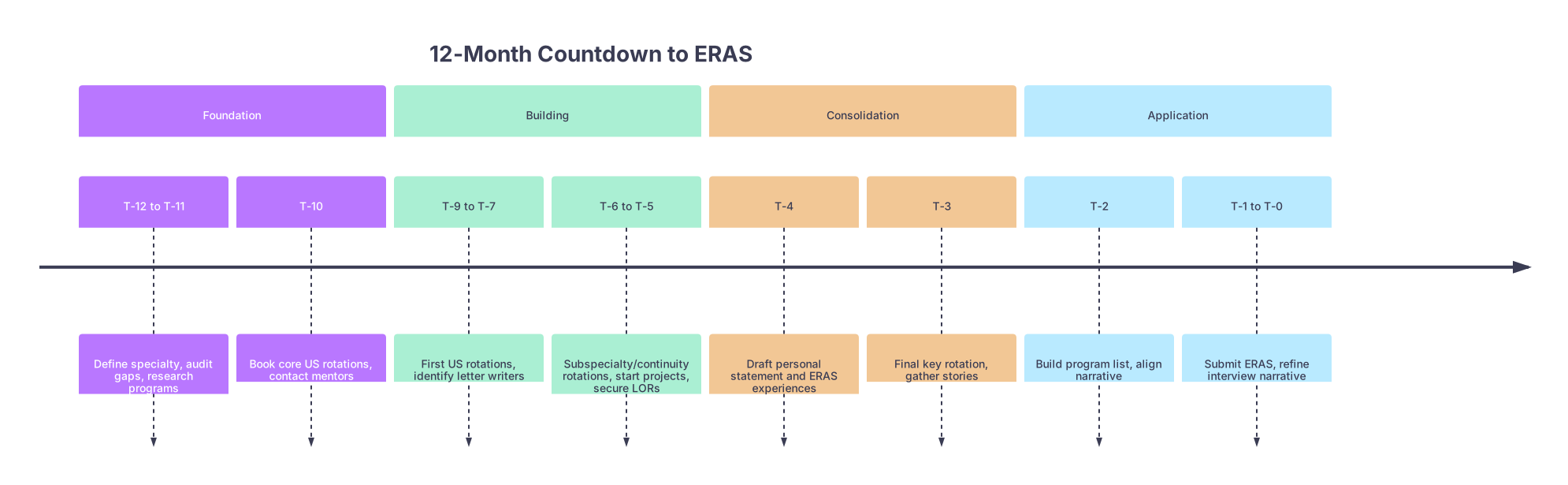
| Period | Event |
|---|---|
| Foundation - T-12 to T-11 | Define specialty, audit gaps, research programs |
| Foundation - T-10 | Book core US rotations, contact mentors |
| Building - T-9 to T-7 | First US rotations, identify letter writers |
| Building - T-6 to T-5 | Subspecialty/continuity rotations, start projects, secure LORs |
| Consolidation - T-4 | Draft personal statement and ERAS experiences |
| Consolidation - T-3 | Final key rotation, gather stories |
| Application - T-2 | Build program list, align narrative |
| Application - T-1 to T-0 | Submit ERAS, refine interview narrative |
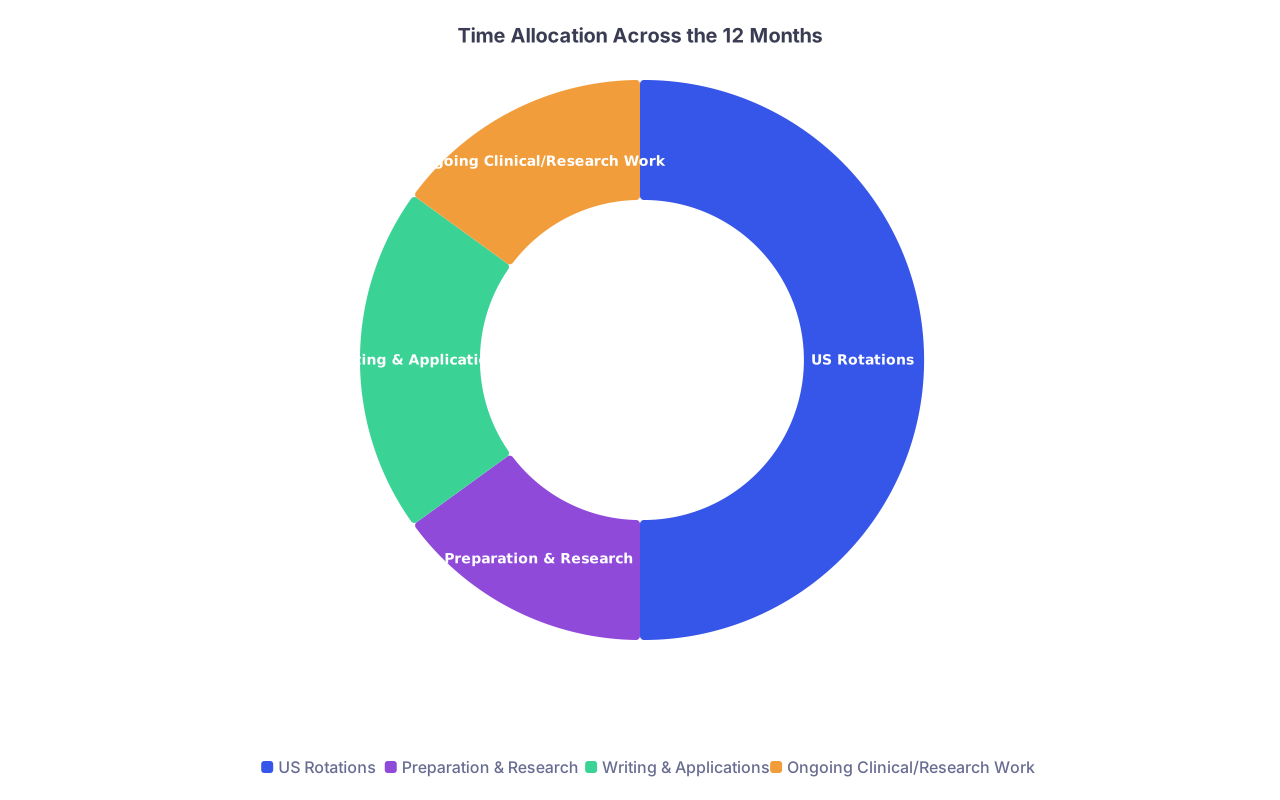
| Category | Value |
|---|---|
| US Rotations | 50 |
| Preparation & Research | 15 |
| Writing & Applications | 20 |
| Ongoing Clinical/Research Work | 15 |
Final Thoughts: What Actually Matters
By the end of this 12‑month countdown, your US clinical narrative should do three things:
Show a clear, believable progression – from early exposure to focused specialty experience, with growing responsibility and insight.
Align every document and letter – personal statement, ERAS entries, LORs, and your interview answers all tell the same story from different angles.
Prove you can function in the US system on day one of residency – not just “I shadowed,” but “I understand the workflow, culture, and expectations, and I’ve already been operating as close to an intern as the system allows.”
If you build that over 12 months, you’re not just another IMG with okay scores. You’re a coherent, compelling future resident whose path into US medicine actually makes sense.