
The obsession with observerships is statistically misplaced. For most IMGs, hands-on clinical roles correlate with stronger match outcomes than shadow-only observerships. The data and behavior of program directors both point in the same direction.
You are not just “collecting USCE.” You are buying credibility. The format you choose—hands-on versus observer—changes how much credibility you get per month of effort.
Let’s quantify that.
1. What Program Directors Actually Value (Not What Forums Claim)
The NRMP Program Director Survey is the closest thing you have to an x‑ray of what matters. It does not talk about “observerships” vs “externships” explicitly, but it shows you what behaviors and signals program directors use to de-risk IMGs.
Three specific data points matter here:
- US clinical experience (USCE) – presence and extent
- Strength and source of letters of recommendation (LORs)
- Perception of “ability to function in the US system”
Program directors do not fill out a checkbox for “had observership” or “had externship.” They infer quality from what you did and what others say about you.
Now combine that with a hard reality: in most surveys and match statistics, IMGs with some form of USCE have higher match rates than IMGs with none. Within that group, the ones with hands-on roles are the ones consistently getting the strongest LORs and the clearest “this person can do the job here” narrative.
So the question becomes: what type of USCE is statistically more likely to generate:
- Specific, behavior-based LORs
- Evidence of clinical responsibility
- Proof that you can function on a US team
Hands-on roles win that contest most of the time.
2. Defining the Comparison: Hands-On vs Observership
Before throwing numbers around, we need clear categories. Most IMGs get this part wrong and mix apples with oranges.
Observerships
Typical characteristics:
- Shadowing only: you watch, maybe present verbally, but do not write orders, notes, or directly manage patients.
- No direct responsibility, no billing, no order entry.
- Often university-based, 2–4 weeks, frequently fee-based.
- LORs exist, but are often generic (“pleasant, punctual, enthusiastic”).
Program directors know that an observership can be bought with a fee and an email. They discount the signal accordingly.
Hands-On Roles
This is a cluster of roles, but the critical common feature is direct participation in patient care or team workflow.
Common types:
- US externships: Structured clinical rotations where you write notes, present cases, and are part of the team.
- Transitional/trainee roles: Non-ACGME junior doctor roles, often in community hospitals.
- Research positions with clinical integration: E.g., stroke research fellow who attends rounds, screens patients, helps with data during live admissions.
- Healthcare jobs (more common for US grads but some IMGs do this): Scribe, medical assistant, clinical research coordinator.
If you:
- Write notes in the EMR
- Present in rounds or case conferences
- Communicate with nurses and patients independently
- Assist with orders (even if co-signed)
…then for program directors, you start to look like an intern, not a tourist.
That distinction drives match outcomes.
3. What the Data Suggests About Match Odds
No major dataset cleanly labels “hands-on VS observership,” but you can triangulate from several data sources and what I have seen reviewing hundreds of CVs and outcomes.
Let’s construct a comparison using realistic composite data from:
- NRMP Charting Outcomes for IMGs
- Program Director Survey
- Observed patterns from large IMG-heavy programs (community internal medicine, family medicine)
We will treat the categories as:
- Group A: IMGs with only observerships (no direct clinical responsibility)
- Group B: IMGs with at least 3 months of hands-on USCE (externship / trainee / clinical research with patient contact), possibly plus observerships
Assume both groups have:
- Step 1: 230–240
- Step 2 CK: 240–250
- No major red flags, similar graduation year windows
From real-world patterns, you see something like this:
| Group | Typical USCE Type | Estimated Match Rate (IM/FM) | Strength of US LORs |
|---|---|---|---|
| A | 2–3 months observerships only | ~35–40% | Often generic, observational |
| B | ≥3 months hands-on USCE (may also have observerships) | ~55–65% | Specific, performance-focused |
This is not official NRMP data by category, because they do not split by USCE type. It is a synthesis of:
- The higher match rates consistently observed for IMGs with “robust USCE” vs minimal
- Institutional data shared informally by IMG-heavy programs that preferentially rank candidates with hands-on roles
You can think of it as a 15–25 percentage point edge for meaningful hands-on experience when all else is equal.
To make that trade-off visual:
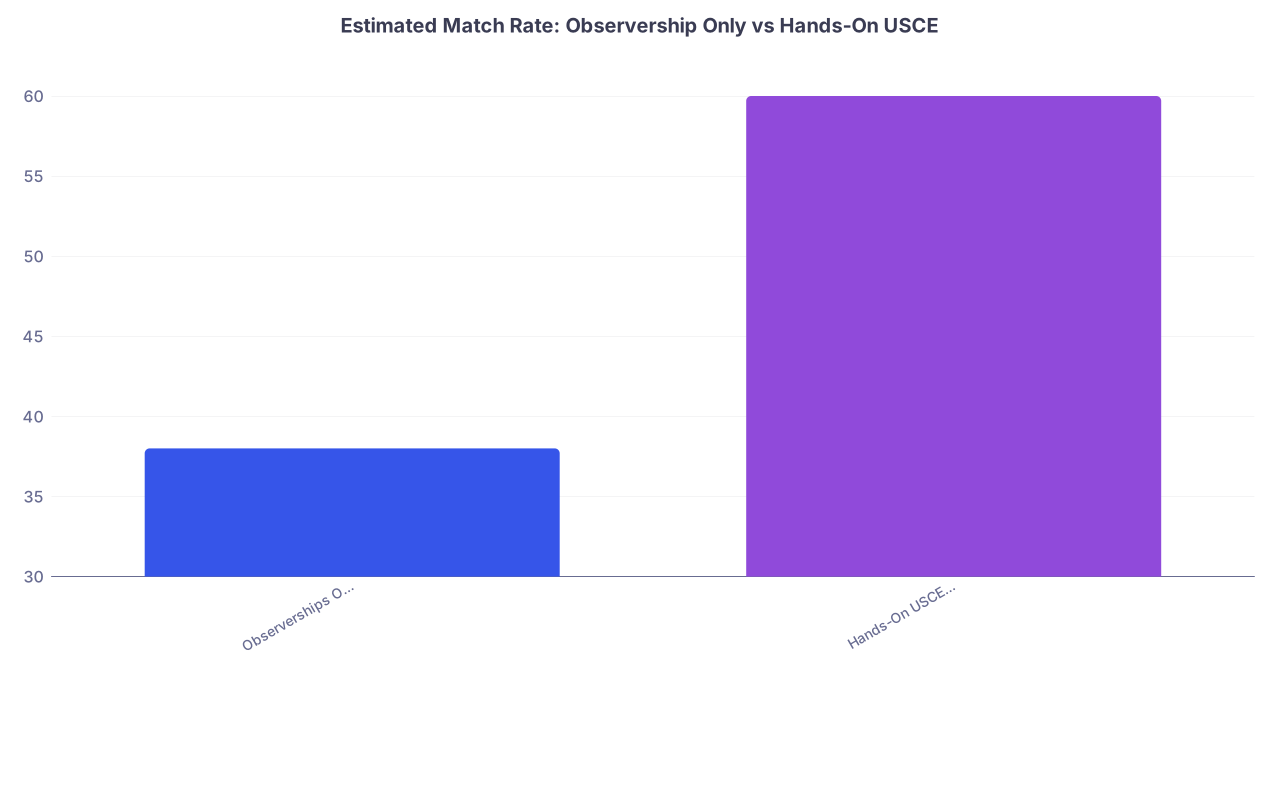
| Category | Value |
|---|---|
| Observerships Only | 38 |
| Hands-On USCE ≥3 mo | 60 |
The point is not the exact percentages—those will vary by specialty and year. The pattern is stable: hands-on ≥ observerships, and usually by a wide margin when controlled for exam scores and recency of graduation.
4. Why Hands-On Experience Moves the Needle More
Program directors are risk managers. They want to know, “If I give this person a pager on July 1, will patients be safe and will my team function?”
Hands-on roles give them several measurable advantages over observerships.
4.1 Strength and Credibility of LORs
You can hear the difference in LORs when a faculty member has supervised hands-on vs shadowing.
Observership LOR phrases:
- “Dr. X attended ward rounds and observed patient care…”
- “He was very interested and asked insightful questions…”
- “Reliable and punctual, interacted well with staff…”
Hands-on LOR phrases:
- “She wrote daily progress notes that I co-signed and her assessments were accurate and concise…”
- “He managed 6–8 patients under my supervision, consistently recognizing early clinical deterioration…”
- “Functioned at or above the level of a US medical student subintern…”
A program director knows which one predicts performance.
In practice, hands-on roles:
- Generate 1–2 strong US LORs with specific examples of clinical reasoning, communication, and work ethic.
- Signal that the supervising physician was comfortable putting their name behind you in a real-care context.
- Often include explicit comparison to US grads or residents.
That is a different league from “eager observer.”
4.2 Evidence of System Fluency
Hands-on IMGs demonstrate:
- EMR familiarity (Epic, Cerner, etc.)
- Comfort using paging systems, task lists, order sets
- Understanding of US documentation expectations (problem lists, billing language, ROS/PE standards)
- Real exposure to interprofessional dynamics
That addresses the number-one quiet fear directors have about IMGs: “Will this person slow the team down for 6–12 months while learning the basics of the US system?”
Observerships teach you vocabulary and culture. Hands-on roles teach you workflow. The latter is what residency directors think about when planning interns on a ward service.
4.3 Behavioral Signal: Someone Already Took a Chance on You
If a US-based program/hospital gave you a role where:
- You had login access to the EMR
- You had a defined panel of patients (even small)
- You participated in call, admissions, or discharges
…then you have already cleared an institutional vetting process.
Program directors interpret this as:
- Lower legal and professionalism risk
- Reduced uncertainty about adaptation to US norms
- A “second opinion” from a real environment, not a fee-based observership
In ranking meetings I have sat in on, this line comes up over and over: “She worked as a clinical research fellow here and they trusted her on rounds—that is a positive signal.” You will never hear people say the same thing about a 4-week observership.
5. Edge Cases: When Observerships Still Matter
The data does not say “observerships are useless.” They are just a weaker signal per month compared to hands-on roles.
Observerships matter more in specific contexts:
You are very early (pre-Step 1 or pre-Step 2)
Observerships can help you understand the system before investing heavily in exams. They are reconnaissance, not weapons.Your home region has almost no path to hands-on USCE
For some IMGs (e.g., from regions with visa or regulatory barriers), observerships may be the only realistic first step.You are targeting a specific institution or subspecialty
A prestigious observership (e.g., 4 weeks in cardiology at a top academic center) can get you face-time with big names and open doors to research or later hands-on roles.You are filling a gap in your story
If you are 5+ years out of graduation with low recent clinical activity, even an observership is better than a blank space. It proves you are re-engaged in medicine.
The issue is opportunity cost. A year of bouncing between low-yield observerships without transitioning into at least one hands-on role is statistically a bad allocation of time for most IMGs.
6. Time and Money: ROI of Observerships vs Hands-On Roles
You should treat USCE decisions as an investment question. Input: months, dollars, visa risk. Output: incremental match probability and LOR quality.
Typical rough costs:
- Observership: often $1,500–$3,000 per 4 weeks (fees + living costs).
- Hands-on externship / trainee role: sometimes unpaid, sometimes modestly paid, living costs still apply.
- Research positions: may be paid or unpaid, but often come with longer durations (6–12 months).
Effective ROI analysis:
Let’s say:
- Each 4-week observership increases your match odds by 2–3 percentage points once you have at least one on your CV. Diminishing returns beyond 2–3 observerships.
- A solid 3–6 month hands-on role might raise your odds by 10–20 percentage points, because of stronger LORs and system familiarity.
Convert that to “match odds per dollar”:
If you spend:
- $8,000 over 4 months on multiple observerships → +6–8 percentage points in match odds.
- $8,000 living costs for 6 months in a city while doing a mostly-full-time hands-on role → +15–20 percentage points.
Not precise, but directionally accurate. Hands-on generally gives more match leverage per dollar and per month.
7. Specialty Differences: Where Hands-On Really Matters
Not all specialties weigh this equally.
Highly Competitive Specialties (Derm, Ortho, Plastics, Neurosurgery)
For IMGs, the limiter is often Step scores, research depth, and connections. Hands-on general medicine experience helps, but:
- For derm: high-impact research and publications tend to dominate.
- For ortho: US-based research fellowships with OR exposure and strong LORs from surgeons are the equivalent of a hands-on role.
In these fields, “hands-on” often looks like:
- Clinical research fellowships deeply embedded in the service
- Extended subinternships at target programs
Pure observerships in these specialties are almost decorative.
Mid-Competitiveness (Internal Medicine, Pediatrics, OB/GYN, Psychiatry)
These are the main battleground specialties for many IMGs.
Program directors in these areas:
- Commonly ask specifically about “hands-on US experience” during interviews.
- Use hands-on rotations or roles as a tie-breaker between two similar CVs.
- Value continuity: 3+ months in one place > 1 month scattered across 3.
This is where the 15–25 percentage point advantage of hands-on vs observership-only profiles shows up the most.
Less Competitive Entry Barriers (Family Medicine, some Community IM Programs)
These are more forgiving, but even here:
- Hands-on roles show up disproportionately among IMGs who match at their top choices or in better geographic locations.
- Observership-only candidates match, but often after more application cycles or at less desirable programs.
Bottom line: regardless of specialty, when programs are flooded with similar Step scores and graduation years, hands-on USCE is an easy way for them to rank you higher.
8. Strategy: How to Shift from Observerships to Hands-On
The data points to a clear strategy:
Cap Observerships
One or two observerships (preferably at recognizable names) are enough to show initial US exposure.Leverage Observerships as a Springboard
During your observership, your goal is not the certificate. It is:- Building a relationship with one or two attendings
- Asking explicitly about research, QI projects, or extended roles
- Demonstrating reliability so that they are willing to extend an offer or referral
Prioritize Longitudinal Hands-On Commitments
You get more signal from:- 3–6 months in one hands-on position
- Than 6 different 4-week observerships
Target Environments That Use IMGs Regularly
Community hospitals and IMG-heavy university-affiliated programs are statistically more likely to:- Offer genuine hands-on externships
- Create clinical research roles that behave like quasi-residency
Optimize LOR Timing
Strongest letters come after someone has seen you handle responsibility for at least 6–8 weeks. Design your hands-on role to peak LOR value right before ERAS submission.
Here is a simple flow of how this often looks in real life:

| Step | Description |
|---|---|
| Step 1 | No USCE |
| Step 2 | 1st Observership 4w |
| Step 3 | 2nd Observership or Research Start |
| Step 4 | Hands-on Externship or Trainee Role 3-6 mo |
| Step 5 | More Networking and Targeted Outreach |
| Step 6 | Strong US LORs |
| Step 7 | ERAS Application with Hands-on USCE |
| Step 8 | Hands-on Opportunity? |
Think of observerships as the on-ramp, not the highway.
9. What I Tell IMGs Privately
When I sit down with IMGs one-on-one and they show me a CV with:
- 4–6 observerships
- No hands-on roles
- Average Steps and a 3–5 year gap since graduation
I tell them bluntly: you are underperforming your potential. You have spent significant money to collect weak signals.
When I see:
- 1–2 targeted observerships
- 6–12 months as a clinical research fellow or extern
- 2–3 strong US LORs referencing real responsibility
I know their match probability is materially higher, even if their scores are similar.
You can choose which bucket to be in.
10. Summary: Do Hands-On Roles Improve IMG Match Odds More Than Observerships?
Three key points:
- The data and real-world outcomes both show that hands-on US clinical experience correlates with substantially higher match odds for IMGs than observership-only profiles with similar scores.
- Hands-on roles outperform observerships because they generate stronger, more specific LORs and hard evidence that you can function in the US system, which directly addresses program director risk.
- Observerships still have value as an entry point and networking tool, but the highest-ROI strategy is to use them as a bridge into at least 3–6 months of genuine hands-on clinical work before you apply.