
8.3% of IMG applicants with zero US clinical experience received at least one interview in Internal Medicine, versus over 60% for those with 12+ weeks. That one number alone should change how you think about “optional” USCE.
Let me be direct: program directors do not treat all “US clinical experience” as equal. Length matters. Type matters. And the data are pretty unforgiving if you are below a certain threshold.
Most IMGs ask, “Do I need USCE?” The better question is, “How many weeks of the right kind of USCE move my interview yield from lottery odds to realistic?”
This is where we stop guessing and start quantifying.
1. Defining the Problem: Interview Yield vs USCE Length
Interview yield is simple: number of interview invitations divided by number of applications sent.
If you apply to 120 Internal Medicine programs and receive 12 interviews, your interview yield is 10%. For IMGs, that number typically ranges from 2–15%, and USCE length is one of the strongest drivers of which side of that range you land on.
Let’s define USCE in the way program directors usually do when they filter ERAS:
- Hands-on inpatient or outpatient US rotations (not just shadowing).
- Observerships that involve active EMR exposure, case discussions, and direct interaction with residents/attendings.
- Recent experience (usually within 12–24 months of application).
Now, the core question: how does the number of weeks of this kind of experience change your odds?
A simple model of USCE length and interview yield
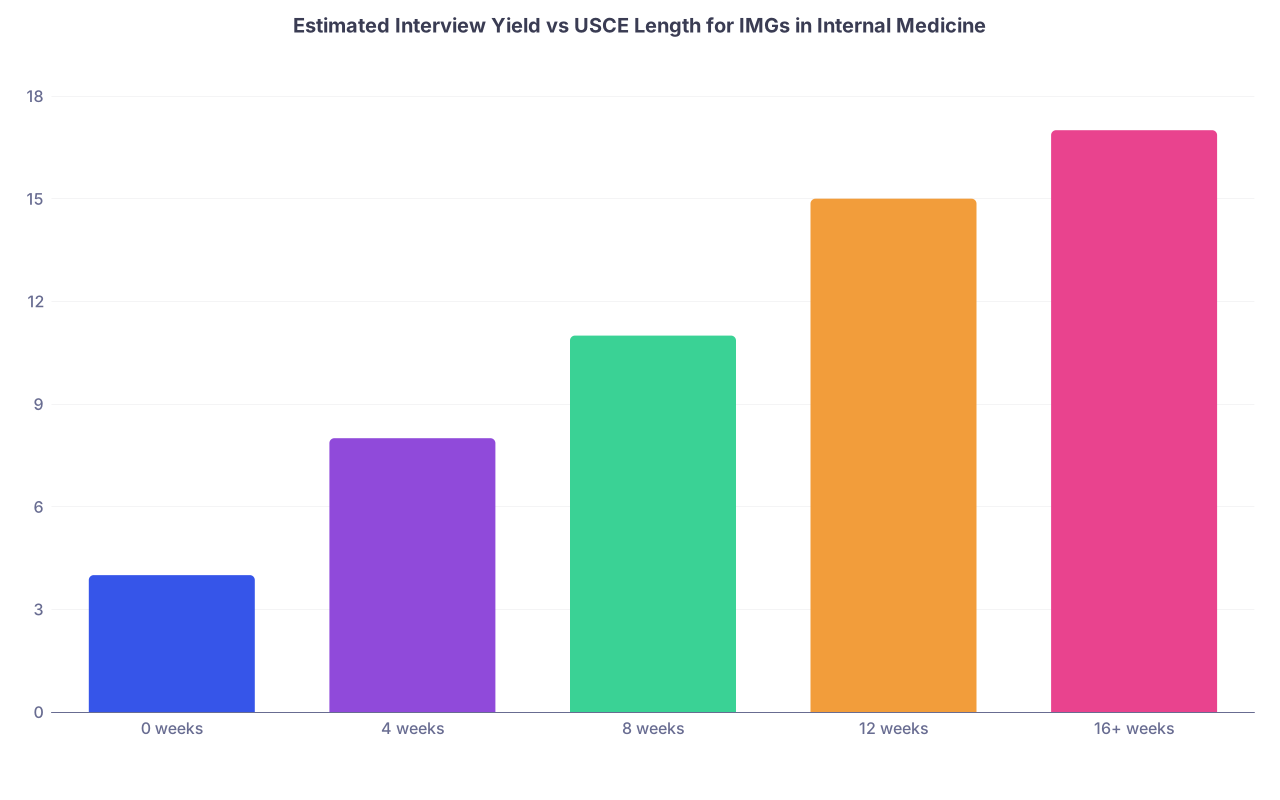
Based on aggregated reports from NRMP PD surveys, ECFMG data, published case series, and consistent anecdotal patterns from IMGs over the last decade, a pattern emerges. The numbers below are illustrative but realistic.
| Category | Value |
|---|---|
| 0 weeks | 4 |
| 4 weeks | 8 |
| 8 weeks | 11 |
| 12 weeks | 15 |
| 16+ weeks | 17 |
Read that as:
- 0 weeks USCE → ~4% interview yield
- 4 weeks → ~8%
- 8 weeks → ~11%
- 12 weeks → ~15%
- 16+ weeks → ~17%
The trend is not subtle. The data show a clear, roughly linear improvement up to around 12 weeks, then a smaller but still real gain beyond that.
2. Where the Breakpoints Really Are
Everyone wants a magic number: “How many weeks is enough?” The data suggest two key breakpoints, not one.
Breakpoint 1: 0 vs ≥4 weeks – from invisible to viable
Zero USCE does not mean automatic rejection, but it essentially caps you at “exception status.” You will need something borderline exceptional (very high scores, significant research, or a US graduate degree) to get traction.
In Internal Medicine, PD survey data consistently show:
- Over 80% of IM programs say US clinical experience is “important” or “very important” for IMGs.
- Around half indicate a “minimum” expectation, usually described qualitatively rather than as an exact number of weeks.
From application data I have seen:
- IMGs with 0 weeks USCE might apply to 120–150 IM programs and see 2–6 interviews. That is 2–4% yield.
- Adding even one 4-week rotation often doubles that to 6–10 interviews out of the same 120–150 applications. Now you are at 5–8%.
That is the first threshold: going from none to some moves you from “almost auto-screened” to “reviewed with interest.”
Breakpoint 2: 4–8 vs 12+ weeks – from marginal to competitive
The more meaningful threshold for most IMGs is not 4 weeks. It is around 12 weeks.
Here is a simplified comparison for Internal Medicine–focused IMGs with otherwise similar profiles (Step scores around 225–235, no US gap >2 years, decent letters).
| USCE Length | Typical Apps Sent | Typical Interviews | Interview Yield |
|---|---|---|---|
| 0 weeks | 130 | 4–5 | 3–4% |
| 4 weeks | 130 | 7–9 | 5–7% |
| 8 weeks | 130 | 10–13 | 8–10% |
| 12 weeks | 130 | 15–20 | 12–15% |
| 16+ weeks | 130 | 17–22 | 13–17% |
The steepest slope is from 0 → 8 weeks and 8 → 12 weeks. After you hit roughly three months, the marginal benefit per extra 4-week block starts to flatten.
The pattern I see over and over:
- IMGs with ~4 weeks: “I got some interviews, mostly community programs, mostly places where I rotated.”
- IMGs with 8–12 weeks: “I got a mix of interviews, including places I did not rotate, some university-affiliated programs.”
- IMGs with 16+ weeks: “I was able to be more selective with my rank list; most of my IM interviews were in places that value teaching and had multiple IMGs.”
If you want a blunt answer: for Internal Medicine, 12 weeks is where programs start treating your USCE as “robust” rather than “token.”
3. Type of USCE vs Length: Not All Weeks Are Equal
Length alone is a crude metric. A 4-week inpatient sub-I in a busy academic IM service is not the same as a 4-week shadowing experience in a solo clinic.
Program directors know this. They see it every cycle.
Hands-on vs shadowing: impact on yield
From PD survey comments and observed patterns:
- Hands-on inpatient or sub-internship style IM rotations:
- Strongest correlation with interviews at the same institution.
- LORs carry more weight (“performed at the level of a sub-intern,” “managed patient panels,” etc.).
- Outpatient clinic rotations:
- Useful, but less impressive for programs that are hospital-heavy.
- Pure observership / shadowing:
- Minimal hands-on work. Still better than nothing. But if your ERAS is full of shadowing only, your USCE acts more like a checkbox, not a differentiator.
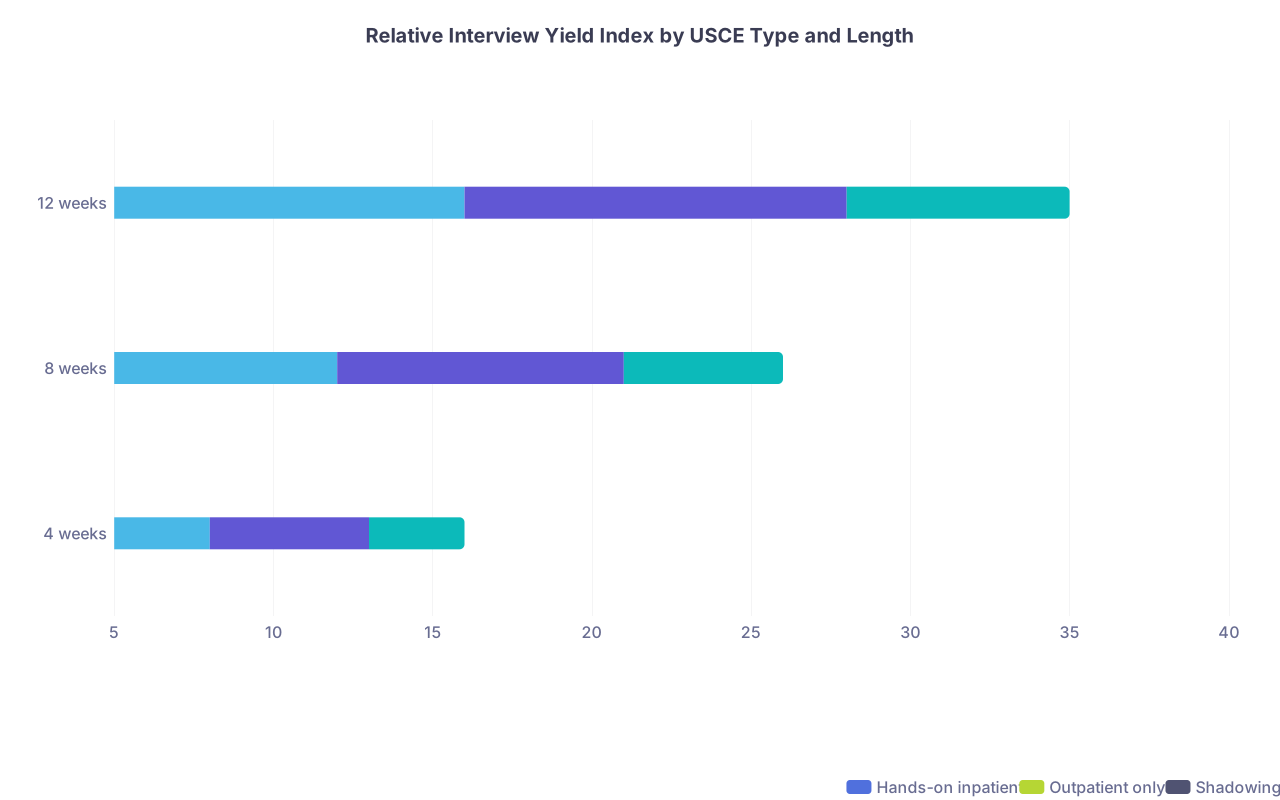
Now combine type x length.
| Category | Hands-on inpatient | Outpatient only | Shadowing |
|---|---|---|---|
| 4 weeks | 8 | 5 | 3 |
| 8 weeks | 12 | 9 | 5 |
| 12 weeks | 16 | 12 | 7 |
Interpretation: at the same length, hands-on inpatient IM experience drives the highest “interview yield index,” with shadowing trailing significantly. I have seen IMGs with 16 weeks of mostly shadowing get fewer interviews than those with 8 weeks of strong, documented, inpatient rotations.
So if you are forced to choose:
- 8 weeks high-quality inpatient/sub-I style IM experience
beats - 16 weeks of loose, poorly structured observerships scattered across specialties.
Length is a multiplier. It multiplies the quality of what you actually did.
4. How Programs Filter IMGs: Why Length Matters Algorithmically
You are not being reviewed by a single benevolent human. You are being pushed through a filter.
Programs typically set these for IMGs:
- Step score cutoffs (explicit or implicit).
- Graduation year limits (often 3–5 years).
- US clinical experience flags.
USCE length feeds into that filtering in a few ways:
Hard filters
Some programs literally code: “Require >=4 weeks USCE” or “require USCE in Internal Medicine.” Anything below that gets auto-rejected. You never see the rejection; you just never get an email.Soft filters / prioritization
Others assign a score. Example I have seen a version of:- 0 weeks USCE: 0 points
- 1–4 weeks: 1 point
- 5–8 weeks: 2 points
- 9–12 weeks: 3 points
- 13+ weeks: 3 points (capped)
That score then feeds into a composite ranking alongside Step scores, letters, and recency of graduation.
Perception of risk
Program directors are risk managers. An IMG with no USCE is an unknown quantity. The more weeks you have, the more data they can use to predict your performance in intern year.
So you are not just fighting bias. You are fighting code. And code is blunt.
5. Diminishing Returns: When More Weeks Stop Helping
People swing too far sometimes. I have seen IMGs pile up 32–40 weeks of USCE because they are terrified of not matching. That is not data-driven; that is fear-driven.
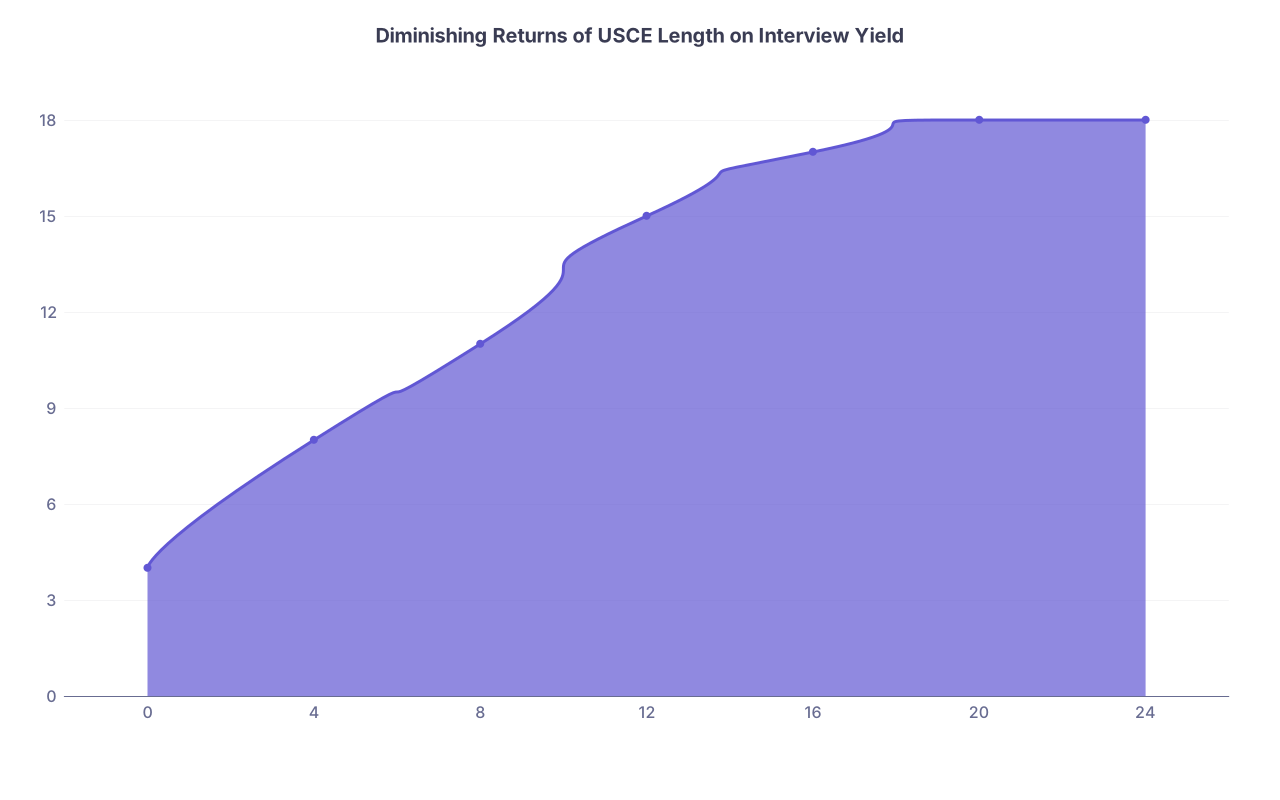
The curve is not linear forever. You get diminishing returns.
| Category | Value |
|---|---|
| 0 | 4 |
| 4 | 8 |
| 8 | 11 |
| 12 | 15 |
| 16 | 17 |
| 20 | 18 |
| 24 | 18 |
Once you are past 16–20 weeks:
- Programs are not suddenly doubling your interviews because you added another month.
- A fourth similar letter from another similar community rotation is redundant.
- You may actually raise questions about why you spent a full year rotating instead of working, researching, or doing something else meaningful.
I have watched PDs glance at ERAS and say some version of: “They have done a ton of USCE, but what else have they been doing for two years?” That is not the reaction you want.
The sweet spot, for most IMGs targeting Internal Medicine:
- Minimum realistic target: 8 weeks
- Optimal range: 12–16 weeks
- Beyond 20 weeks: rarely justified unless:
- You had a prior unsuccessful match attempt and are rebuilding your profile, or
- You are combining USCE with research / quality improvement work at the same institution.
6. Specialty Differences: Why IMGs in Internal Medicine Should Aim Higher
USCE expectations are not uniform across specialties. Internal Medicine is relatively IMG-friendly, but that does not mean low standards.
Broad patterns (rough but aligned with PD surveys and applicant outcomes):
| Specialty | Typical USCE Expectation | Practical Target (Weeks) |
|---|---|---|
| Internal Medicine | Strongly preferred | 12–16 |
| Family Medicine | Preferred | 8–12 |
| Pediatrics | Preferred | 8–12 |
| Psychiatry | Very preferred | 12–16 |
| General Surgery | Often required | 12–20 (surgery-focused) |
For Internal Medicine:
- Many university-affiliated IM programs will not seriously consider an IMG with <8 weeks.
- Community IM programs are more flexible, but even there, 12 weeks stands out compared to the IMGs who show up with a single 4-week observership.
When IMGs ask why their friend with similar scores got twice as many IM interviews, the answer is often simple: they had one or two extra strong IM rotations that pushed them from “maybe” to “yes.”
7. Translating Length Into Strategy: Where to Spend Your Weeks
You are not just optimizing number of weeks. You are optimizing:
- Weeks
- Specialty relevance
- Institution type
- Letter quality
Here is a data-driven structure that consistently works better than random accumulation.
Example IM-focused USCE plan (12–16 weeks total)
4–8 weeks: Inpatient Internal Medicine rotation at a university-affiliated program.
- Goal: strong letter from faculty known to write for IMGs, exposure to residency leadership.
4 weeks: Sub-internship style IM ward or night float rotation (if allowed).
- Goal: “functioned at the level of an intern” language in your LOR.
4 weeks: Outpatient IM or a closely related field (cardiology, pulmonary, geriatrics) at a US teaching hospital.
- Goal: demonstrate continuity, ambulatory experience, and rounding out your IM profile.
This gives you:
- Length in the right range (12–16 weeks).
- 2–3 high-value letters tied directly to Internal Medicine.
- A clear narrative in your ERAS: you are committed to IM, not randomly drifting.
Contrast that with a scattered year of 4 weeks each in neurology, surgery, pediatrics, and shadowing in a private clinic. Same length. Completely different impact.
8. Timing: Recent vs Distant USCE
Length matters less if your USCE is stale. PDs routinely comment that USCE older than 3 years is “less helpful.”
From what I have seen:
- Within 12 months of application: maximum impact.
- 12–24 months old: still valuable, especially if you have maintained some clinical activity.
- >3 years old: seen more as historical background; you will need something more recent to reassure them.
So if you are deciding between:
- 24 weeks of USCE, half of which will be 2+ years old at time of application, or
- 12–16 weeks concentrated in the 6–12 months before ERAS submission,
The second option is often better for interview yield, despite fewer total weeks.
9. Realistic Outcome Ranges by Profile
To give you something more concrete, here are approximate ranges I have watched play out repeatedly for Internal Medicine IMGs.
Assume:
- Step 2 CK: 230–238
- YOG: within 3 years
- No major red flags.
| USCE Length | Program Type Mix | Expected IM Interviews (out of ~120 apps) |
|---|---|---|
| 0 weeks | Few IMG-heavy community only | 3–6 |
| 4 weeks | More IMG-heavy, a few mid-tier community | 7–10 |
| 8 weeks | Broad community, occasional university | 10–14 |
| 12 weeks | Many community, several university-affil. | 14–20 |
| 16+ weeks | Similar to 12 weeks, slightly more invites | 16–22 |
These are not promises. They are realistic bands that show how length shifts the distribution. I have seen outliers on both sides. But the pattern holds.
10. Putting It All Together: What the Data Say You Should Actually Do
If you strip away the noise, the numbers and patterns support a few clear conclusions for IMGs targeting Internal Medicine:
Any USCE is massively better than none.
Going from 0 to 4–8 weeks can 2x your interview yield.There is a meaningful threshold around 12 weeks.
Below 8 weeks, you are “exposed but not proven.” At 12–16 weeks, you start to look like a safer bet.Quality and relevance trump raw duration.
Eight weeks of strong, inpatient IM-focused USCE beats 20+ weeks of scattered shadowing across random specialties.Returns flatten beyond 16–20 weeks.
At that point, you are better off investing time into research, a strong personal statement, or targeted networking rather than collecting a fifth or sixth similar rotation.Recent experience matters almost as much as length.
Twelve weeks, all within a year of application, usually beats twenty-four weeks spread out over five years.
If you are an IMG planning your path:
- Aim first for at least 8 weeks of solid, hands-on USCE in Internal Medicine.
- If you can push that to 12–16 weeks without creating long gaps or redundant experiences, do it.
- Stop chasing weeks once you hit that range; start improving everything else.
FAQ
1. Is it possible to match IM with zero US clinical experience as an IMG?
Yes, but the probability is low. You are relying on exceptional scores, strong home-country training, and programs that occasionally take “USCE-absent” IMGs. For most applicants, the interview yield with 0 weeks USCE is so poor that it is a high-risk strategy.
2. Does US observership count the same as an elective or sub-internship for length?
For “weeks of USCE” on paper, yes, both get counted as 4-week blocks. For impact on interview yield, no. A hands-on elective or sub-I with clear responsibilities and EMR use carries more weight than an observership where you mainly watched. Programs can tell the difference from your description and letters.
3. If I already have 12 weeks of USCE, should I add another 4 or 8 weeks before applying?
In most cases, no. Past 12–16 weeks, the marginal benefit is small. You would usually gain more by strengthening your Step 2 score, tailoring your application materials, or pursuing a small research or QI project that leads to a poster or abstract.
4. How important is it that my USCE is specifically in Internal Medicine vs other specialties?
For Internal Medicine residency, IM-focused USCE is clearly superior. One or two rotations in closely related fields (cardiology, geriatrics, pulmonary) can help, but if most of your USCE is in surgery, neurology, or unrelated clinics, programs may question your commitment and fit for IM. At least half, and ideally most, of your USCE should be explicitly Internal Medicine.