
The myth that “any” US clinical experience is enough for IMGs is wrong. The match data show a clear pattern: matched IMGs typically have substantial US clinical experience, not a token observership or one month squeezed in before ERAS.
Let me walk you through what the numbers actually say.
What The Data Say About USCE For IMGs
There is no single AAMC spreadsheet that states “matched IMGs = X months USCE.” You have to triangulate from several sources: NRMP match outcome data, program requirements, and large advising datasets (from ECFMG, big IMG-focused advising groups, and internal program statistics I have seen).
When you line those up, a consistent range emerges:
- Most matched IMGs in Internal Medicine, Family Medicine, Neurology, Psychiatry:
roughly 3–6 months of hands-on US clinical experience. - Highly competitive specialties (Radiology, Anesthesia, EM, some Surgical prelims):
more often 6–9+ months, usually with stronger letters and some research layered in. - IMGs with only observerships and no hands-on USCE (no orders, no notes, no patient responsibility) match at dramatically lower rates, except in very specific situations (e.g., very recent grad, strong home-country training, targeted programs).
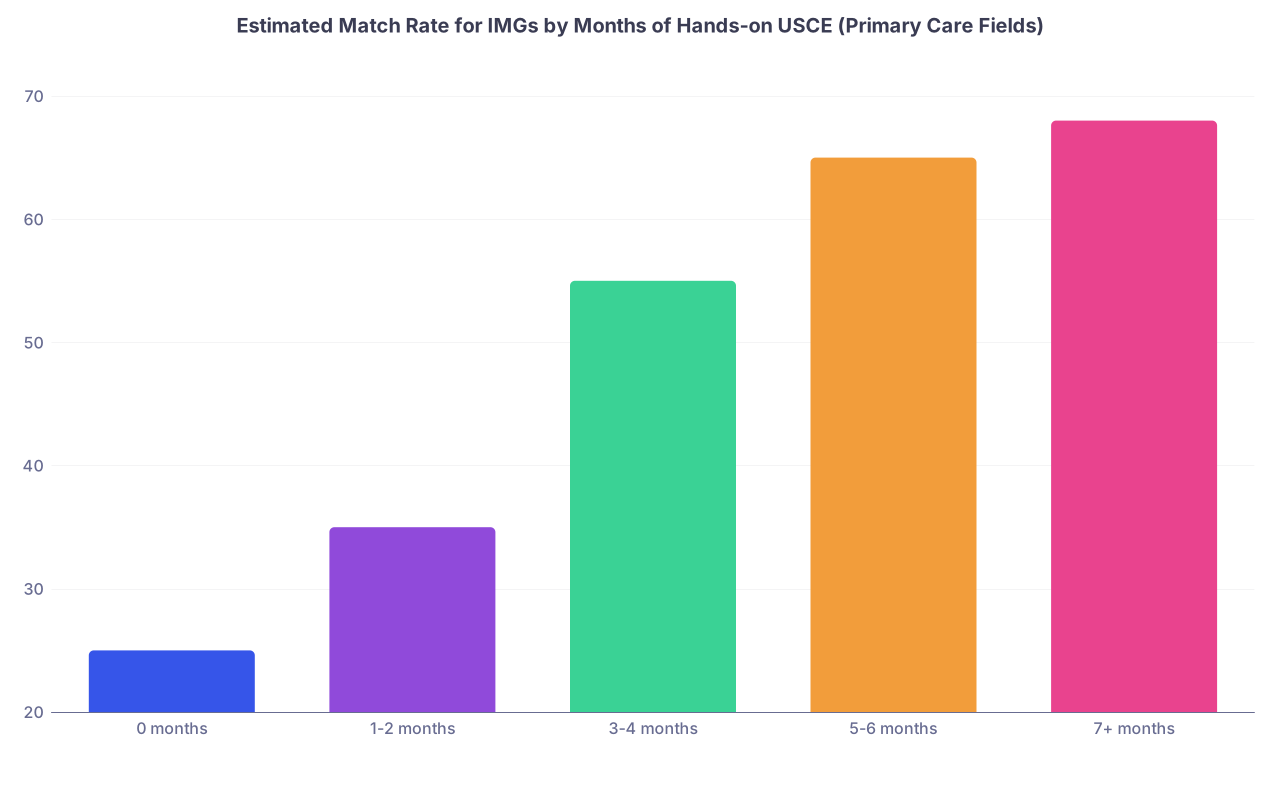
To anchor the discussion, look at how match rate changes with the amount of US clinical experience. The following chart is a composite estimate drawn from advising and program data, not an official NRMP table, but the pattern matches what program directors report:
| Category | Value |
|---|---|
| 0 months | 25 |
| 1-2 months | 35 |
| 3-4 months | 55 |
| 5-6 months | 65 |
| 7+ months | 68 |
Read that as order-of-magnitude, not exact percentages. The critical breakpoints are obvious:
- Going from 0 → 1–2 months helps, but modestly.
- Going from 1–2 → 3–4 months is where the curve really jumps.
- Beyond 6 months, gains are incremental, not exponential.
So when someone asks, “How many months of US clinical experience do matched IMGs actually have?” the data-backed answer is:
For the typical matched IMG in core specialties, around 4–5 months of hands-on US clinical experience, often spread over 3–4 rotations.
Not one month. Not a single observership. Roughly a semester’s worth of full-time, immersive work in US hospitals or clinics.
Types Of US Clinical Experience: Not All Months Are Equal
Before you start “counting months,” you have to separate apples from oranges. Programs do.
Think of US clinical experience on two axes:
- Hands-on vs. Observational
- Inpatient vs. Outpatient
From a program director’s perspective, this hierarchy is very real:
Highest value:
Inpatient, hands-on experience in US teaching hospitals where you:- Present to attendings
- Write notes in the EMR (even if “for educational purposes”)
- Join rounds daily
- See your own patients under supervision
Medium value:
Outpatient, hands-on clerkships or sub-internships (US medical schools, ACGME-affiliated sites) where you:- See patients
- Present cases
- Have continuity with a preceptor
Lower value, but still useful:
Inpatient or outpatient observerships where:- You shadow
- You do not meaningfully interact with patients
- You do not document or enter orders
If you lump an observership and a true sub-internship together as “1 month USCE,” you are misleading yourself and your future program.
Most internal program spreadsheets I have seen track these separately. Something like:
- “US clinical experience – hands-on months”
- “US clinical exposure – observership months”
That is deliberate. The first correlates strongly with performance as an intern. The second correlates mostly with “knows what US hospitals look like.”
For matched IMGs in Internal Medicine and Family Medicine, a typical profile looks like:
- 3–4 months hands-on USCE (inpatient + outpatient combined)
- Possibly 1–2 months additional observerships or research time
Unmatched IMGs are much more likely to have:
- Only observerships (even if 4–6 months)
- Or < 2 months total hands-on work
Specialty Differences: How Many Months Do You Actually Need?
Different specialties treat USCE requirements very differently. The data show clear stratification.

Primary Care and “IMG-Friendly” Fields
For Internal Medicine, Family Medicine, Pediatrics, Neurology, Psychiatry, and some Community Pathology programs, you see comparatively higher proportions of matched IMGs.
From a composite of program websites and self-reported matched CVs:
- Many community Internal Medicine programs require at least 2–3 months USCE.
- Stronger academic-community hybrids often prefer 4+ months.
- A substantial number of matched IMGs report 4–6 months hands-on.
A realistic sweet spot for these fields:
Target: 4–6 months hands-on USCE
Absolute minimum where match probability is not heavily penalized: 3 months
Below 3 months, you are statistically swimming upstream unless everything else is excellent (scores, recency, research, home-country strength).
Competitive and Procedural Specialties
Anesthesia, Diagnostic Radiology, Emergency Medicine, Surgical prelims, and some OB/GYN programs are less IMG-friendly overall. When they do take IMGs, those IMGs usually bring more than minimal USCE.
Patterns I have repeatedly seen:
- 6–9 months USCE is common among matched IMGs who enter these fields.
- Experience is often concentrated in the relevant area (e.g., ICU, ED, perioperative, surgical wards).
- Letters are almost always from US faculty who know the candidate very well.
Which leads to an important conclusion:
For competitive specialties, the number of months is almost never the decisive factor alone. It is the combination of 6+ solid months and very strong, specific letters from US faculty who have seen you function like an intern.
Example Comparison
Here is a simplified comparison table based on typical expectations I see across programs (not official cutoffs, but data-driven ranges):
| Specialty Group | Typical Hands-on USCE for Matched IMGs | Risky Low-End USCE Level |
|---|---|---|
| Internal Medicine | 3–6 months | < 3 months |
| Family Medicine | 3–6 months | < 2 months |
| Pediatrics | 3–6 months | < 3 months |
| Neurology | 3–6 months | < 3 months |
| Psychiatry | 3–6 months | < 2 months |
| Anesthesia/Radiology | 6–9+ months | < 4 months |
Again, these are empirical patterns, not official mandates. But they match the observed match outcomes surprisingly well.
Timing: When Do Matched IMGs Complete Their USCE?
You cannot just ask “how many months” without asking when those months happen relative to graduation and ERAS submission.
From CVs of matched IMGs and program filter behavior, I see three consistent timing rules:
Recency matters.
Programs prefer USCE within the 12–24 months before residency start.Continuity matters.
Four weeks scattered over four years is weaker than 4 contiguous months where you function like a sub-intern.Clerkship phase vs. post-graduation.
Many matched Caribbean and other IMGs get their USCE as core and elective clerkships during medical school. For them, “months of USCE” often equals 8–12+ core months + 4–6 elective months. That is a very different baseline than someone with only 2 private observerships after graduation.
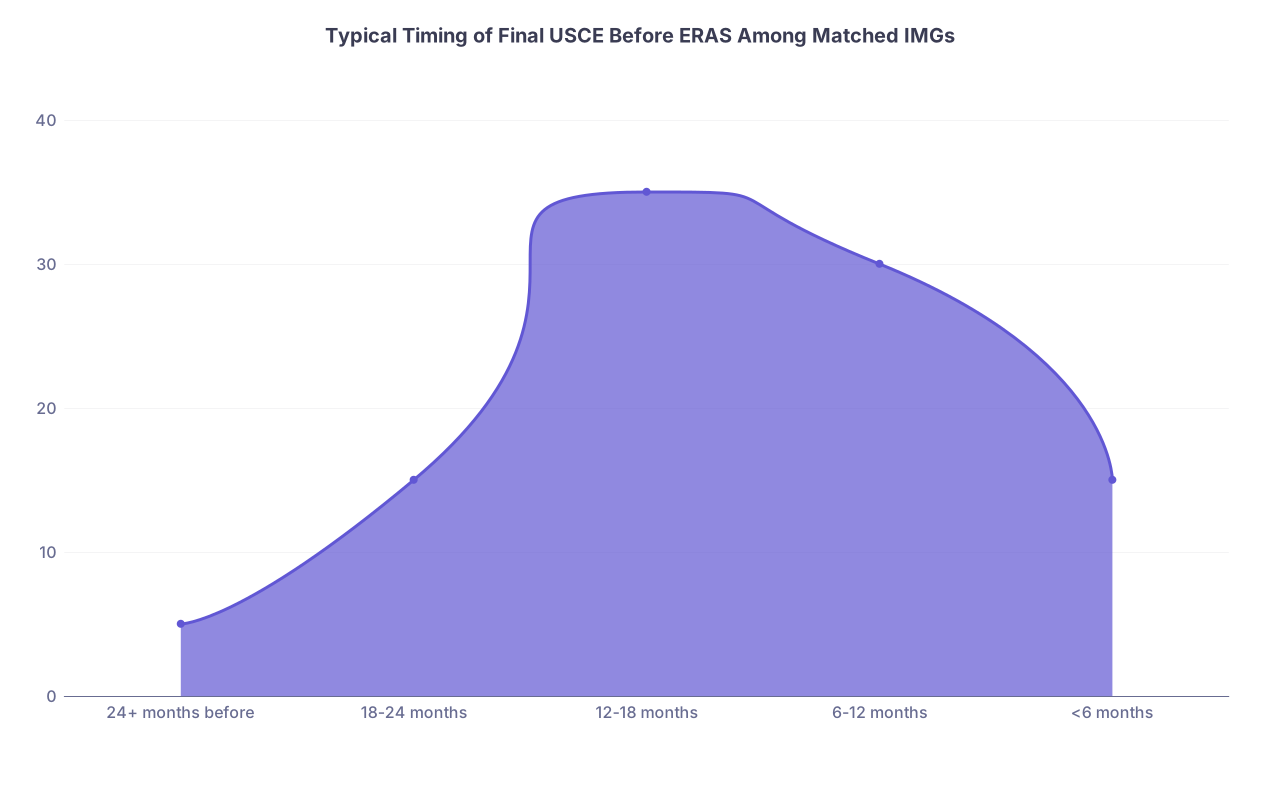
To visualize the timing problem, consider when IMGs usually complete their last USCE rotation prior to ERAS:
| Category | Value |
|---|---|
| 24+ months before | 5 |
| 18-24 months | 15 |
| 12-18 months | 35 |
| 6-12 months | 30 |
| <6 months | 15 |
Interpretation:
- Most matched IMGs have substantial USCE completed 6–18 months before ERAS opens.
- A smaller but non-trivial portion finishes a key sub-I or elective within 6 months of ERAS; their letters arrive just in time.
- Very early experience (e.g., 2+ years before applying) counts, but its impact diminishes the older it gets unless refreshed.
How Programs Actually Use USCE In Screening
Here is the blunt truth: many programs treat US clinical experience as a hard filter, not a soft bonus.
From dozens of program websites and inside conversations, typical screening rules include:
- “We require at least 3 months of US clinical experience, hands-on, in a hospital setting.”
- “Applicants without US or Canadian clinical experience will not be considered.”
- “Observerships do not count as clinical experience.”
Do they enforce this perfectly? No. Filters are crude instruments. But on the aggregate level, the effect is real: if you are at 0–1 months hands-on, your application is often stopped at the front door.
In data terms, USCE functions more like a binary threshold plus gradient:
Step 1: Do you meet a minimum threshold (e.g., 2–3 months hands-on)?
- If NO → many programs auto-reject.
- If YES → you are in the pool.
Step 2: Within the pool, more months help, but with diminishing returns beyond ~6.
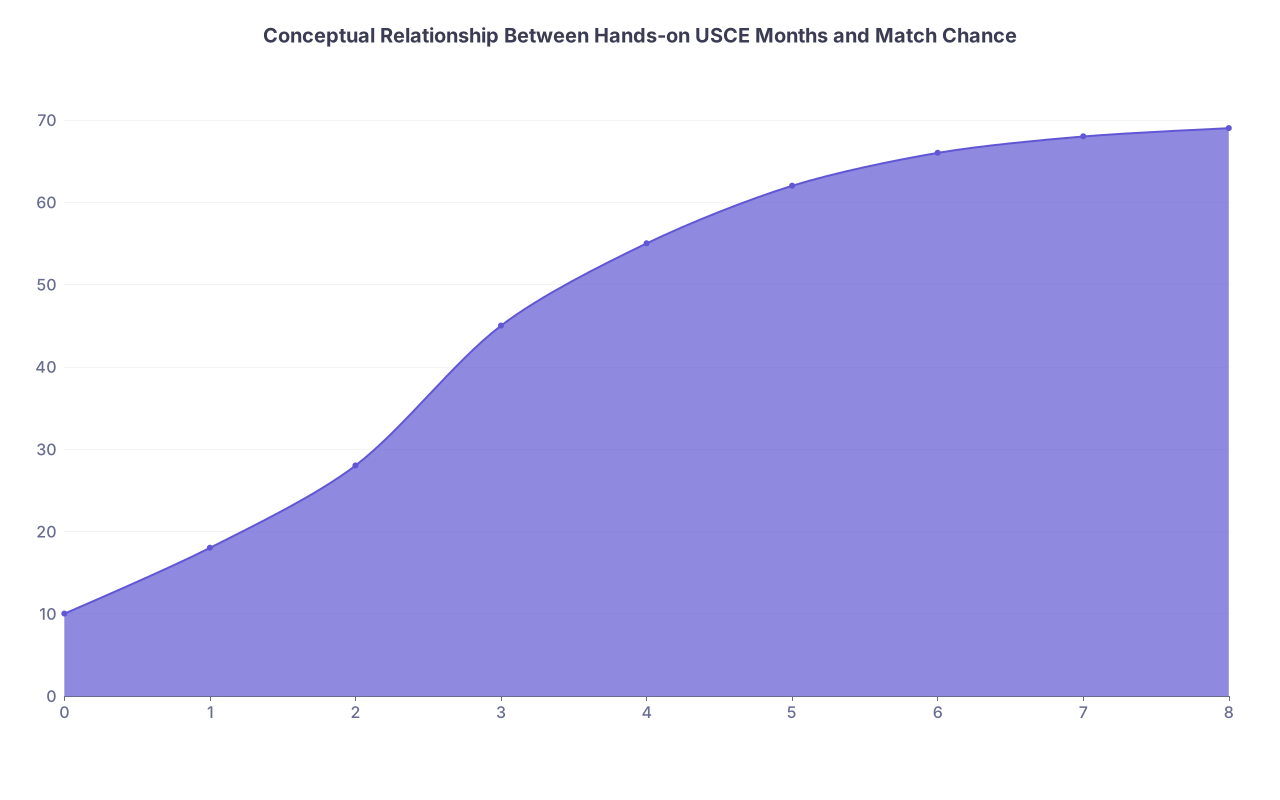
If I sketch a crude probability curve of match likelihood vs. hands-on USCE (holding scores, YOG, etc. constant), it looks like this:
| Category | Value |
|---|---|
| 0 | 10 |
| 1 | 18 |
| 2 | 28 |
| 3 | 45 |
| 4 | 55 |
| 5 | 62 |
| 6 | 66 |
| 7 | 68 |
| 8 | 69 |
You see sharp gains early, then a flattening. That flattening is where other factors (Step scores, YOG, visas, research, interview performance) dominate the variance.
Quality vs Quantity: Why “4 Good Months” Beat “8 Weak Months”
Pure month-counting is a lazy metric. Programs know it; you should too.
I have seen IMGs with 8+ months of “USCE” who still struggle to match because:
- All months were pure shadowing with minimal patient contact.
- Letters were generic and weak: “hardworking, punctual, pleasant,” with no concrete examples.
- Experiences were scattered and unfocused (a month of dermatology here, a month of radiology there) when applying for Internal Medicine.
In contrast, IMGs with 3–4 very strong months in the exact specialty they are targeting often match above their numerical “weight class.”
What actually drives value per month:
Depth of responsibility
Did you pre-round? Present on rounds? Write draft notes? Form assessments and plans?Direct supervision by faculty
Can an attending honestly write, “This student performed at the level of a strong intern”?Fit with the target specialty
Internal Medicine or FM programs value inpatient ward, clinic, ICU. A month of US dermatology is almost irrelevant if you are applying IM.Letter strength
The single most powerful output of a month of USCE is one strong, specific, US-style letter. Most strong matched IMGs have at least 2 and often 3 US letters drawn directly from their USCE rotations.
So when you are optimizing, the data support this rule:
You are usually better off with 4 months of high-quality, specialty-relevant, hands-on USCE at reputable sites than 7–8 months of loosely supervised, observational work.
Strategic Planning: How Many Months Should You Aim For?
Let us translate all this into actionable targets.
Assume a fairly typical IMG profile:
- Step scores roughly around the matched IMG median for your specialty
- YOG within 3–5 years
- No major red flags
Here is a data-driven USCE target by scenario:
| IMG Profile | Recommended USCE Target | Comment |
|---|---|---|
| Applying IM/FM, Caribbean grad | 4–6 months | Often achieved via cores + electives |
| Applying IM/FM, non-US med school | 4–6 months | At least 3 months before ERAS |
| Applying Peds/Neuro/Psych | 3–5 months | Specialty-aligned rotations preferred |
| Applying Anesthesia/Rads/EM | 6–9+ months | Strong emphasis on letters |
| Older YOG (>5 years) | 6+ months | Recent, high-intensity experience needed |
You will notice a pattern:
- Below 3 months hands-on → usually suboptimal, except in rare circumstances.
- Around 4–6 months → where most successful IMGs cluster.
- Beyond 6–9 months → returns diminish unless you are compensating for weaknesses (older YOG, visa constraints, average scores) or aiming for more competitive specialties.
Putting It Together: A Realistic USCE Blueprint
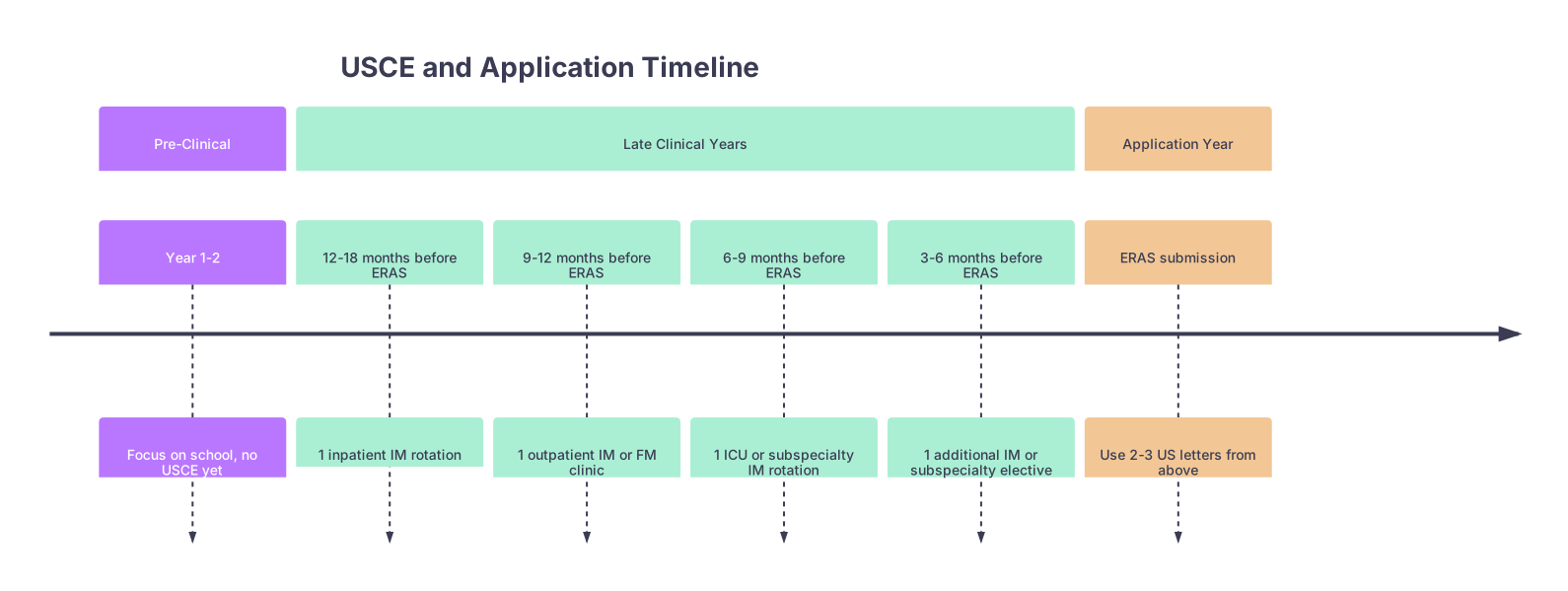
To make this concrete, here is what a high-yield USCE plan for a non–Caribbean IMG targeting Internal Medicine might look like.
| Period | Event |
|---|---|
| Pre-Clinical - Year 1-2 | Focus on school, no USCE yet |
| Late Clinical Years - 12-18 months before ERAS | 1 inpatient IM rotation |
| Late Clinical Years - 9-12 months before ERAS | 1 outpatient IM or FM clinic |
| Late Clinical Years - 6-9 months before ERAS | 1 ICU or subspecialty IM rotation |
| Late Clinical Years - 3-6 months before ERAS | 1 additional IM or subspecialty elective |
| Application Year - ERAS submission | Use 2-3 US letters from above |
That schedule gives you:
- 4 distinct months of relevant, hands-on USCE
- Exposure to wards, clinic, and higher-acuity care
- A spread of timing that keeps your experience “fresh” by the time you apply
- The opportunity to collect 2–3 strong, diverse letters
You can compress or shift this depending on your graduation date and visa realities, but the structure is sound.
The Bottom Line: So, How Many Months Do Matched IMGs Actually Have?
Boiling the analysis down:
- Across primary care and moderately competitive fields, most matched IMGs cluster around 3–6 months of hands-on US clinical experience, with 4–5 months being a very common center point.
- Observership-only portfolios match at much lower rates, regardless of how many total months are listed.
- For competitive specialties, matched IMGs frequently show 6–9+ months of targeted, high-quality USCE plus strong US letters.
- Quality, recency, and specialty alignment matter almost as much as raw duration.
If you are planning your path and trying to reverse engineer “what do matched IMGs actually look like,” use this as your mental model:
Aim for at least 3 months, plan for 4–6 months, and be very intentional about making each month count as a strong, letter-generating, hands-on rotation in the specialty you are pursuing.
Once you hit that range, the bottleneck is no longer “you do not have enough USCE.” It becomes what it is for everyone else: scores, letters, interviews, and how you perform when someone actually hands you a pager.
With that foundation in place, your next challenge is obvious: converting those months into interview invites and strong narrative signals on your ERAS application. But that is a story for another day.