
It is mid-September. ERAS just opened.
You are an IMG staring at your application, trying to decide which “US Clinical Experience” boxes to tick. You have 4 observerships, 1 “hands-on” month that was mostly shadowing, and a tele-rotation that promised the world and delivered Zoom didactics.
You are about to over-call all of them as “USCE – hands-on” because a WhatsApp senior told you “programs don’t check.”
This is exactly how strong applications die.
US clinical experience can rescue mediocre scores and a non‑US degree. It can also quietly destroy you if it looks fake, padded, or irrelevant. Program directors are not stupid. They have seen every trick IMGs use to make weak or meaningless clinical exposure sound impressive.
I am going to walk you through the specific USCE mistakes that scream red flag to programs, and how to avoid them before they sink your match year.
The First Big Lie: Calling Everything “Hands-On” When It Wasn’t
Let me start with the most common and most damaging error.
Mistake #1: Inflating shadowing/observerships into “hands-on USCE”
Programs are not upset that you did observerships. They are upset when you pretend you did not.
Here is what raises alarms:
- You list 4–6 “clinical electives” at private clinics with no affiliation to a teaching hospital.
- Your tasks sound like an attending’s fantasy assistant: “performed procedures, managed patient care plans, independently examined patients” at a community outpatient office as an unlicensed foreign graduate.
- Your LoRs use vague, copy‑paste phrases with no specific examples and identical formatting across multiple “rotations.”
Programs know:
- True hands‑on electives for students usually:
- Are for current students, not graduates.
- Are linked to a US teaching hospital or medical school.
- Use EMR access, notes, case presentations, and direct teaching language.
If your CV screams “I was basically practicing medicine without a license,” that is not impressive. It is terrifying.
How to avoid this:
Label experiences accurately.
- If you never documented in EMR, never presented cases formally, and never touched the patient other than maybe observing vitals → this is observership, not “hands-on USCE.”
- If it was tele-rotation with case discussions only → virtual observership or virtual elective, not “hands-on clinical.”
Describe what you actually did.
Use concrete, believable tasks:- “Observed outpatient visits and participated in case discussions.”
- “Presented patients on rounds under supervision.”
- “Wrote draft notes that were reviewed and edited by residents/fellows.”
Check consistency with LoRs.
If your application says “performed procedures” but the letter says “observed clinic workflow,” you have a credibility problem.
The Wrong Kind of USCE: Irrelevant, Random, and Misaligned
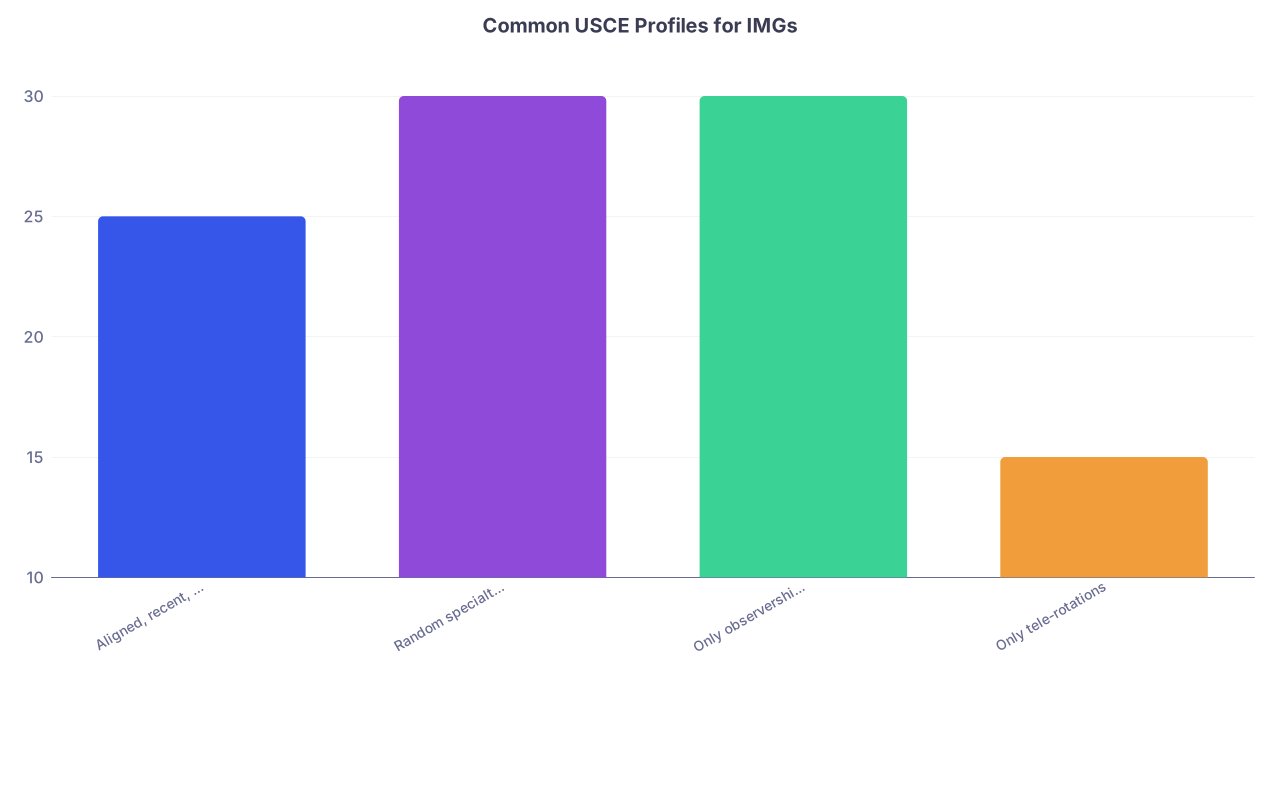
| Category | Value |
|---|---|
| Aligned, recent, hands-on | 25 |
| Random specialties, outdated | 30 |
| Only observerships | 30 |
| Only tele-rotations | 15 |
You want internal medicine. Your entire US experience? Two months of pediatric neurology observership and a cosmetic dermatology clinic.
This is not a “well-rounded” profile. It is a confused one.
Mistake #2: USCE in specialties that do not match your application story
Program directors look for coherence.
Red flag patterns:
- Applying to IM with:
- 3 months psych observership.
- 2 months neurosurgery observership.
- 1 month dermatology tele-rotation.
- Applying to FM but everything you did was in interventional cardiology and GI labs.
- Declaring passion for pediatrics with only adult ICU and cardiology rotations.
They immediately ask:
“Why is this person applying here? Did they fail in their target field? Are they just desperate?”
How to avoid this:
Anchor at least 2–3 rotations in your target field.
- IM applicant → aim for inpatient IM, outpatient IM, maybe subspecialty like cardiology/nephrology.
- FM → continuity clinic, community FM, outpatient internal medicine, urgent care.
- Psych → inpatient psych, outpatient psych, integrated behavioral health.
If you have unrelated rotations, explain them.
- In your personal statement or a short blurb: how those experiences informed your interest in your chosen field, not confused it.
Sequence matters.
Do not have:- 3 months of surgical subspecialties last year, then suddenly “lifelong passion for psychiatry” with zero psych exposure.
The Date Problem: Old, Stale, and Useless USCE
Programs look at when you were in the US, not just that you were.
Mistake #3: Relying on ancient USCE to compensate for a large time gap
Here is the pattern I see constantly:
- Graduated in 2017.
- Did 3 months of USCE in 2016 as a student.
- No clinical work (US or home country) from 2017–2023.
- Now applying for the 2026 Match and leaning heavily on those 2016 US electives.
To a PD, that reads as:
“This person has not touched real patients in 7+ years, but wants to start residency now.”
USCE older than 3–4 years, with no recent clinical practice anywhere, is basically decoration.
How to avoid this:
Keep your USCE recent.
- Aim for within 2–3 years of application at most.
- If you graduated long ago, you absolutely need recent clinical activity (home country practice counts, if documented properly).
Do not over-sell old experience.
An elective from 2015 can be on your CV, but not as your main argument that you are “well prepared for US training.”Bridge gaps with real clinical work.
- Paid doctor work in your home country.
- Clinical research with patient contact.
- Government or NGO clinical programs.
If all your clinical stories are almost a decade old, PDs will not see you as “rusty.” They will see you as unsafe.
The Fake and Fluffy: Low-Quality, Pay-to-Play, and Questionable Rotations
You know those ads: “Guaranteed USCE! Letters of Recommendation! No visa? No problem!”
Yes. Program directors know them too.

Mistake #4: Loading your CV with sketchy, pay-to-play experiences
Red flags that make committees suspicious:
- Multiple rotations from the same unknown private “institute” that is not a hospital, not a medical school, and not clearly led by academic physicians.
- LoRs from “Clinic Director” with no clear specialty, academic title, or institutional affiliation.
- Rotations that:
- Are described as “university-affiliated” but the university name never appears anywhere official.
- Have no physical hospital name listed.
- Are all arranged through the same commercial company that is infamous in IMG circles.
Are paid rotations always bad? No. Sometimes, that is the only realistic route. But low‑quality, unstructured, mass-import IMG rotations are easy to sniff out.
How to avoid this:
Prioritize structured, reputable sites.
- University hospitals.
- Community teaching hospitals with residency programs.
- Recognized academic physicians (Associate/Assistant Professor, Program Director, etc.).
Research before you pay.
At minimum, check:- Does this hospital have an ACGME residency?
- Does your supervising physician appear on hospital or university websites as faculty?
- Are there IMGs currently in US residency who used this rotation and can vouch for it (privately, not via testimonials on the company website)?
Limit the number of dubious sites.
If you already did one sketchy experience because you did not know better, do not stack three more. Add at least one or two clearly legitimate rotations to balance your profile.
Tele-Rotations: When “USCE” Never Set Foot in the US
Tele-rotations exploded during COVID. Programs adjusted. Now they can distinguish fluff from value.
Mistake #5: Presenting tele-rotations as equivalent to in-person USCE
Tele experiences can add something. But they are not a substitute for:
- Being on rounds.
- Seeing patient interactions.
- Learning hospital systems.
Yet I constantly see:
- Applicants listing 4–6 months of “US clinical rotations” that were 100% virtual, done from another country.
- LoRs clearly describing only online case discussions.
Many PDs now discount these almost entirely for “clinical readiness.”
How to avoid this:
- Label them honestly.
- Use “Virtual observership” / “Virtual elective” in the title.
- Do not count them as your core USCE.
- They can be supplement, not center, of your experience section.
- Highlight what was real.
- Exposure to US guidelines and management approaches.
- Discussion of actual patient cases from US practice.
- Regular presentations with feedback.
If you only have tele-rotations and no in‑person clinical work at all, expect many programs to silently filter you out.
The Documentation Trap: Sloppy, Inconsistent, or Vague Descriptions
| Type of Description | Program Director Reaction |
|---|---|
| Precise, concrete tasks | Credible, believable |
| Vague, copy-paste phrases | Doubt, suspicion |
| Overstated responsibilities | Red flag, possible dishonesty |
| Inconsistent with LoRs | Serious trust issue |
Your experiences might be decent. How you write them can still kill you.
Mistake #6: Using vague, generic language that triggers suspicion
Here is the sort of thing that programs skim and then mentally discard:
“Actively involved in all aspects of patient care in a dynamic clinical setting. Rounded with the team and provided compassionate, patient-centered treatment.”
This tells them nothing. It sounds like you copied it from a brochure.
Other problems:
- Same description for multiple different rotations.
- Using identical phrases that appear, almost word-for-word, in your LoR. Clearly copy-paste.
- Listing tasks that would not be legally allowed for you to do (independent prescribing, unsupervised procedures, signing notes, etc.).
How to avoid this:
Be specific and believable:
- “Pre‑rounded on 4–6 inpatients daily, collected data, and formulated assessment and plan for presentation.”
- “Drafted admission notes in EMR which were reviewed and edited by residents/attendings.”
- “Prepared short presentations on heart failure, COPD, and sepsis management during rotation.”
Tailor to each setting:
- Outpatient clinic vs inpatient wards vs subspecialty service should look clearly different.
Cross-check with letters:
- Ask your writers to mention concrete behaviors that match your bullet points. Not copy them, but align with them.
Letter of Recommendation Landmines from USCE

| Step | Description |
|---|---|
| Step 1 | US Clinical Experience |
| Step 2 | Weak generic LoR |
| Step 3 | Strong detailed LoR |
| Step 4 | Red flag suspicion |
| Step 5 | Application strength |
| Step 6 | Quality rotation? |
The whole point of USCE is not a line on ERAS. It is letters. Specifically, strong, specific letters from US physicians who know you well enough to advocate for you.
Mistake #7: Collecting weak, generic, or suspicious LoRs from USCE
Common disasters:
Four US letters where:
- None of them mention your clinical reasoning, reliability, or communication.
- They all use phrases like “hardworking” and “punctual,” and nothing more.
- The letter never clarifies whether you were a student, a graduate, or what level of responsibility you had.
Letters that:
- Sound templated. Same structure, same generic adjectives, no concrete cases.
- Are clearly written by non-academic physicians with no experience writing residency letters.
Program directors know that a generic LoR means:
“The attending had nothing meaningful to say, or barely noticed this person.”
How to avoid this:
Choose writers wisely.
- Someone who actually worked with you closely.
- Someone who has US academic affiliation if possible.
- Someone who is comfortable writing letters for residency (ask directly).
Make it easy for them to write a substantive letter.
- Provide:
- Your CV.
- A short summary of cases you presented or tasks you handled.
- Your target specialty and match year.
- Do not script the letter for them. But a bullet list of concrete examples they witnessed can help avoid generic fluff.
- Provide:
Do not chase quantity over quality.
The Time and Money Sink: Over-Rotating Without Strategy
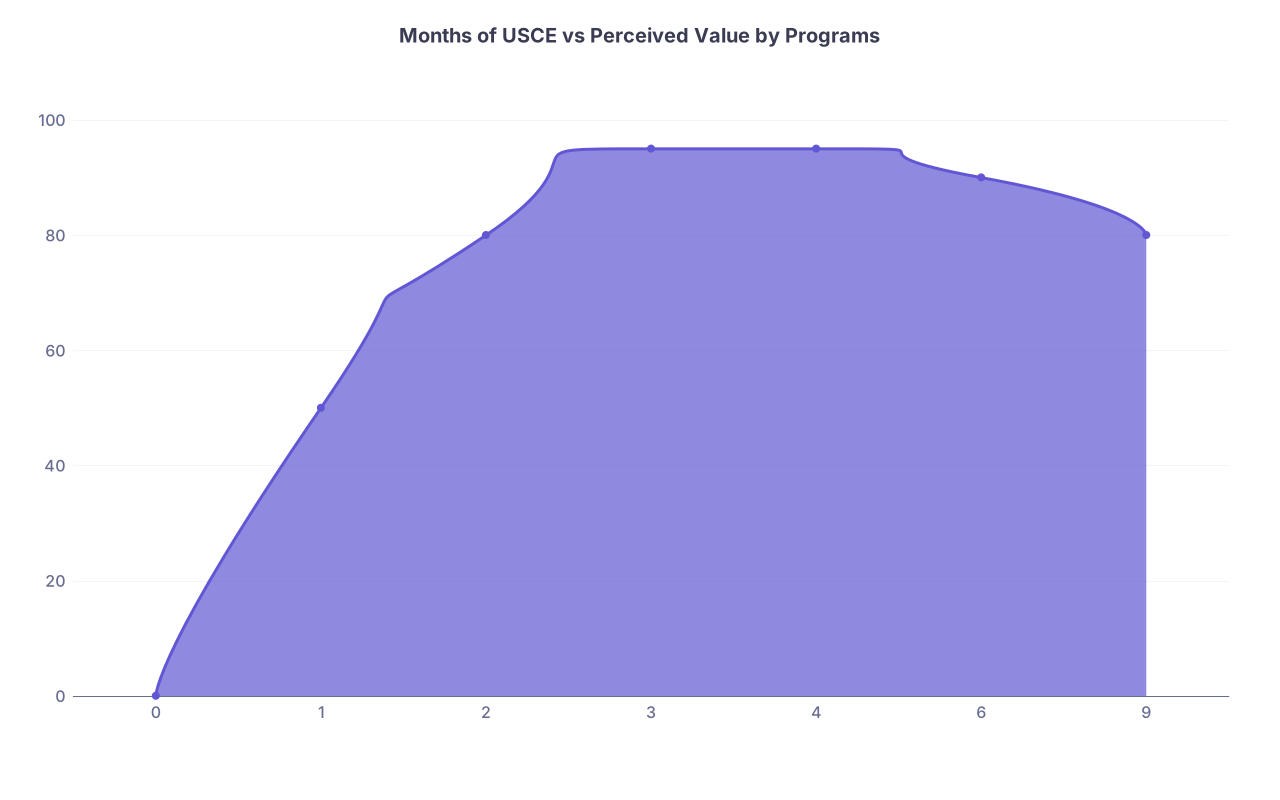
| Category | Value |
|---|---|
| 0 | 0 |
| 1 | 50 |
| 2 | 80 |
| 3 | 95 |
| 4 | 95 |
| 6 | 90 |
| 9 | 80 |
Here is a brutal truth: more months of USCE does not always mean more value.
Mistake #8: Doing 8–12 months of unfocused USCE instead of a targeted 3–4 months
Some IMGs burn a fortune on:
- 2 months IM outpatient.
- 2 months cardiology observership.
- 2 months GI.
- 2 months nephrology.
- 2 months neurology.
Total: 10 months. Outcome: program directors roll their eyes.
Why?
- They worry you are avoiding real work (no job, no research, just endless “rotations”).
- They question why no one hired you or involved you in real projects after so much exposure.
- They assume at least half of these were low-yield, unstructured, and repetitive.
How to avoid this:
- Target 3–4 high-quality rotations:
- 2 core rotations in your specialty (inpatient + outpatient if possible).
- 1–2 subspecialty or related rotations with strong mentoring.
- Use the rest of your time for:
- Research with US clinicians.
- Home-country clinical practice with solid documentation.
- Exam prep and producing something tangible (poster, paper, QI project).
You want your USCE to look intentional, not like you were drifting around hospitals hoping someone would hand you a position.
The Visa and Status Confusion: Letting Your Story Look Illegitimate
Another subtle but deadly category.
Mistake #9: Having USCE that does not make sense with your immigration status
Red flags:
- You claim many months of “full-time US rotations” while:
- You were supposedly in another country full-time.
- Your visa type would not legally support that time in the US if anyone looked closely.
- ERAS timeline + graduation date + USCE dates create an impossible calendar.
Most programs will not investigate you like immigration. But obvious contradictions create trust issues. And trust is non-negotiable.
How to avoid this:
Make your timeline coherent.
- Place rotations in correct months/years.
- Do not overlap full-time jobs, full-time research, and full-time rotations in different countries in the same period.
If something is unusual, briefly clarify in an activity description or personal statement.
- Example: “Rotation performed during a 3-month research sabbatical from my home institution.”
Never fabricate dates to “fill gaps.”
Gaps look bad. Lies look worse.
How Programs Actually Scan Your USCE

Let me pull back the curtain for a moment.
In many programs, this is what actually happens when they see an IMG application:
- Check exams and attempts.
- Scan year of graduation and look for large gaps.
- Jump straight to US clinical experience and LoRs.
They are asking:
- Have you seen US patients in a setting like ours?
- Did any US physician say, in writing, “I trust this person with patients”?
- Does your story make sense?
If your USCE looks:
- Misrepresented (shadowing labeled as “hands-on inpatient management”),
- Outdated (last rotation 7 years ago),
- Disconnected from your specialty choice,
- Or mostly supported by generic, meaningless LoRs,
you are out. Often before anyone even fully reads your personal statement.
Building USCE That Helps You, Not Hurts You

| Step | Description |
|---|---|
| Step 1 | Choose Target Specialty |
| Step 2 | Identify 2 core rotations |
| Step 3 | Add 1-2 related rotations |
| Step 4 | Verify site legitimacy |
| Step 5 | Clarify visa and timeline |
| Step 6 | Perform well and seek strong LoRs |
| Step 7 | Describe experience honestly on ERAS |
Let us flip this and talk precision.
A solid, non-red-flag USCE profile for an IMG applying to Internal Medicine might look like:
- 1 month inpatient IM at a community teaching hospital with an IM residency.
- 1 month outpatient IM or FM focused on chronic disease management.
- 1 month cardiology or pulmonary at a center that actually teaches residents.
- Maybe 1 additional month of a virtual elective during COVID era, clearly labeled as such.
Descriptions are:
- Concrete, showing you know how a US ward/service actually runs.
- Realistic about your role as a student or observer.
- Supported by at least two strong, specific US letters.
Timeline:
- These rotations happened within the last 2–3 years.
- Any earlier experiences are listed but not over‑promoted.
No exaggerations. No fantasy procedures. No magical independent practice.
Programs see this and think:
“Okay. This person knows what they are signing up for. They can adapt to our system. They are not trying to hustle us.”
That is all you need.
Your Next Step Today
Do not book another expensive rotation until you do this:
Open your ERAS (or a draft CV) right now and list every single US clinical experience you have or are planning.
For each one, write three bullets:
- What exactly you did (no buzzwords, only concrete tasks).
- How it directly supports your chosen specialty.
- Whether the dates and status (student vs graduate, visa, location) make sense.
Then ask yourself bluntly:
- Am I overstating anything?
- Do I have at least 2–3 rotations that are clearly relevant, recent, and credible?
- Would a program director trust this story, or start circling question marks?
If anything feels off, fix the strategy now. Not after your application is submitted.