The fastest way for an IMG to kill an otherwise competitive ERAS application is with weak US clinical experience descriptions. Programs do not need a committee to reject you. Your own wording does it for them. Instantly.
Let me be blunt: for IMGs, your USCE is often the only evidence you can function in the American system. When your descriptions read like fluff, copy‑paste, or shadowing-as-“hands-on,” you are volunteering to be screened out.
This is fixable. But only if you stop making the same predictable mistakes.
Why US Clinical Experience Descriptions Can Make Or Break You
Program directors do not have time to “interpret” your potential. They are looking for reasons to move on. Weak USCE descriptions give them those reasons in under 10 seconds.
Here is what they actually care about when they read your ERAS experiences:
- Can this person function safely in a US clinical setting?
- Do they understand basic US workflow and team structure?
- Have they done more than passive observation?
- Is there any evidence they take initiative, communicate clearly, and finish tasks?
- Are they honest about their role?
If your description does not answer those questions fast, you lose.
For IMGs, USCE is not decoration. It is:
- Your proof you can transition to US practice
- Your counterargument to “We do not know how they trained”
- Your main signal for professionalism and communication
Now look at your descriptions and be ruthless: do they actually prove any of that? Or do they just sound vaguely “clinical”?
Mistake #1: Vague, Inflated, or Dishonest Role Descriptions
This is the one that gets IMGs tossed without a second thought.
I have seen this kind of nonsense more times than I can count:
“Managed a diverse panel of patients in an outpatient clinic, independently created management plans and coordinated multidisciplinary care.”
Reality? The applicant followed a resident, wrote an occasional note, and maybe called one pharmacy under supervision.
Program directors know exactly what a “4-week observership” or “hands-on externship” usually means. When your description suggests you functioned like a PGY‑2, you look either:
- Dishonest
- Clueless about your actual role
Both are disqualifying.
Red flags that scream “I’m exaggerating”
If your bullets look like this, you are in trouble:
- “Independently managed…” (as a student or observership participant)
- “Primary decision-maker for patient care”
- “Led the healthcare team”
- “Performed complex procedures such as central lines, thoracentesis, intubation” (during a 4-week observership in community clinic – give me a break)
- “Responsible for admission and discharge decisions”
You do not impress anyone with that language. You just signal that you do not understand scope of practice or you are making things up.
How to fix it
Use verbs that match your actual level:
- Observed
- Assisted
- Participated in
- Contributed to
- Documented
- Presented
- Followed up under supervision
- Communicated
Do not oversell. Show you understand hierarchy and supervision.
Bad:
Independently managed inpatients and adjusted medications as needed.
Better (and believable):
Participated in daily rounds on internal medicine inpatients; presented focused assessments and proposed management plans which were discussed and modified by the resident and attending.
That line does three critical things:
- Shows your role (participated, presented, proposed)
- Acknowledges supervision (discussed and modified)
- Proves you understand workflow (rounds, assessments, plans)
If your real role was mostly observation, say so. Then show what you did with what you observed (notes, case logs, self-directed learning, case presentations).
Do not let arrogance or desperation push you into fantasy-writing. Programs are not fooled. They are offended.
Mistake #2: Shadowing Disguised As “Hands-On USCE”
This is the classic IMG trap: selling shadowing like it was an internship.
Programs hate this.
If your activity was 90% standing in a corner and watching, just calling it “externship” or “clinical rotation” does not magically turn it into hands-on experience.
Common giveaways you are disguising shadowing:
- No mention of actual tasks you performed
- Only buzzwords: “multidisciplinary team,” “strong communication skills,” “various procedures”
- Zero references to EMR, notes, sign-outs, or follow-up
- Generic language that could apply to any specialty, anywhere on earth
Example of weak, suspicious shadowing description:
Clinical extern, Internal Medicine, 4 weeks
Observed various inpatient and outpatient cases, participated in multidisciplinary care and improved communication, leadership and teamwork skills.
That sentence tells the reader:
- You probably watched
- You did not document
- You cannot name a single concrete responsibility
Programs read that and think: “Shadowing. Next.”
How to handle shadowing without tanking your application
Do not pretend shadowing is something else. Instead:
- Label it honestly in the title or description (“Clinical observer,” “Shadowing under Dr. X”)
- Then show intellectual engagement and system exposure even if you could not touch patients
Better:
Clinical observer – Internal Medicine (4 weeks)
Observed inpatient rounds and outpatient clinic visits with a focus on hypertension and diabetes management; maintained a personal case log and discussed diagnostic reasoning, guideline-based therapy, and US documentation standards with supervising attending after clinic sessions.
You are not claiming hands-on. You are proving you were awake, thinking, and learning the US style of practice.
If the only thing you did is “followed the doctor and watched,” do not list it as core USCE. It will hurt more than it helps.
Mistake #3: Content-Free, Adjective-Heavy Descriptions
Many IMGs write experience entries like this:
- Developed excellent communication and teamwork skills by working in a fast-paced clinical environment
- Learned to manage a wide variety of pathologies in a diverse population
- Improved my clinical judgment and decision-making abilities
This is fluff. It could describe a Starbucks shift.
Program directors are allergic to empty adjectives:
- “Excellent”
- “Strong”
- “Outstanding”
- “Effective”
- “Exceptional”
They want actions and evidence. Not your self-evaluation.
The “What did you actually do?” test
Take each bullet and force yourself to answer: What exactly did I do? What would a camera have recorded?
If your sentence does not pass the camera test, it is weak.
Weak:
Worked closely with multidisciplinary team to provide patient-centered care.
Stronger:
Attended daily multidisciplinary rounds with physicians, nurses, case managers and physical therapists; contributed by summarizing overnight events and clarifying discharge barriers for 3–5 patients per day.
See the difference?
One is brochure language. The other is a real day in a real hospital.
Simple template to avoid fluff
For each bullet, aim for this structure:
[Action verb] + [what you did] + [for whom / how often] + [with what system / tool / context]
Examples:
- Reviewed 10–15 outpatient charts per clinic session in Epic prior to visits and prepared brief problem lists to discuss with supervising physician.
- Called 3–6 patients per week under supervision to relay lab results and document conversations in EMR using telephone encounter notes.
- Presented 1–2 new inpatient admissions on rounds daily, including HPI, focused exam, labs, and initial assessment and plan.
No adjectives needed. The concrete details speak for you.
Mistake #4: Not Showing You Understand the US System
Another silent killer: descriptions that could have been written in any country.
If your entry never shows that you interacted with:
- EMR (Epic, Cerner, Meditech, etc.)
- US-style team structure (attending, resident, PA/NP, nurse, case manager)
- Orders, notes, sign-out structure
- Outpatient vs inpatient workflow
- Insurance/authorization/discharge planning elements
You look less “US-ready.”
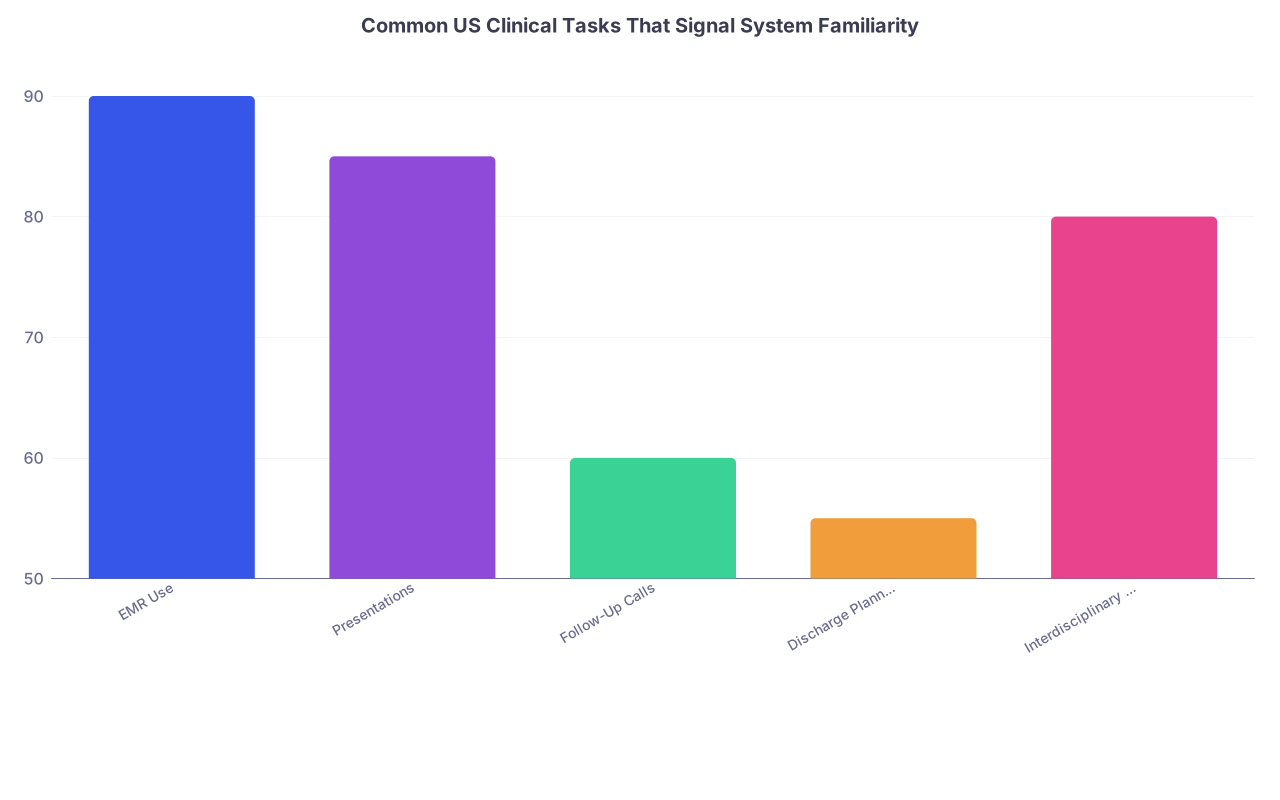
| Category | Value |
|---|---|
| EMR Use | 90 |
| Presentations | 85 |
| Follow-Up Calls | 60 |
| Discharge Planning | 55 |
| Interdisciplinary Rounds | 80 |
(Those percentages are roughly how often strong IMG descriptions mention each element, based on what I have seen from matched vs unmatched candidates.)
Typical weak “international” description
Took histories and performed physical examinations on a variety of patients, formulated differential diagnoses and management plans, and followed up during hospital stay.
This could be from any medical school, any country, any year.
Turn it into US-relevant experience
Add the US-specific layer:
- Name the setting type (community hospital, academic center, FQHC clinic)
- Mention the EMR
- Mention team members
- Show how you communicated or documented
Better version:
Conducted focused histories and physicals on 3–5 clinic patients per session in a community internal medicine practice using Epic EMR; presented cases to the attending, drafted assessment and plan notes, and updated problem lists under supervision.
Now you sound like someone who can slide into a US intern role with less friction.
Mistake #5: Wasting High-Value Space on Irrelevant Detail
You get limited characters in ERAS experience descriptions. Many IMGs waste that prime real estate on:
- Full institutional marketing names
- Long, generic intros about the hospital
- Lists of rare diseases they saw once
- Statements about how “this experience shaped my passion for X”
None of that helps your screening.
Your bullets must do one of three things:
- Prove US-system familiarity
- Show concrete responsibility and reliability
- Align you with the specialty’s core work
Everything else is fluff.
| Content Type | Impact on Screening |
|---|---|
| Specific tasks with EMR | High |
| Notes/presentations responsibilities | High |
| Clear patient volume / frequency | High |
| Generic hospital description | Low |
| Emotional reflections | Low |
| Long disease name lists | Low |
Example of space wasted
ABC Medical Center is a 500-bed tertiary care teaching hospital that serves a diverse patient population with a wide range of medical and surgical conditions. During this rotation I was exposed to numerous cases including stroke, myocardial infarction, COPD exacerbations, and sepsis.
That is 2–3 lines of pure waste. Programs already know what a hospital does.
Strip that out and replace with:
- What you actually did
- How often
- With what tools
- Under whose supervision
Stripped-down, high-yield version:
Participated in internal medicine inpatient rotation at a tertiary care teaching hospital; pre-rounded on 3–4 patients daily, reviewed labs and imaging, and presented concise updates on rounds to resident and attending physician.
Straight to the point. No brochure language.
Mistake #6: One Generic Template Copy-Pasted Across Multiple Experiences
Another silent red flag: every USCE entry looks exactly the same with minor word swaps.
Program directors read:
- “Worked in a fast-paced clinical setting” – everywhere
- “Improved communication and teamwork skills” – everywhere
- “Gained exposure to a wide range of pathologies” – everywhere
You look lazy and unreflective. At best. At worst, fake.
Each rotation should have:
- A different focus
- Different tasks
- Different skills emphasized
If your neurology elective and your internal medicine clinic look identical in ERAS, you have not thought hard enough.
How to differentiate your rotations
Ask yourself:
- What was unique about this setting? (outpatient vs inpatient, academic vs community)
- What did I actually do here that I did not do elsewhere?
- How would the attending describe me in 2 sentences?
Then write your bullets to match.
Internal medicine clinic example:
- Reviewed EMR charts before visits and updated medication lists under supervision.
- Presented focused cases to attending and documented visit summaries in draft notes.
Neurology inpatient rotation example:
- Performed focused neurologic exams on stroke and seizure patients; presented findings to resident during rounds.
- Assisted with NIH stroke scale assessments and documented serial neurologic checks under supervision.
Different tasks. Different language. Same applicant, but now they look real.
Mistake #7: Not Making Your Role Crystal Clear To Filter Algorithms
Here is the part almost nobody tells IMGs: a lot of screening happens before a human ever reads your description.
Filters look for:
- “Observership” vs “Externship” vs “Rotation”
- Country and setting
- Duration (4 weeks vs 2 days)
- Explicit mention of US clinical activity vs mere “exposure”
If you bury the key words, or worse, avoid them to sound fancier, your entry may never get human eyes.

| Step | Description |
|---|---|
| Step 1 | USCE Entry |
| Step 2 | Flag as Low Value |
| Step 3 | Shadowing bucket |
| Step 4 | Potential Interview |
| Step 5 | Clear US role stated |
| Step 6 | Hands on tasks? |
Common self-sabotage patterns
- Calling a 2-week shadowing “Clinical Research Internship” with zero research
- Using “Visiting Scholar” for pure observership
- Hiding “observer” in the final line instead of the title
- Never once mentioning “US” or “United States” in the experience
You are not tricking anyone. You are confusing both algorithms and humans.
Safer, clearer titling and phrasing
Do this instead:
- Title: “Clinical observer – Internal Medicine, [Hospital], [US City]”
- First line: “Four-week US clinical observership focused on inpatient internal medicine at a community teaching hospital.”
Or, if it truly was more hands-on:
- Title: “US clinical extern – Family Medicine, [Clinic], [City]”
- First line: “Hands-on US outpatient primary care experience (4 weeks) with supervised patient interviews, focused exams, and draft documentation in EMR.”
You are giving the filter and the reader exactly what they need to correctly categorize you.
Putting It All Together: Weak vs Strong Description
Let me show you a full side-by-side.
Weak USCE entry (realistic composite of what I see all the time):
Clinical Externship – Internal Medicine
Observed a variety of inpatient and outpatient cases in a fast-paced environment. Gained experience working with a multidisciplinary team. Improved my communication, leadership, and teamwork skills. Managed different pathologies including diabetes, hypertension, COPD, sepsis, stroke, and myocardial infarction. This experience strengthened my desire to pursue internal medicine.
Looks innocent. It is actually useless.
Stronger version of the same basic experience:
Clinical extern – Internal Medicine, Community Teaching Hospital, [City, State]
- Completed 4-week hands-on US outpatient and inpatient rotation under supervision of attending and residents.
- Conducted focused histories and physicals on 2–4 clinic patients per session; presented cases to attending and documented draft notes in Epic for review.
- Pre-rounded on 3–5 inpatients daily, reviewing overnight events, vitals, labs, and imaging; presented concise updates on rounds to the team.
- Participated in discharge planning discussions with case management for selected patients with heart failure and COPD, focusing on follow-up needs and medication access.
Notice what changed:
- Specific setting
- Clear supervision
- Concrete tasks
- EMR named
- Discharge planning mentioned
No adjectives. No fake independence. No meaningless disease lists. It reads like an actual rotation a program director could picture.
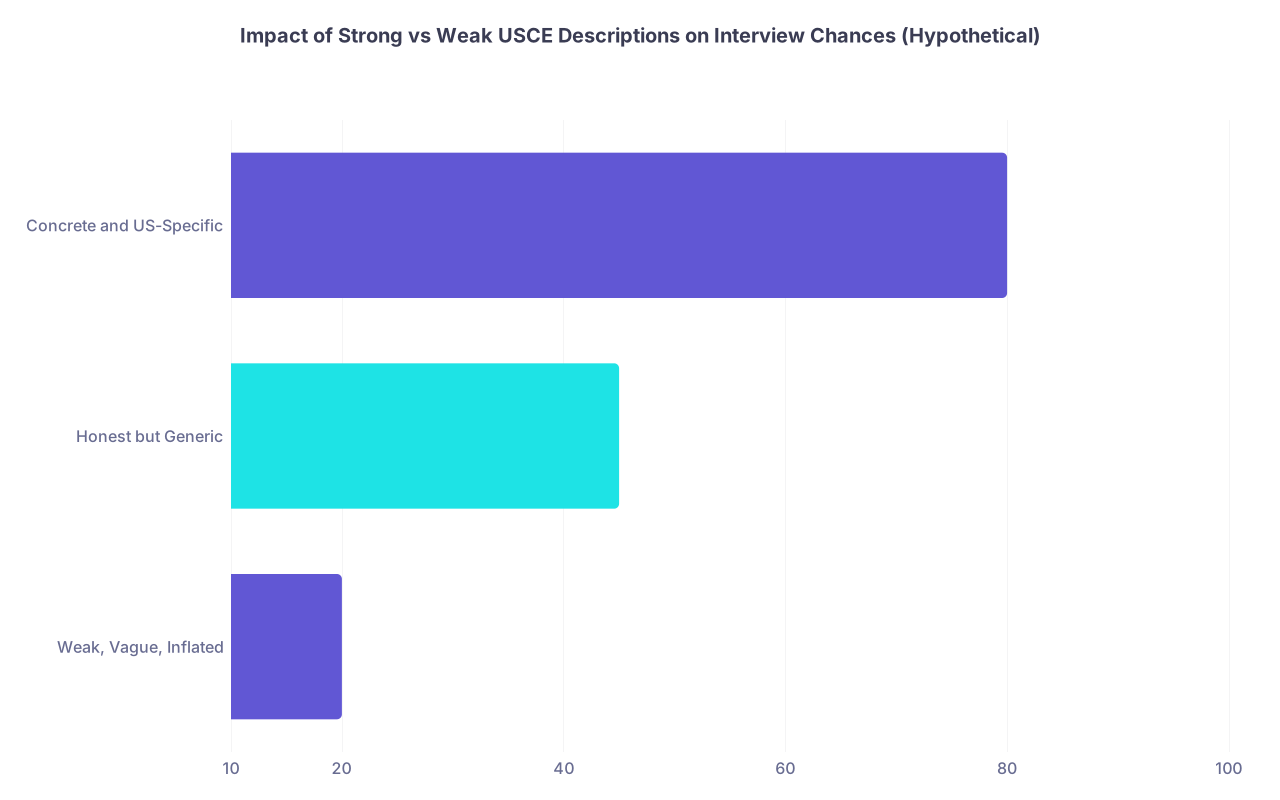
| Category | Value |
|---|---|
| Weak, Vague, Inflated | 20 |
| Honest but Generic | 45 |
| Concrete and US-Specific | 80 |
Numbers aside, the pattern is real: strong, specific descriptions move you out of the “easy reject” pile.
The Bottom Line: How Not To Make Your ERAS Easy To Screen Out
If you remember nothing else, keep these points:
- Be honest and concrete about your role. Do not inflate. Do not pretend shadowing was an internship. Use verbs and tasks that match your level and supervision.
- Prove you can function in the US system. Mention EMR, rounds, team structure, outpatient vs inpatient workflow, and actual responsibilities. Cut the adjectives and marketing language.
- Treat every rotation as unique. No copy-paste templates. Each USCE entry should show different tasks, different strengths, and specific, believable details.
Do this, and your US clinical experience stops being an easy screening excuse—and starts becoming a reason they pause and think, “This IMG might actually be ready.”