
The residency world is unforgiving: unexplained gaps and a string of 2‑week US rotations make program directors suspicious. Not curious. Suspicious.
If you are an IMG banking on “some USCE is better than none,” you’re dangerously close to sabotaging your application. The pattern of your experience matters just as much as the content. And certain patterns scream: risk.
Let me walk you through the mistakes that quietly kill IMG applications – especially around gaps and short rotations – and what you need to do before you become another “looks off” rejection.
Why Program Directors Instantly Distrust Gaps and Short Rotations
Here’s the part most IMGs underestimate: PDs are not looking at your application in isolation. They’re comparing you to hundreds of others with cleaner timelines and more coherent stories.
What raises their guard?
- Long or repeated gaps without a convincing explanation
- Multiple tiny 2‑week or “observer-only” rotations scattered across years
- Big gaps between graduation and the start of US clinical experience
- US experience bunched right before application season with nothing before or after
- A CV that looks like it was “constructed” for ERAS instead of reflecting real continuity
They don’t have time to investigate. They assume the worst and move on. Here are the common suspicions that pop into their heads – often within seconds:
- “Did this person fail exams multiple times?”
- “Were they back home doing nothing clinically?”
- “Are they hiding professionalism issues or prior failures?”
- “Are these short rotations just letter-hunting, not genuine learning?”
- “Why does nothing about this timeline look like a working physician?”
They won’t email you to clarify. They just filter you out.
The Hidden Problem with Gaps: What They Think You Were Doing
Not all gaps are fatal. But unexplained or poorly explained gaps? They’re poison.
Red-flag types of gaps
These are the ones that routinely get applications tossed:
- A 1–3-year gap right after graduation with zero clinical or structured activity
- Long gaps between finishing medical school and starting any US clinical experience
- “Floating” time where you claim to be studying for exams but did nothing else
- Multiple smaller gaps that, when added up, look like you were off the grid
- Gaps that magically line up with exam failure dates or mismatched test timelines
PDs connect the dots even when you don’t spell it out.
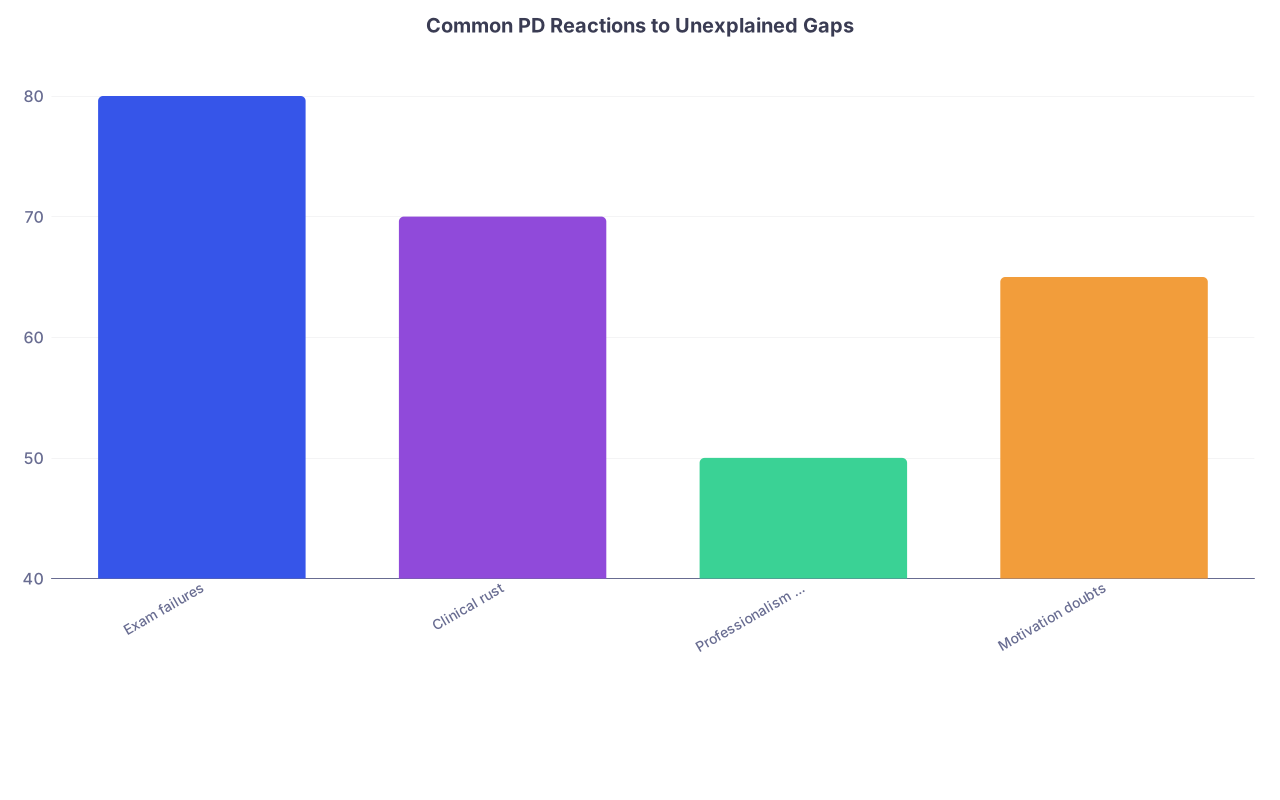
| Category | Value |
|---|---|
| Exam failures | 80 |
| Clinical rust | 70 |
| Professionalism concerns | 50 |
| Motivation doubts | 65 |
Do I think those assumptions are always fair? No. But they’re predictable. You either plan around them or you get crushed by them.
The mistake: “I’ll just say I was preparing for exams”
I see this line on far too many IMG CVs and personal statements:
“From 2020–2022, I was dedicated full-time to USMLE preparation.”
To a PD, that reads as:
“Failed multiple times, didn’t do anything else, lost clinical sharpness, might struggle with residency workload.”
You cannot disappear for years and then hope “exam prep” sounds noble. It does not. It sounds like you couldn’t manage time, stress, or responsibilities in parallel – which is exactly what residency requires.
If you truly had to focus on exams, you still need something:
- Part‑time clinical work or volunteering
- Research, teaching, or structured courses
- Assistant roles (scribing, medical assistant, etc.)
- Any consistent, verifiable activity that shows you weren’t idle
The worst mistake is silence. The second worst is a generic excuse.
Short US Rotations: When “Exposure” Looks Like You’re Hiding Something
IMGs love short rotations. Two weeks here. One week there. A handful of observerships across three hospitals.
On your side of the fence, it looks like:
“I tried multiple programs and diverse settings. That’s good, right?”
On their side, it often looks like:
“This person couldn’t get a real, sustained role anywhere.”
Why 2‑week USCE blocks smell bad
- Learn the elevator locations
- See a couple of typical patients
- Shake hands with attendings you’ll never see again
It is not enough to:
- Earn strong, detailed letters
- Demonstrate growth, reliability, and consistency
- Be trusted with increasingly complex responsibilities
- Show that you can function in a US team long term
So PDs wonder:
- Were they only able to arrange shadowing?
- Did no one want them for a full month?
- Were they shopping for letters instead of showing commitment?
A few short rotations are survivable. A CV made only of short experiences is not.

The Combo That Kills: Gaps + Short Rotations + Weak Story
One of the most damaging application patterns I see over and over:
- 2–3 year gap after graduation
- Then suddenly: three 2‑week observerships in the same year
- No continuity before or after
- No clear reason why things happened in that order
To a PD, that profile screams:
“Someone told this person at the last minute they needed US experience, so they rushed to collect the bare minimum, with no real plan.”
You might think your situation is “unique.” It isn’t. They’ve seen this exact pattern hundreds of times.
Here’s how your story should look instead:
- Grad year → some consistent clinical involvement (home country or US)
- Shorter gap(s) with clear, credible, documented purpose
- Then US clinical experience that builds – not random fragments
- Growing responsibilities, longer durations, deeper engagement
- Letters from people who actually saw you work over time
If that’s not what your CV looks like, you have work to do.
How PDs Actually Scan Your Timeline
They don’t read your whole application line by line at first. They skim the skeleton:
- Graduation year
- Exam dates and scores
- US clinical experience dates and durations
- Current position
Then they run one silent test in their head:
“Does this look like a person who has been working continuously, clinically relevantly, and reliably since graduation?”
If anything breaks that illusion, their suspicion meter jumps.
| USCE Pattern | PD Reaction |
|---|---|
| 3× 1‑month rotations in 1 year | Serious, trying to get real USCE |
| 4× 2‑week observerships only | Letter hunting, little substance |
| 1 long 3‑month rotation | Stable, can integrate into team |
| No USCE, recent home clinical work | Questionable but explainable |
| USCE only years after graduation | Why the long wait? Red flag |
They don’t say this out loud on their website. But this is how they think under time pressure.
The Most Dangerous Assumption: “I’ll Explain It in the Interview”
You might think:
“I know my CV looks messy, but if I get an interview I can explain everything.”
You’re missing the obvious problem: messy CVs often never reach the interview stage.
You can’t rely on interview explanations because:
- Filters cut you off before a human ever reads your personal statement
- Red flags get you auto‑sorted into the “low priority” pile
- Many programs have more viable applicants than interview slots
You need to pre‑empt suspicion on paper.
Mistakes IMGs make trying to patch their gaps
I see the same sloppy attempts over and over:
- Throwing “clinical observership” on the CV even if it was 3 days
- Backdating or compressing dates to hide gaps (dangerous and unethical)
- Over‑inflating nonclinical roles as “clinical” when they’re not
- Writing vague descriptions like “clinical internship” with no details
PDs have read thousands of CVs. They can tell when you are:
- Being vague on purpose
- Dressing up weak experiences
- Trying to hide time you can’t account for
You do not want to look like you’re playing games with your timeline.
Year of Graduation: The Silent Multiplier of Suspicion
If you’re a recent graduate (0–2 years), a short gap or a 2‑week rotation doesn’t hurt as much. Not ideal, but not fatal.
But if you graduated 5, 7, 10+ years ago?
Every gap is magnified. Every short rotation looks desperate.
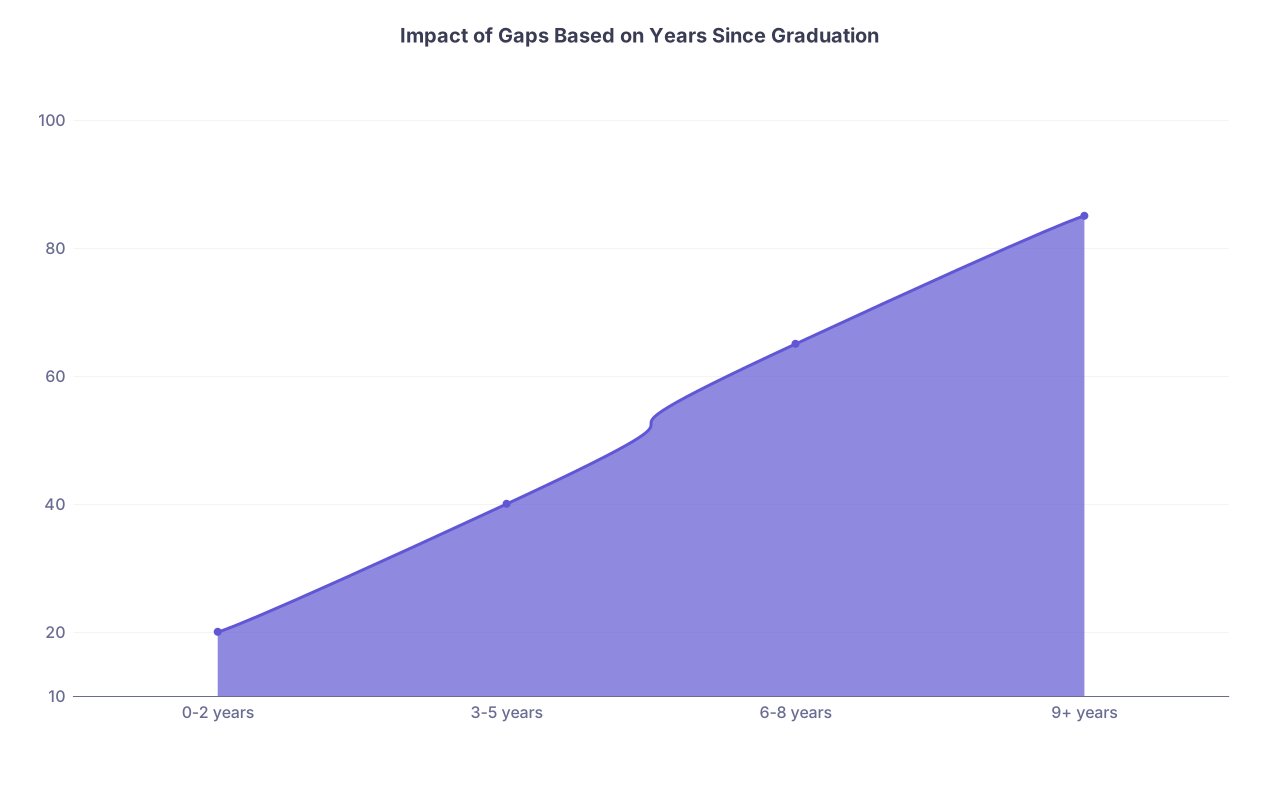
| Category | Value |
|---|---|
| 0-2 years | 20 |
| 3-5 years | 40 |
| 6-8 years | 65 |
| 9+ years | 85 |
(Values represent how concerning PDs tend to find unexplained gaps, roughly speaking.)
An older grad with:
- A 3‑year gap
- Then a 2‑week observership
- Then nothing
Looks like someone who gave up on clinical medicine, then tried to re-enter at the last second.
You may have excellent reasons. Illness. Family responsibilities. Immigration issues. Financial constraints. Those are real. But if you don’t frame and document them, they just show up as: “off the grid.”
How to Stop Looking Suspicious: Concrete Fixes
You can’t magically erase your past timeline, but you can stop making it worse – and start repairing your profile.
1. Replace long idle gaps with something verifiable
If you currently have large empty blocks, your first priority is not another test. It’s structured activity. Even if it’s modest.
Examples that reduce suspicion:
- Part‑time home country clinical work (outpatient clinic, hospital job)
- Telemedicine under supervision (where legally allowed)
- Research assistant roles with actual output
- Teaching roles (tutoring, small group teaching for students)
- Scribing or MA roles in the US (if you can get them)
You don’t need perfection. You need continuity and reality.
2. Prioritize longer, fewer US rotations over many short ones
If you’re planning USCE and have limited time/money, do not spread yourself thin across five 2‑week observerships.
You’re far better off with:
- 1–2 month-long rotations in your target specialty
- Ideally in places that understand IMGs and write strong letters
- Where you can show up consistently and actually be remembered
Two strong, detailed letters from month‑long rotations beat five generic ones from 2‑week shadows.
3. Align your story: exams, USCE, and activities should look intentional
Your application should read like a plan, not a scramble.
You want something like:
- Graduated → did home country internship/residency or work
- Took Step 1/2 while working or at least volunteering
- Started USCE soon after exams, in your chosen specialty
- Continued some form of clinical or academic involvement up to application
What you want to avoid:
- Graduated → nothing → failed exam → nothing → observership 4 years later → application
Same history. Different framing and choices.
Writing About Gaps Without Making Them Worse
You don’t fix gaps by over-explaining or over-dramatizing them either.
Bad approach:
“I was devastated after failing Step 1 twice and went into a period of reflection and self-doubt, during which I was unable to commit to any clinical or academic work.”
That just confirms their fears.
Better approach (if it’s true):
“After facing difficulty with my Step 1 preparation, I realized I needed to strengthen my foundational knowledge and study approach. During this time, I maintained part‑time involvement in [clinic/research/teaching], which allowed me to stay clinically engaged while improving my exam performance.”
You acknowledge the reality without sounding unstable, lost, or disconnected from medicine.
A few rules:
- Never lie about dates. Ever.
- Do not invent “clinical” roles that cannot be verified.
- Keep explanations brief, factual, and oriented toward what you did to move forward.
- Tie the experience to skills or resilience you built.
Specialty Choice: Don’t Expose Your Weaknesses More Than Necessary
If your CV is already fragile – big gaps, late USCE, short rotations – choosing an ultra‑competitive specialty (Derm, Ortho, Plastics, RO, etc.) is asking for rejection.
Those specialties are flooded with:
- US grads with no gaps
- Stellar research output
- Continuous, deep specialty exposure
You look even weaker by comparison.
If you decide to still apply to something competitive, do not make this mistake:
Spreading yourself across multiple specialties to “keep options open,” with tiny, disjointed rotations in each. PDs can smell the lack of commitment.
For most IMGs with suspicious timelines, you need:
- A realistic specialty (IM, FM, Psych, Peds, etc.)
- Deep, focused USCE in that specialty
- A coherent narrative: “I have been building toward this field consistently.”
Common Self-Sabotage Behaviors You Need to Stop
Let me be blunt. These are the patterns I see from IMGs who sink their match chances:
- Treating USCE as a box to check, not a period to build relationships and continuity
- Waiting until the year before application to do all USCE
- Letting 6–12 month blocks pass with zero documented activity
- Assuming “I was studying” is a sufficient justification for years of inactivity
- Hiding uncomfortable facts instead of framing them honestly and tightly
- Choosing short, rotating observerships across fancy hospitals instead of one solid experience at a mid-tier but IMG-friendly program
If you recognize yourself in that list, you’re not doomed. But you need to change course now, not after your third unmatched cycle.
The Bottom Line: What You Must Remember
Let’s end this cleanly.
- Program directors don’t just read your experiences; they read the pattern. Long gaps and strings of tiny rotations tell a story of instability, low commitment, or hidden problems.
- You can’t “explain it in the interview” if you never get one. Build continuity, prioritize longer USCE, and document real activity rather than disappearing behind “exam prep.”
- Your timeline must look intentional. Even if your path was messy in real life, your application should present a coherent, forward-moving trajectory – not panic-driven patchwork.