
The most dangerous US clinical experiences for IMGs are the ones that look impressive on paper and teach you nothing.
Most international graduates do not lose interviews because they lack “USCE” on the CV. They lose them because their letters and experiences are hollow. Generic. Unimpressive. And programs can smell that from a mile away.
If you are an IMG, you cannot afford letters without substance.
Let me walk you through the trap that catches IMGs every year, why it keeps happening, and how to avoid wasting thousands of dollars and irreplaceable months on “experience” that does not move your application an inch.
The Core Mistake: Confusing Any USCE With Valuable USCE
Programs are not impressed just because you set foot inside a US hospital. That era is over.
Here is the misconception that destroys applications:
“I just need something called an observership / externship / rotation in the US, get a letter, and I will be fine.”
No. You will not.
Program directors read hundreds of letters each cycle. They can distinguish in about three sentences whether:
- You actually interacted with patients
- You worked directly with the attending
- You demonstrated judgment, reliability, and growth
- Or you just paid a fee, showed up, and shadowed quietly in the back
The trap: thinking label > content.
You see “US clinical experience” advertised by agencies. You see “LOR guaranteed” on their websites. You see testimonials. You see pictures of people in white coats. It feels like progress.
But what you actually need is not a line on ERAS. You need:
- Specific, behavior-based comments in your letters
- Evidence of clinical reasoning and professionalism
- Mentors who will answer emails when programs contact them
- Experiences you can discuss in detail in interviews, with real examples
If your experience does not give you those, it is cosmetic. And cosmetic USCE is dead weight.
Red Flags: When “US Clinical Experience” Is Basically A Tourist Package
Here is where IMGs get scammed or, at best, shortchanged.

You should be extremely cautious if you see any of the following:
No direct contact role
You are “not allowed” to:- Write notes (even preliminary drafts)
- Present patients on rounds
- Make differential diagnoses or management plans (even as discussion)
- Call consults or speak to nurses on behalf of the team
If your only permitted task is “observe,” that is already a warning sign. Pure shadowing = shallow letters.
Large group observerships
Eight, ten, sometimes fifteen IMGs following one attending around like a tour group. You know this scene:- Half the group cannot hear what is going on
- Attending forgets your name by day three
- Interaction is a brief “Any questions?” in the hallway
That attending cannot write a strong, personalized letter about you. At best, you get a template with your name swapped in.
Third-party broker with no control over the physician
The company “places” you with some clinic or doctor they do not employ. They:- Cannot guarantee teaching
- Cannot guarantee letter strength
- Often cannot intervene if the attending barely shows up
You are paying for logistics and access, not for mentorship or advocacy.
Guaranteed letter, no performance-based criteria
If they promise “you will receive a letter” no matter what, expect:- Highly generic language
- No comparison to US graduates
- No specific patient stories
- Sometimes a one-paragraph form letter printed for everyone
Programs toss these into the mental “neutral” pile. They do not actively hurt you, but they definitely do not help you stand out.
Clinic-only, assembly line medicine
Many paid “externships” are basically:- Primary care mill clinics
- 30–40 patients per day
- Physician in survival mode, barely time to teach
- No multidisciplinary team, no rounds, no teaching conferences
You may learn practical things, but letters from these sites rarely carry the same weight as letters from academic or teaching-focused environments.
No institutional email or letterhead
If your supervising doctor:- Uses Gmail/Yahoo on the letter
- Prints the letter on blank or generic template paper
- Does not list an academic title or hospital role clearly
Programs will doubt how well they know US training standards, or even whether the rotation was legitimate.
What Program Directors Actually Look For In USCE And Letters
Let us be blunt. Program directors do not care that you:
- Paid $3,000 for an “elite US externship”
- Flew across the world
- Took pictures in a white coat
They care about evidence of one thing: Can you function safely and effectively in their system?
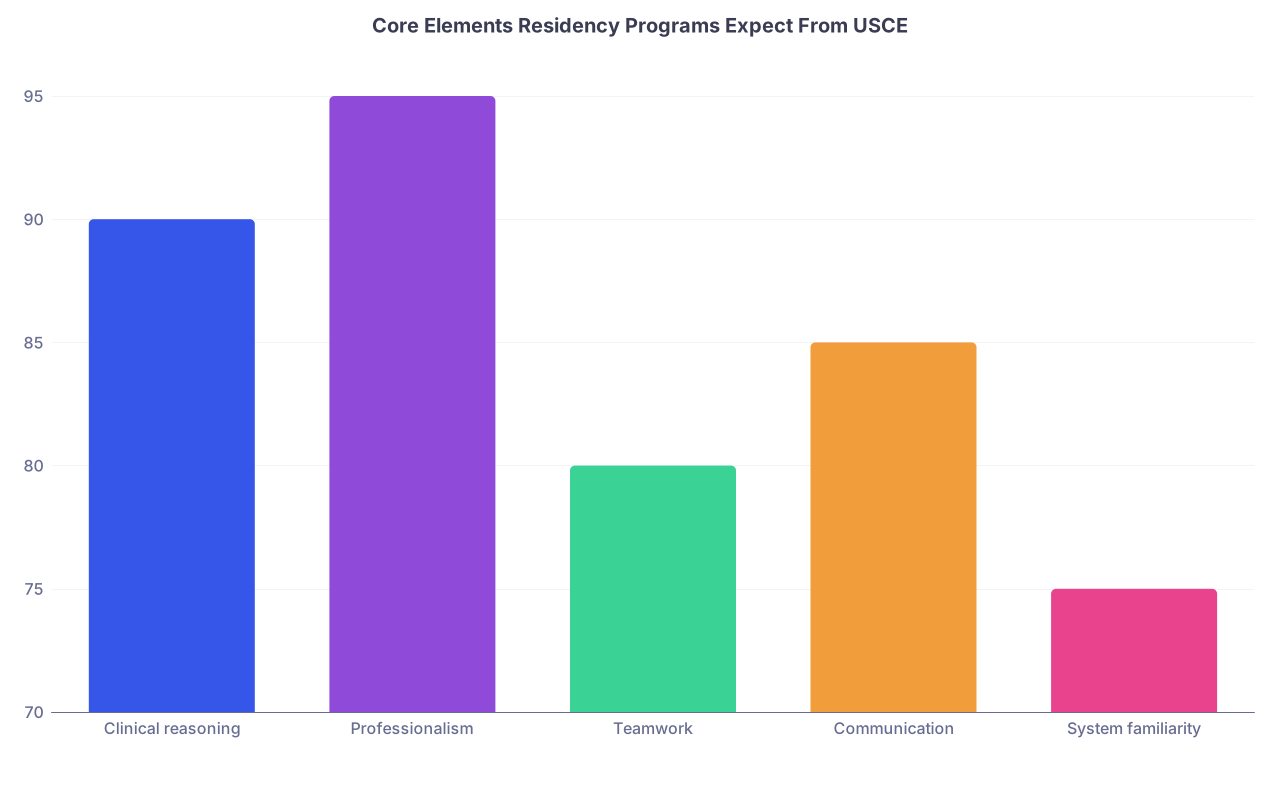
| Category | Value |
|---|---|
| Clinical reasoning | 90 |
| Professionalism | 95 |
| Teamwork | 80 |
| Communication | 85 |
| System familiarity | 75 |
They want to see, in your letters and experience descriptions:
Clinical reasoning and judgment
Strong letters mention:- “She consistently produced organized and thoughtful differentials.”
- “He identified early sepsis and promptly alerted the team.”
- “She adjusted her plan after incorporating new lab results and consultant recommendations.”
If your letter only says “hardworking, punctual, eager to learn,” that is not clinical performance. That is a bare minimum human trait.
Comparison to US grads or residents
Phrases that carry real weight:- “On par with our third-year US medical students.”
- “Comparable to an intern in terms of reliability.”
- “Top 10% of students I have supervised in the last five years.”
This lets PDs calibrate you to their usual talent pool.
Specific stories and behaviors
Strong letters include:- A specific patient you followed and presented
- A challenging situation where you handled communication well
- A time you took ownership and followed through
Weak letters are just adjectives pasted together.
Functioning inside the US system
Mention of:- EMR familiarity
- Understanding of documentation standards
- Appreciation of patient privacy, consent, and healthcare coverage issues
- Comfort in interprofessional communication
Without this, PDs worry you will require too much onboarding.
Reliability and work ethic with teeth
Good: “Never missed a day.”
Better: “Arrived early, stayed late, volunteered for extra tasks, and could be trusted with follow-up phone calls and lab review.”Programs want people who lighten the team’s load, not just exist on it.
If your USCE does not let your attending realistically see and assess those things, they cannot write about them. And if they cannot write about them, your “US experience” becomes decorative wallpaper on your application.
The Most Expensive Mistake: Buying Months Of Weak Letters
I have seen this pattern too many times:
- IMG spends $8,000–$15,000 on multiple commercial observerships and externships
- Collects 3–4 letters that say:
- “X is very hardworking and passionate about medicine.”
- “Y was always punctual and respectful.”
- “Z has good communication skills and was eager to learn.”
- No statement of relative ranking
- No specific cases
- No comparison to US learners
They submit ERAS. They get very few interviews. They are confused because “I have four US letters.”
The issue is not the quantity. It is the lack of substance.
| Feature | Weak Letter Example | Strong Letter Example |
|---|---|---|
| Personalization | Generic template | Detailed anecdotes, specific cases |
| Comparison to US trainees | None | “On par with / exceeds US students” |
| Clinical reasoning | Not described | Concrete examples of assessment and plans |
| Setting | Unclear or vague clinic | Recognizable teaching hospital or robust clinic |
| Credibility markers | Free email, unclear role | Institutional letterhead, clear academic title |
Do not make the mistake of thinking “more US letters” automatically means “stronger application.” Four weak letters are still weak.
The Clock You Keep Forgetting: Timing And Recency
Even if you pick good experiences, you can still sabotage yourself with timing.
Residency programs care about recency of clinical exposure. A great letter from six years ago often carries less weight than a good letter from last year.
Typical problems:
- Graduated 5+ years ago, with no recent clinical work
- Did USCE early, then returned home and worked in a completely different healthcare setting without any new US exposure
- Letters date-stamped 3–4 years before application
This screams “rusty.” PDs worry about your readiness for day-one responsibility.
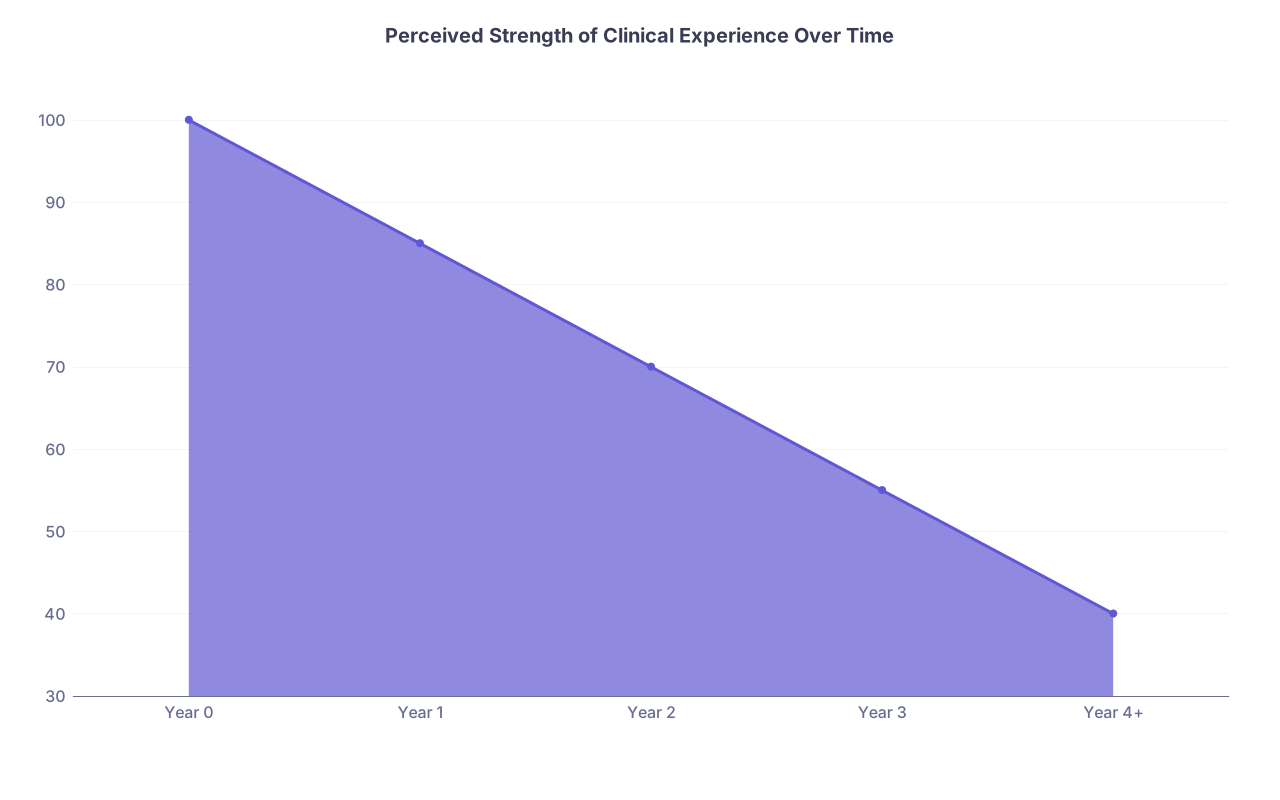
| Category | Value |
|---|---|
| Year 0 | 100 |
| Year 1 | 85 |
| Year 2 | 70 |
| Year 3 | 55 |
| Year 4+ | 40 |
You avoid this trap by:
- Planning at least some USCE within 12 months of applying
- Making sure your letters are updated or refreshed if the rotation was >18–24 months ago
- Keeping ongoing clinical work (even at home) so there is no big gap in practice
If you delay and then try to “patch” your application with one rushed observership, the letter will look exactly like what it is: last-minute, superficial, and limited in scope.
How To Vet A US Clinical Experience Before You Waste Your Money
Let me be very direct: if you cannot get clear answers to these questions, walk away.

| Step | Description |
|---|---|
| Step 1 | Find USCE Opportunity |
| Step 2 | High risk of weak letter |
| Step 3 | Lower risk, consider costs and fit |
| Step 4 | Direct patient contact allowed |
| Step 5 | Supervised by teaching physician |
| Step 6 | Max 2 trainees per attending |
| Step 7 | Institutional email and letterhead |
Questions you must ask (and get specific answers for):
What exactly will be my role day to day?
You want to hear:- Presenting patients on rounds or in clinic
- Drafting notes (even if not signed by you)
- Participating in pre-rounds, sign-out, case discussions
Not just “you will observe and ask questions when time permits.”
How many other trainees will be with me?
Red flag if:- “We usually have a group of 6–10 observers.”
Better: - 1–2 learners per attending, maybe with US students or residents involved.
- “We usually have a group of 6–10 observers.”
What proportion of time is inpatient vs outpatient?
Outpatient-only is not necessarily bad, but if your target is a hospital-based specialty, at least one rotation should involve:- Rounds
- Admissions
- Interdisciplinary teams
Who actually writes the letter and on what letterhead?
You want:- Specific attending physician named
- Institutional or hospital letterhead
- Institutional email address and phone number
How often does the attending work with IMGs?
Attending who routinely writes letters for IMGs understands what programs need to see. Generic community doctors sometimes write very kind, flattering letters that are clinically useless.Can I see a sample schedule or description (without names)?
If they refuse to share even a skeleton schedule, they probably do not have a structured experience.
If the answers are vague, overhyped, or heavily marketing-focused, you are walking into the “letters without substance” zone.
Strategic Use Of USCE: Quality, Alignment, And Story Coherence
You do not need ten US rotations. You need a coherent, believable story that your application, letters, and interview performance all reinforce.
Think in terms of:
Quality over quantity:
Two strong US rotations with detailed letters > six tourist-style observerships.Specialty alignment:
If you are applying to internal medicine, most of your USCE should be IM or closely related (cardio, endocrine, pulm, etc.). Three months in dermatology then applying to family medicine looks scattered.Progression and responsibility:
A nice pattern:- First rotation: Observership with gradually increasing participation
- Later rotation: More hands-on, more responsibility, more ownership
Then your letters reflect growth over time, not repetition.
Letter mix:
Ideal set for many IMGs:- 2–3 US letters in the specialty you are applying to
- 1 strong home-country letter that emphasizes your long-term clinical maturity or leadership
- If possible, at least one letter from an academic or teaching hospital
Common Rationalizations That Will Hurt You
Let me call out a few lies IMGs often tell themselves right before they waste money on weak USCE.
“Any USCE is better than none.”
Not always. Bad USCE can crowd out space for better letters or make your application look disorganized.“I just need US letterheads. Content is secondary.”
Wrong. Programs are skeptical now. Generic letters on famous letterhead still fall flat if the writer barely knows you.“I will impress them once I get interviews.”
You are assuming you will get enough interviews. Weak USCE and letters are a big reason many IMGs never reach that stage.“I cannot be picky as an IMG.”
You cannot be reckless either. Money, time, visa limitations – these are real constraints. Being methodical with fewer, higher-yield experiences is not “picky,” it is smart triage.“Agency X says 90% of their students match.”
They are not showing you the denominator, the selection bias, or how many of those students already had stellar scores and home-country records. Treat marketing stats like pharmaceutical ads: attractive, but not impartial.
The Bottom Line: What To Do Differently
If you strip away all the noise, your job is simple:
- Avoid experiences that only give you a label (“USCE”)
- Seek experiences that let someone credible see you work, think, and grow
- Make it easy for that person to write a specific, grounded, comparative letter

Your filter for any USCE offer should be ruthless:
- If they cannot tell you what exactly you will be allowed to do → pass.
- If more than 3–4 observers are attached to one attending → pass.
- If they guarantee a letter without mentioning performance → pass.
- If you cannot clearly see how the experience supports your target specialty → probably pass.
You do not have unlimited time or money. Stop treating “US clinical experience” as a checkbox to fill and start treating it as an audition. Because that is what it is.
FAQ (exactly 5 questions)
1. Do I absolutely need US clinical experience to match as an IMG?
Not always, but in many specialties and programs it is strongly preferred. The more competitive the specialty or the more community-based the program, the more they tend to rely on USCE to gauge whether you understand the system and can function on day one. High scores and strong home-country experience can compensate in some cases, but for most IMGs aiming for internal medicine, family medicine, pediatrics, or psychiatry, at least a couple of well-chosen US rotations significantly improve credibility.
2. Are observerships useless compared to hands-on externships?
Not automatically. Observerships can be valuable if they are structured, with close supervision by a teaching-focused attending, opportunities to present patients, and genuine evaluation of your clinical reasoning. Many so-called “externships” are actually glorified observerships with a higher price tag. The distinction that matters is not the label but the substance: what you do, how closely you are observed, and what your supervisor can truthfully write about you.
3. Should I prioritize brand-name hospitals for USCE?
Famous names help only if the letter content is strong. A generic letter from a big-name institution is weaker than a detailed, individualized letter from a smaller but teaching-oriented hospital or clinic. If you can get both brand and substance, fantastic. If forced to choose, prioritize an environment where you will be known well enough for your supervisor to describe specific cases, behaviors, and comparisons to US trainees.
4. How many months of USCE are enough for an IMG applying to internal medicine or family medicine?
For most IMGs, 2–3 months of solid, specialty-aligned USCE with strong letters is sufficient. More can help slightly but with diminishing returns. Beyond that, the marginal benefit of another month is usually lower than the benefit of using that time for Step 3, research, quality improvement projects, or continued clinical work at home. Quality and timing (within 1–2 years of application) matter far more than accumulating a large number of short, weak rotations.
5. Can I reuse an older US letter if I cannot return for new USCE before applying?
Yes, but you should try to refresh it. Contact the original writer, send an updated CV and brief summary of your current work, and politely ask if they can update or re-date the letter, especially if they still remember you well. If that is not possible, an older but strong, specific letter is still better than a brand-new but generic one. However, you should then make sure your recent clinical activity (even in your home country) is clearly documented in ERAS and backed by up-to-date local letters to show that you remain clinically active and current.
Key points to remember:
- Do not pay for “USCE” that only lets you stand in the back and watch. If you are not doing meaningful work, no one can write meaningfully about you.
- Letters without specific stories, comparisons, and clinical reasoning statements are background noise. You cannot match on background noise.
- Treat every US rotation as an audition, not a souvenir trip. Your future PD is reading those letters trying to decide if they trust you at 3 a.m. on call. Make sure your experiences give your letter writers something substantial to say.