
It is mid‑September. Your last US rotation just ended. ERAS is submitted. You are sitting in a short‑term rental surrounded by half‑opened suitcases and a stack of visitor I‑94 printouts. You spent thousands of dollars, flew across continents, did three “USCE” blocks… and your inbox is dead quiet. No interview emails. Just automated “We received your application.”
You did what everyone told you: “Get US clinical experience.”
What they did not tell you: you can absolutely waste it.
I see IMGs do this every year. They chase the label (“USCE”) and ignore the substance (what programs actually care about). The rotation goes on the CV, but:
- No one remembers them.
- No one writes a meaningful letter.
- No one advocates for them on a rank list.
You cannot afford that.
This is about how IMGs misuse US clinical experience and how to avoid burning the most expensive, high‑stakes months of your life.
Mistake #1: Treating “Any USCE” as Good USCE
Most IMGs start from this flawed idea: “As long as it is USCE, it is good.” Wrong. There is a hierarchy of usefulness that programs actually care about.
| USCE Type | Typical Value for Residency | Notes |
|---|---|---|
| ACGME core sub‑I | Very High | Direct patient care, EMR, orders |
| ACGME elective | High | Strong letters, real exposure |
| Community hospital rotation | Moderate | Depends on involvement |
| Pure observership | Low | No direct patient care |
| Research‑only | Low‑Moderate | Depends on specialty and output |
The mistake:
You accept whatever you can get first. A random observership with:
- No EMR access
- No order writing
- No patient notes
- No defined role
- No clear letter writer
Then you string together 3–4 of these and expect program directors to be impressed. They are not. They see this pattern all the time.
Let me be blunt: three low‑quality observerships do not equal one strong, hands‑on academic sub‑internship.
How to avoid this
Before paying for any “USCE”:
- Ask directly:
- “Will I have EMR access?”
- “Will I write notes that are co‑signed?”
- “Can I present patients on rounds?”
- “Is there an opportunity for a letter of recommendation if I perform well?”
- Look for ACGME‑accredited hospitals and actual residency programs on site.
- Avoid “shadowing mills” that rotate dozens of IMGs per month with no structure.
If answers are vague, non‑committal, or they highlight “certificate” more than actual clinical work, walk away.
Mistake #2: Chasing Volume, Ignoring Timing
Another classic: IMGs cram USCE in all the wrong months.
- Doing multiple rotations after ERAS submission in a Match cycle where you are applying now.
- Doing USCE very early (two years before applying) and nothing close to application time.
- Doing a heavy USCE schedule during the months you should be preparing for Step 2 CK.
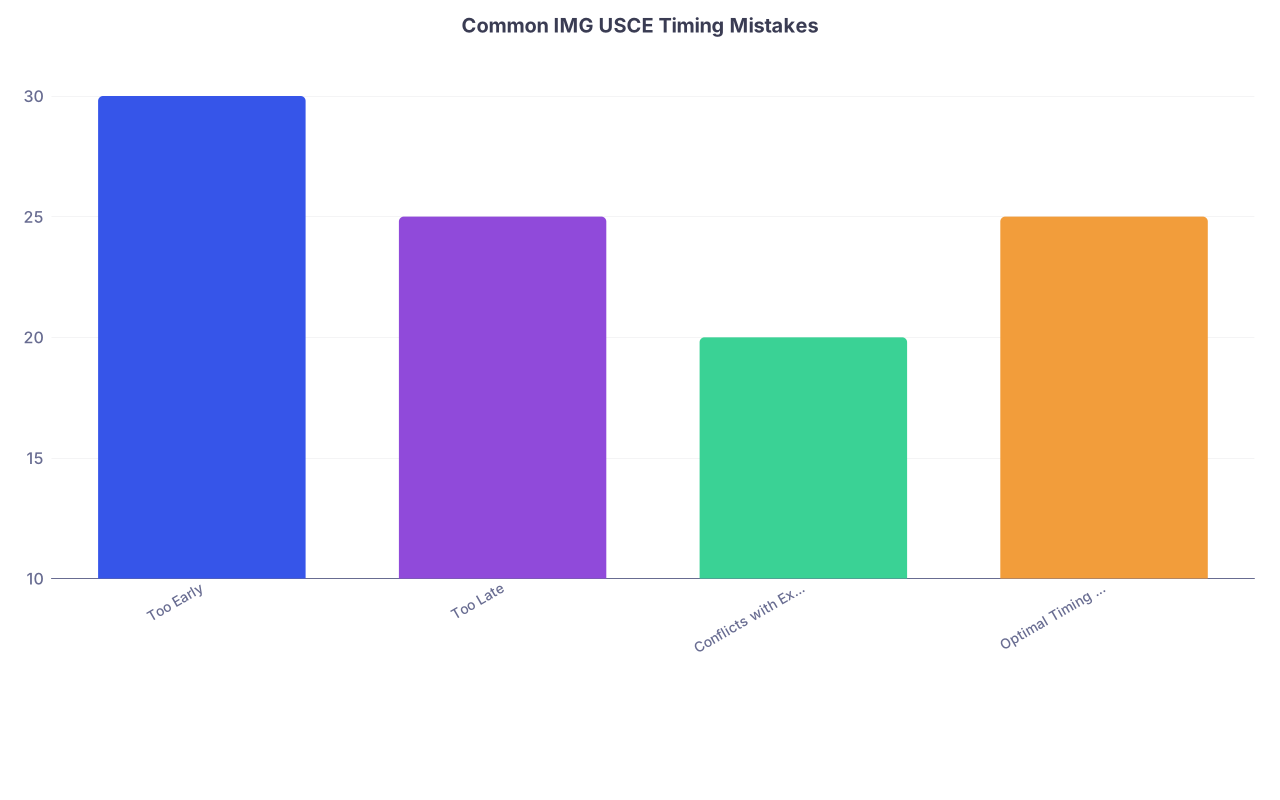
| Category | Value |
|---|---|
| Too Early | 30 |
| Too Late | 25 |
| Conflicts with Exams | 20 |
| Optimal Timing Missed | 25 |
Programs care about recent US experience and actionable letters that arrive before rank lists are built.
The timing mistake looks like this:
- You do a great rotation October–November.
- Your attending says, “I will write you a letter.”
- Letter shows up in January.
- Half your interviews are done. Many programs have already built their rank lists or are close.
Or worse:
- You plan three observerships December–February while applying for the same cycle.
- Those rotations cannot be reflected on your initial ERAS, and letters arrive too late to affect interview offers.
Better timing strategy
For the Match year you are targeting:
- Aim for June–September USCE that will generate letters in time for:
- ERAS opening
- Early interview consideration
- If you can only get later blocks (Oct–Dec):
- Make sure at least one strong US letter is ready by ERAS submission from prior experience.
- Treat later rotations as audition opportunities for SOAP or for the next cycle.
Do not proudly tell programs, “I have three more rotations scheduled after January.” That does nothing for them when they are finalizing their rank lists in February.
Mistake #3: Being a Ghost on Rotation
You show up.
You are always on time.
You follow the team.
You never cause trouble.
And you leave absolutely no impression.
I hear this every year from attendings: “Nice student… quiet… reliable… I guess I can do a generic letter.”
Generic letters are death for an IMG competing in a crowded pool.
Silent presence is one of the most damaging IMG habits on USCE. You think you are being respectful; people perceive disengagement or lack of confidence.
How this plays out
You:
- Stand at the back during rounds.
- Never volunteer to present.
- Rarely offer to write a draft note.
- Do not ask to follow up labs or imaging.
- Avoid teaching moments because you are afraid of being wrong.
Your attending afterward:
“Was that the student from Pakistan or the one from Egypt? I cannot remember which was which, but they were polite.”
That is not going to move any program director.
How to avoid ghost mode
You do not need to be loud. You need to be visible and engaged.
- Ask early: “How can I be most useful to the team?”
- Volunteer: “Would it be alright if I present this patient tomorrow?”
- Offer work: “Can I practice drafting the H&P for this new admission for you to review?”
- Follow through: When you say you will follow up a result, actually be the first to report it back.
You want one or two specific stories burned into your attending’s memory:
- “She came in on a weekend, caught a critical lab, and escalated appropriately.”
- “He read up on all our cirrhosis patients and gave a great mini‑talk on ascites management.”
Those become sentences in your letter.
Mistake #4: Not Managing the Letter of Recommendation Process
Many IMGs treat letters like lottery tickets: “Maybe they will write something good.”
This is naïve. I have seen excellent students get tepid, two‑paragraph letters because they never managed the process.
Common letter mistakes
- Waiting until the last day to mention letters.
- Asking vague questions like “Can you maybe write something for my application?”
- Not clarifying whether the writer can support you strongly.
- Never sending a CV or personal statement, so the letter is shallow.
- Never reminding them about deadlines.
Or the worst: assuming a letter will come, then discovering nothing was uploaded.
Do this instead
Two to three weeks into a rotation, if you are performing well, say something like:
“Dr Smith, I am applying to internal medicine this September. If you feel you can write a strong letter of recommendation based on my performance so far, I would be very grateful.”
If they hesitate or say something non‑committal like “Sure, I can write something,” be cautious. That often equals generic.
Then:
- Provide your CV and personal statement.
- Gently remind them of one or two specific things you did that might be worth mentioning.
- Clarify the due date (ideally before ERAS opening or shortly thereafter).
- Send one reminder email 1–2 weeks before the deadline.
Do not be the student who assumes everything is fine, then finds 0/4 letters in ERAS on October 1st.
Mistake #5: Wrong Specialty / Wrong Signal
Another quiet way IMGs waste USCE: building the wrong story.
Examples I have actually seen:
Applicant says they are applying to internal medicine. ERAS shows:
- 2 months orthopedic observership
- 1 month dermatology observership
- 1 month plastic surgery shadowing
Zero IM‑focused experience.
Applicant wants psychiatry but all their USCE is ICU and trauma surgery. No psych, no outpatient mental health, no continuity clinic.
Program directors draw conclusions:
- “Lack of commitment.”
- “Undecided about specialty.”
- “Using any rotation just to tick USCE box.”

You might think: “USCE is USCE.” They do not.
Align your USCE with your application story
If you are aiming for:
- Internal Medicine
- Inpatient wards, ICU, outpatient IM clinic, endocrinology, cardiology, GI.
- Family Medicine
- Outpatient continuity clinic, community health centers, OB clinic if possible, geriatrics.
- Psychiatry
- Inpatient psych, outpatient clinic, consultation‑liaison psych.
- Neurology
- Inpatient stroke / general neuro, EMU, neuro clinic.
You can have one or two “exploratory” experiences elsewhere. But your core USCE must clearly support your chosen specialty.
Programs should not have to guess.
Mistake #6: Ignoring the Network Right in Front of You
Big missed opportunity: using USCE only for a letter, not for a network.
Every attending you work with:
- Has friends at other programs.
- Trains residents who move to fellowships elsewhere.
- Knows which PDs are IMG‑friendly.
- May be willing to send an email about you.
But they will not do any of that automatically.
Common networking misses
- Never asking about their program’s culture or advice on where to apply.
- Not asking, late in the rotation, “Do you know any programs that tend to be IMG‑friendly?”
- Failing to keep in touch via a short update email when you apply.
- Not telling them where you are interviewing, so they cannot advocate.
A simple version of what you should do near the end:
“Dr Patel, I really appreciated the chance to work with you. I am planning to apply broadly to community internal medicine programs, especially in the Midwest and South. If you know of any programs that have been receptive to IMGs recently, I would really value your perspective.”
Then, when ERAS is submitted:
“Dear Dr Patel, just an update that I applied to X, Y, and Z programs this cycle. If you happen to know any of the faculty there, I would be very grateful for any support or advice.”
Not everyone will help. Some will. One email from the right person can convert you from “random IMG” to “the student Dr Patel mentioned.”
Mistake #7: Focusing Only on Hospital Prestige, Ignoring Teaching Culture
IMGs obsess over names. “I must rotate at a big‑name place—Cleveland Clinic, Mayo, MGH—or it is useless.”
Here is the problem: not all famous hospitals give useful USCE to IMGs. In some, you will:
- Never touch the EMR
- Hardly speak during rounds
- Be one of 10 observers on the same team
- Get completely ignored by the attending
- Receive, at best, a template letter stamped with your name
Meanwhile, a mid‑tier academic or strong community hospital with a committed program director can:
- Let you act almost like a sub‑intern
- Give detailed feedback
- Offer a specific, personalized letter
- Sometimes even invite you to interview if you perform well
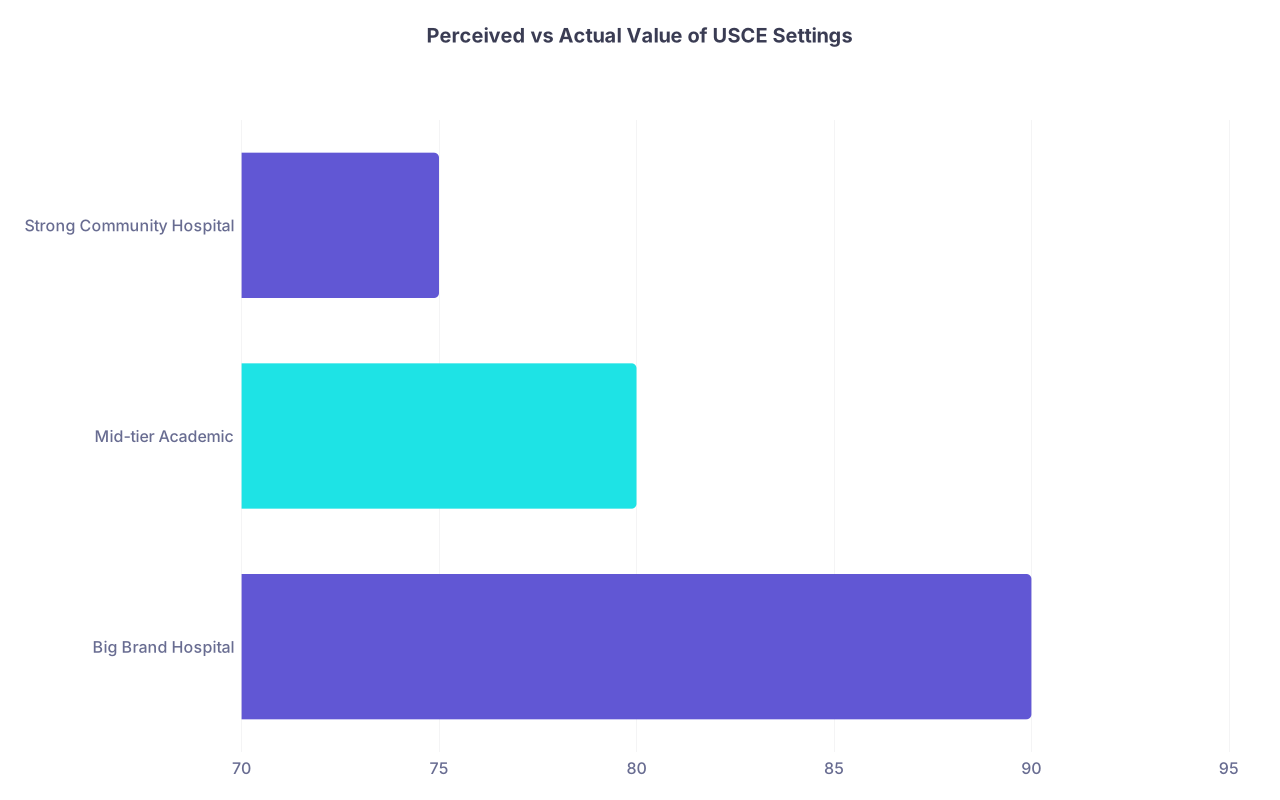
| Category | Value |
|---|---|
| Big Brand Hospital | 90 |
| Mid-tier Academic | 80 |
| Strong Community Hospital | 75 |
The big brand might look fancy on your CV, but a weak letter from a big name is not better than a strong letter from a “less famous” place.
What you should look for
When choosing rotations, prioritize:
- Small team sizes (so you are seen).
- Clear learning objectives.
- Explicit involvement in patient care.
- Attending and residents who appear engaged with teaching (not just service).
If the website focuses mostly on “certificate”, “housing packages”, and “visa letters”, be cautious. That is usually marketing to desperate IMGs, not to serious trainees.
Mistake #8: Not Prepping for the System Before You Show Up
Another preventable waste: showing up to USCE with zero prep on US health‑care basics.
You spend the first 2–3 weeks:
- Figuring out EMR navigation.
- Learning what “HMO”, “Medicare”, or “SNF” even mean.
- Confused about basic order sets (DVT prophylaxis, insulin protocols).
- Struggling with SOAP note format.
By the time you are finally useful, the rotation is almost over. Too late to impress.
Pre‑rotation homework that IMGs skip (and should not)
Before flying in:
- Watch EMR tutorial videos if available. At least review generic EHR workflows.
- Review:
- Common admission orders
- DVT prophylaxis guidelines
- Insulin sliding scale basics
- Code status discussions and documentation
- Practice writing SOAP notes and one full H&P in US format.
- Get comfortable presenting a case in 3–5 minutes, focused and structured.
You should not be spending week 3 learning how to present. That is when your attending is deciding whether you are “letter material.”
Mistake #9: Letting Visa / Logistics Chaos Sabotage Performance
I see this a lot: the rotation fails not because of knowledge, but because of chaos.
- You arrive late due to visa delays.
- You are exhausted from constantly moving Airbnbs.
- You are worrying about money and overbooking Uber shifts on off days.
- You are jetlagged for half the month.
So on rotation, you are:
- Frequently late.
- Distracted.
- Leaving early because of housing or transport problems.
- Calling out sick for solvable issues.
Your attending does not see “brave IMG fighting through adversity.” They see “unreliable trainee.”
Minimize controllable chaos
You cannot control visa processing speed, but you can control:
- Buffer days for arrival before the rotation start date.
- Stable, pre‑booked housing close to the hospital.
- Realistic expectations about working hours so you are not overcommitted to side jobs.
- Clear communication early if any unavoidable delay arises.
Do not let a badly planned bus route become the reason you lose a letter.
Mistake #10: Misrepresenting What You Actually Did
Final, dangerous mistake: stretching the truth about your USCE. Programs know the typical level of responsibility for observerships vs electives.
Red flags:
- Observership described as “managed a panel of patients, wrote and signed orders, independently conducted procedures.”
- Letters from observerships claiming responsibilities that violate hospital policy.
Program directors talk. They know what is realistic. If your description or letter sounds impossible for an observer, they question your integrity.

Stay accurate, without underselling yourself
If you were an observer:
- Say: “Participated in bedside rounds, presented patient summaries, discussed differential diagnoses and management plans with the team, and observed procedures.”
- If you drafted notes: “Prepared draft notes for teaching purposes that were reviewed by the team but not entered as official documentation.”
You can still show initiative and depth without pretending you had intern‑level authority. Programs prefer honest, precise description over inflated nonsense.
FAQ (4 Questions)
1. How many months of US clinical experience do IMGs actually need?
Enough to generate 2–3 strong, recent, US‑based letters in your target specialty. For most IMGs, that means 2–4 months of solid, hands‑on ACGME‑affiliated rotations. Six months of weak observerships is less useful than two focused, high‑quality months.
2. Are observerships completely useless for residency applications?
No, but they are often overvalued. Observerships can help you learn the system and sometimes yield letters, but they rarely carry the same weight as real electives or sub‑internships. If observerships are your only option, choose programs where observers can at least present and engage meaningfully, and do not pretend the role was more than it was.
3. Can a strong letter from a community hospital beat a weak letter from a famous academic center?
Yes. Program directors read content, not just letterhead. A detailed letter with concrete examples from a mid‑tier hospital is much more persuasive than a two‑paragraph generic note from a “big name” where the attending barely knew you.
4. What if I already “wasted” some rotations—am I doomed for the Match?
No, but stop repeating the same pattern. Analyze what went wrong: was it timing, engagement, specialty mismatch, or letter management? Then plan your remaining USCE (or next cycle) so that every rotation has a clear purpose: produce one strong letter, in your target specialty, from someone who actually knows your work.
Key Takeaways
- Not all USCE is equal. Chasing any rotation, at any place, in any specialty is how IMGs burn money and time without getting interviews.
- Your goal is not “USCE on CV”; it is “memorable performance that generates strong, timely letters in the right specialty.”
- Treat every rotation like an audition. Prepare before you arrive, engage visibly, manage the letter process, and build real connections—otherwise you are just another ghost in a white coat.