The biggest lie IMGs are told is that US clinical experience is just a “checkbox.” It is not. It is one of the quiet levers that moves your name up—or down—on a rank list far more than most program websites will ever admit.
You see “USCE required or strongly preferred” and think: fine, I’ll find an observership and I’m done. From the program side, that’s not how this plays out. Your US clinical experience bleeds into every part of how faculty talk about you in rank meetings: how much risk you are, whether you’ll survive July, whether the PD can sleep at night having you on the night float schedule in week two.
Let me walk you through what really happens behind the doors you never see.
What Program Directors Actually Look For When They Say “USCE”
Let me be blunt: for most IMGs, US clinical experience is how programs decide if your application is theoretical or real.
On paper, you might have:
- Great scores
- Decent research
- Strong home-country clinical grades
But in rank meetings, someone always asks a version of:
“Has this person actually functioned in a US hospital, or are we guessing?”
That question alone can drop you 30–50 spots on a mid-size program’s rank list.
Here’s what PDs and faculty are actually trying to answer when they scan your USCE section:
- Can this person function in our system on Day 1 without hand-holding?
- Has a US physician already taken the liability of saying, “Yes, I trust this person with my patients”?
- Have they seen real U.S. inpatient workflow: pages, notes, EMR, sign-outs, pre-rounding, calls from nurses, pharmacy, social work?
- Do they understand U.S. medicolegal and documentation culture or are they going to write unsafe, non-billable notes?
When you list “observership – 4 weeks,” most experienced faculty translate that mentally into: “Probably watched a lot, did very little.” That does not boost your rank list position much unless the letter attached to it is unusually specific and strong.
On the other hand, “Hands-on sub-internship – 4 weeks – wrote notes, presented on rounds, took call” sets off a different internal reaction:
“Ok, someone already test-drove this person in our system.”
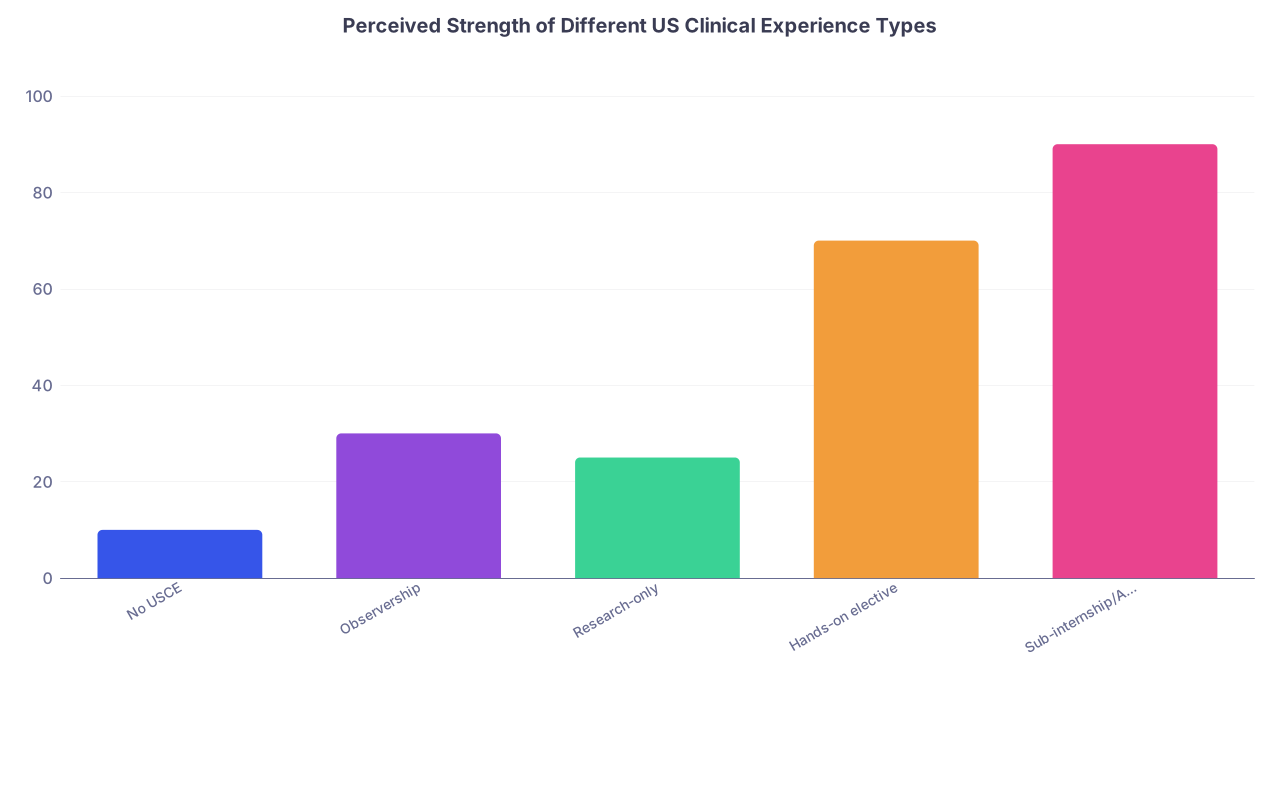
| Category | Value |
|---|---|
| No USCE | 10 |
| Observership | 30 |
| Research-only | 25 |
| Hands-on elective | 70 |
| Sub-internship/Acting Intern | 90 |
Those numbers are not from a published paper; they’re how PDs talk informally at conferences and in committee rooms when you’re not there.
The Hidden Channels: How USCE Echoes in Rank Meetings
You think US clinical experience sits in one ERAS section. It does not. It quietly infects almost every part of the discussion about you.
1. The Line That Changes the Room
Real scene from a rank meeting at a mid-tier IM program:
Faculty are lukewarm about two IMG applicants with similar scores. Committee is drifting toward the other candidate. Then one attending says:
“I actually worked with her on the wards during her rotation with us. She handled a full intern-level list by the second week. I’d be very comfortable having her on nights.”
That one sentence bumped her 20–30 spots instantly. Nobody said, “Let’s move her 30 spots.” The tone just shifted. People nodded, murmured approval, and the coordinator dragged her name much higher on the spreadsheet.
Where did that confidence come from? Not her personal statement. Not her home-country transcript. It came from USCE in that exact hospital.
You want to know the unspoken hierarchy? Here it is.
| USCE Type | Typical Impact on Rank List Position (Relative) |
|---|---|
| No USCE | Strong negative |
| Observership at unknown community site | Mild positive / neutral |
| Observership at affiliated site | Mild positive |
| Hands-on elective at academic center | Moderate positive |
| Sub-I / Acting Intern at same program | Very strong positive |
| Multiple US rotations with strong LORs | Strong positive |
No program will print that table on their website. But this is how people think.
2. The “Risk” Discussion PDs Never Admit Publicly
Behind closed doors, PDs stratify applicants into “safe,” “moderate risk,” and “high risk.” For IMGs, USCE is one of the main risk modifiers.
Example that I’ve heard almost verbatim:
“She’s an IMG, but she did two U.S. sub-Is, one in our system. Strong letters. I see her as low risk.”
Versus:
“He’s got great scores but zero USCE. We have no idea how he’ll function with U.S. documentation and nursing. That’s a risk in July.”
Same scores. One drops a tier on the rank list.
USCE is one of the only ways you can shift yourself out of the “risk” bucket as an IMG if you don’t have a famous-name degree backing you.
How Different Types of USCE Really Play Out
Programs rarely spell this out for you, so I will.
Observerships: The Overrated Default
Most IMGs start here. And most overestimate the value.
Typical faculty reaction to “observership”:
“Ok, at least they’ve been in a US hospital and seen the environment. That’s better than nothing.”
But for rank list movement, observerships are weak. They help when:
- They are at the same program you’re applying to and the letter is concrete and detailed
- The observer clearly showed up early, read, engaged, presented cases informally, and the attending actually remembers them in rank meetings
Otherwise, your observership is background noise. It prevents a penalty for “no USCE,” but rarely gives you a major boost.
Hands-On Electives and Sub-Is: The Real Currency
This is what PDs care about when they can get it: Did you behave like an intern?
If your USCE allows you to:
- Pre-round independently
- Present on rounds
- Write notes in the EMR (even if they needed cosigning)
- Call consults or discuss with nurses
- Cover a portion of the cross-cover pager under supervision
Then you’ve crossed a psychological line for faculty. You are no longer a theoretical risk; you are a known quantity.
In rank meetings, the language changes:
- From: “They seem strong.”
- To: “I’ve seen them manage 6–8 patients, write appropriate plans, and communicate well with staff.”
That’s a different world.
“Brand-Name” vs “Relevant” USCE
Here’s a nuance IMGs miss:
You think: “If I can get USCE at a big-name place—Cleveland Clinic, Mayo, Mass General—that automatically helps everywhere.”
Not exactly.
At a mid-tier community-based program, what actually impresses them more:
- You did a sub-I at a hospital that looks like theirs (busy, safety-net, diverse population, heavy workload), and the letter says you handled volume and chaos.
At a hyper-academic program, name brand matters more because they trust their peer institutions and like to see you’ve tolerated that intensity.
If you’re applying mainly to community programs and mid-tier academics, chasing letters from “normal” but busy teaching hospitals can be smarter than a single elite observership where you mostly stood in the back.
The Hidden Multiplier: How USCE Turbocharges Your Letters
If you want to know the real way USCE shifts your rank list position, it’s through letters of recommendation.
Most IMG letters from home institutions read the same to US faculty:
“Hardworking, punctual, compassionate, excellent clinical skills, will be an asset…”
This doesn’t move you.
US-based letters tied to strong clinical performance do. In committee, someone will scroll through your LOR and read out loud lines like:
- “Functioned at or above the level of an incoming intern”
- “Managed a full list of 8–10 patients with appropriate plans”
- “I would be comfortable having this applicant as my resident”
Those exact phrases change your rank list position. Right there in the room.
USCE gives attendings the raw material to write that way. Observers who just watched? They get: “eager, observant, interested in learning.” That’s not enough.
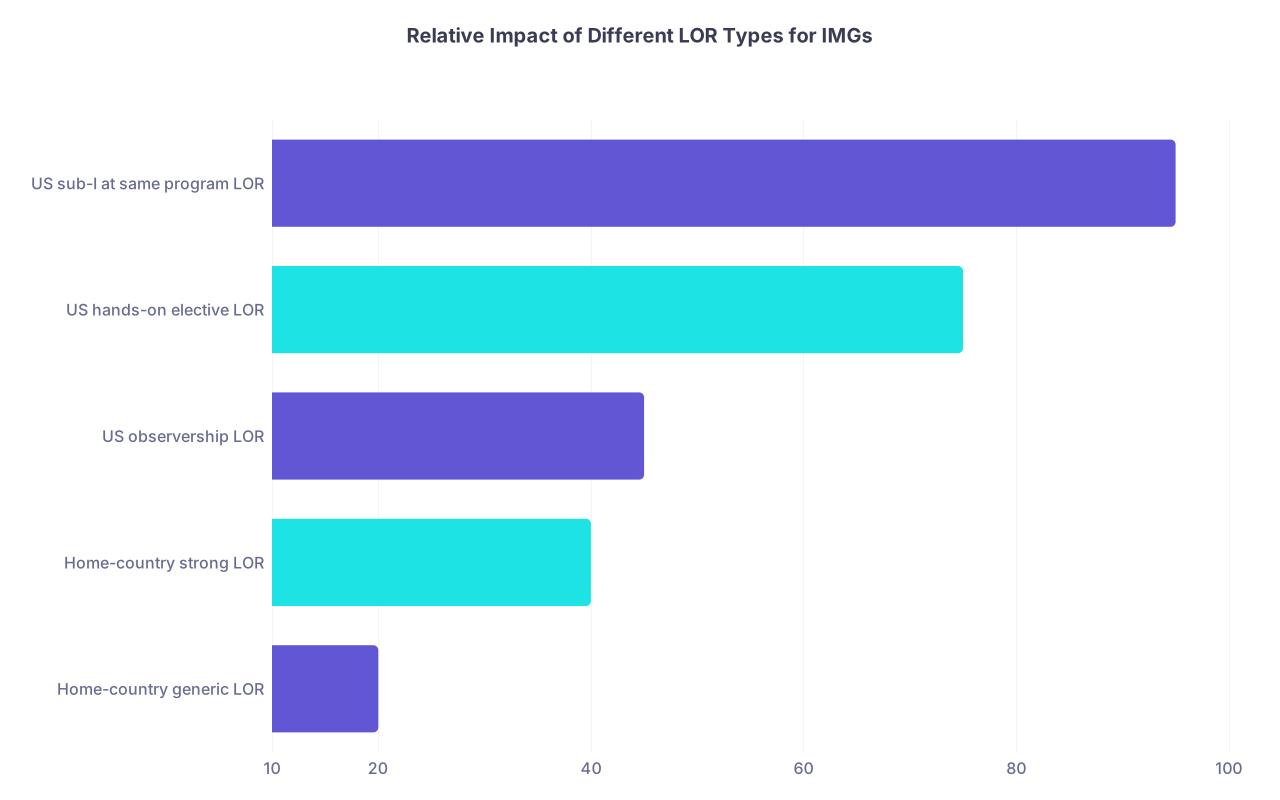
| Category | Value |
|---|---|
| Home-country generic LOR | 20 |
| Home-country strong LOR | 40 |
| US observership LOR | 45 |
| US hands-on elective LOR | 75 |
| US sub-I at same program LOR | 95 |
Again, these numbers are conceptual, but they match how strongly PDs react to each type in rank discussions.
How USCE Changes the Way You Are Remembered
By the time rank list meetings happen, faculty have interviewed dozens—sometimes over a hundred—applicants. Memory gets fuzzy. Application PDFs blur together.
USCE is often what makes your name “stick.”
Here’s the pattern I’ve watched play out:
Applicant A: IMG, excellent scores, no USCE. Interview goes well. On rank day, someone says, “Which one was he again?” People squint, try to recall, scroll through ERAS. Neutral energy. They get placed solidly but not high.
Applicant B: Similar profile, but did an inpatient elective at that program 6 months earlier. People remember specific cases. “Oh, that’s the one who caught the subtle STEMI that hadn’t been called yet.” Bang—instant jump.
USCE converts you from a 2D file to a 3D person in that room.
Your actual clinical behavior during USCE becomes the story people tell when defending moving you up the list. The story is what moves you, not the line item itself.
The Ugly Truth: How USCE Can Hurt You
Now for the part no one warns you about.
USCE doesn’t just help. It can quietly drag you down a rank list if you mishandle it.
Programs remember bad rotations far more vividly than good ones. I’ve seen this:
- A student who was late repeatedly during an elective
- Someone who refused to write even draft notes because “in my country students do not document”
- Poor communication with nurses, perceived as arrogant or dismissive
Months later, in rank meetings, you’ll hear:
“He rotated with us. Honestly, I’d rather not rank him. He struggled to take feedback and seemed disinterested.”
If that person is from your home institution, congratulations: your whole school’s reputation just got a little worse too.
For you personally, a mediocre or bad USCE at a program you’re applying to is worse than no USCE at that program. With no USCE, they at least do not have a negative story attached to your name.
So if you’re going to push for hands-on experiences, you must be prepared to actually function, hustle, and adapt.
Match Strategy: How Smart IMGs Use USCE to Climb Rank Lists
Let’s talk strategy, not theory.
If you’re an IMG targeting the U.S. Match, here’s how the insiders play the USCE game to shift rank list position, not just check a box.
1. Align USCE With Your Target Program Type
Do not just grab any random observership because it’s available.
If you’re applying mostly to:
- Community-based IM, FM, or Pediatrics programs → You want at least one busy, hands-on, inpatient rotation at a similar place.
- Academic IM or competitive specialties → You want strong, name-recognized academic rotations where the letter writer’s institutional credibility carries weight.
2. Prioritize Depth at Fewer Sites Over Shallow Time Everywhere
Four disjointed 2-week observerships don’t help you much.
One excellent 4-week hands-on elective where the attending really knows you and writes a detailed letter? Much more powerful.
Programs look for evidence of sustained performance. They trust someone who improved over 4 weeks more than someone who “was nice for 5 days.”
3. Use USCE to Build “Internal Advocates”
This is the real secret.
Your goal in USCE is not just “do well.” Your goal is to create one or two U.S. attendings who will remember you and defend you on a rank list somewhere.
At places where you rotate and plan to apply, you want at least one faculty member thinking:
“If we do not rank this person, we’re making a mistake. I worked with them. They’re better than many of our current interns.”
That’s how you leapfrog other IMGs with similar scores.

| Step | Description |
|---|---|
| Step 1 | US Clinical Experience |
| Step 2 | Real Clinical Performance |
| Step 3 | Specific Behaviors Observed |
| Step 4 | Strong, Concrete US LOR |
| Step 5 | Faculty Memory of You |
| Step 6 | Advocacy in Rank Meeting |
| Step 7 | Higher Rank List Position |
That’s the chain. Break it anywhere and your USCE becomes just another bullet point in ERAS.
The PD Perspective: Why USCE Matters Even More for IMGs
Let me tell you something PDs will only say over drinks.
Most of them are not “anti-IMG.” They’re anti-surprises.
Domestic grads are a known quantity. PDs understand the variability of U.S. schools, the rough standards of core rotations, the clinical skills level of a typical U.S. MS4.
With IMGs, there’s far more uncertainty:
- Different grading systems
- Variable clinical exposure
- Different hierarchy and expectations
- Variable English communication and documentation norms
USCE is the calibration tool. It tells them: “Relative to what I know—a U.S. MS4 or intern—how does this person perform?”
That calibration directly affects where you land on the rank list, because PDs ask themselves one practical question:
“On July 1, when the pager starts going off, will I regret putting this person in a white coat with our name on it?”
Strong, hands-on USCE with specific, detailed letters gives them permission to say, “No, we’ll be fine. They’ve already done this.”
How Much USCE Is “Enough” To Move the Needle?
There’s no magic number, but I’ll give you the internal logic most PDs use.
For a typical medicine or FM IMG application:
- 0 weeks of USCE: Major concern. You’re a risk. Some programs won’t rank you at all, others push you way down, especially if they have a big pool.
- 4 weeks observership only: Slightly better than nothing. May remove the “automatic reject” but rarely pushes you high unless paired with exceptional other metrics.
- 4 weeks hands-on elective: Now you’re on more equal footing. Strong letters from this can materially raise you above other IMGs.
- 8–12 weeks of mixed USCE with at least one hands-on rotation and at least one strong U.S. letter: This is where PDs start to feel genuinely comfortable ranking you in the same band as mid-range U.S. grads, especially in less competitive specialties.
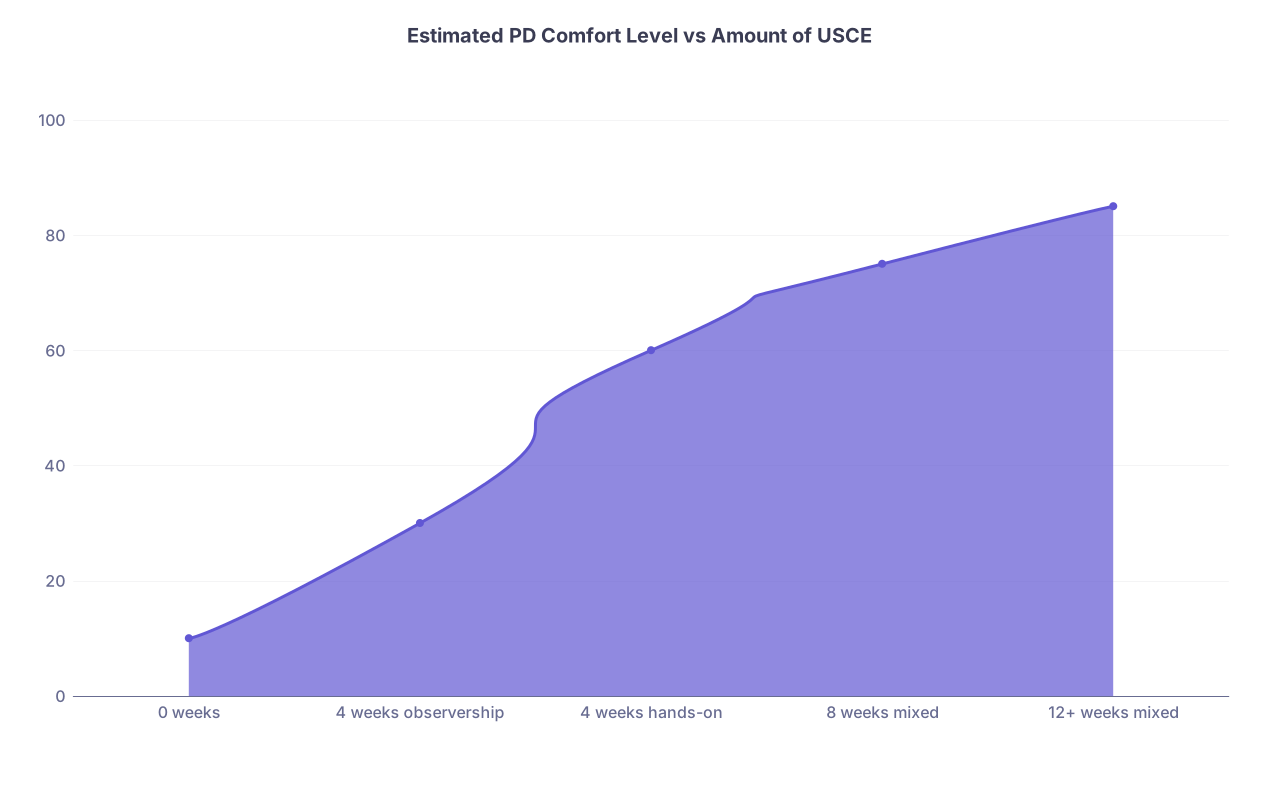
| Category | Value |
|---|---|
| 0 weeks | 10 |
| 4 weeks observership | 30 |
| 4 weeks hands-on | 60 |
| 8 weeks mixed | 75 |
| 12+ weeks mixed | 85 |
Again, nothing official. But these are the comfort curves I’ve watched play out.
The Bottom Line: USCE Is Not a Checkbox. It’s a Lever.
If you remember nothing else, remember this:
US clinical experience doesn’t just “help your application.” It directly shapes how people talk about you in the one room that decides your fate—the rank meeting.
It changes:
- Whether you’re seen as a risk or a safe bet
- Whether your letters are vague fluff or powerful advocacy
- Whether anyone remembers you well enough to argue for moving you up
- Whether a PD feels they can trust you with their hospital, their night float, their reputation
That’s why some IMGs with average scores match well: they used USCE to generate real, memorable performance and powerful U.S. letters. And that’s why some IMGs with stellar scores slide down rank lists: they stayed theoretical.
USCE is how you prove you’re real.
Use it that way.
Because once those rank lists are certified and locked, nobody cares how “promising” you looked on paper.
And when you’ve mastered this phase—leveraging USCE into rank list movement—the next game is different: how you convert that interview day into being the person they remember first when they debate their top 5. But that’s a story for another day.