
It’s late September. You’re staring at your ERAS portal with a Step 2 CK score that makes you wince every time you see it. Not a disaster. But not what you wanted. 227. 229. 231. Somewhere in that “meh” zone.
You keep hearing the same line: “Scores are everything for IMGs.”
Here’s the part no one tells you openly: in a lot of internal medicine and FM programs, one truly strong, vouching US rotation can bend the rules. I’ve watched programs quietly move an IMG from the “auto-reject by score” pile into the “we’re bringing them back” pile because a trusted attending said: “This one’s better than the number.”
So let me walk you through how that actually happens behind the scenes, and how you can make one rotation do more work for you than 10 extra ERAS submissions.
What Program Directors Actually Do With Your Step Score
First, you need to understand the ugly mechanical part.
On the PD side, the first pass is brutal and mostly unromantic. Someone — PD, APD, chief, or coordinator — runs a filter:
- “Show me all IMGs with Step 2 ≥ 230 and no more than 1 attempt.”
- Or “≥ 220 with US clinical experience.”
- Or “≥ 235 and graduated ≤ 3 years ago.”
Whatever flavor. But there’s always a cut. They have to; there are 3,000+ applications.
Here’s what happens in reality:
- If you’re well above the filter: you’re in the “consider” pool; now the rest of your application actually matters.
- If you’re just below the filter: you’re basically dead in the water… unless something overrides the rule.
- If you’re way below: you’re almost never seen at all.
That “override” mechanism is where a strong US rotation comes in. It creates an exception pathway.
I’ve watched this exact conversation in conference rooms:
Chief: “This IMG is at 228, our filter is 230.”
APD: “They look solid otherwise but borderline.”
PD: “Who wrote this letter?”
Chief: “Oh, that’s from Dr. X at [well-known community program]. She only writes strong letters for really good rotators.”
PD: “Okay, flag them. Put them in the review pile.”
Score filter just lost. Because a human who the PD trusts said, “This person can perform.”
Why One US Rotation Is So Disproportionately Powerful
You already know US clinical experience is “important.” Let me tell you why one good block carries so much more weight than a few extra points on a test.
Programs are not just trying to predict who can pass boards. They’re trying to predict who:
- Knows how US teams work
- Can present succinctly on rounds
- Won’t drown on night float
- Isn’t a disaster with EMR, pages, and communication
Your Step score says precisely none of that.
A strong US rotation, in the eyes of a PD, means this:
- A US attending actually saw you function in their natural environment.
- You interacted with nurses, residents, and patients in English.
- Someone tested how you handle uncertainty and pushback.
- You showed up, on time, every day, and didn’t crumble by week 3.
Programs are burned — often — by “fantastic on paper” IMGs who have never functioned in the US system. That trauma makes PDs conservative. A trusted rotation is an antidote to that fear.
So yes, they will bend a score rule if they believe the rotation.
The Secret Hierarchy of Rotations (All USCE Is Not Equal)
Here’s where most IMGs get fooled: they think any US clinical experience is basically the same. It’s not. We rank it in our heads, even if we don’t say it out loud.
Let me show you how PDs and APDs silently categorize this:
| Experience Type | Typical Impact Level |
|---|---|
| Inpatient acting-internship (AI/Sub-I) | Very High |
| Inpatient elective with real responsibilities | High |
| Outpatient rotation with strong letter | Moderate |
| Pure observership in inpatient setting | Low |
| Paid “shadowing/observership mill” | Very Low/Negative |
If I see an IMG with:
- One inpatient medicine rotation at a recognizable US hospital
- Described as an acting intern or with real responsibilities
- And a letter from a US faculty who actually writes decent LORs
…I’m listening. Even with a score of 225–230.
If I see:
- Four “observerships” that are clearly shadowing mills
- No real note-writing, no orders, no clear evaluation
- Generic letters with “hardworking and pleasant to work with” boilerplate
…I don’t care if your Step 2 is 240. You’re not moving up the pile just from that.
You want the first kind. One good one is better than four bad ones.
What a “Strong” Rotation Looks Like From Our Side
Here’s the part you rarely get described accurately. From the faculty and PD side, a “strong IMG rotator” has a very specific footprint.
Things we notice:
- You’re on the list at morning sign-out. Not a ghost.
- Your notes are in the chart, co-signed, and not just copy-paste garbage.
- Residents bring up your name in a positive way without being asked.
Let me make it very concrete. During a good month, I’ll hear things like:
- “Can we have them back on our team next month?”
- “They’re basically at intern level with presentations.”
- “They actually helped me with cross-cover yesterday.”
If I hear that by week 2, you’re getting a real letter.
Now contrast that with the weak rotation:
- “They’re nice but quiet.”
- “Presentations are okay but they need a lot of guidance.”
- “English is understandable but they’re very slow.”
- “They keep asking to leave early to study for Step.”
That last one torpedoes more IMG applications than you’d believe.
How a Rotation Overrides a Borderline Score in Practice
Let’s talk mechanics. The exception process.
Most programs have some version of this workflow:

| Step | Description |
|---|---|
| Step 1 | Application filter run |
| Step 2 | Normal review |
| Step 3 | Stay rejected |
| Step 4 | Maybe review late |
| Step 5 | Manual PD review |
| Step 6 | Invite to interview |
| Step 7 | Score below cutoff |
| Step 8 | Strong US letter? |
| Step 9 | Trusted attending or site? |
This is not hypothetical. I’ve literally watched the coordinator say, “This one is blocked by the filter but the PD wants to see them because Dr. Y emailed about them.”
There are three levers that matter most for this override:
Who wrote your letter
A letter from some unknown private clinic in New Jersey? Almost zero override power.
A letter from a site the program already sends residents to, or from a faculty your PD knows from conferences, committees, or fellowship? Very different.How strong and specific the letter is
“Hardworking and compassionate” means nothing.
“She functioned at the level of our interns; we would be happy to have her back as a resident” gets attention.Whether that attending informally advocates for you
Yes, behind-the-scenes emails and quiet texts happen. “Hey, I had an IMG from your home country rotate with me. She’s actually excellent. You should look at her app even though her score is a bit low.”
That message can move you from “never seen” to “interviewed.”
This is why one well-selected, well-executed rotation beats five random ones. It creates a human who will vouch for you.
And PDs trust humans they know much more than numbers they don’t.
How To Make One Rotation Carry Your Whole Application
You’re not trying to collect experiences like Pokémon cards. You want one rotation that becomes your anchor. That means three stages: picking the right one, performing the right way, and then extracting maximum value from it.
1. Pick the Right Site (Not Just Any USCE)
You want:
- Inpatient internal medicine (or your chosen specialty)
- Preferably at a hospital with a US residency program
- Ideally with exposure to residents and a teaching structure
Sometimes names help. A rotation at a solid community hospital with an ACGME IM program, where attendings are active teachers, is more valuable than some “observership” attached to a big-name university where you never touch a chart.
If you have to choose between:
- A famous name where you’ll just shadow, versus
- A smaller program where you can present, write notes, and be evaluated
Take the second one. Every time.
2. Show Up Like You’re Already an Intern
Here’s what “acting like an intern” actually means from my side of the table:
You:
- Arrive before the residents. Have your patients pre-read. Vitals, labs, overnight events in your head already.
- Volunteer for admissions. Even if you’re “not required.”
- Present crisp, structured H&Ps. Not novels. No wandering through every ROS you memorized.
- Learn the EMR enough to actually help. Flag critical labs. Check imaging yourself.
- Do not disappear to “study for Step” during work hours. You’re there to prove you can work, not study.
By week 2, the team should trust you with:
- Pre-rounding independently
- Drafting notes
- Calling consults with supervision
When that happens, here’s the effect: the attending stops seeing you as “another IMG student” and starts seeing you as “that person who could actually function as a PGY1.”
That mental shift is everything.

3. Convert Performance Into a High-Yield Letter
This is where IMGs mess up. They rotate well, then walk away with a generic letter because they were too timid or too vague in asking.
You need:
- A letter from a US MD or DO faculty who directly supervised you
- Who actually remembers you enough to write something detailed
- And understands what residency programs look for in an IMG
Before the end of the rotation, you should:
Ask for feedback mid-rotation. Not “Am I doing okay?” but “What would I need to improve to function at intern level?”
Then actually act on that. Attending sees growth → stronger letter.At the end, ask directly and clearly:
“Dr. Smith, I’m applying to internal medicine as an IMG with a borderline Step score. Do you feel you know my clinical work well enough to write me a strong letter supporting my ability to perform at an intern level?”If they hesitate, thank them and move on. That’s not your letter writer.
Provide a short, targeted summary:
- Your CV
- Your personal statement
- A 1-page “highlights” sheet: particular patients you managed, things you worked on, your future goals
Good attendings use this to fill in details they forgot.
Don’t be shy about your Step story.
If you underperformed on Step 1/2 but have improved clinically, tell them that. Many faculty will explicitly address it: “While his Step 2 is not reflective of his true capabilities, in our clinical environment he consistently performed above the level expected…”
That line, coming from a US attending we trust, can completely reframe how your score is interpreted.
Where This Strategy Works Best (and Where It Doesn’t)
If you’re trying to match dermatology as an IMG with a 225, no, one rotation will not magically fix that. Let’s stay in reality.
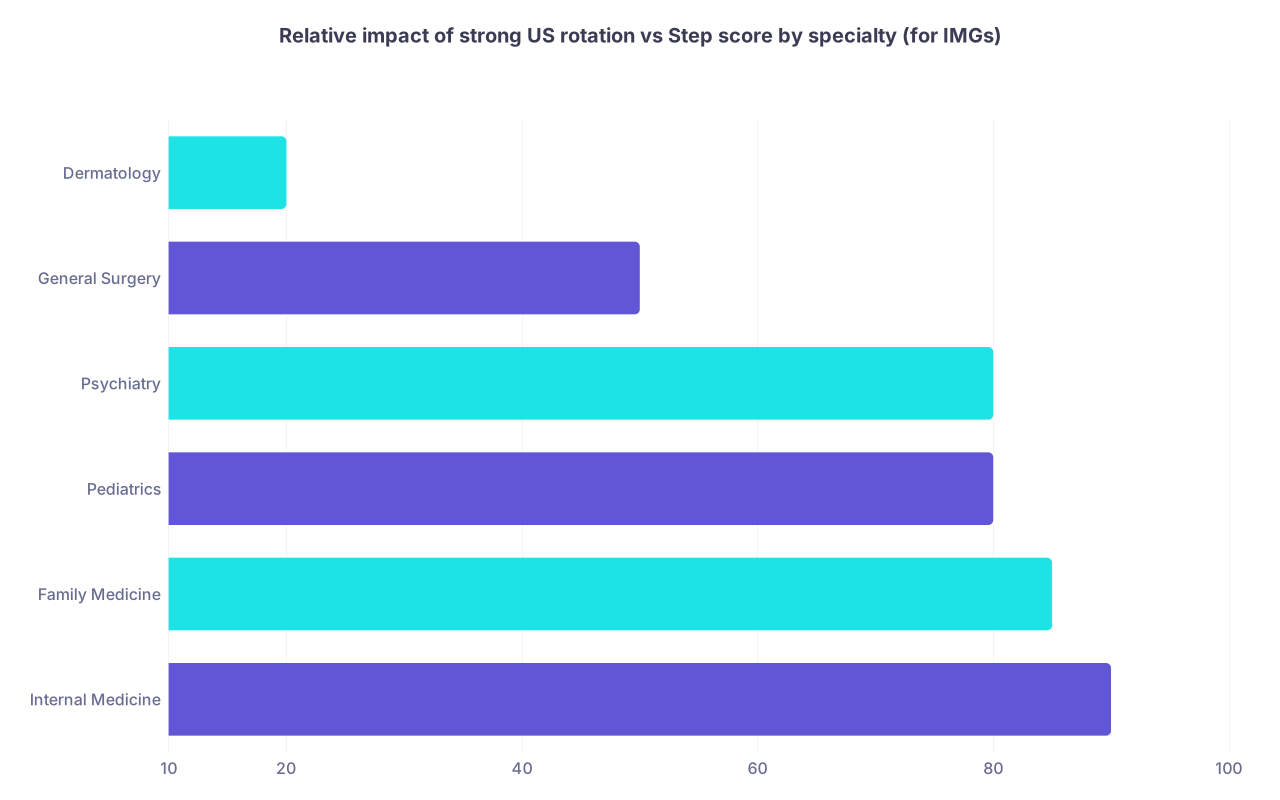
But for certain specialties, this “one powerful rotation” strategy is not just viable — it’s common:
| Category | Value |
|---|---|
| Internal Medicine | 90 |
| Family Medicine | 85 |
| Pediatrics | 80 |
| Psychiatry | 80 |
| General Surgery | 50 |
| Dermatology | 20 |
This is my rough, real-world sense of how much a strong US rotation can compensate for a marginal Step score.
Internal medicine, FM, psych, peds — plenty of PDs will say, “I’ll take a 228 with a killer US rotation and letter over a 240 with no US experience and vague recommendations.”
Surgery, EM, highly competitive specialties — the rotation still helps but the bar is higher and the numbers matter more.
US MD/DO grads are a different game. For IMGs, that one US rotation is often the only tangible evidence that you can operate in the US system.
The Mistakes That Kill the Value of a Rotation
I’ve watched strong IMGs sabotage the only rotation that could have saved their application. Here’s how people ruin it:
They treat the rotation like a checkbox. Show up, follow, don’t cause trouble. That’s it. That gets you a “good student” comment, nothing more.
They’re too quiet. “Respectful” turns into invisible. If the attending can’t picture you as an intern running 10 patients on call, they’re not going to put that in writing.
They’re obsessed with Step. Studying on your phone between every patient, leaving early to go “review questions,” talking constantly about scores and exams. You’re broadcasting the message: “I’m here for the letter, not for the patients.”
They never ask for real responsibility. They wait to be told. Faculty have limited time; if you don’t ask, they won’t push you. Then your eval reads: “Pleasant, punctual, needs more independence.”
You can’t afford that. With a marginal score, your rotation needs to scream: “Ready to work day one.”
Concrete Example: How This Plays Out in Rank Meetings
Let me give you a composite scenario based on multiple real cases.
Two IMG applicants:
Applicant A
Step 2: 241
No US clinical experience
Letters: 3 from home country, all calling him “top 10% of class,” very generic
Personal statement: fine, standardApplicant B
Step 2: 229
One US inpatient IM rotation at a mid-sized community program with residency
Letter from US attending:“She functioned at the level of our interns. She independently managed 6–8 patients a day under supervision, her presentations were concise and well-organized, and she integrated feedback rapidly. I would be very pleased to have her as a resident in our program.”
Which one gets the interview?
In more programs than you think, B does. Because on the committee side, someone will say:
“Yes, her score is 229, but look at this letter. We know Dr. K. He doesn’t write like this unless he means it. He’s basically saying she’s internship-ready.”
Once you’re in the interview, your score moves way down the priority list. Now they’re judging communication, fit, maturity. You’ve already proved you can function clinically.
Applicant A may never even get in the door.
FAQs
1. How low can a Step score be for a strong US rotation to still help?
Below a certain floor — say, <215 for most IM programs — you’re in very tough territory, even with a strong rotation. Between roughly 220–235 is the “gray zone” where a single excellent US inpatient rotation and letter can meaningfully change your fate, especially in community and mid-tier university programs. Above 235, the rotation doesn’t just compensate, it amplifies your competitiveness.
2. Is it better to do multiple short US rotations or one long one?
For IMGs with limited money and time, one high-quality, 4-week inpatient rotation where you’re treated like an acting intern is far more valuable than three or four superficial or observership-style experiences. Depth beats breadth. Programs want at least one situation where you were truly tested, not just exposed.
3. Does it have to be at the hospital where I’m applying?
No. That’s a common misconception. What matters more is the credibility of the attending and the content of the letter, not the logo on the letterhead. A trusted community faculty who regularly teaches residents and writes detailed, comparative letters can do more for you than a famous-name institution where no one really evaluated you.
4. Should I tell my letter writer that my Step score is borderline?
Yes — strategically. You do not need to confess with shame, but you should frame it: “My Step 2 score isn’t as strong as I hoped, so my clinical performance during this rotation will be very important for my applications.” Many attendings will then explicitly address that in the letter, saying your clinical abilities exceed what your test score suggests. That’s exactly the narrative you want PDs to see.
Key points to walk away with:
One serious, high-responsibility US inpatient rotation can absolutely outweigh a marginal Step score for an IMG — if you pick the right site, perform like an intern, and walk away with a specific, convincing letter from a trusted US faculty. Programs will bend their score rules for someone a colleague is willing to vouch for clinically. Your job is to become that exception.