
The idea that “shadowing is enough US clinical experience for IMGs” is wrong. Fatally wrong for a lot of applications.
If you are an IMG building your residency application and your entire “USCE” is two or three shadowing experiences, you are walking straight into a trap that filters out thousands of candidates every year.
Let me show you exactly why this happens, how programs actually read “shadowing,” and what you must do before you burn an application season on a weak clinical profile.
The Core Problem: Shadowing Is Not Clinical Experience
Shadowing is observation. Residency is participation. Programs know the difference, and they care.
Here is the brutal reality: most US program directors do not consider shadowing to be meaningful “US clinical experience” for IMGs. At best, it is a minor supplement. At worst, it signals that you do not understand how the US system works or you could not secure anything better.
I have seen too many ERAS applications where the “US Clinical Experience” section looks like this:
- “Shadowed Dr. X in outpatient clinic, 3 weeks”
- “Observed Dr. Y on hospital rounds, 2 weeks”
- “Shadowing at community clinic, 1 month”
No patient contact. No orders. No notes. No responsibility. Just watching.
Here is what program directors and selection committees think when they see “shadowing only” from an IMG:
- “They have never been responsible for patients in the US.”
- “They do not know our documentation systems or workflow.”
- “They cannot possibly have strong US clinical LORs.”
- “Huge risk on day one of residency.”
So your first mistake is conceptual: calling shadowing “US clinical experience” like it is interchangeable with hands-on rotations, observerships with real engagement, or research with direct patient interaction.
It is not. And programs know it.
How Programs Actually View Different Types of USCE
Stop guessing what counts. The hierarchy is not a secret; it is just routinely ignored by applicants who want an easier route.
| Type of Experience | How Programs Typically Rate It |
|---|---|
| US hands-on elective (student role) | Excellent / Ideal |
| US hands-on externship (postgrad) | Very strong |
| Inpatient observership w/ tasks | Moderate to strong |
| Outpatient clinic observership | Moderate if engaged |
| Pure shadowing only | Weak |
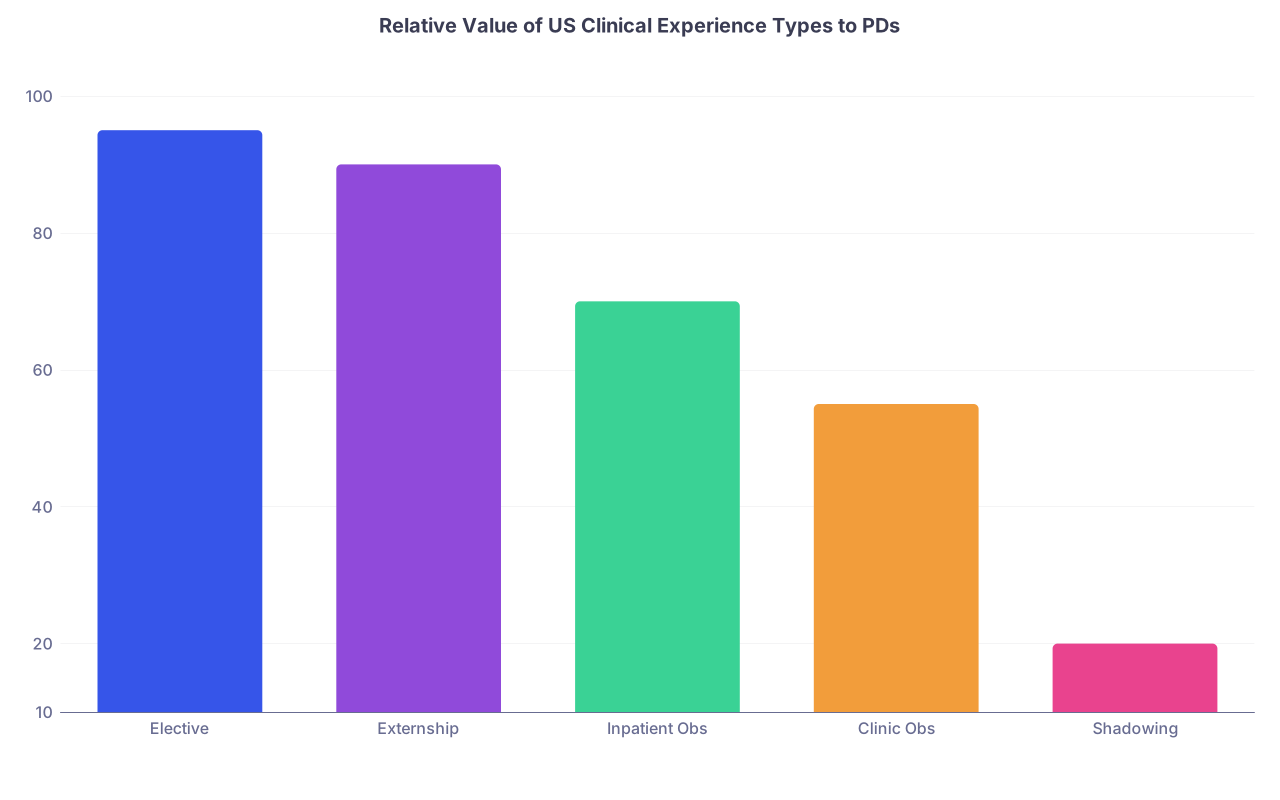
| Category | Value |
|---|---|
| Elective | 95 |
| Externship | 90 |
| Inpatient Obs | 70 |
| Clinic Obs | 55 |
| Shadowing | 20 |
You will not see this chart on a program website, but talk to attendings involved in selection and they will tell you the same thing in different words.
Let me spell out the key distinctions.
Hands-on electives / clerkships (as a student)
You write notes (even if they are “for learning only”), present patients, attend sign-out, get pimped on rounds, maybe call consults under supervision. This proves you can function in a US training environment.Externships (postgraduate hands-on)
You are not a licensed resident, but you act as close to one as legally possible. You help with H&Ps, progress notes, pre-rounding, maybe procedures. These are gold when well-structured.Observerships with real involvement
Yes, technically observer status, but:- You attend teaching rounds
- You present cases informally
- You participate in academic discussions
- You sometimes interact with patients under supervision
Programs can work with this, especially if the LORs are detailed and specific.
Pure shadowing
You stand behind someone. You ask a few questions in the hallway. You maybe sit in the corner during clinic. You do not touch a chart. You do not assume any role.
For most programs, this barely moves the needle.
Your second big mistake: assuming that “US hospital exposure of any kind” all counts equally. It does not. And the filters embedded in selection software and human minds reflect that.
The Shadowing Trap: How IMGs Get Stuck
There is a very common IMG pathway that looks innocent but ends up sabotaging an entire application cycle.
It goes like this:

| Step | Description |
|---|---|
| Step 1 | Graduate or Close to Graduation |
| Step 2 | Search Online for USCE |
| Step 3 | Find Easy Shadowing Opportunities |
| Step 4 | Do 2-3 Short Shadowing Stints |
| Step 5 | Label as US Clinical Experience on ERAS |
| Step 6 | Apply Broadly to Many Programs |
| Step 7 | Get Few or No Interview Invites |
| Step 8 | Realize Too Late Shadowing Was Not Enough |
I have heard the same post-Match regret over and over from IMGs:
- “I thought any US hospital time would count.”
- “The website said they accept observerships and shadowing.”
- “No one told me they expect hands-on or at least strong observerships.”
What actually happens is simple: your application gets screened out not only for scores or YOG (year of graduation) but for the quality of your USCE. If other IMGs have externships, inpatient observerships with documented responsibilities, and strong US letters, your shadowing-only profile looks weak in comparison.
Programs make relative judgments. You are not competing against the theoretical standard; you are competing against that FMG with:
- 3 months inpatient IM observership
- 1 month cardiology elective
- 2 detailed US LORs
- Documented case presentations / QI project
Versus your:
- 2 weeks shadowing outpatient family medicine
- 3 weeks shadowing in an urgent care
Same number of “months.” Completely different value.
Why Shadowing Fails You at the Moment That Matters Most
The most damaging part of “shadowing only” is not the line item on your CV. It is what it does to everything else in your application.
1. Weak, generic US letters of recommendation
Strong US letters are often the deciding factor for IMGs. Shadowing cripples you here.
A typical shadowing-based LOR sounds like this:
“Dr. X observed me in clinic for 3 weeks. She was punctual and professional. She showed interest in learning. I believe she will be a good resident.”
This kind of letter tells a program exactly one thing: you were physically present. It does not prove:
- Clinical reasoning
- Reliability with tasks
- Communication with staff
- Adaptation to US documentation
- Work ethic under pressure
Now compare that to an LOR from a substantive observership / externship:
“Dr. X attended our daily morning report, presented 4 new admissions over the month, and independently prepared thorough H&Ps that we reviewed together. She took responsibility for following up labs and imaging under my supervision.”
That letter changes how your entire file is read.
2. No evidence of functioning within a US team
Residency is not about memorized knowledge; it is about being able to plug into a high-stress, high-volume system.
Programs want to know:
- Can you communicate clearly in handoffs?
- Do you understand hierarchy and roles?
- Can you respond appropriately to a nurse calling about a decompensating patient?
- Do you know how to ask for help?
Shadowing does not test or demonstrate any of this. You are a bystander. A visitor. Programs do not want to gamble that you will figure it out starting July 1.
3. Weak interview answers
One of the most painful things to watch is an IMG in an interview trying to spin limited shadowing as meaningful experience.
Common red flags in responses:
- “I learned a lot from watching how the doctors communicate.”
- “I saw that patient care here is very systematic.”
- “I observed that teamwork is really important in US hospitals.”
Vague. Passive. All observation, no action.
Interviewers will ask very specific questions:
- “Tell me about a difficult patient you managed in the US and what you did.”
- “Describe a time in a US setting when you received critical feedback and how you responded.”
- “How have you handled documentation or EMR challenges here?”
If all you did was shadow, you will struggle to answer these without sounding artificial or evasive.
The Subtle Red Flags Programs See In “Shadowing Only”
You probably do not see them. They do.
Here are quiet red flags that shadowing-heavy applications throw up, especially for IMGs:
“Could not secure better USCE” signal
Programs assume you tried to get more meaningful experiences and failed, whether that is true or not. It raises questions about your networking, initiative, or past performance.“Risk of culture shock on day 1”
If your only US exposure is passive observation, they worry about your ability to cope with the sheer pace and responsibility of intern year.“Likely weak clinical skills in the US context”
Not because you are a bad physician, but because you have not proven real-time decision-making under US supervision.“Questionable commitment to this specialty / to the US system”
If you want internal medicine but your only US experience is 2 weeks shadowing family medicine and 1 week cardiology, that looks shallow.
None of this may be fair in your mind. But it is how your application is being read.
When Shadowing Is Acceptable — And When It Is A Problem
Shadowing is not completely useless. It becomes a problem when it is your only or main USCE.
Shadowing can be acceptable if:
- It is early exposure before you secure better rotations.
- It is clearly labeled as “shadowing” or “observing” and not misrepresented.
- It is paired with at least 2–3 months of stronger experiences.
- It helps you confirm your specialty choice and shows continuity (e.g., you shadowed cardiology, then did a cardiology observership, then applied IM with a strong cardio-focused story).
Shadowing becomes a problem when:
- You are >2–3 years post-graduation and have only done shadowing in the US.
- You are relying on shadowing-based letters as your main US LORs.
- You present shadowing as equivalent to electives or externships.
- You are applying to competitive programs or specialties with nothing stronger.
This is where many IMGs quietly self-sabotage: they underestimate how much it matters that others in the applicant pool have actually done substantive US rotations.
How To Fix This: Move Beyond Shadowing Before You Apply
You cannot time-travel to redo your rotations. But you can stop compounding the mistake.
Here is the priority: convert your profile from “shadowing only” to “demonstrated participation” as much as your circumstances allow before the next application season.
1. Stop investing time in additional pure shadowing
If you already have 2–4 weeks of shadowing, piling on more of the same is not helpful. You are not adding new dimensions to your file. You are just inflating a weak category.
Better to have:
- 4 weeks shadowing + 8 weeks solid observership / externship
than
- 12 weeks of shadowing scattered across random clinics.
2. Target higher-yield USCE options
Focus on experiences that let you:
- Interact directly with teams
- Attend structured teaching
- Present cases, even informally
- Build relationships for strong LORs
For many IMGs this means:
- Paid or structured externships with defined responsibilities
- Hospital-based observerships that include morning report, grand rounds, and consistent team presence
- Academic center rotations whenever possible
Be skeptical of any “USCE” program that:
- Keeps you permanently in the hallway
- Never introduces you to the team as part of the group
- Prohibits any participation in presentations, notes, or discussions
- Promises “letters” after a very short period (2 weeks) with almost no engagement
Those are glorified shadowing gigs with a price tag.
3. Use your next rotation to fix your letters
Your priority during any decent observership / externship:
- Be present and prepared daily
- Ask for specific feedback on your clinical reasoning
- Volunteer to present a case or mini-topic
- Ask (near the end) if the attending feels they know you well enough to write a detailed letter
A short, generic US LOR from 4 weeks shadowing is less useful than a detailed, comparative letter from 4 weeks of active observership.
How To Present Past Shadowing Without Hurting Yourself
You may already have only shadowing in the US and limited time to add more. Do not lie. Do not stretch the truth. That gets you into much bigger trouble.
Here is how to handle it strategically.
Label it accurately in ERAS
Call it “Shadowing experience in US outpatient clinic” or “Observational experience” if that is how the institution describes it. Do not pretend you were a sub-I.Emphasize what you actually did
If you:- Attended teaching conferences
- Participated in hallway handoffs
- Discussed cases with the attending
You can describe that. Just do not cross the line into inventing responsibilities.
Pair it with strong home-country clinical stories in your personal statement
Use your real hands-on experiences from your own country to demonstrate clinical capability. Then frame your US shadowing as your way of understanding system differences and expectations.Be honest and focused in interviews
If asked about USCE:- Admit if most of it was observational.
- Then pivot to what you learned concretely and how you are closing any gaps (courses, additional rotations, EMR training, etc.).
Programs hate dishonesty more than they hate limited USCE. You can survive modest USCE if you are transparent and show a plan.
If You Already Applied With Shadowing Only
Harsh truth: sometimes the damage is already done for this cycle.
If you are mid-season with few or no interviews and your USCE is all shadowing, do not just blindly reapply next year with the same profile and more “hope.”
Stop and ask:
- How many months of real, meaningful USCE can I add in the next 6–12 months?
- Can I secure at least 2 strong US LORs from more substantive experiences?
- Can I show clear continuity in my specialty choice with my new rotations?
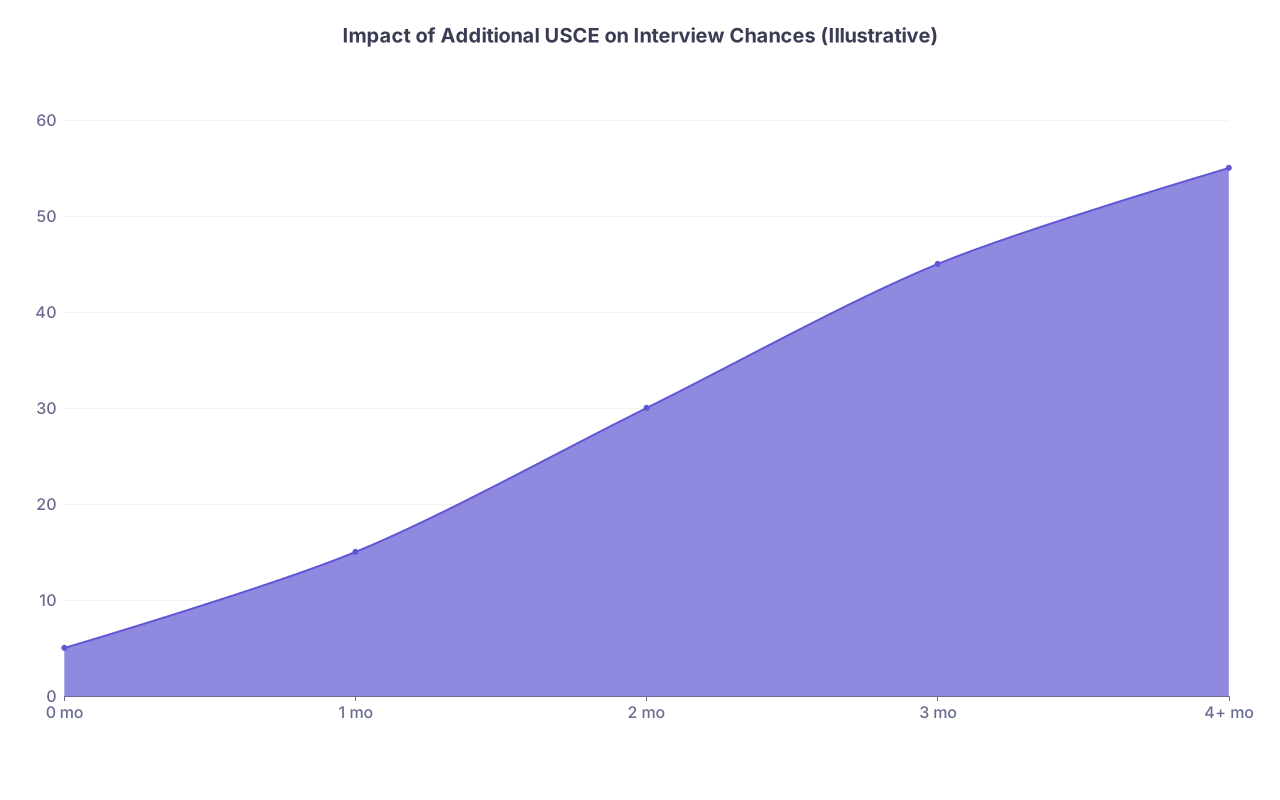
| Category | Value |
|---|---|
| 0 mo | 5 |
| 1 mo | 15 |
| 2 mo | 30 |
| 3 mo | 45 |
| 4+ mo | 55 |
You are far better off:
- Skipping one cycle
- Doing 3–4 months of good-quality USCE
- Reapplying with stronger letters and stories
than reapplying immediately with nothing but more shadowing.
I have watched IMGs repeat the same mistake for 2–3 years, spending thousands of dollars on ERAS instead of investing a fraction of that into one high-yield rotation that finally changes their trajectory.
Key Takeaways Before You Fall Into The Same Hole
Do not confuse access with value. Shadowing is easy to get, so people cling to it as if it were the main ticket. It is not.
The core principles:
- Shadowing is support, not foundation.
- Programs care about what you did, not what you watched.
- Your letters and interview stories expose the weakness of pure observation every time.
Fix this early, or you will be learning these lessons the hard way—through silence from programs.