
The fastest way to sabotage your U.S. clinical experience is to choose the wrong site.
I’ve watched smart, hard‑working IMGs spend thousands of dollars and months of their lives on “clinical” experiences that residency programs barely respect. Some of those experiences look great on a website but raise red flags the moment a program director reads the letterhead.
You’re not just choosing a hospital. You’re choosing how program directors will judge your judgment.
Let me walk you through the biggest mistakes I see IMGs make when picking U.S. clinical sites—and how to avoid burning your time, money, and credibility.
1. Confusing “Any U.S. Experience” with “Useful U.S. Experience”
Too many IMGs think: “As long as it’s in the U.S., it’s good.”
Wrong. Programs don’t value all U.S. clinical experience equally. Some experience actively hurts you because it screams: “This applicant doesn’t understand how U.S. medicine really works.”
Here’s the brutal hierarchy most program directors actually use (they may not say it out loud, but I’ve heard this in selection rooms):
| Type of Experience | Typical Perceived Value |
|---|---|
| ACGME‑affiliated U.S. rotation (in‑person) | Very High |
| University‑affiliated community hospital | High |
| Non‑teaching private hospital rotation | Medium |
| Clinic‑only experience (no inpatients) | Low–Medium |
| Pure observership with minimal contact | Low |
| Shadowing in private office only | Very Low |
The mistake: assuming the bottom of that list is “better than nothing.”
What this looks like in real life:
- You pay $3,000+ for a “rotation” that turns out to be sitting in a corner of a clinic, barely speaking to one or two patients a day.
- Your letter writer is a solo private practitioner with no academic title, unknown to programs, writing a generic, two‑paragraph letter.
- You walk into interviews and struggle to answer basic questions about U.S. inpatient workflow because you’ve never actually seen rounds in a teaching hospital.
How to avoid this:
- Prioritize ACGME‑affiliated teaching hospitals and sites with residency programs in your target specialty.
- If those are full, move to university‑affiliated community hospitals, not random private clinics.
- Always ask one clear question: “Do your attendings regularly write letters that are used for residency applications, and are they familiar with the process?”
If the answer is vague or defensive, that’s a bad sign.
2. Ignoring ACGME Affiliation and Teaching Environment
If your site isn’t training residents, many PDs quietly downgrade it.
Not because community care is bad. Because it doesn’t prove you can function in the U.S. training system.
Common mistake: Choosing a hospital simply because:
- It’s in a big city.
- It has “Medical Center” or “Teaching” somewhere in the marketing.
- An agency told you, “Many IMGs come here!”
You end up in a place where:
- There are no residents.
- There’s no morning report, no academic conferences, no structured teaching.
- You never present a patient. You never write a note. You never communicate with a multidisciplinary team.
Then you apply to residency and claim: “I understand the U.S. clinical environment.” The interviewer asks:
- “Tell me about how rounds were structured.”
- “What were your responsibilities?”
- “How did you coordinate with residents and nursing?”
And your answers expose that you were basically an observer in a private practice with hospital privileges.
Checklist to avoid this:
- Confirm: “Is this hospital ACGME‑affiliated? Which residency programs are based here?”
- Ask: “Will I be interacting with residents and medical students on a daily basis?”
- Look up the hospital on the ACGME or FREIDA database. If no residency programs exist there, you’re already in less valuable territory.
If there’s no teaching structure, your “clinical experience” is superficial. Programs can smell that.
3. Buying Rotations from the Wrong Third‑Party Companies
Some of the worst mistakes I’ve seen come from IMGs who heavily rely on shiny rotation companies that:
- Overpromise outcomes (“Our students match at top programs!”) with zero transparent data.
- Place you in random, low‑volume clinics or hospitals.
- Pair you with attendings who barely speak to you, then send a one‑paragraph LOR.
You know you’re dealing with a red flag company when:
- They refuse to name the exact hospital/clinic before payment.
- They talk more about “visa support” and “beautiful housing” than about teaching quality and evaluation structure.
- They do not have clear policies about evaluations, feedback, or how letters are generated.
Here’s what often happens:
- You pay $4,000–$5,000 for a “4‑week hospital rotation.”
- In reality, you get:
- 1–2 half‑days in the hospital per week.
- The rest is clinic shadowing.
- Minimal to no direct patient interaction.
- Your letter looks like: “Student attended clinic on time and was respectful. I recommend them for residency.” That’s basically useless.
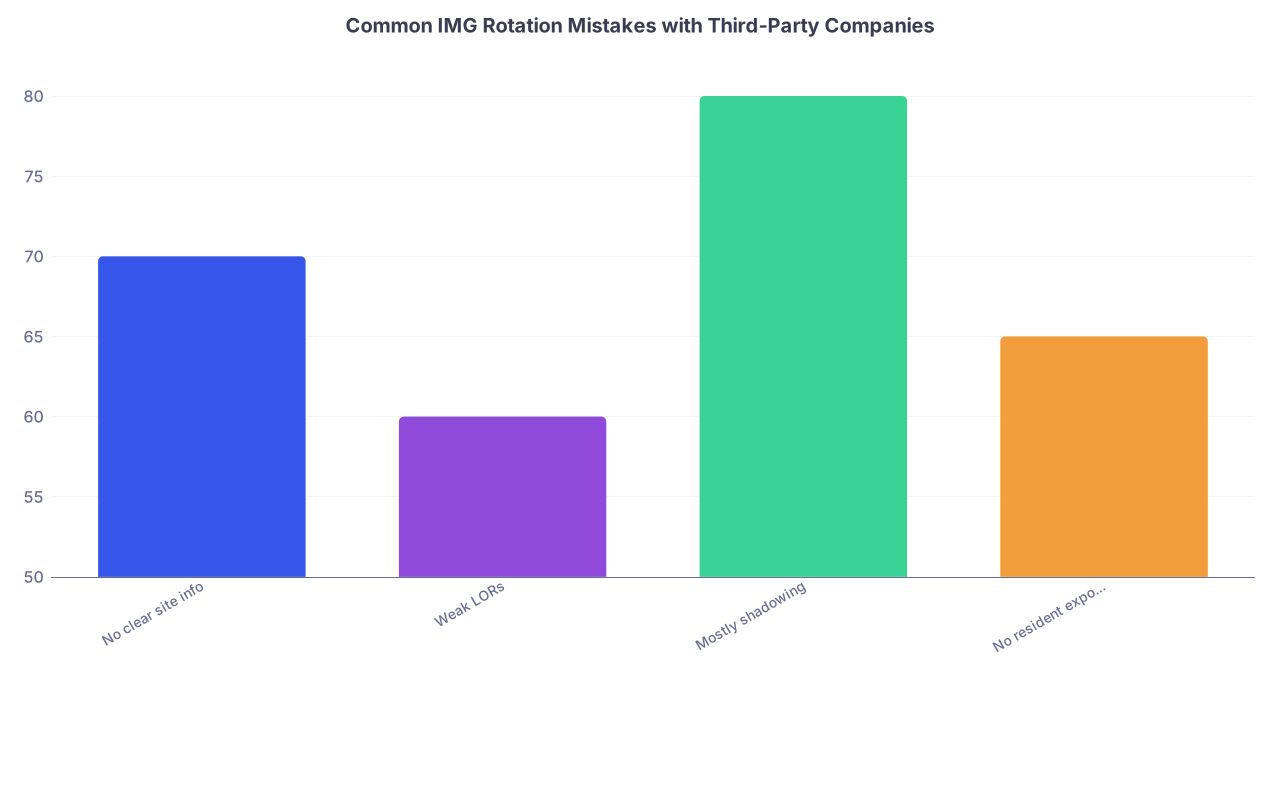
| Category | Value |
|---|---|
| No clear site info | 70 |
| Weak LORs | 60 |
| Mostly shadowing | 80 |
| No resident exposure | 65 |
Numbers are approximate, but the pattern is real: I’ve seen these same four problems over and over.
How to protect yourself:
- Before you pay a cent, demand:
- Hospital name
- Attending name and specialty
- Clear schedule (clinic vs inpatient breakdown)
- Whether the attending has academic affiliations or titles
- Search that attending on:
- Doximity
- Healthgrades
- Hospital faculty pages
- Ask bluntly: “Does this attending routinely supervise U.S. medical students or residents? Do they write structured academic letters?”
If the company dodges or gives scripted lines—walk away.
4. Choosing Sites with No Pathway to a Strong LOR
The whole point of U.S. clinical experience for IMGs in the MATCH phase is twofold:
- Show you can function in U.S. clinical settings.
- Get credible, detailed letters of recommendation.
You cannot afford to waste a month on a site where getting a meaningful LOR is impossible.
Classic mistake: Assuming “Any attending can write a good letter.”
No. They can’t. And they won’t, if:
- They barely know you.
- They don’t understand residency selection.
- They work in a non‑academic environment and rarely write LORs.
I’ve seen letters that literally:
- Get the applicant’s name wrong.
- Don’t mention a single specific patient case.
- Are obviously copy‑pasted for every IMG who rotated there.
Programs read hundreds of these. Weak letters hurt you more than no letter.
When evaluating a site, you must ask:
- “How are students evaluated?”
- “Do attendings provide written evaluations or just completion certificates?”
- “Will I have chances to:
- Present patients?
- Discuss differential diagnoses?
- Be observed taking histories or presenting on rounds?”
You need a site where an attending can honestly write things like:
- “I personally observed Dr. X present multiple complex patients on internal medicine rounds.”
- “Dr. X demonstrated clear understanding of U.S. clinical documentation and team communication.”
- “I would rank Dr. X in the top 10% of IMGs I’ve worked with.”
If a site doesn’t realistically allow that depth of observation—even if it’s cheaper—it may be a waste for someone in the residency application phase.
5. Misaligning Site Choice with Your Target Specialty
Another mistake: choosing U.S. sites just because they’re available, not because they match your specialty goals.
Example I see all the time:
- You want Internal Medicine.
- Your U.S. experience: 2 months of outpatient psychiatry, 1 month geriatrics in a nursing home, and 1 month of family medicine clinic only.
- Zero inpatient internal medicine. Zero night calls. Zero acute care exposure.
Program directors wonder:
- “Do they actually understand internal medicine in the U.S.?”
- “Have they shown commitment to our specialty?”
- “Why didn’t they seek at least one solid inpatient IM rotation?”
Even if your home‑country experience is strong, the U.S. part still matters. You are being compared to IMGs who have:
- 2–3 months of U.S. internal medicine with real inpatient exposure.
- Letters directly from IM attendings at ACGME institutions.
Here’s how to think strategically:
Primary specialty first
At least 2 rotations in your target specialty:- For IM: Inpatient IM > subspecialty clinics.
- For FM: FM clinics, community hospitals, maybe some IM.
- For Psych: Inpatient psych, consultation‑liaison, outpatient psych mix.
Supportive experiences second
Rotations that show:- Breadth of care (ED, geriatrics, cardiology).
- Continuity (primary care clinics paired with inpatient time).
Avoid random scatter
Four rotations in four unrelated fields looks like you’re guessing, not planning.
If a site can’t give you specialty‑relevant exposure and you’re tight on months or money, skip it. Save for something aligned.
6. Falling for Purely Observational or “Shadow Only” Sites
Observerships are not all bad. But many are almost useless for MATCH‑ready IMGs.
The mistake is choosing:
- A purely observational hospital “rotation” where you:
- Never touch a chart.
- Never write a note (even unofficially).
- Never present a case.
- Are explicitly not allowed to speak to patients.
- Then listing it on your CV as if it was equivalent to a clerkship.
Program directors are not stupid. They know:
- Most observerships for IMGs are passive.
- Without clear responsibilities, your learning and assessment are shallow.
You can still use observerships strategically—but not as your only U.S. experience when applying.
If you must do an observership, try to avoid these pitfalls:
- Red flag: They tell you, “Students are not allowed to speak with patients at all.” That kills your chance of getting a meaningful LOR.
- Red flag: They have 10–15 observers in the same room with one attending. You’ll be invisible.
- Red flag: They don’t differentiate between pre‑meds, students, and graduates. You’ll be judged as part of a generic crowd.
Aim for:
- Small teams (1–3 learners per attending).
- Clear teaching structure (case discussions, journal clubs, presentations).
- At least some allowed interaction with patients and team (even if not hands‑on orders).
If you already graduated and are actively applying, hands‑on externships or clerkships in ACGME‑affiliated settings should be your priority.
7. Ignoring Location, Program Type, and Match Realities
No, rotating in “some hospital in New York” does not magically make New York programs want you.
Another common miscalculation:
- You pick sites purely because they’re in NYC, Chicago, or LA.
- The sites are expensive, oversaturated with IMGs, and low‑quality in terms of teaching.
- The actual residency programs that match IMGs are small community hospitals in other cities entirely.
Here’s the part applicants don’t like to hear:
Your best rotation might not be in a famous city. It might be in a quiet community teaching hospital in the Midwest that:
- Has an IM or FM residency with a history of taking IMGs.
- Gives you real responsibility and solid faculty contact.
- Actually reads and trusts letters from their own faculty.
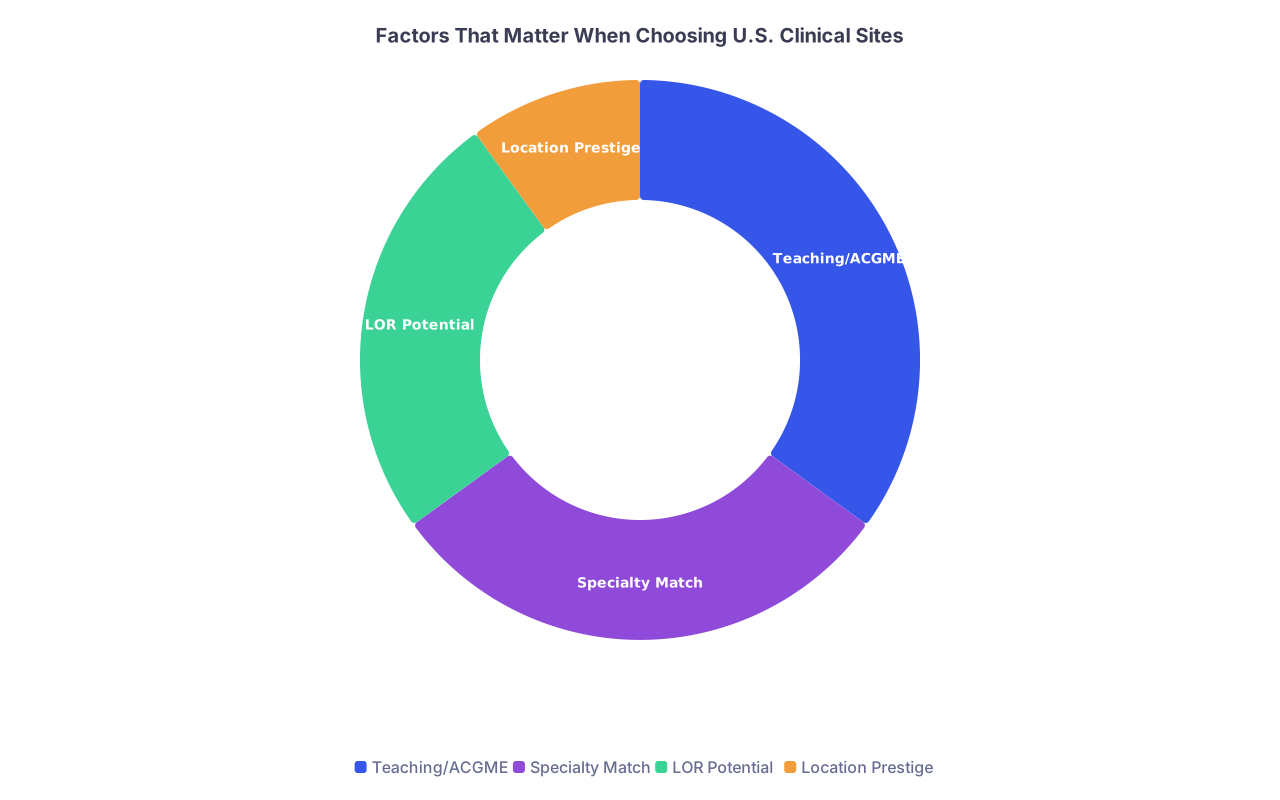
| Category | Value |
|---|---|
| Teaching/ACGME | 35 |
| Specialty Match | 30 |
| LOR Potential | 25 |
| Location Prestige | 10 |
Location prestige is the least important factor—yet it’s the one many IMGs obsess over.
Smarter approach:
- Start from the Match outcomes you want:
- Which programs regularly take IMGs?
- Which states are friendlier to IMGs and visas?
- Then look for affiliations and rotations in those ecosystems:
- Community teaching hospitals.
- University‑affiliated smaller sites.
- Ask if residents from those programs interact with rotators or if there’s any pipeline from rotation → interview.
That beats blindly chasing big city brand names with no real pathway.
8. Not Planning Rotations Around Your Application Timeline
Another subtle but costly mistake: doing the right sites at the wrong time.
Common pattern:
- You spend early months on weaker or random rotations.
- Your best, most impressive U.S. experience happens after ERAS opens or even after you submit.
- Your strongest letter arrives too late to be included in your initial application.
Program directors often make their first pass decisions early. If your best LORs and experiences are missing at that stage, you’ve handicapped yourself.
You want your strongest, most relevant experience:
- Completed before ERAS submission.
- With letters ready or at least requested.
A rough, more intelligent timeline for an IMG in the MATCH phase:
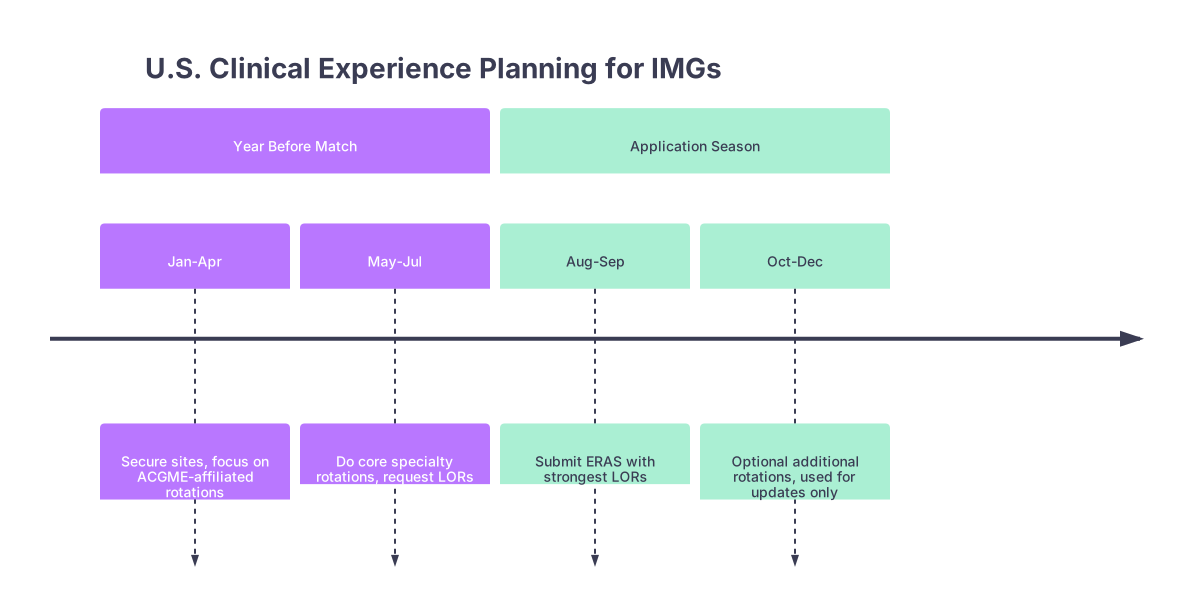
| Period | Event |
|---|---|
| Year Before Match - Jan-Apr | Secure sites, focus on ACGME-affiliated rotations |
| Year Before Match - May-Jul | Do core specialty rotations, request LORs |
| Application Season - Aug-Sep | Submit ERAS with strongest LORs |
| Application Season - Oct-Dec | Optional additional rotations, used for updates only |
Key point: Do not leave your highest‑quality rotation for “later when I’m free.” Later is often too late for the current application cycle.
Plan backwards from ERAS deadlines. Not forwards from your travel preferences.
9. Ignoring Red Flags in Contracts and Policies
Some IMGs are so desperate to secure a U.S. spot that they ignore obvious red flags in contracts and payment terms.
I’ve seen:
- Non‑refundable full payments required before giving you exact site details.
- Waivers that say the company is not responsible if:
- The hospital cancels.
- The attending stops showing up.
- You get no evaluation or letter at all.
- Strict “no complaint” or “no refund under any circumstances” policies.
If the paperwork is more aggressive about protecting the company than supporting your education, that’s a hint.
Watch for:
- No mention of:
- Evaluation process
- Performance feedback
- Access to letters
- Vague language:
- “You may have the opportunity to…”
- “At the discretion of the preceptor…”
You’re not buying a hotel room. You’re buying access to clinical evaluation and mentorship. If that’s not clearly guaranteed in some form, reconsider.
Quick Comparison: High‑Yield vs Low‑Yield Sites
| Feature | High-Yield Site | Low-Yield Site |
|---|---|---|
| Teaching status | ACGME teaching hospital | Non-teaching private clinic/hospital |
| Specialty alignment | Matches your residency target | Unrelated or random |
| Resident exposure | Daily interaction | None or rare |
| LOR quality potential | Academic attendings, detailed letters | Generic letters, weak or no letters |
| Student responsibilities | Presentations, notes, discussions | Passive shadowing only |
If a site mostly fits the right-hand column, do not convince yourself it’s “better than nothing” when you’re in active application mode. It may just be expensive padding.
FAQs
1. Is a non‑ACGME U.S. hospital rotation still better than no U.S. clinical experience?
Sometimes, but not always. If you already have:
- One or two strong ACGME‑affiliated rotations
- Solid letters from recognized attendings
Then adding a weak, non‑teaching hospital just to say “I did more U.S. experience” adds little. It can clutter your CV and generate mediocre letters. If it’s your only option and you have zero U.S. exposure, it can be better than nothing—but only if you’re sure you’ll get:
- Direct supervision
- Clear responsibilities
- A detailed, honest LOR
Otherwise, save the money and aim for higher‑yield options later.
2. Are observerships completely useless for residency applications?
Not completely. Observerships can:
- Show initiative to understand U.S. healthcare
- Provide networking opportunities
- Help you learn culture and communication norms
But they’re weak compared to:
- Hands‑on externships
- Formal clerkships with evaluations
If you’re applying soon, observerships should not be your core experience. Use them as add‑ons, not the foundation of your U.S. clinical profile.
3. How many months of U.S. clinical experience do I really need as an IMG?
For competitive internal medicine or family medicine, I often see a minimum of 2–3 months of solid, relevant U.S. experience at ACGME‑affiliated or clearly academic sites as a realistic bar. More can help, but only if it’s:
- High‑quality
- In your specialty
- Producing strong letters
Four months of low‑yield shadowing in random clinics will not beat two months of robust inpatient teaching rotations with excellent LORs. Quality first, quantity second.
Remember these core points:
- Not all U.S. clinical sites help you; some actively weaken your application.
- ACGME affiliation, real responsibilities, and strong LOR potential matter more than city, glamour, or marketing.
- Plan your highest‑yield rotations before ERAS submission and never trade quality for convenience.