
The match will not care why your rotation evaluation was mediocre. It will only care what you do about it now.
If you are an IMG with a lukewarm US clinical evaluation, you are on a clock. That paper (or PDF) is either going to quietly weaken your application, or you are going to turn it into a controlled damage story and surround it with stronger evidence. There is no middle ground.
Let me walk you through exactly how to salvage this. No fluff. No false hope. Just a concrete plan.
Step 1: Diagnose the Damage Objectively (Not Emotionally)
Your first job is to stop reacting and start analyzing. Most candidates stay stuck in shame or denial for weeks and lose their only window to fix it.
Pull up the evaluation and go line by line.
1. Categorize the Type of “Mediocre”
You are not dealing with “bad” in the same way if the form says “Meets Expectations” everywhere vs “Below Expectations” or negative comments. Those are different fires.
Use this quick classification:
| Type | Typical Wording | Urgency Level |
|---|---|---|
| Flat / Generic | Meets expectations, Average | Medium |
| Mixed with Red Flags | Some below expectations | High |
| Personality / Teamwork Issues | Difficult to work with | Critical |
| Professionalism Concerns | Late, unreliable, unprepared | Emergency |
Now, read the written comments three times:
- As the attending probably meant them (literal).
- As a program director might interpret them (skeptical).
- As a lawyer reading hostile evidence (worst‑case).
Why? Because PDs read fast and assume the worst when something is ambiguous.
Look for:
- Words like “average”, “adequate”, “quiet”, “needs improvement”
- Any mention of:
- Punctuality
- Professionalism
- Communication
- Taking feedback
- Clinical reasoning
- Patient interaction
If there is ANYTHING hinting at reliability or professionalism issues, that is your top priority. PDs forgive knowledge gaps. They do not forgive professionalism risk.
2. Separate “Score Problem” vs “Narrative Problem”
- Score problem: Checkboxes mostly in the middle column, maybe 1–2 low boxes, but neutral or bland written comments.
- Narrative problem: Comments that create a story in the PD’s mind: “quiet, did not integrate with the team,” “needed frequent redirection,” “limited initiative,” “concerns about independence.”
Narrative problems are more dangerous than numeric ones.
If you are unsure how bad it sounds, ask a brutally honest person:
- A US resident you know
- A faculty mentor who reads LORs
- An advisor who has actually sat on a residency selection committee
Send them ONLY the evaluation (no backstory) and ask: “If this was one of three US rotations for an IMG, how worried would you be on a scale 1–10?” You need that external calibration.
Step 2: Decide Whether to Use, Bury, or Counterweight It
You do not have to feature every evaluation you get. You do have to understand how it fits into your overall clinical experience story.
Here is how I think about it:
1. How Many US Clinical Experiences Do You Have?
If this is:
- Your only USCE: you cannot bury it. You must counterweight it.
- 1 of 2: you still need it, but you can reframe and reduce its visibility.
- 1 of 3 or more: you can afford to downplay or even exclude it in some ways (depending on how your school / ERAS structure works).
2. Is It Tied to a Letter of Recommendation?
Two separate but related issues:
- The rotation evaluation (internal form).
- The letter of recommendation (what goes to ERAS).
If this rotation is your only chance at a US letter in that specialty, the situation is different than if you already have a rock‑solid letter from another site.
Ask yourself:
- Did the attending offer or agree to write a letter?
- If yes, what did they verbally say about your performance?
- Do you know what is actually in that letter? (Most of you do not.)
If the evaluation is mediocre but the attending likes you personally and is willing to support you, you may still salvage a usable letter by active intervention (more on that later).
Step 3: Immediate Damage Control with the Attending
Most IMGs never do this and lose their best shot at rehabilitation.
You need one uncomfortable, strategic conversation.
1. Request a Brief Feedback Meeting
Email the attending. Keep it short and respectable:
- Subject: “Request for feedback on recent rotation”
- Body:
- Thank them for the opportunity.
- Say you value their assessment and want to improve.
- Ask for 15–20 minutes to discuss specific areas for growth.
The goal is NOT to argue your score. The goal is:
- Clarify exactly what they perceived.
- Understand if they see you as:
- A weak applicant.
- A developing applicant who could improve.
- An average applicant they did not know well.
During the meeting:
- Ask explicitly:
- “If you had to summarize my main areas for improvement in one sentence, what would it be?”
- “If you saw me again in 6 months, what concrete changes would convince you I have addressed these issues?”
- Take notes. Out loud. They need to see you are serious.
2. Carefully Explore Letter Possibility (If Appropriate)
If the evaluation was not horrible and the conversation is constructive:
- Say: “I know my evaluation was not outstanding. I am committed to improving. If I address these issues and strengthen my skills, would you still feel comfortable writing a supportive letter for me, maybe focusing on my growth and specific strengths you saw?”
If they hesitate or say anything lukewarm like “I could write a letter, but it may be more descriptive than strongly supportive,” do not use that letter for competitive programs unless you are desperate.
A mediocre letter from US faculty can sink you faster than no letter.
Step 4: Build a Redemption Rotation (ASAP)
You fix a mediocre US rotation evaluation with one thing: a clearly better, more recent, stronger rotation performance. Ideally with a strong letter.
You need a “redemption rotation.”
1. Choose the Right Setting
Better to choose:
- An attending who:
- Actually enjoys teaching.
- Has had IMGs before.
- Has a reputation for detailed letters.
- A site where:
- You will be evaluated directly by the letter writer.
- You are embedded with residents who can advocate for you.
Aim for:
- 4 weeks, not 2.
- Core specialty if possible (IM, FM, Peds, Psych, Surgery) depending on your target.
2. Go In with a Written Performance Plan
Do not just “try harder.” That is vague and useless.
Based on your bad evaluation, construct a 1‑page plan with:
- 3 specific behavior goals
- 3 daily habits
- 1 weekly feedback checkpoint
Example for someone dinged for being “too quiet” and “low initiative”:
Goals
- Present at least 1 patient per day on rounds.
- Speak up with a management suggestion for every patient I follow.
- Introduce myself to each nurse and resident on day 1 and ask how I can help.
Daily Habits
- Arrive 30 minutes before residents. Pre‑round on all my patients and have vitals/labs ready.
- Write a brief assessment/plan for each patient I see, even if not required.
- Ask the senior resident at midday: “Is there anything I can do better this afternoon?”
Weekly Checkpoint
- Every Friday, ask the attending: “Can I get 3–5 minutes of feedback on how I am doing compared with other students you work with?”
And then actually do this. Every day.
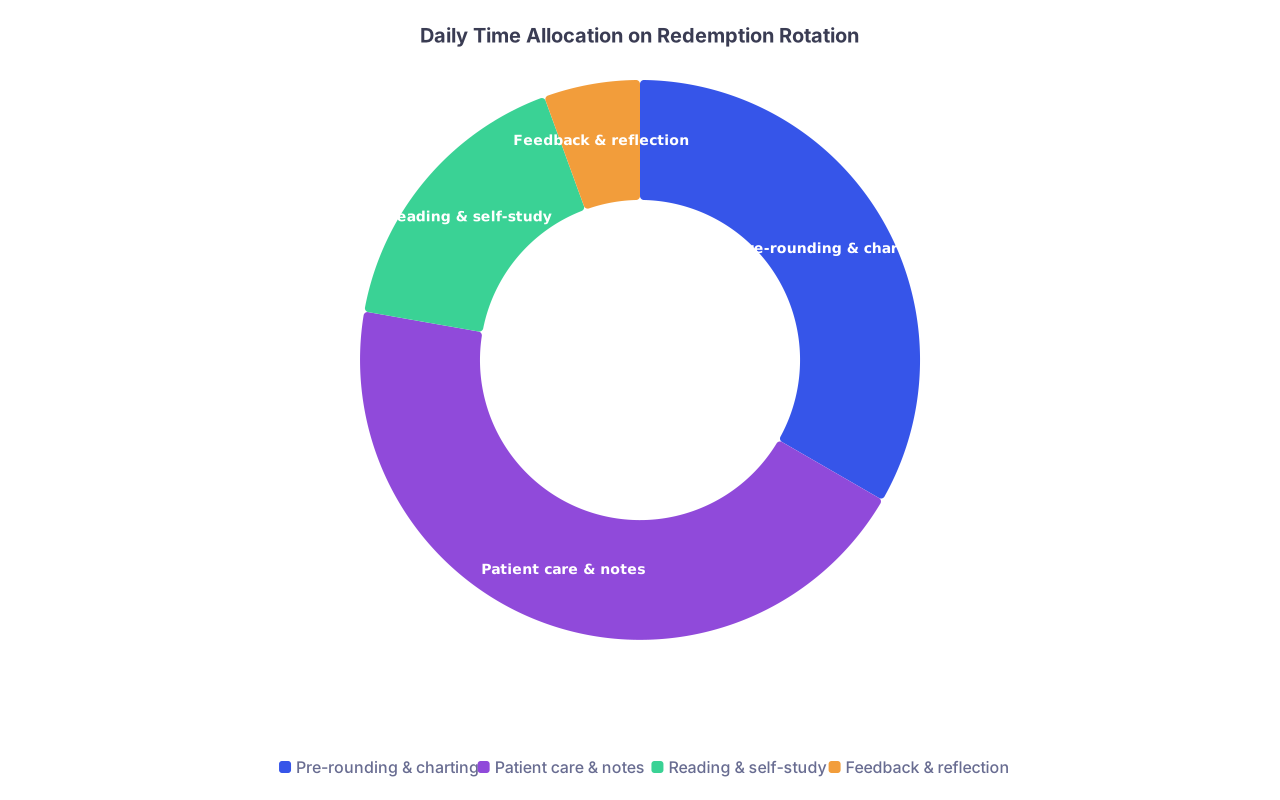
| Category | Value |
|---|---|
| Pre-rounding & charting | 180 |
| Patient care & notes | 240 |
| Reading & self-study | 90 |
| Feedback & reflection | 30 |
3. Make Your Commitment Visible Early
On day 2 or 3 of the new rotation, tell the attending something like:
“Doctor, I want to be transparent. I had a previous US rotation where I received an evaluation that was more average than I hoped. The main feedback was that I needed to be more proactive and communicate more with the team. I am working very actively on that now. If you see me slipping into old patterns, I would appreciate immediate feedback so I can correct it.”
This does three things:
- Shows maturity and willingness to grow.
- Frames any old evaluation as a past version of you.
- Invites them to see themselves as part of your “redemption arc.”
Attending physicians remember growth stories more than perfect students.
Step 5: Control How the Mediocre Rotation Appears in ERAS
You cannot erase history, but you can control what PDs see first and how they interpret it.
1. Prioritize Stronger Experiences in ERAS Descriptions
In your “Experience” section:
- Put your best rotations and roles at the top (by date).
- Use action‑heavy, specific bullet points.
- Under the mediocre rotation, keep the description clean and factual. No overcompensation.
For example:
Mediocre IM Sub‑I at Community Hospital
- “Participated in daily rounds on a general medicine service.”
- “Performed initial histories and physical exams on assigned patients under supervision.”
Do NOT write:
- “Excelled in all aspects of patient care.” The PD will compare that to the evaluation and roll their eyes.
2. Who Sends Which Letters
If you have:
- 1 mediocre rotation (no letter)
- 1 strong rotation with a very supportive attending (letter)
- 1 research mentor letter
You build your core letter set around the strong clinical one plus research, and possibly a department letter from home institution.
If you ended up with a letter from the mediocre rotation, you can:
- Use it only for:
- Less competitive programs.
- Programs that explicitly request “all US clinical letters.”
- Omit it for:
- Your top 10–15 programs.
- Very competitive specialties where every letter must be strong.
Step 6: Rewrite Your Narrative So the Evaluation Does Not Define You
Program directors do not read your file as isolated documents. They read for patterns. Your job is to flood the file with evidence that contradicts the implication of that mediocre evaluation.
1. Personal Statement: Subtle, Not Confessional
Do not write, “I once received a mediocre evaluation…” That is self‑sabotage.
You can subtly address the theme.
Example:
- If you were labeled “quiet” or “reserved”:
- Emphasize how you learned to speak up on teams, advocate for patients, and actively participate in decision‑making.
- If you were hit on “efficiency” or “organization”:
- Tell a story of building a structured way to pre‑round and manage tasks that later impressed residents.
One paragraph is enough.
2. MSPE / Dean’s Letter Context (If You Can Influence It)
Some schools will reflect US rotations in the MSPE. Some will not.
If your home dean’s office asks for input, or if your advisor writes a summary, you can suggest language that emphasizes:
- Trajectory: “Student has demonstrated steady improvement in clinical performance, particularly in communication and initiative.”
- Comparison: “By graduation, performance was comparable to other students entering internal medicine.”
You are not lying. You are framing.
3. Have Your Strongest Letter Indirectly Counter It
A great letter can quietly neutralize a prior mediocre evaluation.
If your previous issue was initiative/engagement, you want phrases like:
- “One of the most proactive students I’ve worked with.”
- “Frequently stayed late to follow up on patient results and plans.”
- “Integrated seamlessly into our team and communicated effectively with staff and patients.”
You cannot script a letter, but you can give your letter writer a CV, a short paragraph outlining what you are working to improve, and concrete examples of your behavior on their service. Many attendings will echo that language.
Step 7: Adjust Your Application Strategy to Reality
If your US rotation record is:
- 1 mediocre + 1 solid but not outstanding
- Limited research
- Average scores
Then you do not build a list heavy in university hospital powerhouses and hyper‑competitive specialties. That is fantasy and self‑sabotage.
1. Calibrate Competitiveness
For IMGs, mediocre USCE weighs more heavily than for AMGs.
You should be asking:
- Is my specialty choice realistic with this record?
- Should I:
- Pivot from competitive fields (Derm, Ortho, ENT, Plastics) to something IMG‑friendly (IM, FM, Psych, Peds)?
- Accept a transitional or prelim year plan?
- Apply very broadly in community programs?
2. Over‑Invest in Programs That Actually Read Applications
Academic “name” programs often filter heavily by scores and school. Community‑based programs and newer residencies sometimes look more closely at narrative and growth.
Target:
- Community IM/FM programs in IMG‑friendly regions.
- University‑affiliated community programs where IMGs have historically matched.
- Programs where your home institution or mentors have connections.
Use your bandwidth there. Write better, more program‑specific communications. Attend virtual open houses where possible.
Step 8: If There Is a Real Red Flag, Confront It Directly
We need a separate protocol if your evaluation mentions:
- Unprofessional behavior
- Poor reliability
- Failure to follow instructions
- Inappropriate interaction with staff or patients
These are not “mediocre.” These are red flags.
1. Get the Full Story in Writing
Request, politely, any additional documentation or context from the site. You want to know:
- Who wrote the comment.
- Whether others co‑signed that concern.
- Whether there was any formal remediation or just a note.
2. Craft a 2–3 Sentence “Own and Move On” Statement
If asked in an interview, you say:
- Identify the issue simply.
- Accept responsibility without being defensive.
- State concretely what you changed.
- Close with current proof.
Example:
“On an early US rotation I received feedback that my time management and responsiveness were not at the expected level, which affected my evaluation. That was a fair criticism. Since then I have implemented a strict pre‑rounding schedule, made a habit of checking in with the senior resident before leaving daily, and completed another medicine rotation where I was specifically commended for reliability and follow‑through.”
Then stop. Do not over‑apologize.
3. Back It Up with Pattern Change
One “bad” evaluation with three later strong ones reads as “growth.”
Two mediocre, one bad, and no strong ones read as “pattern.” PDs will not gamble on pattern.
If time allows (for example, you are taking a research year before applying), your most important task is: stack your file with:
- 2–3 strong, recent, US clinical rotations with clearly positive feedback.
- One letter explicitly praising the area that used to be weak.
Step 9: Mental Reset – So You Do Not Keep Repeating the Same Mistakes
Rotations are stress tests. Under stress, we fall back to default habits. Many IMGs carry habits from their home system that do not translate well to US teams:
- Being overly deferential and silent on rounds.
- Avoiding questions for fear of “bothering” the resident.
- Waiting for explicit instructions for every task.
Those behaviors often produce “average” or “underwhelming” evaluations.
You fix this by consciously rewiring a few core habits:
- Speak once on every patient: a question, a differential, or a plan suggestion.
- Ask for roles: “Can I take responsibility for this patient’s daily note and orders under supervision?”
- Volunteer for unglamorous work: calling families, updating med lists, chasing labs.
This is what US teams interpret as “engaged,” “hard‑working,” “team player.”
Step 10: Concrete 30‑Day Salvage Plan
You want a checklist. Here it is.
Within 48–72 hours of seeing the evaluation:
- Classify the type and severity of the evaluation.
- Send email requesting a feedback meeting with the attending.
- Show the evaluation to one trusted, blunt advisor and ask for their read.
Within 1–2 weeks:
- Have the feedback meeting; extract specific corrective behaviors.
- Decide whether to pursue a letter from that attending (yes/no, not “maybe”).
- Start securing a “redemption rotation” – earlier in calendar is better.
- Draft your 1‑page performance plan for the redemption rotation.
During the redemption rotation:
- Implement your daily habits and weekly feedback check.
- Tell the attending early that you are actively working on specific growth areas.
- Ask explicitly in the final week: “Based on my performance, would you feel comfortable writing a strong letter of recommendation for my residency applications?”
Before ERAS submission:
- Prioritize strong rotations in your experience section and CV.
- Select your letter set strategically, avoiding lukewarm letters for top programs.
- Adjust your specialty and program list to match your realistic competitiveness.
- Fine‑tune your personal statement to show growth in the exact domains that were weak.
You cannot rewrite a mediocre US rotation evaluation. You can bury it under stronger evidence and turn it into chapter one of a growth story instead of your entire identity as an IMG.
Open that evaluation again today and write down three specific behaviors it criticizes or implies. Then, for each one, design one daily habit you will implement on your next rotation to prove it wrong. That is your starting line.