
It is mid-September. You are an IMG. You scraped together money and favors to get one US clinical rotation. Four weeks. Maybe eight if you are lucky. You are staring at your ERAS portal realizing: this one rotation has to produce the letters that will decide whether you match or not.
You are not getting five different US rotations. You are not getting “backup” letters. This one shot has to equal multiple strong LORs.
Here is how you actually do that.
1. Understand What A “Strong” LOR Really Looks Like
Forget the fluffy advice. Let us be concrete.
Program directors and selection committees are scanning hundreds of IMG applications. They are skimming your LORs, not reading them like novels. What they want from a letter:
- Is this student safe to work with?
- Will this person show up, work hard, and not melt down?
- Are they at least at the level of our average US grad?
- Would I trust this person on my night float team?
A strong LOR for an IMG usually has four clear features:
Specific role and context
- “Rotated with me on inpatient internal medicine at XYZ Hospital from July–August 2026.”
- “Worked directly with me in my outpatient cardiology clinic for four weeks.”
Direct observation and concrete behaviors
- “I observed her present new admissions daily and independently formulate assessment and plans.”
- “He consistently arrived before the team, pre-rounded reliably, and followed through on all assigned tasks.”
Comparative language
- “Among the top 10% of students I have worked with in the past five years.”
- “On par with our US senior medical students.”
Clear endorsement
- “I strongly recommend her for an internal medicine residency position.”
- “I would be pleased to have him as a resident in our program.”
Your entire strategy during this one US rotation is to engineer situations that make those four features easy and honest for attendings to write.
2. Set Up Your Rotation Before Day One
Most IMGs waste the pre-rotation period. You cannot afford to.
2.1 Map Your Targets
You want multiple letters from a single rotation. That means you need more than one attending actually knowing who you are.
Before you start, clarify:
- How many attendings will you be working with?
- How is the rotation structured (inpatient, outpatient, mix)?
- Will there be fellows or senior residents who influence letters?
If you have a coordinator email, write a short, focused note 1–2 weeks before you start:
- Confirm schedule
- Ask (one line) who you will be working with
- Clarify expectations for students/observers
Your goal is simple: know the names and roles of your potential letter writers and how to get in front of them.
2.2 Decide Your LOR “Portfolio”
From a single rotation, you ideally want:
- 1 letter from a core attending (who saw you the most)
- 1 letter from a subsidiary attending or service (clinic, consults, another week)
- Optional: 1 letter from a fellow co-signed by an attending, or a rotation director
You do not ask all three on day one. You plan a pathway so that by weeks 3–4, you have three people who can honestly say:
- “I know this student.”
- “I saw them work.”
- “I can compare them to others.”
| Letter Type | Writer | When to Target |
|---|---|---|
| Core Inpatient LOR | Primary attending | Weeks 2–3 of rotation |
| Secondary LOR | Clinic/consult attending | Weeks 3–4 |
| Fellow/Director LOR | Fellow + co-signer or rotation director | Late week 4 |
3. Week 1: Make Yourself Impossible to Ignore
Week 1 is reputation week. Not “show off” week. “Prove I am reliable and safe” week.
Your objectives:
- Be memorable in a good way
- Show baseline competence fast
- Signal seriousness about residency and letters without sounding desperate
3.1 Start With a 30-Second Introduction That Matters
On day one, you will get the usual: “Hi, I’m Dr. Smith, attending on service.”
Your response should not be just your name and school. You need a tight, professional identity:
“Good morning, Dr. Smith. I am [Name], a final-year international medical student from [Country/School]. I am very interested in [Specialty] and hope to apply to US residency this cycle. I am here to work hard, learn your system, and help the team however I can.”
Short, direct, and it plants three key facts: IMG, serious, applying.
Tell the senior resident something similar. They often control which student gets exposed to which attending.
3.2 Nail the Basics in the First 3–4 Days
Most attendings form a strong impression in 72 hours. You need that first impression to be: “This IMG is surprisingly good.”
Hit these non-negotiables:
- Timing – 15–20 minutes early. Every day. No exceptions.
- Pre-rounding – Have at least 1–2 patients you know cold:
- Overnight events
- Vitals trends
- Labs and imaging
- One or two suggestions for the plan (even if basic)
- Notes – If allowed, offer to draft notes. If not allowed, draft sample notes for yourself, show a resident, ask for feedback.
Watch carefully how PGY-1s present. Copy their structure. Do not invent your own style.
4. Week 2: Deliberately Build Multiple Relationships
This is where most IMGs fail. They impress one attending, ignore everyone else, and walk out with one so-so letter.
You need depth with 1–2 attendings and breadth with others.
4.1 Identify Your “Anchor” Attending
By end of week 1 or early week 2, ask yourself:
- Who has seen me the most?
- Who has given me the most feedback?
- Who seems open to teaching and mentorship?
That is your anchor. Your most important letter will likely come from this person.
Focus on:
- Volunteering to present more cases when they are on service
- Asking 1–2 targeted clinical questions after rounds (not random trivia)
- Circling back when you apply: “I learned a lot from you and hoped you might support my application.”
4.2 Create Exposure to Secondary Attending(s)
If your rotation includes:
- Clinic days
- Consult services
- Subspecialty weeks
Then you have built-in secondary attendings. Use them.
On day 1 or 2 with a new attending:
“Dr. [Name], I am on this rotation for four weeks and very interested in [Specialty]. I want to make sure I am helpful while working with you. Could you let me know what you expect from students here – especially regarding presentations and follow-up tasks?”
This signals: I care. I am coachable. I understand expectations matter.
Then you execute like your anchor attending is standing over your shoulder. Because this secondary attending might become LOR #2.
5. Behaviors That Turn Observers into Advocates
You cannot ask for a strong LOR if no one saw you do anything substantial. You have to give them material.
5.1 Own a Small Slice of the Team’s Work
You are not the intern. But you can “own” tasks appropriate to your level:
- Track all lab results and imaging for 1–2 patients
- Make a checklist of follow-ups after rounds and confirm they happened
- Draft discharge summaries (where permitted)
- Call the lab or radiology for results under supervision
Tell your senior resident: “Can I help track X/Y/Z for the team and report back?” If you do this reliably for a week, residents will start phrases like “He is very reliable” and “She follows through” when attendings ask, “How is our student doing?”
Those exact phrases land in LORs. I have seen it repeatedly.
5.2 Demonstrate US-Style Communication
Programs worry IMGs will struggle with communication and hierarchy.
So show them you get it:
- Present in a structured way: CC → HPI → PMH → Meds → Allergies → Exam → Labs → Assessment/Plan
- Adapt to feedback the same day. If an attending says “Shorten your HPI,” your next HPI should be half the length. They will notice.
- Speak clearly, without whispering, without over-apologizing every two minutes.
When you page or call consults (if allowed), rehearse with a resident first. Use SBAR. Show that you know how to function in the US system, not just medically.
6. Ask for Letters the Right Way (and at the Right Time)
You do not walk in on day 3 and say “Please write me a strong letter.” That telegraphs insecurity.
You build a track record. Then you ask.
6.1 Timing for Each Letter
Your target:
- Anchor attending LOR: End of week 3 or beginning of week 4
- Secondary attending LOR: Mid to late week 4
- Fellow/director LOR: End of week 4
Spacing them out lets you adjust based on responses. If one attending seems lukewarm, you can push harder on another.
6.2 The Actual Script to Use
With your anchor attending, after a good day or at the end of the week:
“Dr. [Name], I have really appreciated working with you this month. I am applying for [Specialty] residency this cycle. Based on your experience working with me, do you feel you know me well enough to write a strong letter of recommendation for my application?”
Two key things:
- You explicitly say “strong letter.” That gives them an out if they cannot.
- You reference your shared work. This is not a cold ask.
If they hesitate, thank them, and mentally move them to “maybe, if needed.” Then put more energy into another attending or the rotation director.
If they say yes, reply:
“Thank you, that means a lot. I can send you my CV and a short summary of my work on this rotation if that would help.”
Do the same structure with secondary attendings later in the rotation.
7. Multiply “Writers” from One Physical Rotation
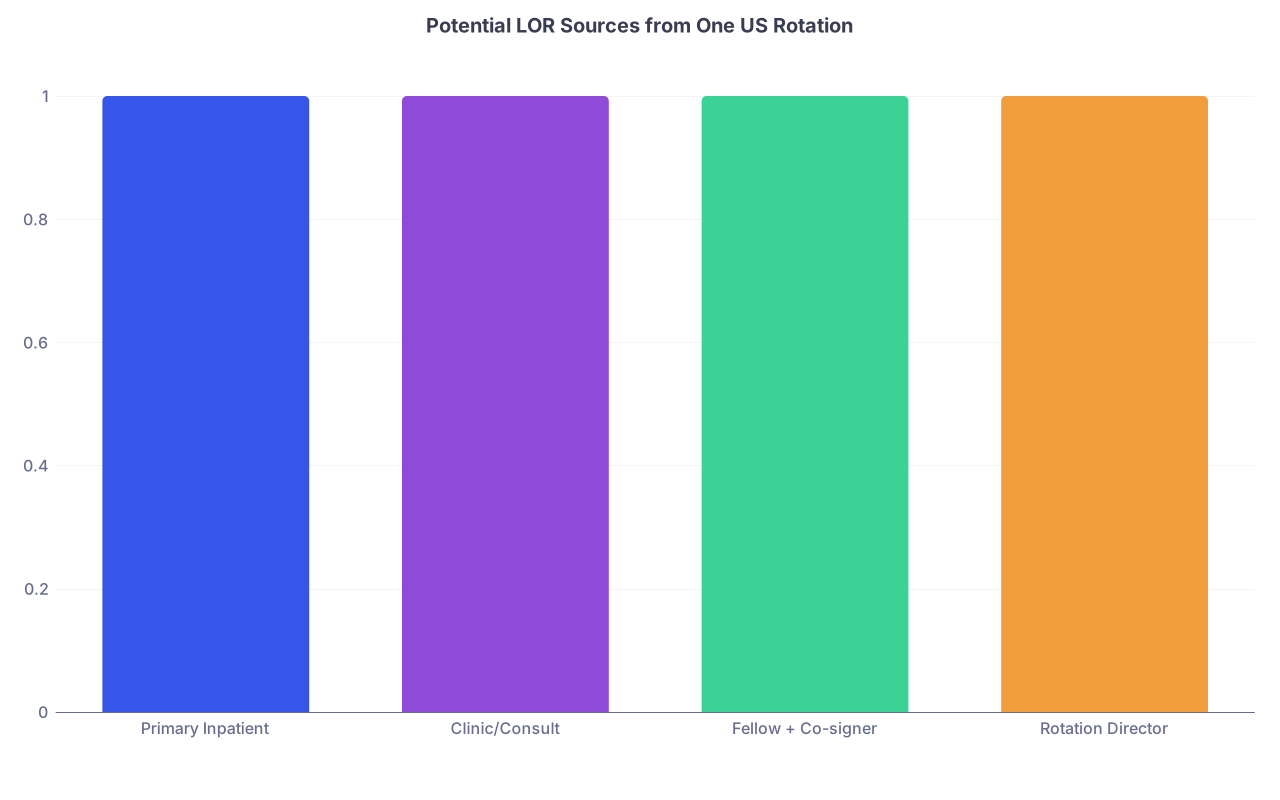
You have one physical location. You want three distinct voices.
Here is where you leverage the structure:
| Category | Value |
|---|---|
| Primary Inpatient | 1 |
| Clinic/Consult | 1 |
| Fellow + Co-signer | 1 |
| Rotation Director | 1 |
7.1 Inpatient + Clinic Combo
If your four-week rotation has:
- 2 weeks inpatient
- 2 weeks outpatient clinic
You can realistically get:
- 1 strong inpatient LOR
- 1 strong outpatient LOR
They will speak to different strengths:
- Inpatient: acuity, team function, work ethic
- Outpatient: communication, continuity, patient interaction
Both are valuable. Both can come from the same hospital. That is fine.
7.2 Fellow Letter Co-Signed by Attending
In some services (cards, GI, heme/onc), the fellow sees you constantly, while the attending floats around.
If the fellow knows you best:
Ask the fellow first:
“Dr. [Fellow], you have worked with me closely this month. Would you feel comfortable supporting my residency application with a letter, perhaps co-signed by Dr. [Attending]?”
If they agree, they will often draft it, send to attending, and the attending signs or adds comments.
Programs know this happens. It is not a problem if the content is strong.
7.3 Rotation Director Letter
If there is a designated student coordinator or rotation director who:
- Knows your name
- Has heard positive feedback from multiple attendings
- Oversees your eval
They are perfect for a “summary” LOR. It can say:
- “I am the director of the [X] rotation. [Name] rotated through our service and received consistently high evaluations from multiple attendings.”
- “He was described as reliable, hardworking, and at the level of our US students.”
This one letter can package feedback from several people who did not individually have time to write.
You still have only done one rotation. But you have multiple voices on paper.
8. Make It Easy for Them to Write You an Excellent Letter
Attending physicians are busy. Resentfully busy. If you want a good letter, you reduce friction.
8.1 Send a Focused Follow-Up Email
Once someone agrees to write:
Within 24–48 hours, email them:
- Subject: “LOR for [Your Name] – [Rotation/Month]”
- Include:
- ERAS letter request link (if ready)
- Your CV
- 1-page “LOR support sheet” (not a life story)
What goes on that support sheet:
- 3 bullet points about what you did on the rotation
- 3 brief clinical moments that reflect your strengths
- Your specialty of interest and a one-line career goal
- Your contact info
Example bullets:
- “Independently pre-rounded and presented 2–3 patients daily on the inpatient service, including formulating initial assessment and plans that we refined as a team.”
- “Consistently followed up on lab and imaging orders, updating the team and ensuring plans were carried through.”
- “Received feedback on early presentations and rapidly adjusted to a more concise, structured format similar to our US senior students.”
You are not writing your own letter. You are jogging their memory and giving them easy material to reference.
8.2 Gentle, Professional Reminders
If your ERAS portal still shows “Not started” 2–3 weeks after the ask:
Send a single polite reminder:
“Dear Dr. [Name],
I hope you are well. I wanted to gently check whether you had the chance to submit the letter of recommendation for my residency application. The ERAS deadline I am targeting is [Date]. I am very grateful for your support and understand you have a busy schedule.
Best regards,
[Name]”
If they still do not submit after another 2–3 weeks and a second, final reminder, assume it is not happening and adjust your LOR strategy. Do not harass them weekly.
9. If Your Rotation Is Only Observership-Level
Many IMGs are stuck as “observers”:
- No notes
- No orders
- Limited patient contact
You can still get strong letters, but you have to work harder.
9.1 Max Out Every Allowed Responsibility
Clarify exactly what you are allowed to do. Then push to the ceiling of that scope:
- If you cannot write in the chart, write parallel notes for yourself and review them with residents for feedback.
- If you cannot talk to patients alone, join every patient encounter, then afterwards present your assessment out loud to the resident.
- Offer to prepare brief literature reviews on a patient’s condition and share a 3–4 line summary with the team.
You want the attending to be able to write things like:
- “Although limited by observership status, she consistently came prepared with thorough notes on each patient she followed.”
- “He regularly reviewed relevant literature on our cases and summarized it succinctly for the team.”
Those are still powerful statements.
9.2 Show Up Like a Resident, Not a Tourist
A lot of observers float in and out. Quiet. Invisible. Learning nothing and impressing nobody.
Do the opposite:
- Arrive when residents arrive, not at 10:00.
- Stay for sign-out when permitted.
- Ask residents for tasks within your allowed scope: data gathering, chart review, problem lists.
When it is time to ask for a letter, your pitch can be:
“Dr. [Name], even though I was here as an observer, I tried to participate as much as possible within that role. Based on your observations of my work and preparation on this rotation, would you feel comfortable writing a strong letter of recommendation for my application?”
Some will still say no. But the ones who say yes will write that line: “He functioned at the level of an active team member despite being technically an observer.” That sentence alone can set you apart.
10. Post-Rotation: Keep Your Writers Warm
Once the rotation ends, your job is not over.
10.1 Send a Simple Thank-You
Within a week:
“Dear Dr. [Name],
Thank you again for the opportunity to work with you on the [Service] rotation. I learned a great deal, especially about [specific thing]. I am grateful for your willingness to support my residency application with a letter.
Best regards,
[Name]”
No drama. Just professional closure.
10.2 Update Them at Key Milestones
These people are now in your long-term professional network. Treat them that way.
Two useful updates:
When you submit your application:
- “I submitted my ERAS application in [Specialty] this week and included your letter. Thank you again for your support.”
After Match Day:
- “I wanted to share that I matched into [Program, City] in [Specialty]. Your support and letter were a crucial part of this, and I remain very grateful.”
This is not just politeness. You are building relationships. Maybe for fellowship. Maybe for future jobs.
11. Putting It All Together – A Four-Week Game Plan
Here is a concise, realistic framework.

| Step | Description |
|---|---|
| Step 1 | Week 1 - Prove reliability |
| Step 2 | Week 2 - Deepen anchor relationship |
| Step 3 | Week 3 - Ask anchor for LOR |
| Step 4 | Week 4 - Secure secondary letters |
| Step 5 | Post rotation - Follow up and thank |
Week 1:
- Be early. Be prepared. Be visible.
- Learn exactly how your team works.
- Identify potential anchor attending and secondary attending.
Week 2:
- Start taking small ownership of tasks.
- Ask for feedback and apply it immediately.
- Get more face time with anchor attending.
Week 3:
- Ask anchor attending for a strong LOR.
- If yes, send CV and support sheet.
- Keep building rapport with secondary attending(s) and fellow/rotation director.
Week 4:
- Ask secondary attending for a strong LOR.
- If appropriate, ask fellow or rotation director for a summary LOR.
- Confirm letters are being uploaded or will be soon.
Post-Rotation (1–4 months):
- Send thank-you emails.
- Check ERAS portal for letter receipt.
- Send one or two gentle reminders if needed.
- Update after application submission and match.
FAQs
1. How many LORs should I realistically aim for from a single US rotation as an IMG?
Aim for two strong letters as your primary goal and consider a third as a bonus. If you can get:
- 1 robust inpatient or core attending letter, and
- 1 solid secondary letter (clinic, consult, director, or fellow co-signed),
you have done very well. Quality beats quantity. Two excellent, specific letters from one place will help you far more than three generic “to whom it may concern” notes from people who barely remember you.
2. Should I tell attendings I am also asking others from the same rotation for letters?
You do not need to volunteer that, and you definitely do not need to hide it. If it comes up naturally, you can say:
“Yes, I have also asked Dr. [Name], since I worked closely with both of you and you saw different aspects of my work.”
Most attendings expect students to get multiple letters, especially IMGs with limited US time. What matters to them is that your request feels genuine and based on real interaction, not just letter-collecting.
3. What if an attending agrees to write a letter but I suspect it will be weak?
If you had to drag them into agreeing, they paused for a long time, or they used lukewarm phrases like “I can provide a letter if you need one,” be careful. You want enthusiasm, not obligation. In that situation:
- Treat that letter as a backup at best.
- Focus on securing other, stronger letters from people who respond with genuine support (e.g., “I would be happy to write you a strong letter.”).
You are better off with fewer strong LORs than padding your file with a bland or subtly negative one.