
What actually happens to that glowing US letter from “Dr. Smith, Internal Medicine” when the reviewer can’t figure out if you ever touched a patient or just watched from a hallway?
Let me be blunt: program directors are flooded with “excellent,” “outstanding,” “one of the best students I’ve worked with” letters that mean almost nothing because the clinical context is missing or weak. Especially for IMGs.
If you’re an IMG and you think, “As long as I have three US doctors sign letters, I’m good,” you are playing the game on hard mode with your eyes closed.
This myth costs people interviews every single year.
Let’s dismantle it.
What Programs Really Use LORs For (And What They Don’t)
There’s a fantasy version of how letters of recommendation work: attendings write detailed, nuanced assessments and program directors carefully analyze each paragraph.
Reality is harsher.
Most PDs and selection committees use letters in three main ways:
- To verify you functioned in a real US clinical setting with real responsibility.
- To see if anyone actually stakes their reputation on you as a future resident.
- To spot red flags or lukewarm language hidden under polite phrasing.
That’s it.
They’re not trying to figure out if you’re in the 82nd vs 84th percentile of “work ethic.” They’re asking:
- Did this applicant see real patients in my system (or a similar system)?
- Were they observed doing doctor things, not tourist-shadow things?
- Do I trust this writer’s judgment?
- Does the writer compare them convincingly to US grads I already know?
Now look at how most weak IMG letters fail:
- Vague role: “He observed in my clinic and showed great interest.” Translation: useless.
- No US system context: “I knew her from online teaching and mentorship.” Translation: not a clinical evaluator.
- No comparison group: “He is very hardworking and polite.” Translation: no idea if they’re residency-ready.
- Writer has zero name recognition or unclear position in US training.
The committee isn’t heartless. They’re overloaded. So vague letters get mentally downgraded or ignored.
Letters are not lottery tickets. They’re structured signals. If the clinical context is off, the signal is garbage.
Observership ≠ Clinical Experience (And Committees Can Tell)
Here’s the core uncomfortable truth: not all “US clinical experience” is the same, and programs know it. They see thousands of applications. Patterns are obvious.
You know what every PD has seen?
The observership letter that reads like this:
“Dr. X observed patient care in my busy internal medicine clinic. He attended lectures, listened attentively, and showed great interest. He is polite, punctual, and enthusiastic.”
On paper: US doctor, internal medicine, positive words.
In reality: red flag for “never touched a patient.”
Compare that with this kind of description:
“During his four-week inpatient sub-internship, Dr. Y carried 4–6 patients daily, wrote progress notes in the EMR (co-signed by me), presented on multidisciplinary rounds, and called consults under supervision. I directly observed his physical exams and clinical reasoning on a daily basis.”
Same number of words. Totally different impact.
Why? Clinical context.
One sounds like a tourist. The other sounds like an actual member of the team.
Programs care about that distinction because they’re asking a brutally practical question: If I put you on my night float team in July, are my interns going to suffer carrying you?
If your letter never clearly puts you in the role of someone functioning in the US system, they can’t answer yes.
What counts as strong clinical context?
You don’t need magic phrasing; you need reality reflected in specifics:
- Setting: inpatient vs outpatient, academic vs community hospital
- Role: sub-intern, acting intern, extern with patient contact, vs “observer”
- Responsibilities: pre-rounding, writing notes, calling consults, counseling patients
- Systems: EMR use, understanding of orders, handoffs, multidisciplinary teams
- Evaluation: direct observation of physical exam, decision-making, communication
If none of that shows up in your letter, the reviewer will assume you didn’t do it. That’s how risk-averse selection works.
The Rank Order of Letters: All “US Doctor” Is Not Equal
Let’s destroy the idea that “a US letter is a US letter.” That’s like saying a “publication is a publication” whether it’s in NEJM or some predatory PDF graveyard.
Here’s the hierarchy most PDs implicitly use, especially for IMGs.
| LOR Type | Typical Impact |
|---|---|
| US core specialty, inpatient rotation, PD/APD | Very strong |
| US core specialty, inpatient attending | Strong |
| US subspecialty with clear patient role | Moderate to strong |
| US outpatient-only, real patient care | Moderate |
| US “observership” letter | Weak |
| Non-US clinical letter | Variable, usually weak |
Notice what’s at the top: PD/APD or core faculty in the specialty you’re applying to, in a setting where you clearly acted as a junior resident.
Notice what’s at the bottom: letters where your role is unclear, your responsibility is minimal, or the system is foreign to what that residency runs every day.
Does this mean a brilliant non-US letter is worthless? No. But a brilliant non-US letter plus a flimsy US “observer” letter still looks like: strong clinician in home country, no proven US performance.
Programs can like that and still not risk it.
What The Data Actually Shows (Not the Forum Myths)
You’ll see endless forum posts saying, “You just need 2–3 US letters from any US doctor.” That’s not what actual surveys show.
Let’s pull from the NRMP “Program Director Survey” patterns (aggregation across years; questions don’t change that much):
- US clinical experience is one of the top filters for IMGs in many specialties.
- Program directors value “demonstrated clinical performance in our healthcare system” more than just “familiarity with US medicine.”
- Letters of recommendation in the specialty are consistently ranked among the most important factors after exam scores and MSPE/Dean’s Letter.
Now combine all that:
Programs care about:
- Clinical experience in the US.
- In that specialty.
- With performance assessed by people they trust.
The “any US doctor letter works” myth ignores that middle line: in that specialty, in a meaningful clinical role.
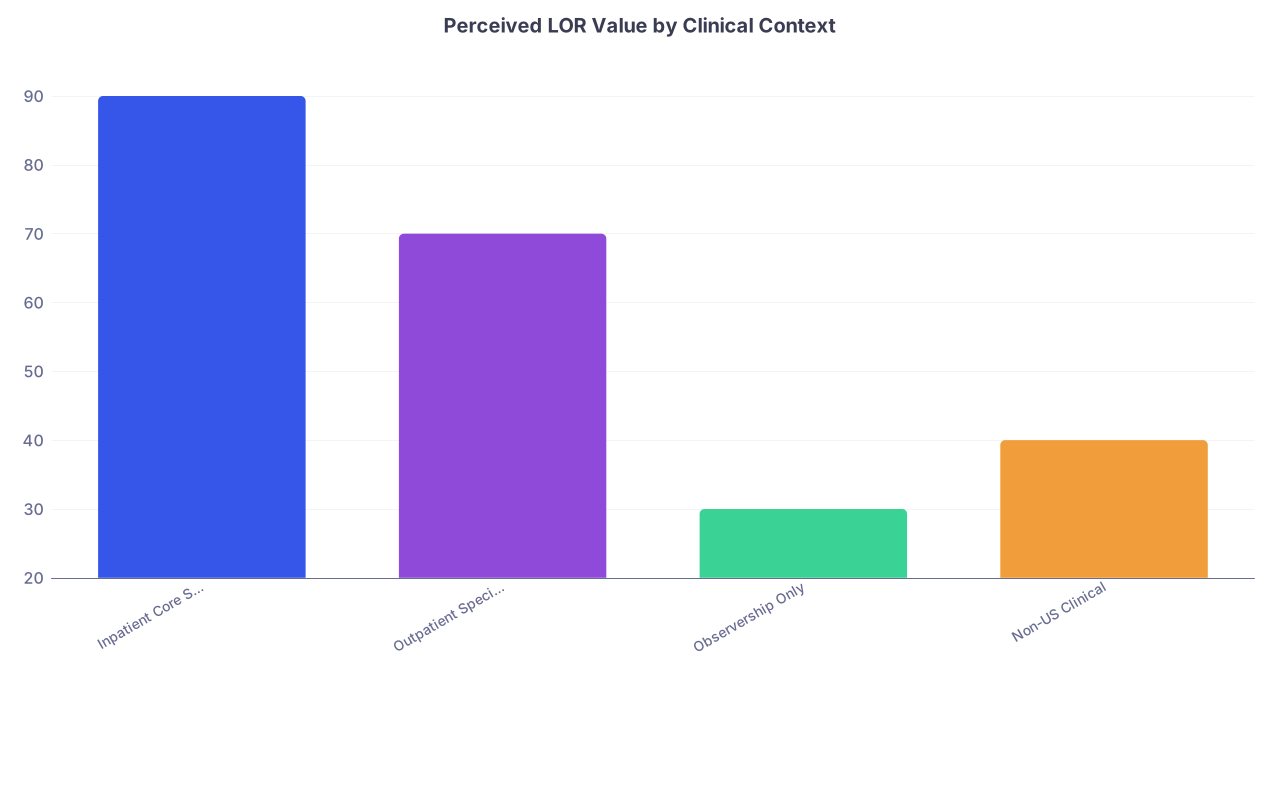
| Category | Value |
|---|---|
| Inpatient Core Specialty | 90 |
| Outpatient Specialty | 70 |
| Observership Only | 30 |
| Non-US Clinical | 40 |
That’s not literal NRMP numbers, obviously. But it reflects how PDs I’ve talked to informally would rank relative strength. And it matches what you see: IMGs with mediocre scores but superb, well-contextualized US inpatient letters get interviews; high scorers with “observer” fluff get ignored.
Concrete Examples: Two Applicants, Same Scores, Different Letters
Let me show you how this plays out.
Applicant A: “Any US Doctor Will Do”
- Step 2 CK: 238
- USCE: two 4-week observerships in internal medicine clinics
- LOR 1: “Dr. A observed in my clinic… very interested… strong knowledge”
- LOR 2: “Dr. B shadowed me, asked excellent questions… would do well in further training”
- LOR 3: Non-US, strong but from home country hospital
All letters are from “US doctors” except one. All are positive. None say:
- “Carried patients”
- “Wrote notes”
- “Functioned as part of the care team”
- “I would gladly have them as a resident in my program”
This applicant looks like a smart, polite observer. Not obviously residency-ready.
Applicant B: “Clinical Context First”
- Step 2 CK: 236 (slightly lower)
- USCE: 8 weeks inpatient IM sub-internship in a community hospital + 4 weeks inpatient IM at an academic affiliate
- LOR 1: From APD, inpatient: clearly states carrying 5 patients, daily presentations, call shifts, EMR notes
- LOR 2: From hospitalist: detailed case descriptions, observed managing diabetes exacerbation, pneumonia etc., explicit comparison to US seniors
- LOR 3: From home country but emphasizes years of independent ward responsibilities
Scores about the same. Letters not both “US doctors” in all three. But this file screams: already functioning like a PGY-1.
In borderline cases, Applicant B gets the interview over Applicant A. Over and over.
That’s why this myth is so expensive.
How To Make Your Letters Actually Mean Something
You cannot micromanage what someone writes. But you can absolutely influence the context.
You want letters that:
- Come from people who directly observed you in a real clinical role, not just as a shadow.
- Describe specific clinical tasks you performed: presentations, notes, management plans, follow-ups.
- Place you in a comparison group: “as strong as our US seniors,” “among the top IMGs I’ve supervised.”
- Are clearly relevant to the specialty you’re applying to (or at least adjacent).
So how do you push in that direction without being weird or pushy?
You control two big levers:
Where you get experience.
Pay attention to the structure of the rotation, not just the name. “Inpatient sub-I with notes, presentations, and call” beats “outpatient shadowing with no chart access” every time.How you brief your letter writers.
When someone agrees to write you a letter, you do not just say “thank you” and disappear. You send them:- Your CV
- Your personal statement draft
- A bullet list (for them, not for ERAS) of specific things you did on that rotation: patients followed, responsibilities, call, systems you used
You’re not writing your own letter. You’re reminding a busy attending of the concrete details that improve the accuracy and context of their assessment.
If they barely saw you, or only in a shadowing capacity, that’s actually the red flag: you probably shouldn’t be asking them for a letter in the first place.
The Prestige Trap: Big Names, Weak Context
Another variant of the myth: “If I get a letter from a famous US doctor, I’m set.”
No. Fame doesn’t fix missing clinical context.
Program directors would rather read a detailed, grounded letter from a no-name but solid community hospitalist who worked with you every day, than a generic “great student” paragraph from a superstar at a top academic center who barely knows you.
I’ve watched committee meetings where someone says, “Big name, but very generic letter. I don’t think they know this applicant well.” And then they move on.
The only time a big name helps is when:
- The writer actually supervised you clinically, in depth.
- The letter still contains the same gritty details: patients, tasks, comparisons.
That’s rare. So don’t chase prestige at the expense of substance.
FAQ: Clinical Letters and IMGs
1. Is an observership letter ever useful?
Yes, but mostly as a minor supporting piece, not as a core clinical letter. If all three of your US letters are pure observership with no real responsibilities described, you’re confirming every fear PDs already have about IMGs: unfamiliar with US workflow and not tested under pressure. One observership letter plus two strong, responsibility-heavy inpatient letters? Fine. Three observer letters? Weak.
2. Do I absolutely need letters in the specialty I’m applying to?
For competitive fields: almost always yes. For IM and FM: strongly preferred but not always an absolute deal-breaker. But here’s the thing—if you’re applying to internal medicine and all your US letters are from neurology and radiology, you’re making your life harder. At least 2 letters from the specialty (or very close neighbors) is the safe baseline.
3. Are home-country clinical letters useless?
Not useless, but they’re usually not enough by themselves. They can prove you were a trusted, functioning physician elsewhere, which helps. But they don’t address the core US concern: can you function in our system, with our documentation, our communication style, our patient expectations? A strong home letter plus a weak US observer letter still reads like: “Good doctor, untested here.”
4. Should I worry if my letter writer is not “famous”?
No. Worry if your letter writer barely knows you. A community attending who saw you grind through admissions at 2 a.m. and watched you present cogent plans is more powerful than a division chief who saw you twice and says “hardworking and polite.” Title matters less than substance and specificity. Committees can smell a “favor” letter from three sentences away.
5. Can I use a research mentor letter instead of a clinical one?
Use it as a supplement, not a substitute. For research-heavy specialties (like heme/onc, cards later in fellowship applications), research letters matter. For a core residency match, especially as an IMG, they want proof of clinical performance. A research mentor who never saw you manage a single patient is not a clinical evaluator, no matter how glowing their letter. One research letter is fine; three non-clinical letters is asking for a reject pile.
Key takeaways:
Most “US doctor letters” are weak because they describe proximity to medicine, not participation in it. Committees sort applications by clinical context, not adjectives. As an IMG, your real leverage is not “3 US letters”; it’s 2–3 letters from people who watched you function like a junior resident in the US system and are willing to say exactly that.