US clinical experience without research is not useless. The idea that your USCE “doesn’t count” unless it comes bundled with publications is lazy, ahistorical, and not supported by match data.
You are up against something real, though. The rising obsession with research—especially in competitive specialties—has warped a lot of advice IMGs get. Attendings telling you “You must have research” usually leave out a key part: they’re talking about matching dermatology at a top-10 program, not about every residency in the country.
Let’s separate myth from measurable reality.
What Program Directors Actually Say They Care About
Everyone has opinions. Program directors have data. And they get surveyed about it.
The best large-scale window into their thinking is the NRMP Program Director Survey. It’s not perfect, but it’s better than “my friend said.”
Look at how program directors rank factors when deciding who to interview and how to rank them. Certain things keep showing up at or near the top:
- USMLE scores (now mostly Step 2 CK)
- MSPE/Dean’s Letter and letters of recommendation
- Personal knowledge of the applicant / performance at that institution
- Perceived commitment to the specialty
- For IMGs specifically: US clinical experience in the specialty
Research output, presentations, and publications? Present, helpful, but not the universal deal-breaker people pretend they are—especially outside of highly competitive specialties.
Here’s a simplified comparison based on repeated themes from recent PD surveys (note: exact percentages vary by year and specialty, but the hierarchy is consistent):
| Factor | Typical PD Priority (Broad IM specialties) |
|---|---|
| Step 2 CK score | Very High |
| US clinical experience in specialty | High |
| Letters of recommendation (US) | High |
| Personal knowledge / rotations | High |
| Research experiences | Moderate |
| Publications / presentations | Low–Moderate (except competitive fields) |
Notice what’s missing: “No research = application is useless.” It’s just not there.
For many IMGs, especially targeting internal medicine, family medicine, psych, peds, neurology, community EM, etc., solid US clinical experience plus strong scores, plus decent English, plus coherent story beats “good research, weak clinical performance” nine times out of ten.
The nuance: as competition rises (think radiology, anesthesia at big names, surg subspecialties, dermatology, ophtho), research importance ramps up. But that’s a different question: “Is research important for these competitive targets?” versus “Is USCE useless without research?” Those are not the same claim.
What US Clinical Experience Actually Does For You
People underestimate USCE because they think of it as “just shadowing.” If that’s your mindset, you’re already wasting it.
Done properly, US clinical experience is not tourism. It’s signal.
It sends five very loud messages about you to programs:
You understand US clinical workflows
Not hypothetically. Not from YouTube. You have seen how teams round, how notes are written, how orders are placed, how nurses communicate, what “sign-out” really looks like.You can function in English in a real clinical environment
This is a huge anxiety point for some programs with IMGs. A letter from a US attending saying “This person communicated clearly with staff and patients” is gold because it reduces their risk.You can handle US-style documentation and EMR
I’ve watched IMGs completely lost inside Epic or Cerner during their first week. Programs know onboarding a resident who’s never touched a US EMR is painful. Prior exposure is a plus.You’ve seen the culture—and didn’t run away screaming
US medicine is its own ecosystem: hierarchy, medico-legal paranoia, patient expectations, throughput pressure. Surviving and engaging in that environment is a data point.You’re a known quantity to someone in the US system
The coldest part of the match is being an unknown. USCE done at decent sites, with engaged attendings, turns you from “random PDF” into “the student Dr X worked with last fall.”
None of that is replaced by a PubMed link.
Research, by contrast, mainly screams three things:
- Can plan and execute long-term projects
- Can write and think somewhat analytically
- Understands literature in that specialty
Useful, yes. Mandatory, no. Interchangeable with USCE, absolutely not.
The IMG Reality: Where USCE Matters More Than Research
Let me be blunt: for the majority of IMGs aiming at common residency paths, lack of US clinical experience is more damaging than lack of research.
If we’re talking:
- Internal Medicine (especially community, mid-tier university programs)
- Family Medicine
- Pediatrics (non-elite programs)
- Psychiatry
- Neurology (outside top-10)
- Ob/Gyn at many mid-tier programs
the appetite for “robust research portfolios” is far lower than the appetite for “people who can function on the wards on July 1.”
You see this in three places:
Program websites explicitly stating “US clinical experience required or strongly preferred,” sometimes even stating a minimum number of months. Far fewer list “research required” outside top-heavy specialties.
The ERAS filters that programs use. A lot of IM and FM programs filter by “US clinical experience yes/no.” Very few filter by “publications > 1.”
The questions in interviews. IMGs with USCE get asked about specific patient encounters, handoffs, communication challenges. IMGs with research but no USCE get grilled on “So how will you adjust to the US system?” The former sounds like a future intern. The latter sounds theoretical.
If you have to choose—in a world of limited time and money—between an extra observership vs a “maybe publication in 18 months” project with no guaranteed output, you are not crazy for choosing the clinical work, especially if your scores are not stellar.
Where Research Does Genuinely Matter
Now for the part people misuse.
There are real situations where lack of research will hold you back, even with solid USCE:
- You’re gunning for highly competitive specialties (derm, plastics, neurosurgery, ortho, ENT, ophthalmology, top radiology and anesthesia programs).
- You’re targeting elite academic centers (MGH, UCSF, Hopkins, Penn, etc.) where research is part of the identity.
- You’ve got weaker scores, and your only hope to stand out at those program tiers is “research beast” combined with connections.
For those lanes, research is not optional; it’s currency. Publications, abstracts, posters, maybe even advanced degrees.
But let’s stop generalizing that world to every IMG.
The myth goes like this: “Everyone needs research to match nowadays.”
The reality is closer to: “If you want the shiniest, most academic brands, you either need stellar scores plus research, or some exceptional narrative. But thousands of IMGs match each year into solid training programs without a single publication.”
Check the NRMP’s “Charting Outcomes in the Match – IMGs” data. Year after year, IMGs matching IM or FM have modest average numbers of abstracts/pubs/presentations—often 1–3. Not zero, but nothing like the 15+ you see thrown around on social media. And many have none.
What they almost all have, though:
- US clinical experience
- US letters of recommendation
- Passing (often decent) Step 2 CK scores
This is the part you’re rarely told in webinars sponsored by research-for-fee outfits.
The Dangerous Trap: “I’ll Just Do Research And Skip Clinical”
I’ve watched this play out repeatedly.
IMG spends 1–2 years doing research, often unpaid, sometimes semi-exploited. They’re told, “Focus on the lab, the charts, the database—your CV will shine.” They end up with:
- Maybe 1–2 publications or abstracts
- Weak or nonexistent US clinical experience
- Minimal exposure to actual in-hospital workflow
- Letters from PhDs or MD-PhDs who barely saw their clinical side
Then they apply to internal medicine or psych. And guess what PDs think when they see “2 years research, no real USCE”?
“Are they actually interested in patient care? Can they handle nights and cross-cover? Or are they just academic?”
You do not want program directors asking themselves whether you can handle a cross-cover pager. You want them picturing you on call actually doing the work.
Some research fellowships are well structured and can integrate clinical exposure. Great. But if your research “opportunity” explicitly says you’ll never see the wards, never interact with nurses, never touch the EMR, and you’re aiming for non-ultra-competitive specialties, you’re making a skewed investment.
USCE, even as “just” observerships, at least anchors you to the clinical planet.
How USCE Without Research Still Moves the Needle
Let’s talk mechanics. How does pure clinical exposure—no research attached—concretely improve your application?
First, letters. Real, specific US letters, not generic fluff.
I’ve read hundreds. The difference between:
“Dr. A is a hardworking, punctual observer who demonstrated interest in the cases…”
and
“Dr. A pre-rounded independently on assigned patients, presented succinctly on rounds, developed and updated problem lists, and communicated effectively with consultants and nursing staff. I would trust them with intern-level responsibilities.”
is night and day. The second one gets attention. It comes only from meaningful clinical engagement.
Second, interview invites from the same institution.
A strongly positive performance on a sub-internship / rotation / hands-on experience at a program that accepts IMGs absolutely boosts your chances of an interview. Many PDs openly admit: they are more comfortable ranking people they’ve seen in action.
Third, narrative coherence.
When your personal statement, experiences, and interviews are grounded in specific US clinical moments—“On the night float at X Medical Center, I learned…”—you sound like you know what you’re signing up for. That matters.
You’ll never get that depth from “I did a retrospective chart review on outcomes in Y disease.” Valuable, yes, but it doesn’t answer the “Will you survive as an intern?” question.
The Real Equation: How To Think About Tradeoffs
The honest answer is not “USCE good, research bad.” It’s: stop pretending one replaces the other.
Different targets, different leverage.
If I had to simplify the decision-making for the average IMG applying to IM/FMx/Psych/Peds with limited resources, it would look roughly like this:
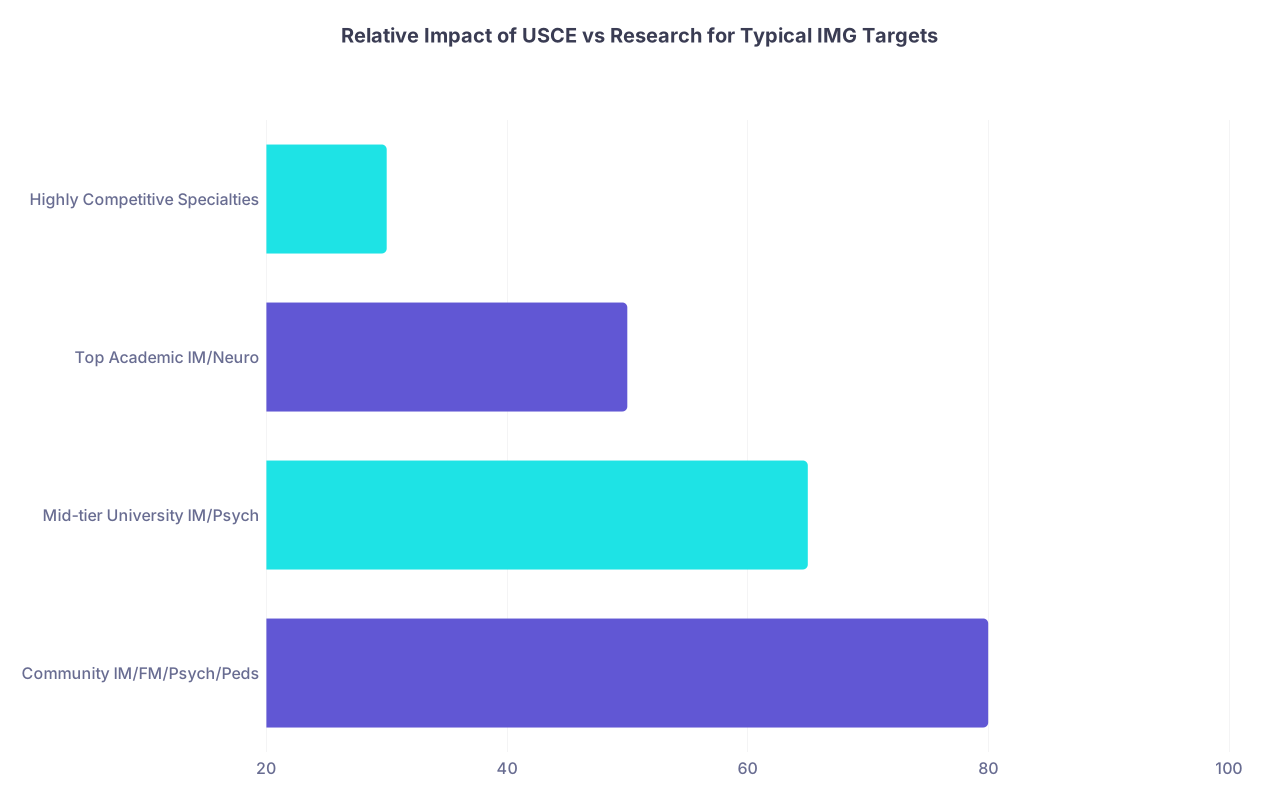
| Category | Value |
|---|---|
| Community IM/FM/Psych/Peds | 80 |
| Mid-tier University IM/Psych | 65 |
| Top Academic IM/Neuro | 50 |
| Highly Competitive Specialties | 30 |
Interpretation: in the first group, clinical exposure has much more practical impact than research. As you climb up the competitiveness ladder, research grows in importance, but it never makes clinical meaningless.
Flip the perspective:
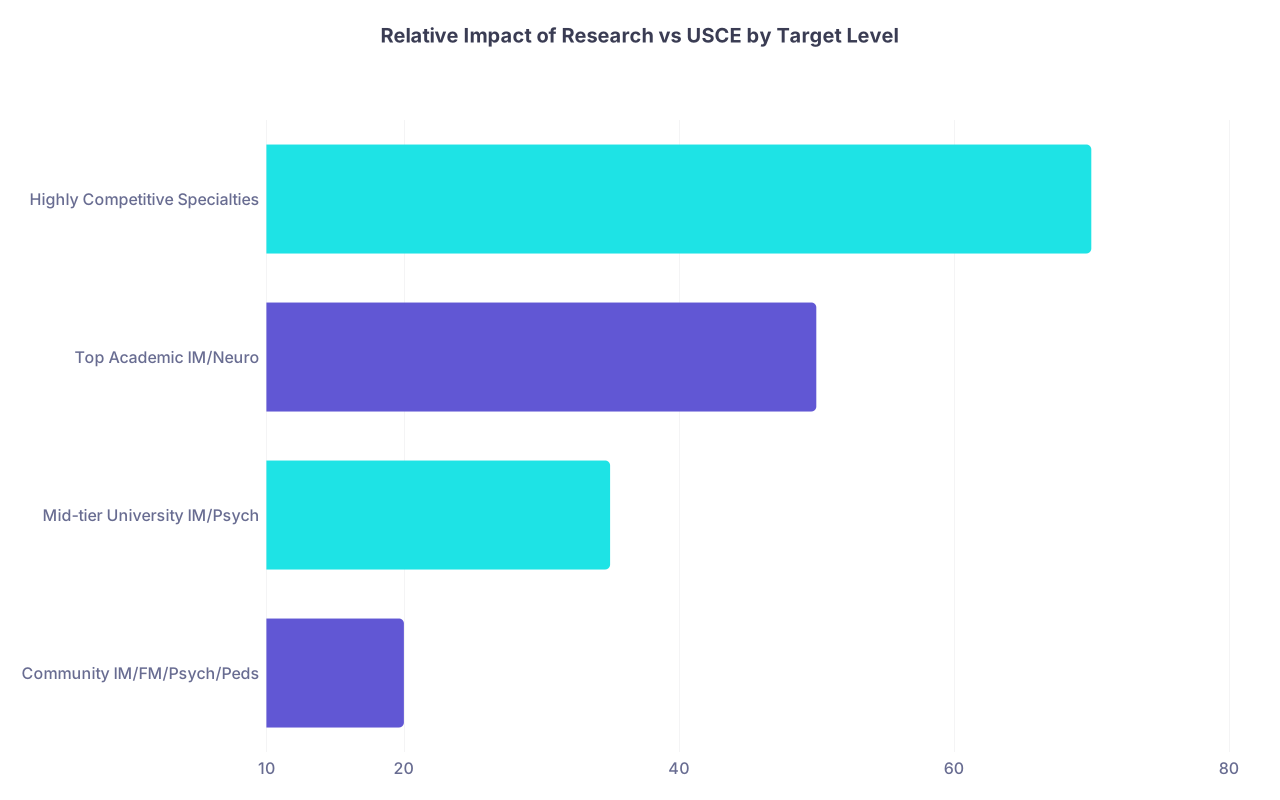
| Category | Value |
|---|---|
| Community IM/FM/Psych/Peds | 20 |
| Mid-tier University IM/Psych | 35 |
| Top Academic IM/Neuro | 50 |
| Highly Competitive Specialties | 70 |
This is the nuance everyone compresses into the lazy slogan: “Research is everything now.” No. It depends who you’re trying to impress.
How To Make “Just” USCE Actually Count
If all you have is US clinical experience, you cannot afford to treat it passively.
You should be doing everything you can to turn that time into high-yield signal:
- Show up early, stay a bit late. Yes, the cliché is true; people notice who’s consistently present.
- Ask to present, even one patient per day. Get your attending to see your clinical reasoning.
- Volunteer for small but useful tasks: pre-round notes (if allowed), follow-up on labs, draft discharge summaries, call families with updates under supervision.
- Ask for feedback mid-rotation: “What can I improve in my presentations?” Then actually fix it.
- At the end, ask directly if they’d feel comfortable writing a strong letter. If the answer is tepid, do another rotation elsewhere.
You can’t magically convert USCE into publications. But you can convert it into:
- Strong, specific US letters
- Mentors who answer PD emails or calls on your behalf
- Interview invites where you rotated
- Concrete stories to use in your personal statement and interviews
That is not “useless.” That’s foundational.
The Bottom Line: Stop Worshiping Research as a One-Size-Fits-All Solution
Let me be very clear.
US clinical experience without research is absolutely not useless. For many IMGs and many specialties, it’s more important than research when it comes to convincing programs you can function as a resident.
Research is a powerful differentiator in competitive, academic-heavy lanes. If your dream is derm at UCSF, then yes—you’re in the research arms race. But that truth does not magically extend to every internal medicine program in the Midwest.
The smartest strategy isn’t “clinical or research.” It’s understanding your target programs’ culture, then allocating your very limited time and money accordingly—often meaning: secure credible USCE first, then add research if your lane and resources justify it.
If someone tells you, “Your USCE is useless unless it comes with publications,” they’re not giving you sophisticated advice. They’re selling fear. Or a paid research spot.
Look at the evidence, look at your goals, and stop letting blanket myths drive multi-year life decisions.