
Away rotations do not guarantee you interviews. For most IMGs, they barely move the needle unless you use them strategically and stop believing the fairy tale you hear on WhatsApp groups and Telegram channels.
Let’s tear this apart properly.
The Myth: “If I Do US Clinical Experience, I’m In”
The dominant narrative in IMG circles goes like this:
“No USCE, no interview. Get US rotations, get interviews. Simple.”
Except it is not.
Look at real data, not anecdotes. The NRMP and ECFMG data over the last several cycles tell a pretty consistent story: matched IMGs usually have some US clinical experience, yes. But the idea that any US rotation converts into interview offers is fantasy.
Programs are not sitting there with a checkbox:
USCE = yes → auto-interview.
USCE = no → auto-reject.
What they actually do is use USCE as one small piece of a much bigger risk calculation:
Can you function in the US system, under pressure, with real patients, in English, without creating disaster on day 1?
That is what they care about. Not whether you bought a four-week “US rotation package” from some third-party vendor.
And this is where most IMGs misread the whole game.
What The Data Actually Shows About US Clinical Experience
Let me be very clear: US clinical experience is correlated with higher match rates for IMGs. But correlation is not a guarantee, and not all USCE is equal.
, USCE 1-2 mo, USCE 3+ mo](https://cdn.residencyadvisor.com/images/articles_svg/chart-match-rate-vs-us-clinical-experience-for-imgs-3836.svg "Match Rate vs US Clinical Experience for IMGs")
| Category | Value |
|---|---|
| No USCE | 25 |
| [Observerships Only](https://residencyadvisor.com/resources/clinical-experience-imgs/do-observerships-count-the-same-as-externships-for-imgs-hard-truths) | 32 |
| USCE 1-2 mo | 45 |
| USCE 3+ mo | 55 |
Those are representative, rounded numbers based on patterns from NRMP/ECFMG trend reports, not some magical official table. The pattern is what matters:
- No USCE? Your match odds are way lower, especially for competitive programs.
- Short or token USCE? Better than nothing, but hardly a golden ticket.
- Sustained, meaningful USCE (especially sub-I / hands-on in your specialty)? Now we’re actually talking signal, not noise.
But even that 55% hypothetical match rate with 3+ months of USCE means 45 out of 100 such IMGs still do not match.
Plenty of candidates do “everything right” by the common IMG checklist—USCE, some research, okay letters—and still get 0–2 interviews. Why? Because the rotation itself is not the product. The output of that rotation is.
Here’s the real hierarchy programs care about from your away rotation:
- Strength and specificity of letters of recommendation
- Evidence you can function in their clinical environment
- Fit with the specialty and communication skills
- Only then: the fact you did a rotation at all
The rotation is a platform. Not a credential.
The Big Misreads IMGs Have About Away Rotations
Misread #1: “Any US Rotation Is Good USCE”
No, it is not.
I see IMGs pay thousands of dollars for the following:
- Four-week “observership” where they shadow a private clinic doctor, no EMR, no team, no teaching
- Hospital “experience” where they are explicitly barred from notes, orders, or even talking to patients directly
- Rotations in specialties they are not applying to, with zero plan to convert that into meaningful letters
Then they slap those on ERAS like they just did a sub-internship at MGH.
Program directors can tell the difference between:
- A structured, supervised, documented clinical role within a hospital team
versus - You standing behind someone with a stethoscope for four weeks
If your “USCE” doesn’t:
- Put you inside the team structure
- Expose you to US documentation and communication standards
- Give an attending enough substance to write a specific letter
…it’s not useless, but it’s weak. And it will not rescue borderline scores or a messy application.
Misread #2: “Rotating at a Program = Guaranteed Interview There”
This is one of the most dangerous myths.
You hear people say:
“If you rotate there, they’ll feel obligated to interview you. They know you.”
No, they do not feel obligated. What they feel is responsible. There is a difference.
I’ve watched this happen repeatedly:
- IMG does 4 weeks at a mid-tier medicine program
- Average performance, quiet on rounds, inconsistent notes, weak initiative
- Attending is polite, says “you did fine”
- Application season comes, same program receives 2,000 applications
- That same attending says in committee, “Honestly, I would not take this person over our other applicants”
And no interview invite goes out.
You are not auditioning for “attention.” You are auditioning for a spot. That means:
- If you’re average on your rotation, you’ve just shown them exactly why they should not invite you.
- If you’re invisible, they forget you the minute you leave.
- If your rotation is in October and they have to finalize interviews by November, you might be too late to influence anything.
Rotations do not bypass the filter. They feed into it. Sometimes negatively.
Misread #3: “One Month is Enough”
This is classic checklist thinking:
“Program wants USCE. I have 4 weeks. Box checked. Next.”
Programs don’t see it that way. One month is barely enough for:
- You to figure out how the EMR works
- The team to remember your name
- An attending to see you in more than 2–3 patient interactions
That’s why many successful IMGs end up with 3–6 months of meaningful US experience—some clinical, some research, some hybrid.
Longer is not automatically better. But sustained exposure gives you time:
- To adjust to communication style
- To actually add value to the team
- To stack strong letters from more than one person
A single, rushed month before apps go out is usually too little, too late.
Misread #4: “USCE Can Hide My Score Problems”
Scores are still king. Not because programs “love numbers,” but because that’s the first blunt tool to slice 4,000 applications down to 400.
If your exam scores are significantly below the typical threshold for your specialty, here is the harsh truth:
- USCE will not reliably compensate for that.
- A good LOR will not reliably compensate for that.
- A “US rotation at a big-name place” definitely will not compensate for that.
You may impress one or two individual attendings who might push for your interview at their program. That’s the best-case scenario.
But if you think: “My Step 2 is 215, but I have 3 months USCE, I’ll be fine,” you’re playing make-believe. You might scrape some community programs. You might also get nothing.
USCE is an amplifier. Not a silencer.
What Away Rotations Actually Do Well (If You Use Them Right)
Let’s stop trashing and talk about how they can help—when used properly and not as a magical token.
1. They Generate Real Letters – Or They Should
The main product of a rotation is not the line on your CV. It is the letter.
Programs read hundreds of letters that sound like:
“Dr. X was a pleasure to have on our service. They were punctual and got along well with the team.”
That’s wallpaper. It says nothing.
The letters that move the needle sound like:
“Compared with our US seniors, this student performed at or above their level…
Did independent pre-rounding, wrote accurate notes in the EMR, and presented succinct plans on rounds…
I would rank this applicant in the top 10% of students I’ve worked with in the last five years.”
You do not get that kind of letter by quietly following the intern and “learning a lot.” You get it by:
- Owning patients (within your allowed role)
- Asking for feedback and applying it visibly
- Making your attending’s work easier, not harder
- Showing up consistently prepared, not just enthusiastic
If your rotation logistics don’t even allow for this kind of impact, you picked the wrong rotation.
2. They Prove You Can Function in the US System
Let’s be blunt: programs are scared of IMGs for a few predictable reasons:
- Language/communication problems
- Cultural disconnect with patients and staff
- Documentation incompetence
- “Nice but slow” – can’t keep up with the pace
A good rotation gives you the chance to directly disprove all of that. Not by telling them. By showing them.
I’ve seen IMGs with decent but not stellar scores win over skeptical PDs because an in-house attending said, “This person worked here for a month. They can handle this place.”
That kind of credibility has more weight than 10 generic observership certificates.
3. They Teach You How To Talk Like a US Resident
This part is underrated.
Rotations expose you to:
- How residents present patients
- How attendings think through risk and documentation
- How consults are requested, how conflict is handled, how nurses are communicated with
That directly affects:
- Your personal statement (do you sound like someone who understands US training realities?)
- Your interviews (can you discuss real patient cases in a US context?)
- Your performance once you match (do you survive internship or drown?)
A lot of IMGs bomb interviews not because they’re stupid but because they sound disconnected from the actual daily culture of US residency. Good rotations fix that—if you pay attention and not just chase signatures.
Not All Rotations Are Created Equal
Here’s where people really get misled: they think “USCE” is one category. Program directors absolutely do not.
| Type of Experience | Typical Signal Strength |
|---|---|
| Shadowing in private clinic | Very low |
| Paid observership (no notes) | Low |
| Inpatient observership w/ team | Moderate |
| Hands-on sub-I / externship | High |
| In-house rotation at target program | Very high |
That “Very high” at the bottom? It still does not mean guaranteed interview. It means:
- If you crush that rotation
- And the PD or key faculty know you by name
- And your scores are within their realistic range
…then you’ve moved from “random IMG #584” to “known quantity.” That’s a massive difference. But still not automatic.
Meanwhile, the “shadowing” and lowest tier observerships? They’re basically confirmation you’ve at least stepped foot in a US facility. That is all.
Strategy Instead of Superstition
Here is the uncomfortable advice IMGs do not like hearing: sometimes you should not spend your limited money on another random away rotation.
Sometimes your $3,000 is better spent on:
- Improving your Step 2 CK score with a dedicated retake (if still possible)
- Funding a longer but fewer number of rotations with real impact
- Extending research with a US mentor who can co-sign your academic seriousness
- Taking extra time to rewrite a weak personal statement and scrub ERAS of red flags
Another four-week “experience” with no guarantee of a strong letter, no connection to your target programs, and no hands-on role is not an investment. It’s a tax on your anxiety.
If you’re serious about using rotations properly, think like this:

| Step | Description |
|---|---|
| Step 1 | Want US Rotation |
| Step 2 | Clarify Specialty Choice |
| Step 3 | Reconsider Site or Save Money |
| Step 4 | Use for Next Cycle Strength |
| Step 5 | Do Rotation and Aim for Top Letter |
| Step 6 | Target Specialty Defined |
| Step 7 | Rotation Offers Strong LOR? |
| Step 8 | Timing Before ERAS? |
Rotations are tools. If they are not clearly connected to a letter, a specialty, a program target, or a timing advantage, you are probably overpaying for a line on your CV that will not fix the structural weaknesses of your application.
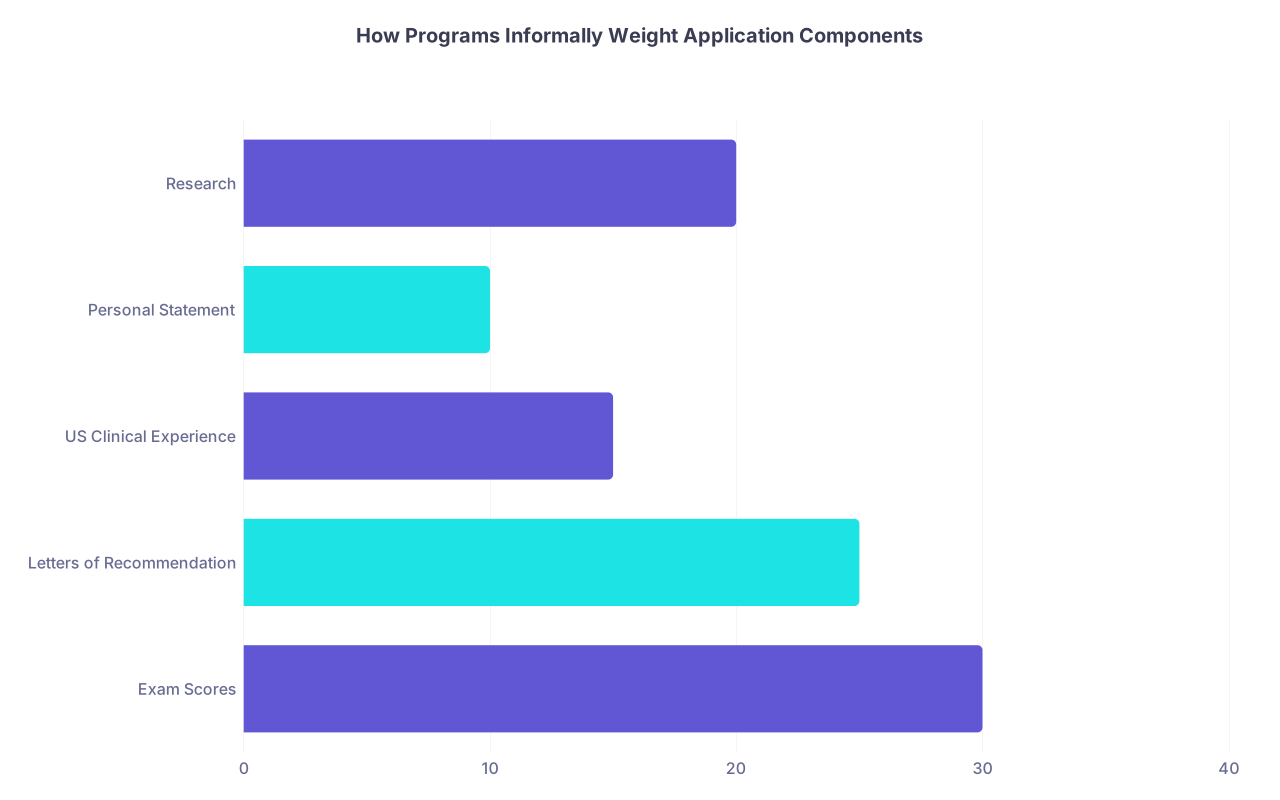
| Category | Value |
|---|---|
| Exam Scores | 30 |
| Letters of Recommendation | 25 |
| US Clinical Experience | 15 |
| Personal Statement | 10 |
| Research | 20 |
Again, these are representative, not official. But if your entire effort is stacked into that 15% bucket (USCE) while your scores and letters are weak, you’re attacking the problem from the wrong side.
What Actually Makes an Away Rotation “Work” For You
Strip away the marketing and emotion. A successful rotation does three concrete things:
- Produces at least one specific, comparative, enthusiastic letter from a US faculty member in your specialty.
- Gives you real, detailed experiences you can reference in your personal statement and interviews.
- Puts you on the radar of at least one program or mentor who can vouch for you beyond “nice student.”
Everything else—certificates, badges, vague “US exposure”—is noise.

If you come home from a rotation with none of the three outcomes above, you did not “fail,” but you also did not significantly boost your probability of interview invites. You probably just stayed neutral.
The Harsh Takeaways IMGs Need To Hear
Let me wrap this up without sugar-coating it.

First: away rotations are useful but overrated. They’re tools, not tickets. Programs do not owe you an interview because you showed up for four weeks.
Second: most IMGs overspend on quantity of USCE and underinvest in quality and positioning. Two high-yield, well-chosen rotations with strong letters will beat six generic observerships almost every time.
Third: rotations amplify what you already are. If your scores, communication skills, and work ethic are strong, a rotation can showcase that and get you a champion. If they’re weak, a rotation may just expose that weakness to the very people deciding your fate.
So the next time someone confidently says “Away rotations guarantee interviews,” you’ll know the truth: they don’t. What gets you interviews is a coherent, evidence-based strategy where USCE is one important piece, not the entire plan.