

You submit your ERAS, hit “certify,” and then… silence. A couple of courtesy rejections. Zero interviews. Or maybe one or two Zoom calls that go nowhere. March rolls around and you refresh the NRMP page until your eyes hurt. “We are sorry, you did not match.”
If that’s you—an IMG who already failed at least one Match cycle—let’s talk about what actually moves the needle on the next attempt: targeted US experience. Not random observerships. Not “more LORs.” Targeted, strategic clinical exposure that fixes the specific reasons you got ignored the first time.
Step 1: Be Brutally Honest About Why You Failed
Before you chase any US experience, you need a post‑mortem. Without this, you’ll waste time and money.
Here’s the uncomfortable reality: most reapplicant IMGs did not fail only because programs “hate IMGs.” They failed because of a predictable combination of things:
| Category | Typical Problem |
|---|---|
| Scores/Exams | Late/low Step 2, failed attempt, old exams |
| Clinical Experience | No solid USCE, only observerships |
| Time Since Grad | >3–5 years with weak recent activity |
| Application Strategy | Too few programs, wrong specialties |
| LORs | Generic, non-US, or outdated |
Ask yourself, and actually write it out:
- Did I have 0–1 hands-on US rotations?
- Were my letters all from home country or short observerships?
- Was I >3 years from graduation with nothing strong or clinical in the recent past?
- Did I have any exam failures or very average scores for IMGs in my specialty?
- How many programs did I apply to, and were they IMG-friendly?
If you answer “yes” to any of those, your next cycle cannot just be “apply again and hope.” Your US experience has to be designed to directly address those gaps.
Your goal for the next year is simple:
- Get recent, relevant US clinical experience in the right setting
- Produce strong, specific US letters
- Show a coherent story for why you’re a better candidate now
Everything else is secondary.
Step 2: Understand What “Useful US Clinical Experience” Actually Means
A lot of IMGs waste thousands on useless “experiences.” Let me be clear:
- Four shadowing weeks where you never write a note? Weak.
- “Tele-rotation” where you sit on Zoom from overseas? Practically worthless for most programs.
- A research-only year with no clinical contact if you already did research before? Marginal benefit.
- Can you function in a US clinic or ward?
- Do you understand US documentation, communication, workflow?
- Did a US physician see you work closely enough to say, “This person will survive our residency”?
That means the most valuable experiences are:
Hands-on USCE (the gold standard)
- Externships
- Sub-internships (if you somehow still qualify)
- Rotations where you interact with patients, help with H&Ps, notes, presentations, etc.
Inpatient or strong outpatient with real responsibility
- Community hospital rotations tied to residency programs
- Busy clinics with EMR use, case discussions, and real teaching
Supervising physicians who actually write detailed LORs
- Ideally faculty or attendings with a known connection to residency programs
- People who see you for at least 4 weeks and let you show growth
Observerships can sometimes help—especially for older grads or those with visa issues—but they need to be:
- Structured
- In the right specialty
- With faculty who are used to IMGs and know how to write LORs
If your last cycle failed and you only had observerships or very weak USCE, this is where your rebuild starts.
Step 3: Pick the Right Specialty and Then Aim Your US Experience
Do not start booking random US rotations until you answer one question:
Am I staying with my original specialty, or pivoting?
If you’re staying with your specialty
Example: You applied to Internal Medicine, got no interviews. Your plan is still IM.
Your US experience should now be:
- At least 2–3 months of US internal medicine in the next 12 months
- At least one inpatient-heavy rotation (wards, step-down, hospitalist service)
- Ideally at:
- Community hospitals with IMG-heavy IM programs
- Hospitals where your attending has sent IMGs into residency before
If you’re sticking with Family Medicine, same logic: clinics, preventive care, continuity, community-based programs. Psychiatry? You need actual psych exposure—outpatient psych clinics, inpatient psych units, consult services.
If you’re pivoting specialties
You applied to, say, General Surgery with one Step failure and no interviews. You’re now switching to IM or FM. In that case:
- Don’t waste time doing more surgery observerships “because you like it.”
- Your new rotations must be in your new target specialty.
- You need fresh, specialty-specific US LORs in IM/FM/psych/etc.
Programs don’t want to see that you used to want surgery. They want evidence that you now belong in their field.
This is where most reapplicants sabotage themselves—they keep chasing the first dream instead of building a winnable plan.
Step 4: Build a One-Year Rebuild Plan Around USCE
You’re an IMG who failed at least one cycle. You probably have limited money, visa constraints, maybe family obligations. So this rebuild has to be tight and realistic.
Here’s how a focused 12‑month plan might look.
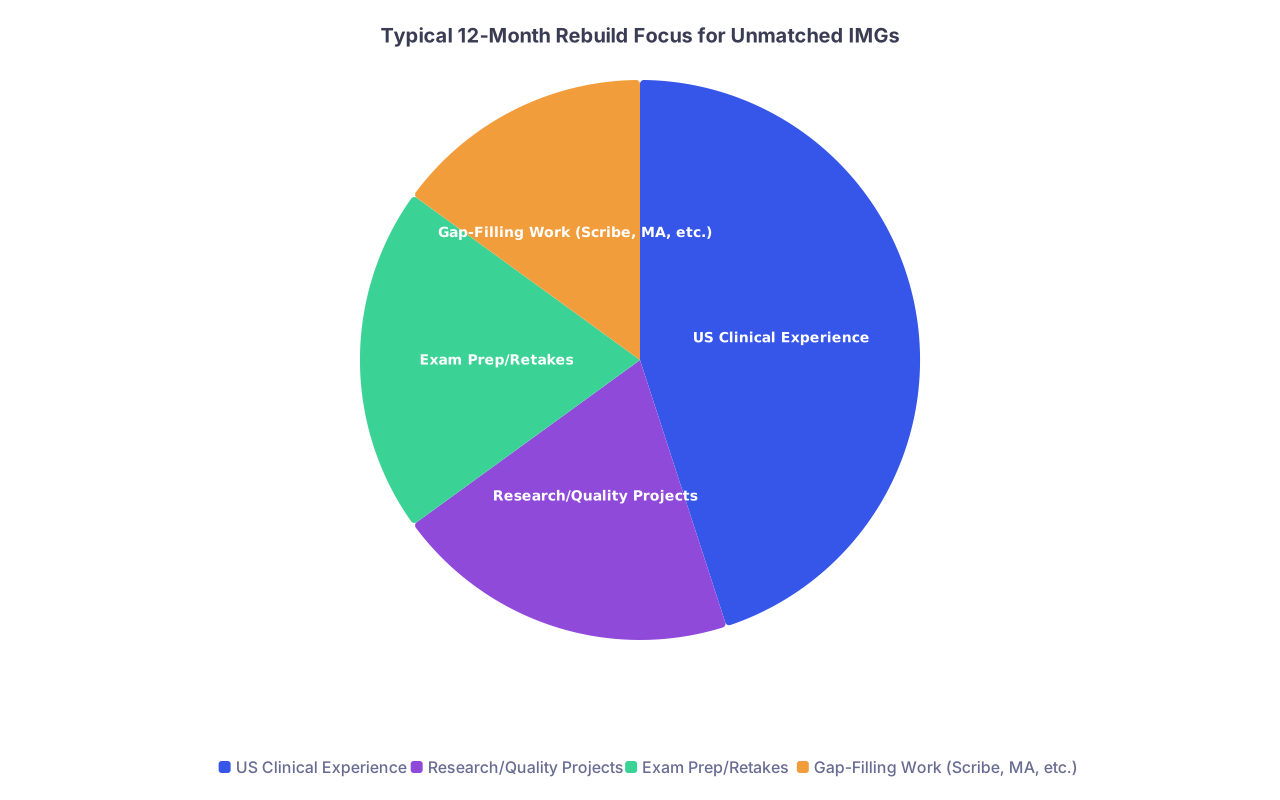
| Category | Value |
|---|---|
| US Clinical Experience | 45 |
| Research/Quality Projects | 20 |
| Exam Prep/Retakes | 20 |
| Gap-Filling Work (Scribe, MA, etc.) | 15 |
Months 1–2: Assessment and Targeting
- Decide on final specialty (no more wavering).
- Map out IMG-friendly programs in that specialty:
- Community hospitals
- States that regularly take IMGs (NY, NJ, MI, IL, TX, FL, etc.)
- Identify:
- Where alumni from your school matched
- Programs that accept your visa category (if needed)
Then, start aggressively applying for rotations:
University-affiliated community programs
Known IMG-rotation companies (some are overpriced; pick carefully)
Direct emails to program coordinators or clinic managers:
“I’m a foreign medical graduate, ECFMG certified, pursuing Internal Medicine. I’m looking for a 4–8 week hands-on rotation where I can actively participate in patient care under supervision: H&P, presentations, notes. I’m especially interested in community hospitals that work closely with IMGs.”
You’ll send dozens of these. Most won’t reply. That’s fine.
Months 3–6: First Block of USCE
Aim for your first 8–12 weeks of targeted USCE here.
On each rotation, your mindset is: “I’m here to earn a letter and a phone call.”
What you do practically:
Show up early, stay a bit late
Ask to:
- Present patients on rounds
- Draft notes (even if they’re never submitted)
- Call consults or present to seniors when allowed
Ask for regular feedback in week 2 and week 3
By week 3, if things are going well, say clearly:
“Dr. Smith, I’m reapplying to Internal Medicine this year after an unsuccessful cycle. Your feedback and mentorship have been really helpful. If you feel you know my work well enough, I’d be grateful if you’d consider writing a strong letter of recommendation for my residency applications.”
You’re not begging. You’re being direct. The “strong” part cues them that a generic “to whom it may concern, he observed…” letter is useless.
If you do 8–12 solid weeks like this, you should walk away with at least 2 strong US clinical LORs.
Months 7–9: Second Block + Add-On Role
If you can, do another 4–8 weeks in the same specialty, ideally in a different setting (ex: first inpatient, second outpatient; or first community, second slightly more academic).
Parallel to this:
- If you’re local, look for paid or semi-clinical roles:
- Medical assistant (if allowed)
- Scribe
- Care coordinator, clinical research coordinator with patient-facing work
- If you’re not in the US and can’t move:
- Double down on remote-friendly research with US collaborators
- Aim for at least one abstract/poster/case report in your specialty
- But do not kid yourself: this is secondary to USCE if you can get USCE
This second block is your chance to show consistency: you didn’t just have one good month; you can function across multiple teams.
Months 10–12: Application Construction + Fresh USCE
For the cycle you’re targeting:
- Make sure you have recent activity up to or near ERAS submission
- If possible, have at least one rotation that ends right before or shortly after September:
- This lets you say in your PS and CV: “recent US experience in 2025…”
- It also makes you more current—programs hate large unexplained gaps
Parallel tasks:
- Rewrite your personal statement to match your new narrative:
- “I went unmatched, here is what I did about it.”
- Show growth and humility without self-pity.
- Fix your CV:
- List rotations with clear descriptions: “hands-on inpatient IM rotation using Epic, daily case presentations.”
- Prepare your interview story around the failed cycle:
- Why you failed
- What you changed
- Why you’re better now
Step 5: Make Your US Experience Actually “Targeted”
Targeting is where you separate yourself from the herd of IMGs who collect random observership certificates like Pokémon.
Here’s what “targeted” actually looks like:
Specialty-aligned
- If you’re applying IM, 80–100% of your new USCE should be IM
- A random cardiology observership at a fancy place might look nice, but an inpatient IM month at an average community hospital is more valuable for the Match
Program-type aligned
- You want community or community-affiliated rotations if that’s where IMGs match most
- If your dream is big-name academic but your profile is average, stop fantasizing and aim where you’re competitive
Geography-aligned
- Some states are consistently more IMG-friendly
- If you rotate in NY, NJ, MI, IL, TX, FL, and list those rotations, programs there recognize their environment
- Rotating in those regions gives you a better chance of saying, “I’ve worked with a similar patient population”
Letter-writer aligned
- Rotations where your attending:
- Has an academic title
- Is core faculty or program leadership
- Or historically helped IMGs land interviews
- I’ve seen a mediocre IMG get IM interviews just because one letter writer knew three program directors personally and emailed them. Happens every year.
- Rotations where your attending:
Step 6: Fixing the Other Red Flags While You Build USCE
US experience alone won’t save you if there are other landmines you ignore.
If you have exam failures
One Step 1 or Step 2 failure is not fatal, but you no longer live in the “I’ll be judged only by my scores” world. You live in the “I must prove I can function clinically” world.
Your strategy:
- Crush Step 2 (if still pending) or shelf exams if in school
- Use your PS + interviewer conversations to:
- Own the failure (“I underestimated… I fixed my approach by…”)
- Connect it to your success in USCE (“My later US clinical rotations show how I apply that discipline on the wards”)
If you’re an older graduate (YOG > 5 years)
This is where recent, intense USCE matters even more.
You must:
- Show continuous clinical engagement in recent years (home country + US)
- Avoid big empty periods on your timeline
- Use USCE to prove your skills are not outdated
A 2015 grad with 2024 US inpatient IM experience + ongoing clinical work looks far better than a 2015 grad who disappeared from clinical work for 3 years.
Step 7: Turn USCE Into Outcomes: LORs, Mentors, and Signals
US clinical experience is not an item on a checklist. It’s leverage.
Here’s how to squeeze value from it:
Strong, detailed LORs
- Ask writers to include:
- Specific stories: “She managed a complex diabetic patient, updated the team proactively, and followed through on all tasks.”
- Direct comparisons: “Among other foreign graduates I’ve worked with, he is in the top 10%.”
- Readiness: “I believe he will be an asset to any Internal Medicine residency.”
- Ask writers to include:
Advocacy beyond the letter
- Some attendings will email or call PDs or APDs they know
- They won’t do this unless they really believe in you—and they won’t really believe in you unless in USCE you worked like a resident
Interview talking points
- Use your experiences to answer clinical and behavioral questions:
- “Tell me about a difficult patient encounter” → pull from your US inpatient month
- “How have you worked with multidisciplinary teams?” → describe your role with US nurses, social workers, PT/OT
- Use your experiences to answer clinical and behavioral questions:
Program signals (ERAS signals where applicable)
- If you rotated in a program’s region or system, signal them
- Mention in your PS or supplemental: “My recent rotation at X community hospital exposed me to [similar patient population/setting]. I’m particularly drawn to programs that share this focus, such as yours.”
Step 8: When USCE Is Hard to Get – Realistic Workarounds
Some of you are reading this from another country with a tight budget, visa issues, or family duties. You might not pull off 6 months in the US. Fair.
Here’s what to prioritize when resources are tight:
At least ONE high-yield US rotation
- Instead of four weak Zoom observerships, save and do one strong 4–8 week in-person hands-on block
- Make that rotation count: show up as if your entire career depends on that letter—because it kind of does
Combine USCE with cheaper local clinical work
- Keep showing clinical continuity in your home country
- Prefer roles with:
- Hospital work
- Teaching or supervision
- QI or protocol implementation projects you can describe
Remote collaboration with US attendings
- Research, QI projects, case reports with a US mentor
- Present at US conferences (even virtually) in your specialty
Again, do not pretend remote work equals in-person USCE. It doesn’t. But it is a decent supplement when in-person time is short.
Step 9: Application Strategy the Second Time Around
You can do all this perfectly and still blow it by applying like it’s your first cycle.
Your second attempt must be more disciplined:
- Apply broadly enough:
- IMGs often need 100+ programs in IM/FM unless they’re truly exceptional
- Focus on IMG-friendly programs:
- Check program websites and recent match lists
- Avoid wasting spots on institutions that took 0 IMGs in 3+ years
- Be honest in your documents:
- Do not hide the previous attempt. Explain it:
- “After an unsuccessful Match cycle in 2024, I reassessed my application. Over the past year I completed X, Y, and Z US clinical experiences and strengthened my skills in…”
- Do not hide the previous attempt. Explain it:
Your message:
“I failed. I learned. Here is the evidence I’m ready now.”
Final Tight Summary
- Failing a cycle as an IMG is common; staying generic is what kills you the second time. Your rebuild has to center on recent, specialty-targeted US clinical experience that produces real, detailed letters.
- Design the next 12 months around 2–3 strong US rotations in your chosen specialty, linked to IMG-friendly programs and attendings who actually see you work like a resident.
- Use that USCE to fix your narrative: own the failed cycle, show concrete growth, and pair your clinical work with a smarter, broader, specialty-appropriate application strategy.


