

What do you do when everyone tells you “You must get US clinical experience,” but your bank account says you get one shot, maybe one month—no more?
That’s the situation. You’re an IMG, you can afford one US rotation (maybe two if you eat rice and lentils for six months), and you keep hearing vague advice like “Just get any USCE” or “Aim for big-name places.” That advice is lazy and sometimes flat-out wrong.
Let’s treat this like what it is: a high-stakes, single-bullet decision. If you only get one US rotation, it has to work as hard as possible for your application.
Here’s how to choose, step by step, without wasting your single shot.
Step 1: Be Brutally Clear About Your Main Objective
You don’t “just need USCE.” That’s too vague. Your one rotation can’t do everything. You must pick the primary job you need it to do for your application.
In real life, a rotation usually does one of these best:
- Get you a strong US letter of recommendation.
- Show commitment and “fit” for a specific specialty/program.
- Rescue or elevate a risky profile (gaps, attempts, low scores, late grad).
- Give you actual skills and confidence before starting residency.
You have to prioritize. If you try to optimize for all four, you’ll pick a bland, middle option and lose the real impact.
Here’s the rough logic:
- If you have no US letters and are applying this year → priority is LOR from someone with real credibility.
- If you’re switching specialties (e.g., you did a lot of psych at home but now want IM) → priority is demonstrating commitment to the new specialty.
- If your profile has damage (old grad, multiple attempts, gap) → priority is a rotation where someone is likely to vouch for you as a person, not just “good student.”
- If you already have decent letters but feel clinically unprepared → priority is a hands-on community setting where they actually let you work.
Decide this first. Write it in one sentence:
“My #1 goal from my one US rotation is __________.”
If you can’t finish that sentence in one clear phrase, you’re not ready to choose a rotation.
Step 2: Choose the Right Type of Hospital for Your Goal
Not all hospitals are equal for an IMG. And no, “big name” is not automatically better.
Let me give you the actual trade-offs I see over and over.
| Hospital Type | Pros | Cons |
|---|---|---|
| Big academic center | Prestige, subspecialty exposure | Limited hands-on, harder for standout LOR |
| University-affiliated community | Decent name + real responsibility | Moderate competition for attention |
| Community teaching hospital | Best for hands-on + strong personal LOR | Less name recognition, weaker research |
| Outpatient private clinic | Lots of US exposure, continuity | Often weak for core residency programs |
If you need a powerful LOR
You want a place where:
- Attendings actually see you work.
- You can follow patients, present, write notes or at least contribute deeply.
- The attending is willing to write detailed letters for IMGs.
That’s usually:
- A community teaching hospital or
- A university-affiliated community program
…not the fanciest Ivy hospital where you’re one of ten observers standing against the wall.
If you want brand name
If you already have US letters and you mainly want to decorate your CV:
- An observership or elective at a strong academic center can help.
- The LOR may be generic, but “Elective, Cardiology – [Good Name University Hospital]” looks nice on your application.
That said, if this is your only USCE, trading letter quality for a name is risky.
Step 3: Core Specialty vs Subspecialty – Don’t Get Cute
You’re applying to internal medicine but considering an ICU, cardiology, or GI rotation because it “looks more impressive.”
Stop. Programs are not that impressed.
If this is your only USCE, your default should be:
- Internal medicine applicants: Inpatient internal medicine (ward) rotation at a hospital with residents.
- Family medicine applicants: Family medicine clinic and/or inpatient family medicine with residents.
- Psych applicants: Inpatient psych or CL-psych with strong faculty involvement.
- Peds applicants: Inpatient pediatrics or general peds clinic with continuity.
Subspecialties (cards, GI, endo, neuro ICU, etc.) are useful if and only if:
- You already have at least one strong core specialty LOR, and
- You’re aiming at academic or subspecialty-oriented programs.
For most IMGs with limited money, your one rotation should be core, not subspecialty. The letter from a general IM attending who really knows you is more valuable than a superficial letter from a big-name specialist who barely spoke to you.
Step 4: Decide On Observership vs Hands-On – And Be Honest About Reality
If you’re already graduated, many “US rotations” will actually be observerships. Shadowing. You stand there. Nod. Maybe present once. That’s it.
If you’re still a medical student, you have a better shot at hands-on electives.
Your priority, if you only get one:
- Prefer hands-on (electives, sub-internships, externships) over pure observerships when possible.
- But a really strong, engaged observership with an attending who writes detailed letters is better than a fake “externship” that’s just standing in the hallway.
Ask concrete questions before you pay anything:
- Will I be able to:
- Present patients?
- Write notes (even if unofficial)?
- See patients alone first?
- How many students/observers per attending usually?
- How many IMGs last year got LORs from this site?
If they “can’t say” or dodge these questions, I don’t care how shiny their brochure is. That’s a bad sign.
Step 5: Target Programs That Actually Take IMGs
Do not burn your only rotation at a hospital whose residency program never ranks IMGs. I’ve seen people do neurology “electives” at places that haven’t matched a single IMG in 5 years. Complete waste from a residency angle.
Check the program’s current and recent residents:
- Go to the residency website.
- Look at current PGY1–3.
- How many are IMGs/foreign grads?
- From where? Are they all US-IMGs (Caribbean) or a mix?
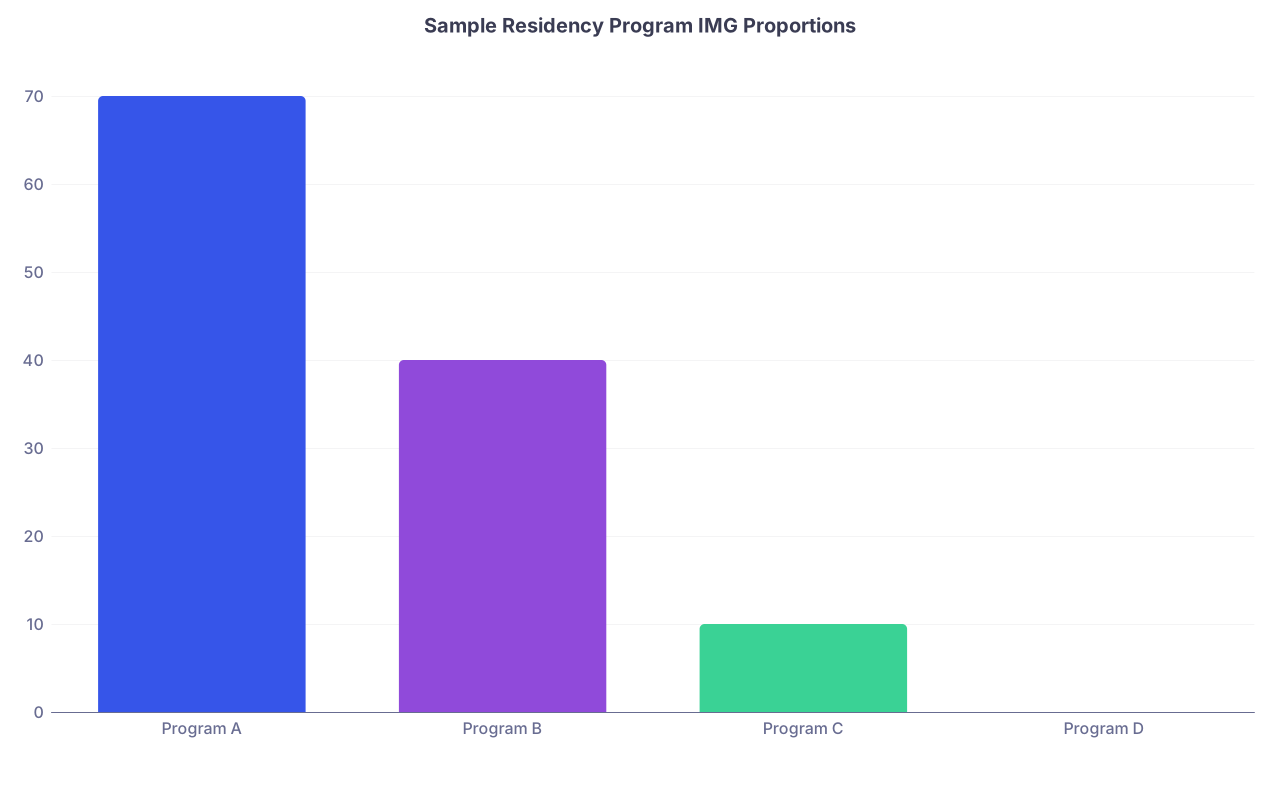
| Category | Value |
|---|---|
| Program A | 70 |
| Program B | 40 |
| Program C | 10 |
| Program D | 0 |
If the breakdown looks like that last bar—0% IMGs—and you’re an IMG… why do a rotation there? You’re not special enough to change their institutional culture.
You want:
- Programs with a visible history of matching IMGs.
- Bonus if they take IMGs from your country or similar schools.
Your ideal situation:
Do your rotation at a hospital that either has its own IMG-friendly residency program in your specialty, or is directly affiliated with one.
Because then:
- Your letter writer might talk to the program director.
- Your name might come up during rank meetings.
- You can say on your personal statement: “My experience at X Hospital, where I worked with residents in your program…”
That level of connection matters.
Step 6: Timing – When During the Application Cycle?
If you only get one month, timing can help or hurt you.
If you’re applying this coming cycle
Best timing:
- July–October of the year you apply.
Why? Because:
- You’re fresh in the attending’s mind when they write your LOR.
- You can include that LOR with your application or add it soon after.
- Some programs remember the students they saw just a few months before rank lists.
Worst-case timing:
- After January of the same application cycle.
By then, most interviews are done. Your rotation may still help future cycles, but not much for the current one.
If you’re applying next year
You have more flexibility. But still:
- Try to do your rotation within 12 months of applying. More recent = more believable.
- If you plan multiple attempts at the Match, doing the rotation earlier might still be useful.
Step 7: Faculty Who Actually Write for IMGs
Here’s a detail most people miss: the personality and habits of your supervising attending matter as much as the hospital name.
You want:
- Someone who:
- Has supervised IMGs before.
- Is known to give detailed letters.
- Is accessible and present on the ward/clinic.
Red flags:
- The coordinator says, “The attending changes every week, and we can’t promise who you’ll get.”
- The attending rounds for 30 minutes, disappears the rest of the day.
- Most teaching is by residents and fellows, and attendings barely interact.
If you can, ask previous IMGs or alumni:
- “Did you actually get a letter?”
- “Was it generic or detailed?”
- “Did the attending know your work specifically?”
If nobody can answer that clearly, assume the LOR pipeline is weak.
Step 8: Avoiding the Scammy Stuff
If you’re paying for a rotation (and many IMGs do, unfortunately), you’re entering a world full of half-truths and marketing.
Common traps:
- “Guaranteed LOR” – usually code for a generic letter from someone who barely knows you.
- “University-affiliated” – might mean the attending has some connection from 10 years ago. Doesn’t mean the residency program cares.
- “Hands-on externship” – at a site where nurses and administrators will not legally allow you to touch a patient.
How to sort real from fake:
- Ask for:
- The name of the hospital and confirm it exists with proper accreditation.
- Confirmation whether it has an ACGME-accredited residency program on-site.
- Clarification: are you in that program’s environment or just in a private clinic across the street?
Then check the residency program’s website yourself. Does it list that hospital as a teaching site? If yes, that’s a good sign. If not, you’re probably paying for a rotation that’s technically “near” a residency program but not functionally connected.
Step 9: Geography – When Location Actually Matters
Where the rotation is geographically can matter strategically.
Good reasons to choose a specific region:
- You have strong personal ties there (family, spouse, visa sponsor) and you can genuinely explain that in your personal statement and interviews. Programs like geographic stability.
- That region is IMG-heavy (e.g., NYC outer boroughs, parts of New Jersey, Michigan, certain parts of Texas). More IMG presence usually means more IMG-friendly systems.
Weak reasons:
- “This state is more competitive, so it must be better.”
No. You’re not doing this for bragging rights. You’re doing it to get interviews and match.
If you absolutely must choose blind, my bias:
- Rotations near IMG-heavy internal medicine or family medicine programs are often more forgiving and more receptive to IMGs building a path.
Step 10: If You Have Specific Weaknesses
Your rotation choice can be used as “evidence against their doubts.”
Old graduate (5+ years since graduation)
You want:
- A rotation where:
- You’re clearly working at near-resident level (presenting, thinking through plans).
- The attending can write: “Despite being a later graduate, they showed excellent up-to-date knowledge and functioned like a first-year resident.”
So choose:
- A busy community teaching hospital where they’ll happily throw you into real work if you’re willing and capable.
Low scores or multiple attempts
Your rotation will not erase the numbers. But it can say:
- “I’ve seen hundreds of IMGs. This one is strong, reliable, and clinically safe despite earlier exam setbacks.”
So again:
- Choose somewhere your clinical work is visible and you’re not just wallpaper.
Gaps in CV
Programs worry about motivation and reliability.
A good attending writing something like “Always early, took extra effort, stayed late, followed up on patients, very dependable” is more powerful than you saying it in your own words.
So pick:
- A rotation where showing up early and doing extra work is noticed, not one where you’re lost in a crowd of 12 students.
Step 11: How to Compare Two Real Options
Let’s pretend you have two offers:
- Option A: Observership at BigName University Hospital in Cardiology. No guaranteed LOR. 4 observers at a time.
- Option B: Hands-on IM inpatient rotation at MidTier Community Teaching Hospital with an IM residency program that has 50–60% IMGs.
You’re an IMG applying IM with no US letters yet.
I would tell you to pick Option B almost every time. Why?
Because a strong letter from Dr. Smith, program faculty at MidTier Community, describing your real clinical performance, beats a generic “they rounded with us” note from BigName.
If options look similar, use this simple ranking formula in your head:
- Strength + specificity of potential LOR
- IMG-friendliness and residency presence
- Amount of actual clinical responsibility
- Name recognition / prestige
- Location convenience
In that order. Most people reverse it and pay for the logo. That’s how they lose.
Step 12: Once You Choose – How to Extract Maximum Value
The rotation choice is half the battle. The other half is how you behave there.
Non-negotiables if you only get one rotation:
- Be on time every single day. Early, actually.
- Volunteer for presentations. Short teaching talks, case summaries, literature reviews.
- Ask for feedback in the second week. Not the last day when it’s too late.
- Make it obvious that you care about patients, not just your CV.
- And near the end, directly and respectfully ask:
- “Dr. X, would you feel comfortable writing me a strong letter of recommendation based on my performance here?”
Not “a letter.” A strong letter. If they hesitate, you know where you stand.

| Step | Description |
|---|---|
| Step 1 | Start - One Rotation Budget |
| Step 2 | Community teaching with IMGs |
| Step 3 | Academic hospital |
| Step 4 | Check IMG % and faculty engagement |
| Step 5 | Reconsider - Look for residency site |
| Step 6 | Shortlist |
| Step 7 | Reject site |
| Step 8 | Pick date aligned with application |
| Step 9 | Main Goal |
| Step 10 | Residency on site? |
| Step 11 | Hands-on or high LOR potential? |
Key Takeaways
- Your one US rotation needs a job description: usually “get me a strong, specific LOR from an IMG-friendly residency environment,” not “look impressive.”
- Prioritize: IMG-friendly program, real clinical involvement, and a faculty member who will actually write for you. Prestige is secondary.
- A modest community teaching hospital where you shine and get a powerful letter will help your Match chances more than a famous logo where nobody remembers your name.


