

The fastest way to kill an IMG application is to let programs doubt your US clinical fit and then do nothing about it.
If you’re an IMG and you’ve heard any of these lines, this is for you:
- “You have strong academics, but we’re not sure about your fit with the US system.”
- “We usually prefer applicants with more recent US clinical experience.”
- “We’re uncertain how your prior training translates here.”
That’s code. It means: You did not show us, clearly and concretely, that you can function as a safe, effective, culturally aware intern in our system on July 1.
You fix that with targeted clinical experience and smarter storytelling. Not with begging, not with “I’ll work hard,” and absolutely not with vague statements about being adaptable.
Let’s walk through exactly what to do if programs are questioning your US fit.
Step 1: Understand What “US Fit” Actually Means (They Won’t Spell It Out For You)
Programs are not worried about your ability to memorize facts. They’re worried about risk.
“US fit” usually means 5 specific things, whether they say it or not:
- Can you function safely in a US hospital on day one?
- Do you understand US-style documentation, workflow, and hierarchy?
- Can you communicate clearly with patients, nurses, and attendings in English, under time pressure?
- Will you adjust to US professionalism and culture without drama?
- Will you blend into the team — or be the intern everyone has to rescue at 3 a.m.?
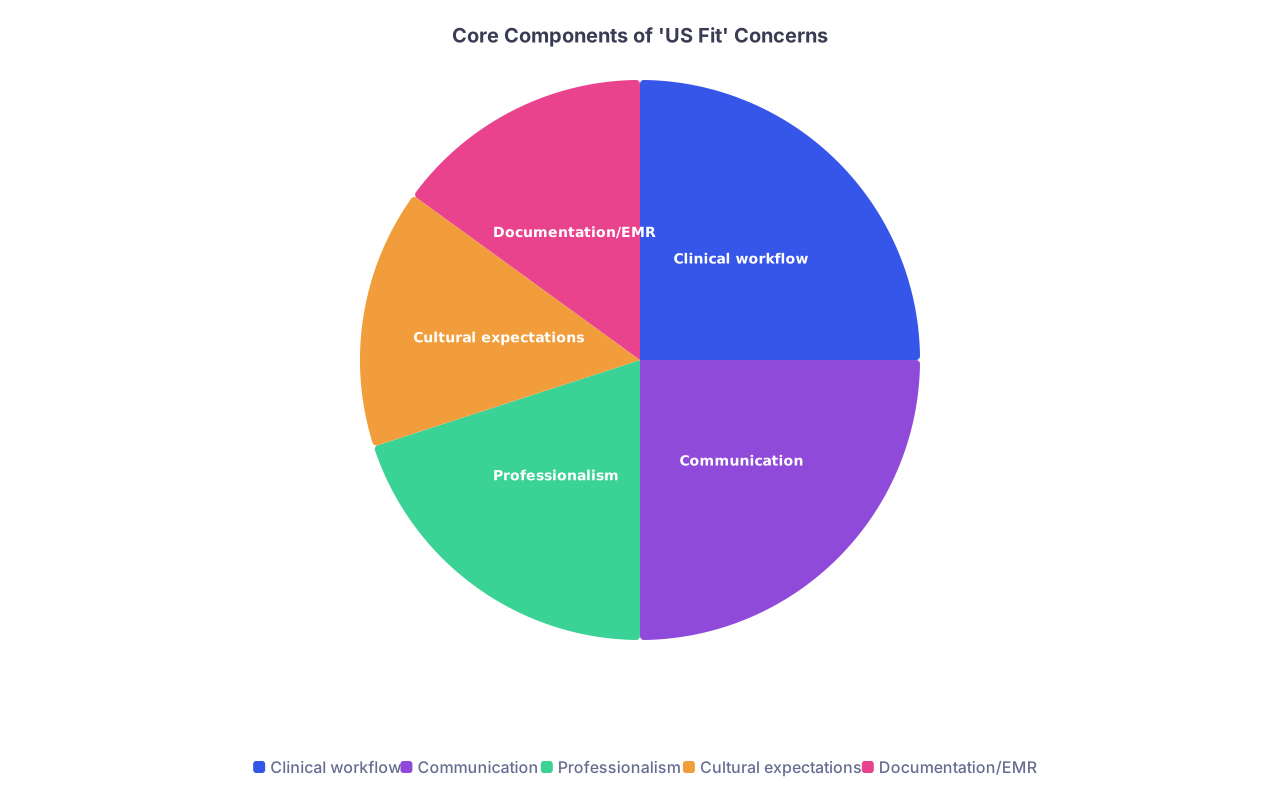
| Category | Value |
|---|---|
| Clinical workflow | 25 |
| Communication | 25 |
| Professionalism | 20 |
| Cultural expectations | 15 |
| Documentation/EMR | 15 |
When an interviewer says, “We’re a little concerned about your lack of US clinical experience,” they are not inviting you to give a motivational speech. They’re asking:
“Can you show me, with concrete examples, that you’ve already operated in our environment and did not sink?”
Your answer needs to come from experience, not theory.
Step 2: Audit Your Current Experience – What Are You Missing?
Before you “reframe the story,” you need to know what story you actually have.
Do this brutally honest self-audit:
Do you have hands-on US clinical experience?
- Not just observerships where you stood in the back.
- Real responsibility (within legal limits): notes, presentations, calling consults, patient counseling, orders (even if cosigned).
Do you have recent US clinical experience?
- Within the last 12–18 months is ideal.
- If your last USCE was 4+ years ago, programs will assume rust.
Do you have evaluations or letters of recommendation from:
- US attendings in your chosen specialty?
- People who explicitly compare you to US grads or current residents?
Can you explain, in detail, how a typical US inpatient day runs?
- Pre-rounds, rounding structure, notes, sign-out, pages, cross-cover.
- If your answer is generic, that’s a red flag.
Be blunt with yourself. If your honest answers are weak, this is not a narrative problem. You have a data problem. You need more and better experience.
Step 3: Get Targeted Clinical Experience That Directly Answers Doubts
If programs are questioning your US fit, you do not need “more experience” in general. You need the right experience.
Here’s the priority list.
| Type of Experience | Priority | Hands-On Level |
|---|---|---|
| US sub-internship/acting intern | Highest | Very high |
| US externship (true, supervised) | High | High |
| Long-term US observership with active role | Medium | Low–Medium |
| US research with clinical exposure | Medium | Low |
| Short, shadow-only observerships | Lowest | Very low |
If you’re already in the “residency match and applications” phase, you’re not starting from zero, but you may need to:
- Add a late-cycle or post-Match US rotation in your target specialty.
- Extend a current observership into something more longitudinal and involved.
- Switch from a meaningless “stand-in-the-corner” observership to a structured externship where you actually participate.
When negotiating or selecting rotations, push for roles where you can:
- Present patients on rounds.
- Write notes (even if they’re “teaching notes” that don’t go in the chart).
- Call consults with supervision.
- Give handoff at the end of the day.
- Participate in sign-out, pre-rounding, and multidisciplinary meetings.
You want to be able to say: “On my US rotation at ___, I pre-rounded on 4–6 patients daily, presented them on team rounds, and wrote structured problem-oriented notes reviewed and co-signed by the attending.”
That sentence hits “US fit” harder than 10 paragraphs about passion.
Step 4: Reframe Your Story Around “Evidence of Functioning Like a US Intern”
Now the part everyone does badly.
If you’ve been told programs question your US fit, stop leading your story with:
- “I come from a humble background…”
- “Medicine has always been my dream…”
- “I will work harder than anyone…”
None of that answers their actual doubt.
You need to explicitly frame your narrative around: “I have already worked in US-style environments in ways that closely resemble an intern’s responsibilities.”
Rewrite your core pitch
Most IMGs’ personal statements and interview answers sound like biography. You need yours to sound like a competence brief.
Before:
“I did an observership at ABC Hospital where I learned about the US healthcare system and saw firsthand the importance of teamwork and communication.”
After:
“During my four-week internal medicine rotation at ABC Hospital, I pre-rounded on 5–7 patients daily, presented new admissions on resident-led rounds, and drafted assessment and plan sections that were reviewed and corrected by my supervising attending. I used Epic to review labs, imaging, and prior notes, and participated in morning handoff and afternoon sign-out.”
One is decoration. The other is proof.
Step 5: Use Specific Experience-Based Language in Applications
Every time you talk about your US experience, you should be answering the unspoken question:
“Can this person function here without chaos?”
Here’s how to translate your experience into the language program directors actually trust.
Instead of saying…
- “I did an observership in internal medicine.”
- “I am familiar with EMR systems.”
- “I have seen multidisciplinary care in the US.”
- “I adapt quickly to new environments.”
Say…
- “On my internal medicine rotation at XYZ Medical Center, I followed a panel of 3–5 patients, pre-rounded daily, and presented updates on rounds using the SOAP format.”
- “I used Epic during that rotation to review labs, enter medication histories, and build problem lists under supervision.”
- “I regularly joined interdisciplinary rounds with case managers, social workers, and physical therapists to help plan discharge and follow-up.”
- “When I first started, my notes were too narrative and less problem-focused; by the end of the month, my attending told me, ‘This looks like an intern’s note now.’”
That last line is gold: an attending quote that directly answers their doubts about fit.
Step 6: Handle the “US Fit” Question Directly in Interviews
Let me be clear: If your file raises US fit concerns, you want this question to come up in the interview. It’s your chance to flip the narrative.
You’ll hear it in different forms:
- “How do you see yourself transitioning into the US system?”
- “You trained abroad — how did you adapt to US clinical environments?”
- “We see you have observerships; can you describe your role in those?”
Here’s a simple framework.

| Step | Description |
|---|---|
| Step 1 | Question about US fit |
| Step 2 | Brief acknowledgment |
| Step 3 | Concrete example from US experience |
| Step 4 | Specific skills that match intern role |
| Step 5 | Feedback or result that validates performance |
Example answer:
Acknowledge:
“That’s a fair concern, especially for IMGs without meaningful US experience.”
Example:
“During my recent four-week sub-internship at City Hospital on the internal medicine service, I essentially functioned in an intern-like role under close supervision.”
Details:
“I pre-rounded on 4–6 patients, presented them on attending rounds, drafted daily notes, and placed orders that were reviewed and co-signed. I also took cross-cover calls for my own patients in the afternoons, discussed them with the senior resident, and updated the notes accordingly.”
Validation:
“At the end of the rotation, my attending commented that I was ‘well-prepared to start as an intern in this system’ and mentioned that my documentation and communication style were similar to US graduates they had recently supervised.”
You’ve just:
- Acknowledged the concern.
- Provided hard evidence.
- Brought in a trusted third-party (attending) judgment.
- Mapped your past performance to the intern role.
That’s how you reframe the story.
Step 7: Use Letters of Recommendation as Weapons, Not Decorations
Your US letters are your loudest voice in the selection meeting when you’re not in the room.
If programs question your US fit, you need letters that do three things:
- Describe your role in concrete terms:
- “He pre-rounded, presented, wrote notes, and fielded nursing calls under supervision.”
- Compare you to a known benchmark:
- “Her performance was comparable to that of our US fourth-year medical students.”
- Or better: “similar to our incoming interns.”
- Mention specific behaviors that matter for US fit:
- Responding to pages.
- Reliability in follow-up.
- Team communication.
- Adaptation to EMR.
Before your attending writes, have a short, direct conversation:
“Programs have sometimes questioned my fit with the US system as an IMG. The most helpful thing for me would be if your letter could describe the specific tasks I did on your service — like pre-rounding, notes, and presentations — and, if possible, how I compared to your US students or interns.”
You’re not scripting them. You’re focusing them.
Step 8: Fix Red Flags that Strengthen “Bad Fit” Narratives
Sometimes “US fit” is just polite language for other concerns that you need to address:
- Large gap since graduation?
- Very limited or no recent clinical practice?
- Very old USCE?
- Prior professionalism issues?
You can’t erase these, but you can build counter-evidence.
If you’re a 2014 graduate with a gap:
- Get recent, continuous US or home-country clinical work.
- A 3-month rotation is not enough. You want longitudinal work in a hospital, even if it’s low-paying or volunteer.
If your only USCE is 5 years old:
- You need fresh exposure. A 4–8 week recent US rotation can dramatically change how your file is perceived.
If you have no hands-on work since exams:
- Start something this month: clinic work, hospitalist assistant, clinical research with patient contact. Even part-time is better than nothing, but be honest about your role.
Your story should sound like: “Yes, I trained abroad and had gaps, but in the last 12–18 months I’ve been steadily working in clinical environments that mirror the way your residents practice.”
Step 9: Show You Understand the US System — Don’t Just Say It
Programs are exhausted by IMGs who say they “understand the US system” but then can’t answer basic workflow questions.
Before interviews, be able to talk concretely about:
- How sign-out works on your US rotations.
- Typical intern tasks on a medicine/surgery/whatever-service.
- How you’ve handled a difficult nurse call or family conversation.
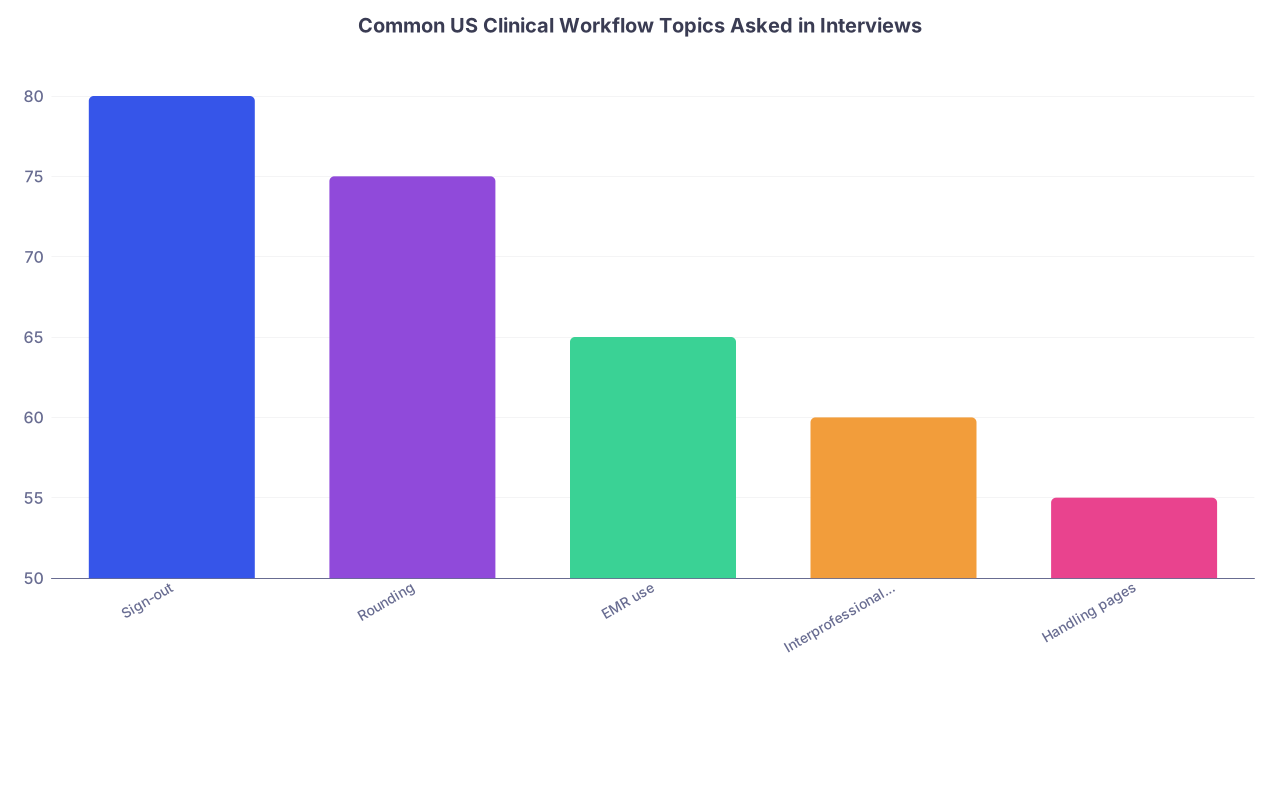
| Category | Value |
|---|---|
| Sign-out | 80 |
| Rounding | 75 |
| EMR use | 65 |
| Interprofessional communication | 60 |
| Handling pages | 55 |
If asked “Tell me about a typical day on your US rotation,” your answer should not be vague.
Bad:
“We rounded in the morning, then saw patients, went to noon conference, and checked labs.”
Better:
“I arrived at 6:30 a.m., pre-rounded on my 5 assigned patients, checked overnight events, vitals, and labs in Epic, and wrote brief pre-round notes. We started resident-led rounds at 8:00 a.m. I presented each patient in SOAP format, we updated the assessment and plan, and then I entered the day’s orders under supervision. In the afternoon, I returned calls from nurses, discussed new issues with the senior, and updated notes when there were significant changes. At 5:00 p.m. we signed out to the night team using a structured handoff in the EMR.”
That tells them you know what the job actually looks like.
Step 10: Adjust How You Present Yourself On Paper
If programs have questioned your US fit before, you should not recycle the same CV, ERAS descriptions, and personal statement.
Rebuild them with one lens: Does this show I can function as a US intern?
In your ERAS experiences, stop writing poetic nonsense. Use this kind of structure:
- “Pre-rounded on 4–6 patients daily and presented on attending rounds.”
- “Drafted H&Ps and daily progress notes under attending supervision.”
- “Used Epic to review labs, imaging, and prior documentation; entered medication histories and problem lists.”
- “Participated in interdisciplinary rounds with nursing, case management, and social work.”
You don’t need to be creative. You need to be clear.
A Quick Reality Check: When Experience Alone Won’t Be Enough
If your scores are weak, your graduation year is old, and your USCE is minimal, you’re in a high-risk category. You can still improve, but you need to be strategic about specialties and programs.

In those cases:
- Maximize community programs where IMGs with strong recent USCE have historically matched.
- Consider transitional year or preliminary year pathways to prove yourself in the system.
- Be open to smaller, less “brand-name” places where your US experience and work ethic will matter more than your school’s reputation.
But the principle stays the same: use targeted experience to rewrite the story programs tell about you.
FAQs
1. I only have observerships, no hands-on externships. Can I still prove US fit?
Yes, but you’ll have to squeeze every drop out of what you did. Emphasize anything that went beyond passive shadowing: presenting patients, writing unofficial notes, participating in sign-out, calling consults with supervision. If your observership was truly just standing behind the attending, consider adding at least one more structured rotation where you have a more active role, even if it’s just for 4–6 weeks.
2. My US clinical experience is all in a different specialty than what I’m applying to. Is that a problem?
It’s not ideal, but it’s workable. You frame it as: “I’ve already learned how the US inpatient/outpatient system functions; now I want to apply that skill set in [target specialty].” Then be very clear about the transferable pieces: using EMR, communicating with nurses, handling pages, presenting on rounds. If possible, line up even a short US experience in your target specialty, even if it’s closer to Match season or after submission.
3. Programs commented on my accent or communication in past interviews. How do I address that?
You do not apologize for having an accent, but you do take ownership of clarity. Get feedback from US-based colleagues on your speed, volume, and medical vocabulary. Practice common patient explanations out loud. In interviews, you can say something like: “Early in my US experience, some patients had trouble understanding me, so I slowed down, checked for understanding more frequently, and asked nurses and attendings for feedback. By the end of the rotation, I was consistently complimented on clear explanations.” Then back it with a letter where an attending praises your communication.
4. I’ve already submitted ERAS. Is it too late to change my narrative about US fit?
You can’t rewrite what’s in ERAS, but you can still reshape the story in:
- Interview answers.
- Update letters to programs.
- Post-submission US experiences you add as new entries. If you start a new US rotation mid-season, send targeted updates to programs: where you are, what you’re doing (specific tasks), and a brief note from the supervising physician if possible. In interviews, reference your ongoing experience with up-to-the-week examples of what you’re doing.
5. What’s one concrete sign that my US experience is actually convincing programs?
Look at the content of your US letters and the feedback you’re getting. If attendings are writing things like “ready to be an intern,” “similar to our US fourth-years,” or “would not hesitate to have them as a resident on our team,” you’re on the right track. Also watch your interview questions: if they stop asking “How will you adapt to the US system?” and start asking more nuanced, specialty-specific questions, it usually means they’re no longer worried about basic US fit.
Open your CV and ERAS experience section right now. For every US clinical entry, ask yourself: “Does this sound like someone who functioned like a US intern, or someone who just watched?” Then rewrite one entry today to make that answer unmistakably clear.


