

It is September. Your Step scores are in. ERAS is open. You are an IMG staring at your application and you know the uncomfortable truth: a lot of programs will barely glance at your file if your US clinical experience (USCE) looks weak, random, or poorly explained.
You might have:
- One observership from three years ago
- A couple of short electives you crammed in during final year
- A “tele-rotation” you are not even sure counts
- Or nothing at all yet, just plans
And you are wondering: “Now what? I cannot change my scores. But can I still move the needle with US clinical experience?”
Yes. You can. But you need to be strategic, not desperate.
This is the playbook.
Step 1: Understand What USCE Actually Buys You
Let me be blunt. For IMGs, USCE is not a “nice to have.” For many programs, it is an unofficial filter.
Here is what solid USCE does for you:
Checks the “can function in the US system” box
Programs want proof you can:
- Write notes in English that do not need rewriting from scratch
- Understand orders, pages, EMR workflows
- Communicate with nurses and patients clearly
- Show up on time, not disappear when rounds end
Generates powerful letters of recommendation (LoRs)
Not the generic “hard-working, pleasant” nonsense. The kind of letter that says:
- “I would rank this applicant in the top 10% of students I have worked with in the past 5 years.”
- “We would be pleased to have them as a resident in our program.”
Signals genuine interest in the specialty and the US system
If you say you love internal medicine but your only USCE is dermatology and ophthalmology, it looks inconsistent. Programs notice this. They talk about it openly in meetings.
Offsets some weaknesses
No, USCE will not erase a 205 on Step 2. But I have seen:
- Applicants with mediocre scores match solid community programs because they had:
- 3–4 months of relevant USCE
- 3 strong US LoRs from attendings known to PDs
- Clear, specialty-focused experience
Programs will take a “risk” on someone who has proven they can work in their system.
- Applicants with mediocre scores match solid community programs because they had:
Step 2: Know Which Type of USCE You Actually Need
Not all USCE is equal. You are not buying a certificate. You are buying credibility and evidence.
Here is the hierarchy.
| Type of Experience | Strength for IMGs | Typical Duration |
|---|---|---|
| US core/clerkship rotations | Very strong | 4–12 weeks |
| US sub-internships/acting intern | Very strong | 4 weeks |
| Hands-on externships (bedside) | Strong | 4–12 weeks |
| Structured observerships | Moderate | 2–8 weeks |
| Shadowing / tele-rotations | Weak | Variable |
Best: Core rotations, sub-Is, true hands-on externships
These are the gold standard, especially if:
- You see patients
- Write notes
- Present on rounds
- Get direct evaluation and feedback
If you are still in medical school and can secure US core rotations or electives: do it. If you are a graduate, target structured externships that are:
- In a hospital (not just a private clinic)
- Affiliated with a residency program if possible
- Clear that you will be doing:
- H&Ps
- Notes
- Presentations
Middle: Structured observerships
Observerships are not useless. But they are often:
- Short
- Variable in quality
- Passive
They help if:
- You have no other USCE
- They are in your target specialty
- The attending is actively involved and willing to write a detailed letter
Weak: Random shadowing, tele-rotations, “certificate mills”
These are the ones that look like:
- 2-week “tele-rotation” with 25 students on one Zoom call
- “Shadow at private clinic, no EMR, no residency affiliation”
- Fancy websites, lots of marketing, no real educational structure
Can you list them? Yes. Do they move the needle much? Rarely.
Use these only:
- As a bridge until you get better USCE
- If they provide something real: case discussions, QI projects, direct interaction, actual evaluation
Step 3: Match Your USCE to Your Target Specialty
Here is where most IMGs make sloppy mistakes. They accumulate random experiences, then wonder why the story does not land.
If you want internal medicine, you need most of your USCE in:
- Inpatient internal medicine
- Outpatient internal medicine or primary care
- Subspecialties that still “feel” like IM: cardiology, GI, pulm, ID
If you want psychiatry, then:
- USCE in psych (inpatient / outpatient / addiction)
- Maybe some internal medicine or neurology to show you can manage comorbidities
If you want surgery:
- Surgery, surgical subspecialties, ICU
- Not just “I observed surgery from the back of the OR”
You want your application to look like:
“This person has consistently worked in environments very similar to ours, in the same specialty, with documented performance.”
Not:
“This person did one psych observership, one peds clinic, one dermatology tele-rotation, and now is applying for internal medicine.”
Here is a simple filter:
If a PD glances at your experiences for 15 seconds, will they instantly see:
- Specialty alignment
- Progressive responsibility
- US-focused experience
If not, you have work to do.
Step 4: Fix the “Too Late” Problem (If You Are Applying Now)
You might be in one of these scenarios:
- Scenario A: ERAS this year, 0–1 month of USCE so far
- Scenario B: ERAS this year, some USCE but not in your chosen specialty
- Scenario C: ERAS next year, time to plan
Let us handle them one by one.
Scenario A: Applying this cycle with minimal USCE
You cannot travel back in time. But you can still act.
Book USCE immediately – even if after ERAS submission
Programs often review applications over weeks to months. If you:
- Start an IM externship in October
- Get a strong letter by November
- Update programs with a new LoR and an experience update
You can still influence rank decisions, especially for:
- Community programs
- Programs that review later
- Those that invite in waves
Prioritize quality over number
You are better off with:
- 4–8 weeks of solid, relevant USCE
- One or two strong letters
Than with:
- Five short, disconnected, superficial experiences
Be explicit in your personal statement and ERAS entries
Spell out:
- “I am currently completing a 4-week inpatient internal medicine rotation at [Hospital, City].”
- “This experience has given me exposure to multidisciplinary rounding, EMR-based order entry under supervision, and independent patient presentations.”
Do not assume they will connect the dots.
Scenario B: USCE exists but is misaligned
Example: You are applying to internal medicine but your USCE is:
- 2 months pediatrics
- 1 month OB/GYN
- 1 dermatology observership
You fix this by:
Adding at least one solid rotation in your target specialty
Even 4 weeks of inpatient IM directly before or during application season makes a difference. It gives you:
- At least one specialty-aligned LoR
- Something recent and relevant to discuss in interviews
Reframing prior experiences in your favor
In your description and PS, emphasize:
- Skills that cross specialties:
- Communication
- Complex decision making
- Working with multidisciplinary teams
- How those experiences confirmed your interest in your final specialty
- Skills that cross specialties:
Getting at least one letter from your target field
Programs want to see:
- “At least one LoR from the specialty they are applying to”
- Preferably from a US faculty member
If you cannot get 3 letters in your specialty, you aim for:
- 2 in specialty, 1 from a related field
- Or 1 strong specialty letter + 2 from fields where you worked closely with that specialty (e.g., cardiology for IM)
Step 5: Choose Rotations and Sites Strategically (Not Emotionally)
Many IMGs pick USCE based on:
- Cheapest option
- Friend-of-a-friend clinic
- City they want to live in
This is how you end up with weak, non-impactful experiences.
You need a basic scoring system in your head. Something like:
| Criterion | High-Value Features |
|---|---|
| Setting | Teaching hospital, residency program present |
| Type of experience | Hands-on, notes, presentations, team involvement |
| Specialty alignment | Same as your target specialty |
| Letter potential | Direct work with attending, formal evaluation |
| Documentation | Official evaluation or certificate |
If a site scores high on 3 or more of these, it is probably worth your time and money.
Red flags:
- “Guaranteed interview” or “we get you matched” marketing
- No clear description of your role
- No mention of residents or structured teaching
- The entire “program” appears to be one private office
If you are paying thousands of dollars for an observership where you are never allowed to speak, write, or present, you are burning money.
Step 6: Turn Each Rotation Into Maximum Evidence
Merely showing up is not enough. You need to leave every rotation with:
- A strong impression
- Specific stories and examples
- A detailed letter
Here is a simple protocol I have seen work repeatedly.
Before the rotation
Email the attending 3–5 days before starting
A short message:
- Thank them for the opportunity
- Briefly state your goals:
- “My primary goal is to learn inpatient internal medicine workflows in the US and to develop my ability to present and write notes at an intern level.”
- Mention your interest in residency in that specialty
Review the basics
If you are starting IM:
- Read up on common inpatient topics: pneumonia, heart failure, DKA, sepsis
- Review US-style SOAP and H&P notes
- Brush up on common US abbreviations and lab units
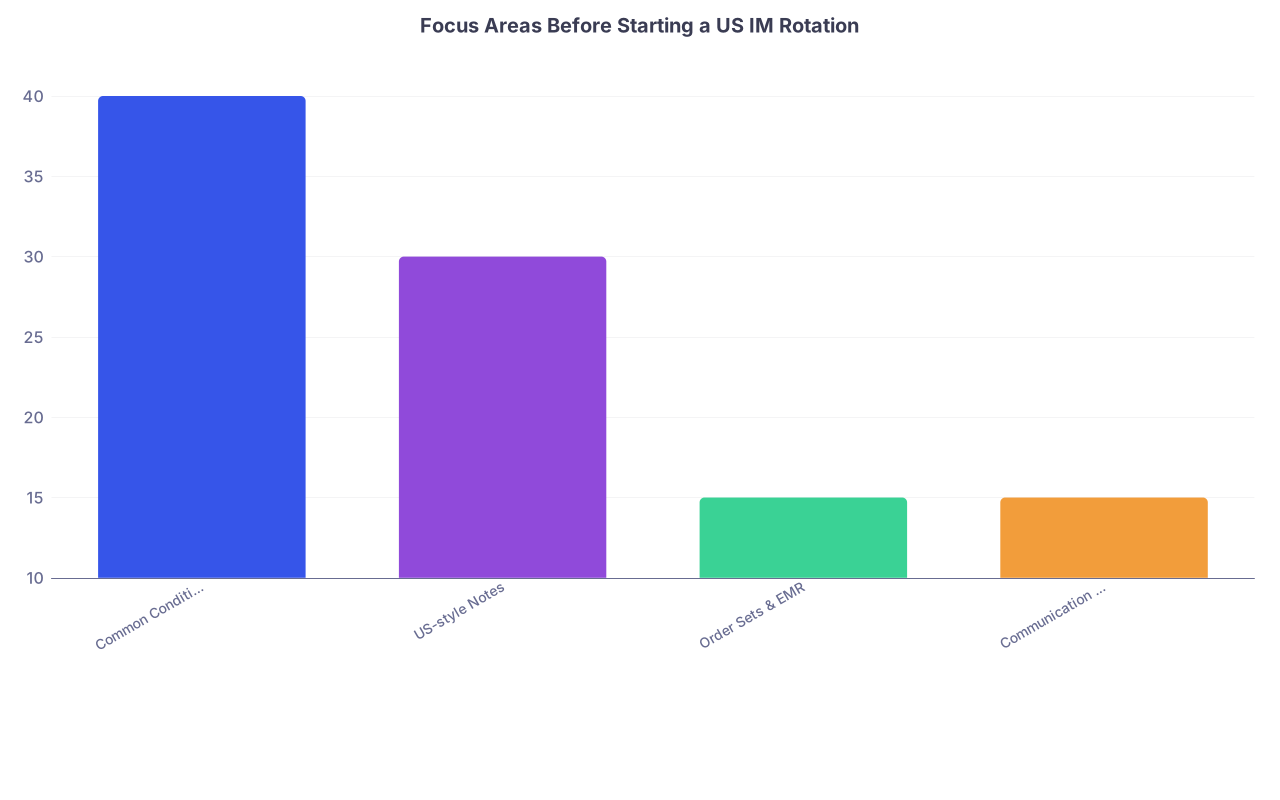
| Category | Value |
|---|---|
| Common Conditions | 40 |
| US-style Notes | 30 |
| Order Sets & EMR | 15 |
| Communication Phrases | 15 |
During the rotation
Your daily job is to demonstrate you can function as a safe, reliable junior team member.
Focus on:
Punctuality
Be early. Not on time. Early.Ownership of patients
If possible:- “These 3 patients are my responsibility.”
- You know their labs, imaging, overnight events, and plan cold.
Efficient presentations
Practice:- 2–3 minute focused updates
- Clear assessment and plan:
- “For Mr. X, 65-year-old male with CHF exacerbation, today he is clinically improved, off oxygen, net negative 1.2L. I think we can transition to oral diuretics and start discussing discharge planning.”
Ask for feedback early
At the end of week 1:
- “Doctor, I want to be sure I am improving. Could you give me one or two things I should focus on for next week to be more helpful to the team?”
You are signaling:
- You are coachable
- You care about performance, not just a certificate
End of the rotation: secure a strong letter
Do not just “hope” for a good LoR.
End of week 3 (for a 4-week rotation):
Ask directly and respectfully:
“Dr. Smith, I have really valued working with you this month and I am applying to internal medicine residency this cycle. Would you feel comfortable writing a strong letter of recommendation for me?”
That word matters. “Strong.” If they hesitate, you know it might be lukewarm and you can decide accordingly.
Offer:
- CV
- Personal statement draft
- List of cases you were involved with
- Your ERAS AAMC ID
Step 7: Present Your USCE Properly in ERAS
I have seen too many IMGs bury good experience under terrible ERAS descriptions.
You need to translate your work into US-resonant language.
For each USCE entry, avoid vague filler like:
- “I observed various procedures and gained valuable experience.”
- “I learned a lot about patient care in the US system.”
Instead, use concrete, active descriptions:
Bad:
“Internal Medicine Observership, 4 weeks. I observed patient care, presented some patients, and learned about the US healthcare system.”
Better:
“4-week inpatient internal medicine rotation on a resident-run teaching service at [Hospital]. Followed 4–6 patients daily, obtained histories and physicals, wrote draft progress notes, and presented on rounds. Participated in multidisciplinary rounds with nursing, case management, social work, and pharmacy. Attended daily noon conferences and morning reports.”
Use numbers:
- “Followed 4–6 patients”
- “Attended 3–4 clinics per week”
- “Assisted with 10+ new patient evaluations”
Make it easy for programs to see what you actually did.
Step 8: Connect USCE Directly to Your Personal Statement and Interviews
If your USCE is just a list on your CV, you are underusing it.
You should be:
Referencing specific cases in your personal statement:
- “During my internal medicine rotation at [Hospital], I followed a patient with decompensated cirrhosis whose care highlighted the value of multidisciplinary collaboration.”
Showing what you learned about yourself as a future resident:
- “This rotation confirmed that I thrive in busy inpatient settings where careful organization and communication are essential.”
In interviews, using USCE to answer:
“Why this specialty?”
→ Pull a concrete case from your rotation.“Why residency in the US?”
→ Talk about how the US structure, feedback culture, or multidisciplinary approach fits your working style.“How have you prepared for residency here?”
→ Point to EMR experience, working with residents, adapting to US communication norms.
You are basically saying:
“I have already been doing a version of your job, just as a student/observer. Here is proof.”
Step 9: Fill US Gaps with Smart Non-US Experience (If Needed)
Some of you will still have limited USCE no matter what you do this year. Visa issues. Money. Timing. It happens.
You can still improve your application if you stop listing your non-US experience lazily.
If you have:
- Strong internal medicine training in your home country
- Hands-on work as a junior doctor
- Quality improvement or teaching experience
Frame it in a way that is intelligible to US programs:
“Worked as a junior resident equivalent in internal medicine at a 500-bed tertiary hospital seeing 15–20 patients per day in the outpatient clinic and covering 10–15 inpatients on call.”
“Participated in weekly morbidity and mortality conferences and helped implement a protocol reducing door-to-antibiotic time in sepsis by 20%.”
Then connect that to why you are safe and ready to function in a US program once oriented.
Do not pretend it is USCE. It is not. But do not undersell it, either.
Step 10: Build a 6–12 Month Plan If You Are Applying Next Year
If you are not in this ERAS cycle, you have a real opportunity. Stop thinking in one-month chunks. Think in a full-year arc.
A realistic, high-yield plan for an IMG targeting IM or psych might look like this:
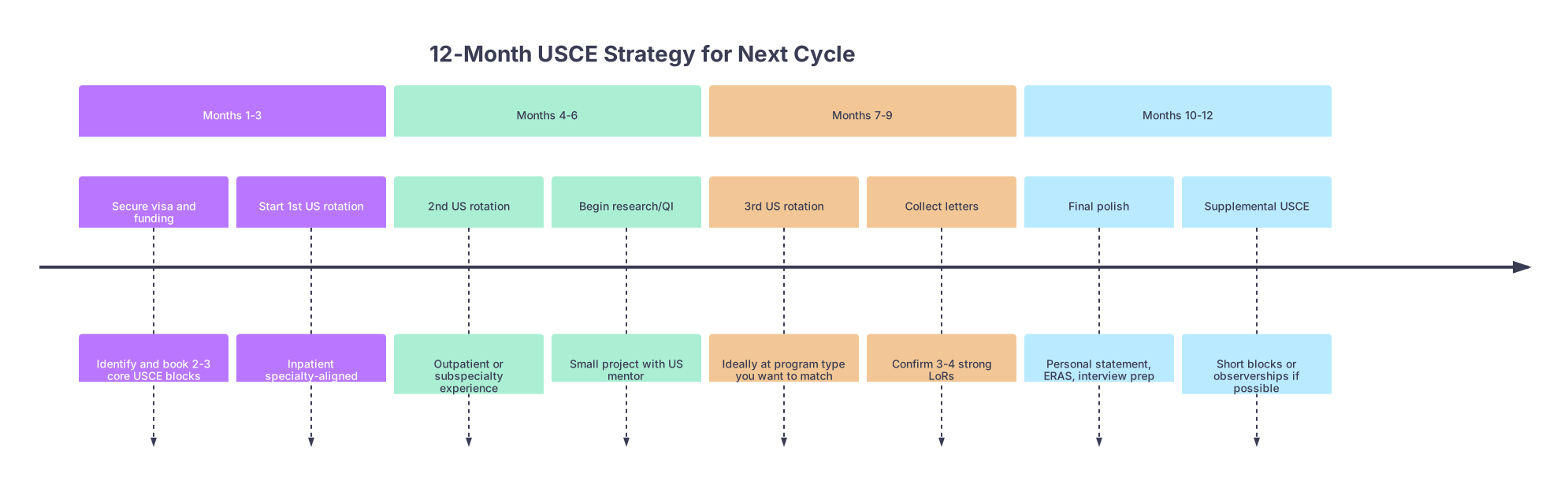
| Period | Event |
|---|---|
| Months 1-3 - Secure visa and funding | Identify and book 2-3 core USCE blocks |
| Months 1-3 - Start 1st US rotation | Inpatient specialty-aligned |
| Months 4-6 - 2nd US rotation | Outpatient or subspecialty experience |
| Months 4-6 - Begin research/QI | Small project with US mentor |
| Months 7-9 - 3rd US rotation | Ideally at program type you want to match |
| Months 7-9 - Collect letters | Confirm 3-4 strong LoRs |
| Months 10-12 - Final polish | Personal statement, ERAS, interview prep |
| Months 10-12 - Supplemental USCE | Short blocks or observerships if possible |
Rough structure:
2–3 months of USCE in your specialty
At least one inpatient, one outpatient if possible.1–2 letters from US faculty in your specialty
Plus 1–2 additional letters from either US or strong home-country supervisors.1 small US-based project
Does not have to be a major publication:- Case report
- QI project
- Poster at a local or national meeting
Continuous clinical activity
Try not to have long unexplained gaps with no clinical contact. If you return to your home country:- Work in a relevant clinical role
- Keep up-to-date clinically
By next ERAS, your application should read like:
“IMG with continuous clinical work, 3+ months of aligned USCE, multiple US LoRs, and clear evidence of functioning well in US clinical systems.”
That applicant gets real attention, even with mid-range scores.
Bottom Line: USCE Is Your Leverage Point – Use It Intentionally
You cannot change your Step scores now. But you can absolutely change:
- How convincingly you look “ready for US residency”
- How believable your specialty choice appears
- How strongly attendings will fight for you in their letters
If you treat US clinical experience as a box to tick, you will get box-tick results.
If you treat it as:
- Your audition
- Your live demonstration
- Your main argument that “I can already do this job”
Then it becomes the most powerful part of your application as an IMG.
Do This Today
Open a blank document and create three headings:
- USCE I already have
- USCE I can realistically add in the next 6–12 months
- Specific attendings who could write strong letters
Under each, list names, dates, locations, and specialties.
Then circle the weakest area and send one email today – either to:
- Book a targeted US rotation
- Confirm a letter from a past supervisor
- Or ask a current mentor for help finding a higher-yield USCE opportunity
Do not just hope your existing experience is “enough.” Fix the gaps while you still can.


