You are in your home country. Your friends are flying to the US for observerships and electives. You are staring at flight prices, visa delays, maybe a bank account that laughs at you. ERAS deadlines are approaching, and your CV has zero US clinical experience.
You keep seeing this line in program requirements: “US clinical experience required or strongly preferred.”
You are stuck abroad. They want USCE. And it feels like checkmate.
It is not.
Let me be blunt: being overseas does make things harder. But you can still build US-style clinical experience that programs respect, understand, and actually value. You just cannot be passive. You need a plan, structure, documentation, and you need to engineer your experiences instead of waiting for an airline ticket or a visa stamp to fix your application.
Below is that plan.
1. Understand What Programs Actually Mean by “US Clinical Experience”
Before we fix the problem, define it properly. A lot of IMGs misunderstand this and waste time.
When programs say “US clinical experience” (USCE), they usually mean:
- Work that:
- Is patient-facing or clinically integrated.
- Uses US-style:
- Documentation (SOAP, problem lists, A/P)
- Workflow (rounds, sign-out, multidisciplinary care)
- Standards (ACGME competencies, EBM practice)
- Is supervised by:
- A US-licensed attending or
- Someone very familiar with US training systems.
Typical forms of “classic” USCE:
- Observerships and externships in US hospitals
- US electives (for students)
- US-based research with clinical exposure
- Telehealth with US teams / US systems
You are abroad, so you probably cannot get the classic stuff in person. But what programs actually care about is:
- Do you understand US clinical culture and workflow?
- Can you function in a team with residents, attendings, nurses, case managers?
- Do you know US documentation style, safety culture, communication style?
- Can someone US-based write a detailed, credible letter vouching for that?
So the game is not “physically stand in a US hospital.” The game is “build and prove US-style clinical functioning and thinking, with verifiable supervision and output.”
That you can do from overseas.
2. The Core Strategy: Rebuild “US-Style” Into Everything You Do
You will build a portfolio with three pillars:
- Tele-clinical work with US teams or US patients
- US-style documentation, case work, and QI / EBM projects
- Strong, specific letters of recommendation from US-affiliated mentors
Your target is to be able to say, on your ERAS and in interviews:
“While I was abroad, I worked on a structured tele-clinical program with Dr. X (US board-certified in Y) where I did A, B, and C, documented cases in SOAP format, and participated in weekly case conferences modeled after US residency conferences. I also completed a QI project aligned with ACGME competencies.”
That sounds like USCE. Because it is US-style clinical experience, even if remote.
Let me outline concrete builds.
3. Build Real Tele-Clinical Experience That Programs Respect
3.1 Where to Find or Create Tele-Clinical Roles
You have three main routes:
- Formal remote/tele-rotation programs
- US-affiliated hospitals/NGOs operating in your country
- Build your own structured tele-clinical role with a US mentor
3.1.1 Formal remote or tele-rotation programs
Some organizations and universities now run remote clinical observerships or “virtual clerkships.” Many are weak, tick-box offerings. Some are useful.
You want programs that:
- Are led by US board-certified physicians
- Have:
- Case discussions
- EMR-style documentation practice
- Regular feedback
- Give:
- A certificate
- A structured letter of completion
- Potential for an individualized LOR
Red flags:
- Purely pre-recorded lectures, minimal interaction
- No real patient cases or EMR simulation
- No identifiable supervising physicians
- Promise “guaranteed residency” or sound like a visa mill
Good use case: You join one serious 4–8 week tele-rotation and squeeze every drop out of it:
- Be the person who always volunteers cases
- Ask for feedback on your notes
- Request a one-on-one at the end to discuss performance and LOR
You are not buying prestige. You are buying structured access to US clinicians and workflow.
3.1.2 US-affiliated care organizations near you
Look for:
- US university global health projects in your country
- NGOs with US physicians rotating through (e.g., Partners In Health-like groups)
- Telemedicine startups that:
- Serve US patients
- Or are US-led
You can search:
- “[Your country] + ‘global health partnership’ + MD”
- “Telemedicine [your specialty] US-based hiring abroad”
- “International clinic US medical director [your city]”
Your pitch to them:
“I am a physician/medical graduate here, interested in structured clinical and quality improvement work under your supervision. I want to help with X (triage protocols, data collection, patient education, clinical documentation) in exchange for close mentorship and the opportunity to learn US standards of care.”
You are not asking for a job. You are offering help plus structure.
3.1.3 Build your own remote role with a US mentor
This is where many IMGs give up. Which is why you will stand out if you do not.
Find US physicians who have:
- International background or interest
- Active involvement in:
- Telemedicine
- Research with clinical overlap
- Education (faculty at academic centers)
Sources:
- Alumni from your med school who matched in the US
- Social media (Twitter/X, LinkedIn) where attendings post #MedEd content
- Conference speakers from virtual events you attend
- Faculty list for US global health or telehealth programs
Then you cold email. Not spam. Two or three carefully targeted messages:
Subject: IMG abroad – interested in structured remote clinical/QI role under your supervision
Body (keep it tight):
- Who you are:
- “I am a 2022 graduate from [School], currently in [Country], pursuing [specialty] with USMLE Step X: Y.”
- What you want:
- “I am looking for a 3–6 month structured remote role in which I can assist with [clinical triage, documentation review, patient education calls, data collection, QI projects], while learning and practicing US-style documentation and workflows under your supervision.”
- What you offer:
- Time availability (hours/week)
- Skills (languages, prior experience, research, coding, etc.)
- Why them specifically:
- One sentence proving you actually know who they are
- Concrete ask:
- “Would you be open to a brief 15-minute call to see if there is a way I could contribute to your work in a structured, supervised way that would also add US-style clinical experience to my development?”
Most will not reply. Some will. You only need one serious mentor.
3.2 What Your Tele-Clinical Work Should Actually Look Like
To feel like USCE, your role should include as many of these as possible:
- Reviewing de-identified patient cases
- Drafting:
- H&P
- Progress notes
- Assessment and plan
- Practicing:
- Problem lists
- Medication reconciliation
- Discharge planning
- Participation in:
- Case discussions
- Virtual rounds or case conferences
If direct patient contact is impossible because of licensing/privacy, you still can:
- Observe live tele-visits
- Prepare pre-visit summaries
- Draft patient education material
- Create note templates and order sets under supervision
- Build QI dashboards (readmission flags, missed follow-up lists)
You want weekly routine that looks like this:
- X hours of case review + note drafting
- Y hours of live or recorded case discussion with your mentor/team
- Ongoing project work (QI or research) tied to those patients or workflows
Now you are no longer “just watching webinars.” You are functioning like a mini–US resident, remotely.
4. Turn Your Overseas Hospital into a “US-Style” Lab
You are physically abroad. Use that.
4.1 Translate your current job into US language
If you are already working clinically (intern, GP, junior doctor), reshape your work:
- Switch your personal documentation to SOAP and problem-oriented notes, even if the hospital format is different. Keep parallel notes for yourself (de-identified if needed).
- Create your own:
- Medication reconciliation sheets
- Discharge summary templates
- Start tracking outcomes: readmissions, unplanned ED visits, complications, follow-up rates.
Then map what you do to ACGME-style language.
Examples:
- “Independently managed” → Sounds like US attending work. Instead:
- “Functioned in a role similar to a PGY-1, under supervision of [specialty] consultants, managing X patients per day.”
- “Did everything, no residents” → Translate:
- “Performed admission H&Ps, daily progress notes, order entry, and discharge planning for an average of 15–20 inpatients, with attending supervision.”
4.2 Add US mentoring on top of your local clinical work
You can combine your local clinical work with remote US mentorship:
- Once a week, present 1–2 de-identified patients from your hospital to a US mentor over Zoom. Exactly like morning report.
- You send:
- A written H&P or progress note in US format.
- Labs, imaging summaries, and your A/P.
- They:
- Critique your thought process
- Suggest guideline-based changes (US guidelines)
- Coach you on documentation style
End result:
- You are using real patients.
- You are learning US-standard evaluation and management.
- You are accumulating material for:
- ERAS experience entries
- LOR content (“I have reviewed over 30 of Dr. X’s inpatient cases and documentation…”).
This blend—local hands-on care plus US-guided reflection—often looks more mature to program directors than a 2-week tourist observership where you just stood behind the team and nodded.
5. Document Everything Like You Are Going to Court
If it is not documented, it did not happen. Programs are cynical because they see vague CVs every year.
You will track your work with obsessive clarity.
5.1 Keep a clinical experience log
Use a spreadsheet or simple database. At minimum:
| Field | Example Entry |
|---|---|
| Date | 2026-02-14 |
| Activity Type | Tele-case review + documentation |
| Supervisor | Dr. Jane Smith, MD (US board-cert IM) |
| Patients / Cases | 3 cases (CHF, COPD exacerbation, new DM) |
| Hours | 2.5 |
| Skills Practiced | SOAP notes, problem list, med rec |
| Notes | Feedback on narrowing differential and clarity |
Why this matters:
- It gives you concrete numbers:
- “Completed ~120 hours of supervised tele-clinical case work under Dr. Smith.”
- It helps your supervisor write a detailed letter with accurate scope.
- It protects you if anyone questions whether this experience is real.
5.2 Build a small “portfolio” for yourself
Not to upload to ERAS. For your mentors and for your own reference.
Include:
- 5–10 anonymized sample notes (H&Ps, progress notes) with:
- Dates removed
- Names scrubbed
- Any identifiers stripped
- 1–3 brief case reflections:
- What you did
- What you learned
- How the US guidelines changed your management approach
This portfolio becomes:
- Material your mentor can reference in your LOR (“I have repeatedly reviewed their notes; they improved from X to Y.”)
- Evidence you can mention in interviews:
- “I built a portfolio of de-identified cases where I practiced US-style documentation; I can walk you through a typical note I would write for a patient with decompensated cirrhosis.”
6. Build QI and EBM Projects That Look Like US Residency Work
Direct patient contact from abroad is nice, but programs also care about initiative and systems thinking.
You want at least one project that sounds like something a PGY-2 would tackle.
Types of projects that work well:
- Protocol standardization:
- Example: Create and implement a pneumonia admission order set in your local hospital based on IDSA/ATS guidelines.
- Safety/quality:
- Track 30-day readmissions for heart failure and design a simple follow-up phone call script.
- Diagnostic stewardship:
- Audit antibiotic use for UTIs and align it with USIDSA guidelines.
- Documentation improvement:
- Implement standardized discharge summaries and measure if follow-up attendance improves.
You can then analyze the data with a US mentor:
- They help with:
- Study design
- Interpretation
- Turning it into a poster or abstract
- You submit to:
- Local conferences
- International or US virtual conferences
- Online poster sessions
This is exactly the type of QI work ACGME expects from residents.
You are just starting it early.
7. Convert This Work into Strong Letters and ERAS Entries
7.1 What your LORs should say (and not say)
Weak letter cliché that program directors ignore:
“Dr. X is hardworking and passionate about medicine. They attended our virtual program and asked good questions.”
Throw that away.
You want letters with:
- Specific scope and structure:
- “Over 4 months, Dr. X participated in weekly 2-hour tele-clinical case reviews and documentation practice under my supervision.”
- Concrete tasks:
- “They drafted more than 40 inpatient H&Ps and progress notes which I personally reviewed and critiqued.”
- Comparison language:
- “Their level of reasoning and communication is comparable to my US PGY-1 residents in internal medicine.”
- Evidence of US workflow understanding:
- “They demonstrated familiarity with US documentation standards, including problem lists, medication reconciliation, and evidence-based order sets.”
Your job is to feed your letter writer the raw material:
- Send them:
- Your log
- A brief bullet-point summary of your responsibilities
- 2–3 cases that show your growth
- Ask explicitly:
- “If you feel you can do so honestly, I would be grateful if you could comment on how my clinical reasoning and documentation compares to your US residents or students.”
If they hesitate, you accept it. You want genuine, not forced.
7.2 How to phrase this in ERAS
ERAS has limited characters. Use them like a scalpel, not a mop.
Bad entry:
“Tele-rotation in internal medicine – online elective, discussed cases with US doctors.”
Better entry:
Title: Remote Tele-Clinical Associate – Internal Medicine
Institution: [Name], supervised by [US physician, board cert]
Description (example)
- Conducted ~120 hours of supervised tele-clinical work, including weekly review of 2–3 complex inpatient cases (CHF, sepsis, cirrhosis) with US board-certified internist.
- Drafted H&Ps and progress notes in SOAP format; received detailed feedback on assessment, differential diagnosis, and evidence-based management aligned with US guidelines.
- Participated in virtual case conferences focusing on medication reconciliation, discharge planning, and transitions of care.
You are not lying. You are describing what you engineered.
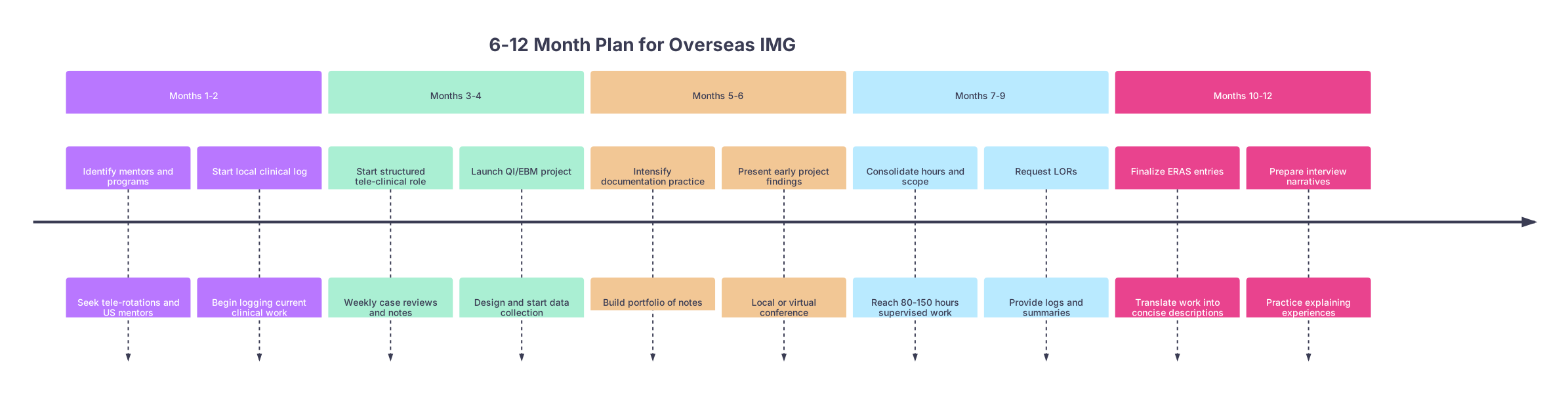
8. Time and Priority: What to Do Month-by-Month If You Are 6–12 Months from Applying
Let us sketch a rough plan.
| Period | Event |
|---|---|
| Months 1-2 - Identify mentors and programs | Seek tele-rotations and US mentors |
| Months 1-2 - Start local clinical log | Begin logging current clinical work |
| Months 3-4 - Start structured tele-clinical role | Weekly case reviews and notes |
| Months 3-4 - Launch QI/EBM project | Design and start data collection |
| Months 5-6 - Intensify documentation practice | Build portfolio of notes |
| Months 5-6 - Present early project findings | Local or virtual conference |
| Months 7-9 - Consolidate hours and scope | Reach 80-150 hours supervised work |
| Months 7-9 - Request LORs | Provide logs and summaries |
| Months 10-12 - Finalize ERAS entries | Translate work into concise descriptions |
| Months 10-12 - Prepare interview narratives | Practice explaining experiences |
Roughly:
- If you have:
- 6–8 months:
- Aim for 60–120 structured tele-clinical hours + one QI/EBM project with output.
- 3–4 months:
- Aim for at least 40+ hours with one strong letter.
- 12+ months:
- Build 1–2 different experiences (e.g., primary care tele-clinic + hospitalist-style case review).
- 6–8 months:
9. What This Actually Looks Like on a Typical Week Overseas
Let us make it concrete. You have a standard 50–60 hour hospital job in your country.
Here is a realistic weekly add-on:
2 hours / week – Tele-clinical case session
- Before the session:
- You pick 2 cases from your week.
- You write full H&Ps or progress notes in SOAP format.
- During the session:
- You present each case.
- Your US mentor walks through differential, guidelines, orders.
- You edit your notes based on feedback.
- Before the session:
1–2 hours / week – QI/EBM work
- Update your dataset (e.g., HF admissions, antibiotic use).
- Read relevant US guidelines and summarize one key change to apply.
30–45 minutes / week – Log and reflection
- Update your hour log.
- Write a 3–5 sentence reflection on one case or challenge.
Total: ~3.5–4.5 hours weekly. This is heavy, but not insane. Over 6 months, this builds a serious narrative.
10. Common Mistakes IMGs Make When Stuck Abroad
You avoid these; you are already ahead of half of your competition.
Buying weak “certificates” instead of real supervision
- A shiny PDF from a no-name “virtual observership” with 100 people on Zoom means little. One serious mentor who knows your work is stronger than 10 certificates.
Exaggerating or lying about USCE
- “Tele-observership in New York” when you just watched YouTube-like lectures. Program directors see through this; it destroys trust if you cannot back it up in interviews.
Failing to quantify and structure
- If you do not track hours, tasks, cases, and feedback, your ERAS entries sound vague. Vague = forgettable.
Not translating experience into US language
- You cannot assume they understand your country’s system. You must map your roles explicitly to something they recognize.
Waiting for the “perfect” opportunity
- Many IMGs sit for a year “hoping” for a US visa or rotation instead of building meaningful remote experience now. By the time they realize, they have wasted a full application cycle.
11. Quick Comparison: Traditional USCE vs. Remote US-Style Experience
| Aspect | In-Person USCE (Elective/Obs) | Remote US-Style Experience Abroad |
|---|---|---|
| Location | US hospital/clinic | Your country + virtual connection |
| Patient Contact | Sometimes direct, sometimes passive | Usually indirect, but can be case-based |
| Supervision | US attendings, face-to-face | US attendings/mentors via tele-platforms |
| Documentation | EMR notes, variable involvement | Structured SOAP notes, portfolio-based |
| Cost | High (travel, housing, fees) | Low–moderate (internet, some program fees) |
| Visa Required | Yes | No |
| Letter Strength | Highly variable | Can be very strong if work is structured |
Many program directors, when pressed, will admit: a 2-week observership where you barely interacted is not automatically better than 4–6 months of real, structured remote case work with documentation and QI under a committed US mentor.
You just have to make that clear in your materials and interviews.
12. Handling the Interview Question: “Do You Have US Clinical Experience?”
Here is how you respond without looking defensive.
Wrong approach:
“I do not have formal US hospital experience because I could not travel, but I did some online observerships.”
You just framed yourself as lacking.
Better approach:
“I have not yet been physically present in a US hospital because of travel and visa constraints, but I anticipated that gap and built structured US-style clinical experience remotely. For example, over the last 8 months I worked under Dr. Smith, a US board-certified internist, doing weekly tele-clinical case reviews. I drafted and revised over 40 SOAP-format notes, aligned my management with US guidelines, and completed a QI project on heart failure readmissions that mirrors resident-level work in many programs.”
Then, if they seem interested:
“I would be happy to walk you through one of the cases or the project if that would be helpful.”
You are not apologizing. You are showing initiative and adaptation.
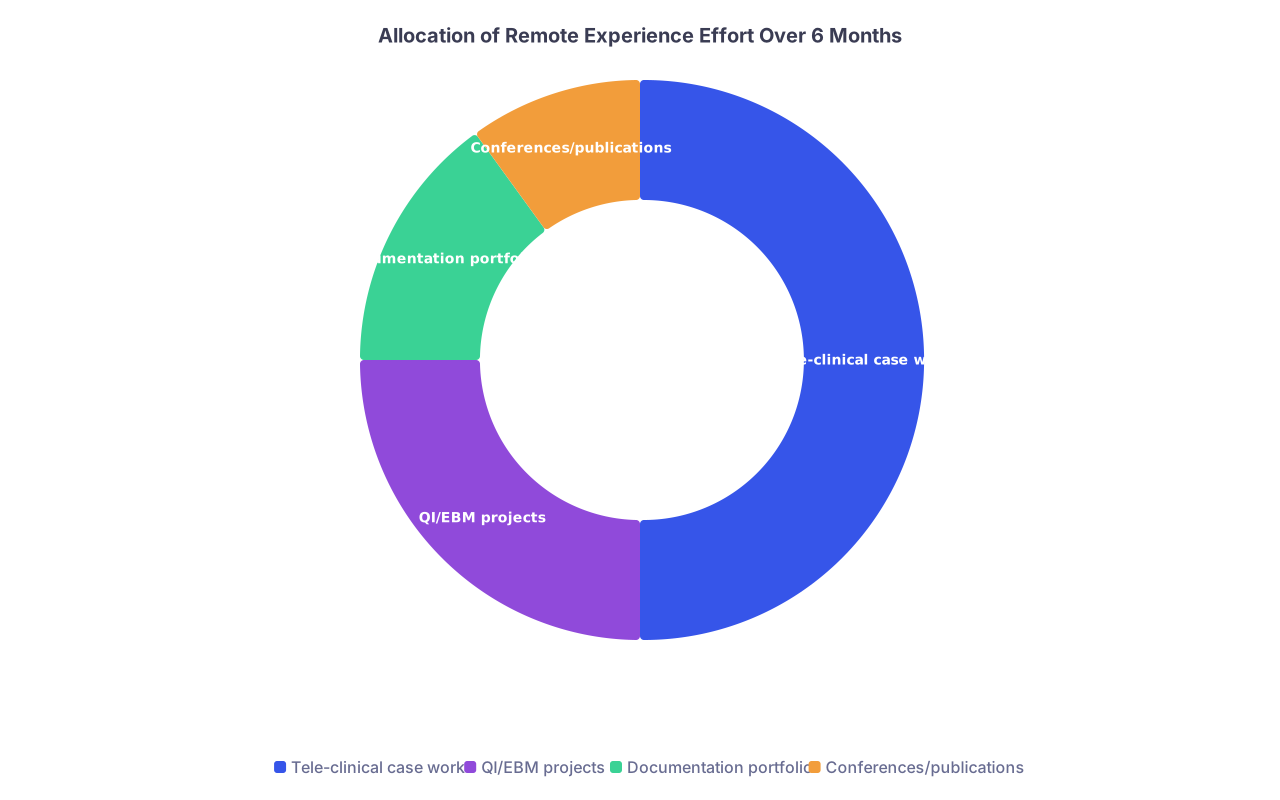
13. Where Charts and Data Help You Make Your Case
You are applying to a system that responds to data. So present your work as data.
| Category | Value |
|---|---|
| Tele-clinical case work | 50 |
| QI/EBM projects | 25 |
| Documentation portfolio | 15 |
| Conferences/publications | 10 |
Rough breakdown over 6 months:
- ~50% time: Actual case work and supervision
- ~25%: QI or research
- ~15%: Documentation practice and portfolio building
- ~10%: Presentations, abstracts, or posters
Having even a simple slide like this in your own notes helps you explain your year in a clear, structured way when asked, “What have you been doing since graduation?”
14. Final Reality Check
You are at a disadvantage compared with someone who has three US electives, a green card, and a home address in Ohio. I will not pretend otherwise.
But I have seen IMGs match into internal medicine, family medicine, pediatrics, and even some competitive specialties from abroad with zero physical US rotations. The pattern is the same:
- They built real relationships with US mentors.
- They did structured clinical thinking and documentation, even if remote.
- They produced something concrete: QI, posters, solid letters.
- They could explain their path clearly and without excuses.
If you are waiting for the perfect rotation to fall from the sky, you will likely be here again next year with the same problem. If you start engineering a US-style environment around you now, you give yourself a fighting chance.