
No hands-on US clinical experience as an IMG is not a death sentence. It is a fixable liability—if you attack it methodically and stop pretending it does not matter.
Most unmatched IMGs I talk to have the same painful realization around January: “Programs keep asking about ‘US clinical experience’ and I have nothing.” By that point it is too late for that cycle. You are basically relying on luck and one or two “IMG-friendly” programs. That is not a plan. That is wishful thinking.
You want a recovery plan. Stepwise. Aggressive. Realistic.
Here it is.
Step 1: Get Completely Clear On What “Clinical Experience” Actually Means
First problem: people use “US clinical experience” like it is one thing. It is not. Programs are rating different types of experience very differently. Stop lumping them together.
Here is the rough hierarchy I have seen programs use, from strongest to weakest:
| Type of Experience | Typical Strength Level |
|---|---|
| ACGME-observed externship with notes | Very strong |
| Structured hands-on externship | Strong |
| Sub-internship / final-year core rotation | Strong |
| Inpatient observership with teaching | Moderate |
| Outpatient observership (engaged) | Moderate–weak |
| Shadowing without meaningful role | Weak |
You are starting with “none.” The goal is not to go from 0 to Mayo Clinic. The goal is to move up that hierarchy step by step in 6–18 months.
Let me also draw a clean line:
Hands-on experience (externship, sub-I, supervised clinical role):
- You touch patients under supervision.
- You write notes in the EMR (even if they are “for teaching only”).
- You present patients, participate in plans, get evaluated.
- You can get strong, specific LORs about your clinical skills.
Observership / shadowing:
- You do not touch patients.
- You may observe rounds, clinic, procedures.
- You may help with small tasks, but not billable care.
Programs know the difference instantly. Do not call pure shadowing “externship.” That backfires when attendings describe you as “pleasant observer” in the LOR.
Your plan: if you cannot get hands-on immediately, you use observerships as a bridge, not as the final product.
Step 2: Decide Your Time Horizon (This Changes Everything)
You cannot design a recovery plan without being honest about your timeline.
I break it into three realistic situations:
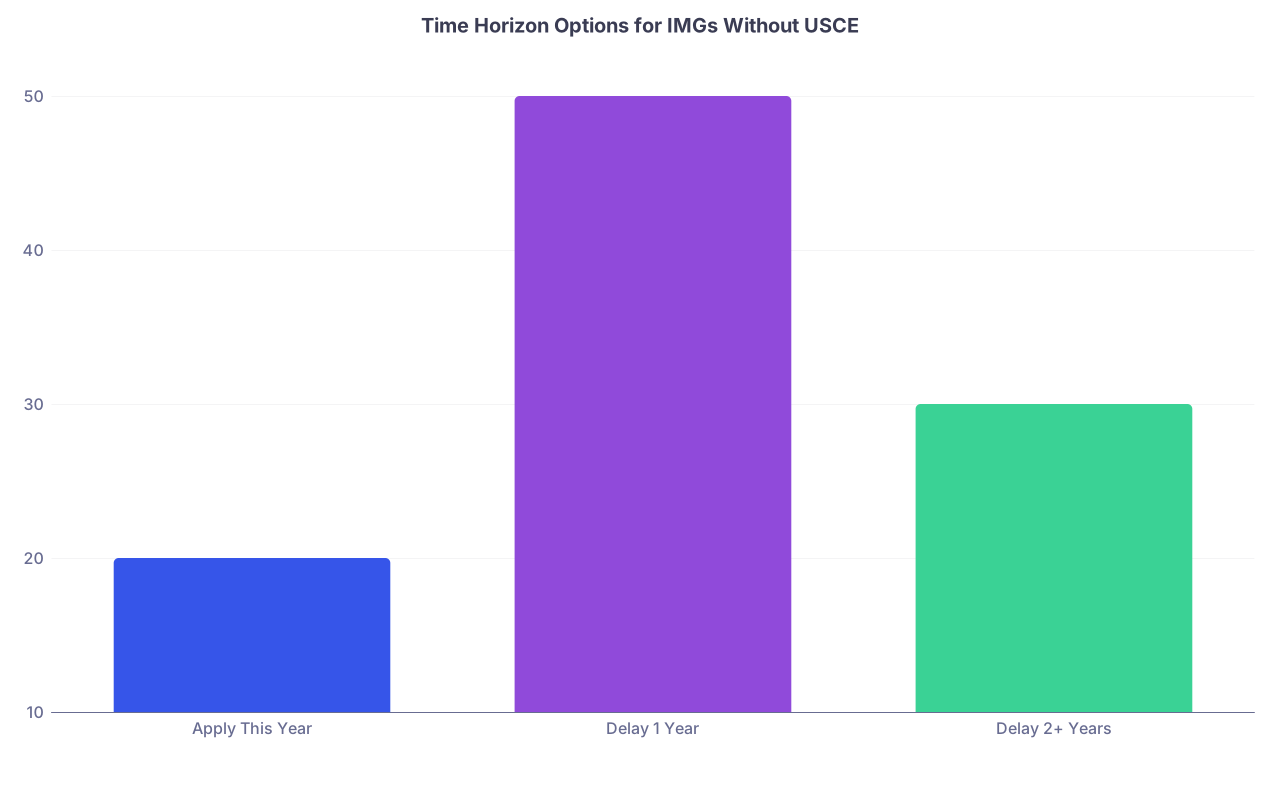
| Category | Value |
|---|---|
| Apply This Year | 20 |
| Delay 1 Year | 50 |
| Delay 2+ Years | 30 |
Those numbers are illustrative, not statistics—but they match what I see: most people need at least 1 year to repair this properly.
Scenario A: “I must apply this upcoming cycle”
This is damage control, not optimal strategy. Your focus will be:
- Get anything US-based on the CV before ERAS opens (even 1–2 months).
- Line up at least one US-based LOR.
- Aggressively target IMG-heavy and lower-competition programs.
- Simultaneously plan a parallel long-term fix (in case you do not match).
Expectations: You may still match, especially in IM/FM/psych, but you are playing from behind.
Scenario B: “I can delay one full cycle”
This is the sweet spot. One year lets you:
- Stack 4–6 months of solid USCE.
- Get 2–3 strong US LORs.
- Maybe add some US research or QI work.
- Clean up your Step 2, OET, gaps, red flags.
This is where a lot of IMGs transform from “automatic screen-out” to “plausible interview candidate.”
Scenario C: “I am 3–5+ years out, no USCE, and can invest 2 years”
You are a “high risk” file on paper. The recovery has to be deeper:
- Structured experiences spanning 9–12 months (research + clinical).
- Possibly a US-based master’s, research fellowship, or long-term observerships.
- Clear explanation for gaps and an obvious current clinical involvement.
If you are in this bucket, skip the “apply this year anyway” temptation. It burns attempts and money with little benefit.
Step 3: Inventory Your Assets And Constraints (Be Brutally Honest)
Stop copying someone else’s plan. Your recovery path depends on what you actually have.
Write this out as a one-page reality check:
Citizenship / Visa status
- US citizen / GC holder: You can work, do paid roles, more flexibility.
- Need visa (B1/B2, F1, J1): You are more constrained. You must target institutions that accept you for observerships / externships.
Finances
- How many unpaid months can you support yourself in the US?
- How much can you allocate for:
- Externship/observership fees (often $500–$3,000/month).
- Lodging and transport.
- Exam fees.
Location flexibility
- Can you relocate anywhere in the US?
- Or are you tied to a specific city/region?
- More flexible = more options and lower costs.
Current CV strengths
- Strong Step scores? (Example: 240+ Step 2).
- Recent graduation (<3 years)? That helps.
- Any home-country residency or experience? Good, but you must still show US adaptation.
Timeline
- When can you realistically arrive in the US?
- When do you aim to submit ERAS?
If you do not do this honestly, you will chase externships you cannot afford, or plan observerships timed so late that letters miss your ERAS window.
Step 4: Choose The Right “Bridge” Experiences
You are going to need a combination of things. Not just one golden externship.
Here are the main categories, and how I use them in planning.
1. Paid “Externships” With Private Companies
There are many companies that “sell” externships. Some are legitimate, some are garbage, some are outright scams.
Use them only if they meet these conditions:
- You work directly with a US board-certified attending in your specialty.
- Program allows:
- Patient interaction (history, exam) under supervision.
- Charting in EMR (even “student” notes).
- Case discussions and presentations.
- You can get a letter on hospital or clinic letterhead, not the company’s letterhead.
- You can confirm the attending’s affiliation on a hospital/clinic website.
Red flags:
- “You will mostly observe due to liability, but we call it externship.”
- Only contact is a coordinator; no direct connect with attending until you pay.
- No clear statement about letters or evaluation structure.
Use these paid externships surgically:
- 2–3 months max.
- In your target specialty.
- Timed 3–6 months before ERAS, so letters are fresh.
2. Hospital-Based Observerships (Preferable When Possible)
Do these before or after paid externships if you can, because they carry stronger institutional weight and usually lower cost.
Typical paths:
- University-associated observership programs (search: “Hospital Name + international observership”).
- Community teaching hospitals open to IMGs (often IM/FM programs).
Strong programs usually have:
- Fixed entry windows (e.g., rolling applications, 3–6 months ahead).
- Requirements: Step scores, vaccinations, malpractice coverage.
- Rotation structure: 2–4 weeks per department.
Your job:
- Line up 2–3 months of these if possible, in related fields (e.g., IM + subspecialties).
- Treat them like a job: show up early, present, read, ask for feedback weekly.
- Identify one attending per month you want a letter from and work intentionally with them.
3. Volunteer Clinical Roles (Safety Net And Continuity)
These do not always count as “formal USCE,” but they help:
- Free clinics / community health centers.
- Hospice volunteering with patient interaction.
- Medical interpreter roles (if you speak another language).
They:
- Fill time gaps.
- Show continued patient-facing engagement.
- Sometimes connect you to attendings who later sponsor observerships or externships.
Not enough alone. Useful as glue between the larger experiences.
4. Research Positions With Clinical Exposure
If you can land a research coordinator or fellow role that includes patient contact (consenting, data collection, following patients), it pulls double duty:
- US employment.
- Exposure to attendings.
- Potential LORs speaking to reliability, communication, professionalism.
This is especially useful if:
- You are aiming at academic IM, neurology, psych, or more competitive fields.
- You have 1–2 years and need to offset an old graduation date.
But do not hide in a lab for 2 years and forget you still need actual clinical observation.
Step 5: Build A 12-Month Recovery Roadmap (Sample Schedules)
Let me give you concrete sample plans. Adjust them, do not blindly copy.
Case 1: You Want To Apply Next Cycle (9–12 Months Away)
Goal: Get at least 3 months of USCE + 2 solid US letters before ERAS opens.
Month 1–2:
- Finish Step 2 (if pending).
- Apply aggressively to:
- At least 30–40 hospitals/clinics for observerships.
- 3–5 vetted externship companies.
- Parallel: start low-intensity clinical volunteering where you live (if in the US).
Month 3–4:
- Start first observership (4 weeks) in IM/FM or your target specialty.
- Behave like a sub-I: notes (if allowed), presentations, follow-ups.
- Mid-rotation, tell the attending clearly: “I plan to apply this September. If by the end of this month you feel you know my work well, I would be very grateful for a LOR.”
Month 5–6:
- Do a paid externship that’s more hands-on.
- Target a place known to host IMGs who later match.
- Aim for a second LOR.
- Use evenings/weekends to refine CV, personal statement core themes.
Month 7–8:
- Another observership or externship (different site).
- Now you are polishing:
- US-style presentations.
- Documentation phrases.
- Understanding of US system (insurance, discharge planning, etc.).
Month 9–10:
- Lock in all LORs (2–3 US-based).
- Finalize ERAS, personal statement.
- Start program list building, focused on:
- IMG-friendly.
- Accepting older graduates (if relevant).
- Programs where your mentors have contacts.
Case 2: You Can Delay One Whole Year
Now you can be strategic instead of panicked.
Option A: Continuous USCE (if you can be in the US)
- Months 1–3: Observership in academic IM.
- Months 4–6: Externship in community IM/FM.
- Months 7–9: Research assistant in same hospital + part-time observership.
- Months 10–12: Another rotation where you want to match geographically.
Option B: Mixed US and home-country activity
If you cannot stay long in the US:
- Months 1–3: Prep Step 2, strengthen home-clinic work, do telehealth shadowing with US attendings (weak but better than nothing).
- Months 4–6: Come to US for 2–3 months: stack two observerships.
- Months 7–9: Return home, maintain clinical practice, start US-based research collaboration (remotely).
- Months 10–12: Second US trip: 1–2 month externship + final observership aimed at letters.
Key idea: Every 3-month block should produce:
- Either stronger USCE, or
- Stronger US relationships, or
- Stronger paper (scores, research, language proof).
Step 6: How To Actually Land These Spots (Most IMGs Do This Wrong)
You will not get good positions by sending two emails with your CV attached and then waiting.
Here is a basic, ruthless outreach protocol.
1. Build a target list
Categories:
- University hospitals with official observership programs.
- Community hospitals with residency programs but less bureaucracy.
- Large multi-physician clinics in IM/FM, psych, neuro, etc.
- Private attendings with academic titles doing community practice.
Use:
- FRIEDA (for residency programs).
- Hospital websites (look up “International Observership,” “Visiting Physician,” “Visiting Student”).
- LinkedIn to find attendings with international/IMG-friendly background.
2. Write a short, functional email template
Subject line examples:
- “IMG seeking 4-week Internal Medicine observership – Fall 2025”
- “Foreign-trained physician requesting supervised clinical observership”
Core email (trimmed to essentials):
- Who you are (name, IMG from X, year of grad).
- Step status.
- Desired dates and specialty.
- One sentence why them (their clinic, their role, their research).
- Attach CV + short personal statement paragraph in PDF.
Keep it under 200 words. Busy attendings will not read more.
3. Volume and follow-up
Real numbers:
- Expect a 5–10% positive response rate if your profile is decent.
- That means:
- 100 targeted emails → maybe 5–10 serious conversations.
- Out of those, 2–4 real opportunities.
Follow-up schedule:
- Initial email.
- If no reply: follow up at 7 days.
- If still nothing: one last follow-up at 14 days.
- Then move on. Do not spam.
I have seen IMGs land observerships by sheer persistence where others “could not find anything”. The difference was sending 150 emails vs 10.
Step 7: Extract Maximum Value From Every US Experience
You can waste a month-long observership by standing in the corner and smiling. Programs will not care.
You want each rotation to generate:
- One potential LOR.
- Concrete talking points for interviews.
- Real understanding of the US system.
Here is your playbook.
Daily behaviors
- Arrive 15–20 minutes before the team.
- Pre-read patient charts, list key labs/imaging.
- Ask for permission to present:
- “May I present patient X today?”
- After rounds, ask one or two targeted questions that show thinking, not random curiosity:
- “For this patient with HFrEF, would you choose sacubitril/valsartan now or after optimizing beta blocker? I read X guideline…”
Weekly structure
Early in week 1: tell your attending what you want.
- “My goal is to learn US-style rounding and presentation, and if by the end of this month you feel comfortable, I would be grateful if you could write me a letter for residency.”
End of each week:
- Ask for feedback on a specific behavior (presentations, notes, communication with nurses).
- Implement it visibly next week.
End of rotation
- Provide a LOR packet:
- Updated CV.
- Draft ERAS personal statement (or at least key themes).
- 5–7 bullet points of things you worked on with them (patients, projects, presentations).
Good attendings are busy. If you make it easy for them to remember your work and write specific comments, you get a strong letter. If you just say “Can you write me a letter?” and disappear, you get a generic letter that says nothing.
Step 8: Fix How You Present Your “No USCE” Story On ERAS And In Interviews
You cannot hide the fact that you started with no US experience. You can control how it is perceived.
On your CV / ERAS
Make your experiences look like structured roles, not random shadowing:
- Use clear titles:
- “Clinical Observer – Internal Medicine”
- “Clinical Extern – Family Medicine”
- Include:
- Institution name and city.
- Supervisor name and title.
- 3–5 bullet points of responsibilities:
- “Participated in daily ward rounds and case discussions.”
- “Prepared and delivered patient case presentations to residents and attending.”
- “Observed EMR documentation, orders, and discharge planning.”
Avoid:
- “Watched patient care” or “just shadowed.” That undermines you.
In your personal statement
Do not write a sob story about being “unlucky” or “not given a chance.” Programs are not impressed.
Focus on:
- What you learned by seeing the US system up close.
- Concrete changes in your practice mindset.
- How your international background plus US exposure gives you a specific advantage (language, cultural understanding, resourcefulness).
One or two crisp stories beat a vague “I learned a lot about teamwork.”
In interviews
When they ask: “Do you have US clinical experience?”
If your experience is limited but recent, answer like this:
- “I recognized that my lack of US experience was a weakness, so over the last year I completed three rotations:
- A 4-week IM observership at X,
- A 4-week externship at Y,
- And a 4-week outpatient IM observership at Z. During these I presented patients daily, participated in team discussions, and received feedback on my presentations and clinical reasoning. It gave me a clear understanding of how care is coordinated here.”
You show:
- Insight.
- Action.
- Growth.
That is far better than: “Sadly, I did not have opportunities earlier, but I am very eager to learn.”
Step 9: Be Strategic With Specialty Choice And Program List
No USCE hurts more in some specialties than others.
If you are starting from zero, applying to:
- Dermatology
- Plastic surgery
- Ortho
- Neurosurgery
…without years of research and deep US ties, you are wasting a cycle.
For a no-USCE IMG, realistic “repair-friendly” specialties:
- Internal Medicine
- Family Medicine
- Psychiatry
- Pediatrics (depending on year of grad)
- Neurology (IMG-friendly in some places)
You do not need to love primary care for life. But if your real priority is training in the US, this is where you can realistically recover and then pursue subspecialties later.
When building your program list:
- Filter for programs that:
- Have a visible proportion of IMGs in current residents.
- List observership/externship as acceptable USCE (not strictly “US medical school rotations only”).
- Are in less competitive regions (Midwest, South, smaller cities).
Do not burn 40 applications on top-20 university programs that barely take IMGs with perfect files, let alone no USCE.
Step 10: If You Already Applied Once Without USCE And Went Unmatched
You are not starting from scratch. But you must change your behavior. “Try again with more applications” is not a strategy.
Your 12–18 month salvage plan should look like:
Stop applying every year just to “see what happens.” That labels you as a serial re-applicant with no improvement.
Take one full year to:
- Rack up 4–6 months of meaningful USCE.
- Replace old, weak LORs with fresh US letters.
- Address any other red flags (Step failures, unaddressed gaps).
Rewrite:
- Personal statement (with real US patient stories now).
- Experiences section to stress US system understanding and growth.
- Program list, aggressively biasing toward IMG-heavy, community-based programs.
When programs see:
- Same scores.
- Same experiences.
- Same generic LORs.
- And another attempt.
They assume nothing has changed. You have to give them new, concrete reasons to think differently.
Two Cold Truths And One Encouraging One
Let me be blunt.
No hands-on US experience is a real handicap. Pretending it does not matter because “I have great Step scores” is how people burn 2–3 cycles.
You will have to invest. Time, money, discomfort, humility. There is no free, easy workaround that has the same effect as working with US attendings who will vouch for you.
Now the good part.
- This is fixable in a structured way. I have watched IMGs go from zero USCE and an unmatched cycle to 4–6 interviews and a match, just by executing a focused 12–18 month plan like the one above. Not magic. Just deliberate, sustained action.
If you remember nothing else, keep these three points:
- Treat “no US experience” as a solvable problem, not an identity.
- Stack real US clinical exposures that produce strong, specific LORs.
- Give yourself enough time—usually at least one full year—to repair this properly before expecting a match.