
You are three weeks into a community hospital rotation in the U.S. The residents are nice. The attendings are busy. The EMR is clunky. You are seeing patients, writing notes that no one officially signs, and helping with scut exactly like every other IMG before you.
And in the back of your mind, one ugly question is running on a loop:
“Is any of this going to matter to academic programs on my ERAS application?”
You see other people bragging about “strong academic letters” from big-name university hospitals. You are at a 200-bed community site in a random city that most program directors have never heard of. You cannot change where you are right now.
But you can absolutely change the value you extract from this rotation.
This is the playbook.
1. Understand How Programs Actually View Community Rotations
Before you fix anything, you need to know what you are up against.
Academic program directors do not automatically dismiss community rotations. They dismiss vague, generic experiences with weak letters and no clear evidence of responsibility or growth.
What they care about from any U.S. clinical experience:
- Did you work directly with U.S. physicians who know your work?
- Did you see real patients, consistently?
- Did you show initiative, reliability, and clinical reasoning?
- Can someone credible vouch for you in detail?
Where community rotations get downgraded:
- Letters full of “pleasant to work with” and “eager learner” with zero specifics
- No clear role: just “observed” or “shadowed”
- No documented output: no QI project, no case report, no presentation
- Rotations that look like paid shadowing mills
Your job is to take the community setting you have and make it look, feel, and perform like an academic-style experience on paper.
That means three main outputs:
- An academic-quality LOR.
- Documented scholarly/educational work.
- Clearly described clinical responsibility and skills.
Everything else is secondary.
2. From “Just Rotating” to “Academic-Level Contributor”
You are not going to magically convert your hospital into a university. But you can make your daily behavior look like that of a strong sub-I at an academic center.
Here is the operational upgrade.
Step 1: Define and Expand Your Clinical Role
Right now you might be doing this:
- Pre-rounding loosely
- Following 2–3 patients
- Presenting only when asked
- Writing “practice notes” no one reads
You need to move toward:
- Owning a small panel of patients
- Presenting them on rounds succinctly
- Writing notes that are good enough that residents want to use them as a template
- Being the person who “keeps stuff from falling through the cracks”
Day-by-day changes you can start tomorrow:
Clarify expectations with your senior/resident
- Script you can use:
“I want to get the most out of this month and build skills for residency. Would it be alright if I fully follow 3–4 patients, pre-round on them, and present them daily, with you reviewing my plans?”
- Most residents will say yes. They like motivated people who make their day easier.
- Script you can use:
Structure your presentations like a U.S. sub-I
- Focused one-liner (age, key comorbidities, reason for admission).
- Overnight events.
- Relevant labs/imaging only.
- Problem-based assessment and plan: bullets by problem, not organ system dumping.
Show ownership
- Follow up on consultant recommendations before being asked.
- Call the lab / radiology / pharmacy when there are delays.
- Keep a personal list of “open loops” for each patient: pending tests, follow-ups, discharge needs.
Academic-style value is not tied to the building. It is tied to how much real responsibility and thinking you show. That is visible in how you act every single day.
3. Turning Daily Work into Academic Talking Points
You want to come out of this rotation with something that sounds like:
- “Led a resident-supervised QI project on X with measurable outcomes”
- “Delivered a case-based teaching session on Y”
- “Participated in data collection for a retrospective study on Z”
Here is how you manufacture opportunities without being annoying.
Step 2: Identify One “Anchor Project” Early
Pick exactly one main project to push. Not five. One.
Possible options in a community hospital:
- Quality Improvement (QI) project
- Case report or case series
- Short clinical teaching or resident presentation
- Protocol/order set improvement
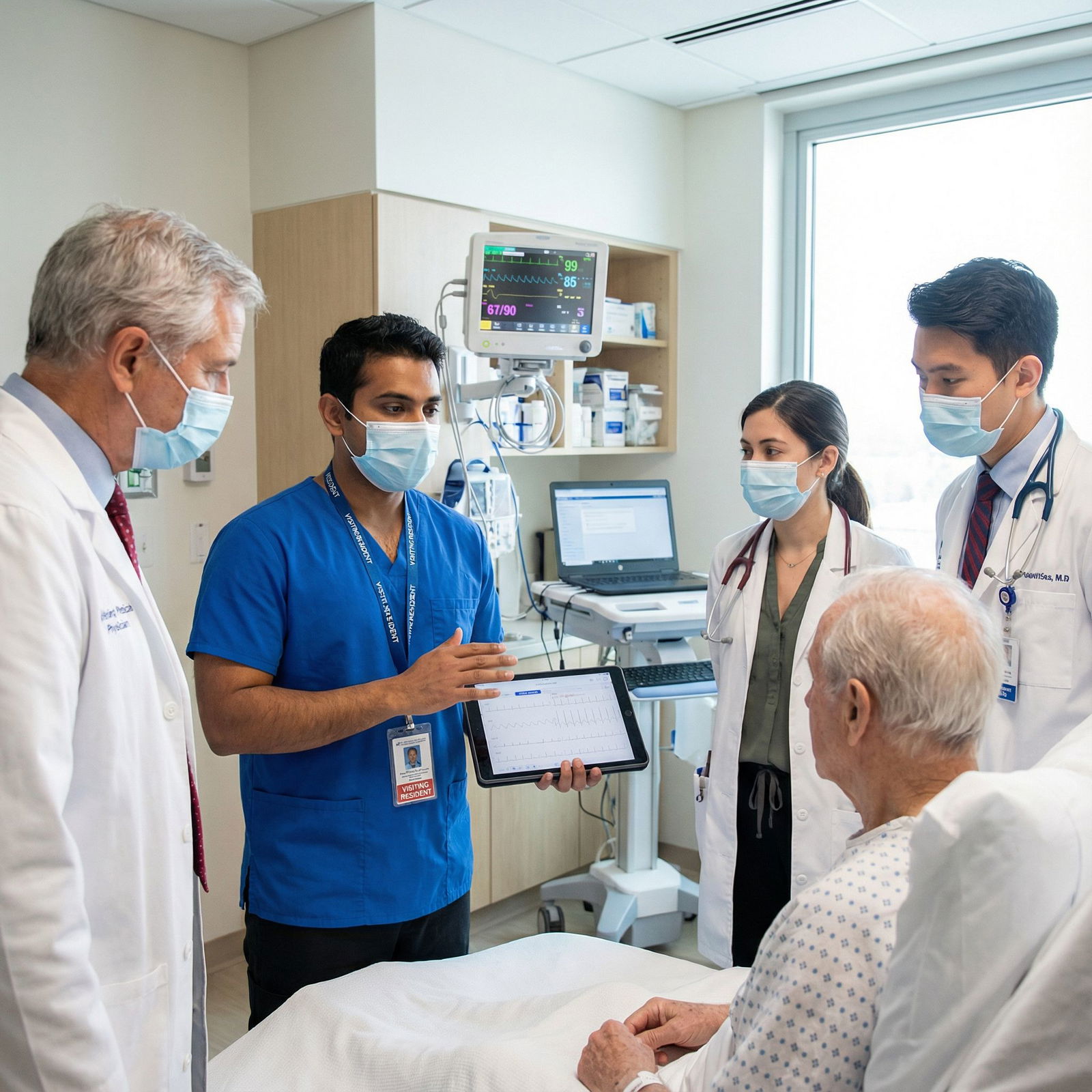
A. QI Project – The Most Realistic and Valuable
You do not need IRB or years of data for a basic, rotation-sized QI project. You need something small that shows initiative and systems thinking.
Examples that have worked:
- Reducing unnecessary daily labs (CBC/BMP) on stable patients
- Improving discharge medication reconciliation completeness
- Increasing documentation of vaccination status on admission
Protocol:
- Ask your attending or senior for a pain point
- Script:
“Are there any small workflow issues on the service that residents complain about but no one has time to fix? I am looking for a manageable QI project for this month.”
- Script:
- Define a very small, 2–3 week intervention
- Baseline data for 1 week (even 10–20 charts).
- Implement a simple change (checklist, reminder, template phrase, educational one-pager).
- Measure again in week 3.
- Produce something visible
- One-page summary with:
- Problem
- Intervention
- Simple before/after data
- Next steps
- Offer to present it briefly at a team meeting or noon conference.
- One-page summary with:
This is exactly the kind of thing that academic programs recognize instantly: QI, metrics, structure.
B. Case Report – Classic and Achievable
If you see something unusual (rare presentation, complex decision-making, surprising outcome), you have material.
Protocol:
- Ask your attending:
- “Would you consider this case for a brief case report? I can do the writing and you could be supervising author.”
- Start a case report template same day:
- Intro: Why this case matters.
- Case description: Clear timeline.
- Discussion: What was unique, what the literature says, what you learned.
- Target a realistic outlet:
- Local/regional conferences
- Online case report journals
- Hospital CME newsletter
It might not be accepted before ERAS. That is fine. “In preparation” or “submitted” is still something.
C. Teaching Presentation – The Lowest Barrier
If your rotation site has no regular student talks, create one.
- Pick a topic you saw on the ward: hyponatremia, upper GI bleed, DKA, COPD exacerbation.
- Build a 10–15 slide, case-based presentation:
- Start with your patient (de-identified).
- Walk through decision points.
- Add 2–3 guideline references (ACC/AHA, IDSA, etc.).
- Offer:
“I put together a short case-based talk on managing COPD exacerbation that I learned a lot from. Could I present it at the end of rounds one day or during downtime this week?”
That is academic behavior. You are signaling: I do not just consume knowledge. I structure and share it.
4. Extracting an Academic-Style Letter from a Community Attending
Most IMGs waste their best shot at a strong letter by doing this:
- Rotating quietly
- Asking for a letter in the last 48 hours
- Giving no guidance on strengths or examples
Then they get a three-paragraph generic disaster.
You want a letter that reads like:
- “Functioned at the level of a strong sub-intern”
- “Demonstrated sophisticated clinical reasoning in…”
- “Took initiative to lead a QI project on…”
Here is how you engineer that.
Step 3: Identify Your “Letter Writer” Early
By the end of week 1, decide: who sees your work most clearly?
- The attending on your main service
- Or the senior resident / chief who works closely with that attending
Then:
- Increase your visibility
- Present to that attending whenever possible.
- Ask 1–2 good, targeted questions per day. Not trivia. Real reasoning questions.
- Ask for mid-rotation feedback
- Script:
“I am aiming to apply to internal medicine this year and hope to grow enough to merit a strong letter eventually. Could you give me specific feedback on what I should improve over the next 2 weeks to reach that level?”
- Then actually fix what they mention. Quickly.
- Script:
Step 4: Set Up the Letter Properly
One week before the end:
Ask directly and confidently:
- “I have really valued working with you. Would you feel comfortable writing me a strong letter of recommendation for internal medicine residency based on my performance this month?”
- If they hesitate, accept that and pick someone else. A lukewarm letter can hurt you.
Provide a concise “LOR packet”
- Updated CV.
- One-page “rotation summary” listing:
- Number/type of patients followed.
- Projects completed (QI, case, presentation).
- Specific examples of initiative (extra calls, family meetings, etc.).
- Short paragraph on your goals (specialty interest, what you are aiming for).
You are not writing the letter for them. You are giving them ammo. Good writers appreciate that.
| Element | Weak Letter Version | Strong Letter Version |
|---|---|---|
| Clinical Role | "Participated in rounds" | "Independently followed 4–6 patients daily" |
| Reasoning | "Eager learner" | "Presented clear, prioritized assessment and plan" |
| Initiative | Not mentioned | "Identified and led a QI/teaching project" |
| Comparison | "Pleasant to work with" | "Among the top 10% of students I have worked with" |
| Specific Examples | None | 1–3 concrete clinical situations described |
Ask if they are comfortable mentioning:
- Your level relative to other students.
- Any project or presentation you completed.
- Any direct comparisons they have (e.g., “similar to our sub-interns”).
Academic programs read between the lines. Specifics and comparisons scream credibility.
5. Documenting the Rotation on ERAS Like an Academic Experience
Most IMGs undersell their rotations on their CV and ERAS. They write:
- “4-week internal medicine rotation at XYZ Community Hospital.”
That says nothing.
You want to sound like someone who functioned in a serious clinical environment and did productive work.
Step 5: Rewrite Your ERAS Entries
For each U.S. clinical experience, structure your description with:
- Clinical responsibility
- Team function
- Academic/scholarly output
Example transformation.
Weak:
4-week internal medicine rotation at ABC Community Hospital. Participated in rounds, saw patients, and attended conferences.
Stronger:
4-week internal medicine acting internship at ABC Community Hospital (200-bed community hospital).
- Independently followed 4–6 inpatients daily under resident and attending supervision, including complex multi-morbidity cases (HF, COPD, cirrhosis, sepsis).
- Performed focused histories and physicals, presented on rounds, and proposed management plans incorporating current guidelines.
- Developed and delivered a 15-minute case-based teaching session on management of DKA to residents and students.
- Led a supervised micro-QI initiative to improve documentation of vaccination status on admission, increasing completion rate from 40% to 70% over 2 weeks.
That reads like an academic rotation. Because it is. You just happen to be standing in a community hospital.
6. Creating Academic Signals Outside a University Environment
You are worried because your rotation site is not affiliated with a big-name university. Fair. PDs do sometimes chase logos.
You counter that with behavior and output that scream “academic mindset.”
Step 6: Plug Yourself Into Academic Ecosystems From Your Community Base
Here are moves that work even if your badge says “Community Hospital.”
Present your work somewhere, anywhere
- Ask if your QI project or case can be presented at:
- A hospital quality meeting.
- A morbidity and mortality (M&M) conference.
- A resident noon conference.
- Even better if the attending mentions this in your letter.
- Ask if your QI project or case can be presented at:
Submit abstracts to regional or national meetings
- ACP, SGIM, CHEST, IDWeek, ASN, etc. often accept student posters.
- A tiny QI with 30 patients can still become a poster if well written.
- Add to your ERAS as “Abstract submitted” or “Poster accepted”.
Build a small reading or guideline habit that people see
- Example: after seeing a patient with spontaneous bacterial peritonitis, you pull the AASLD guideline, make a one-page summary, and share it with your team.
- This is exactly the kind of thing an attending remembers when writing: “Regularly sought out and applied primary literature.”
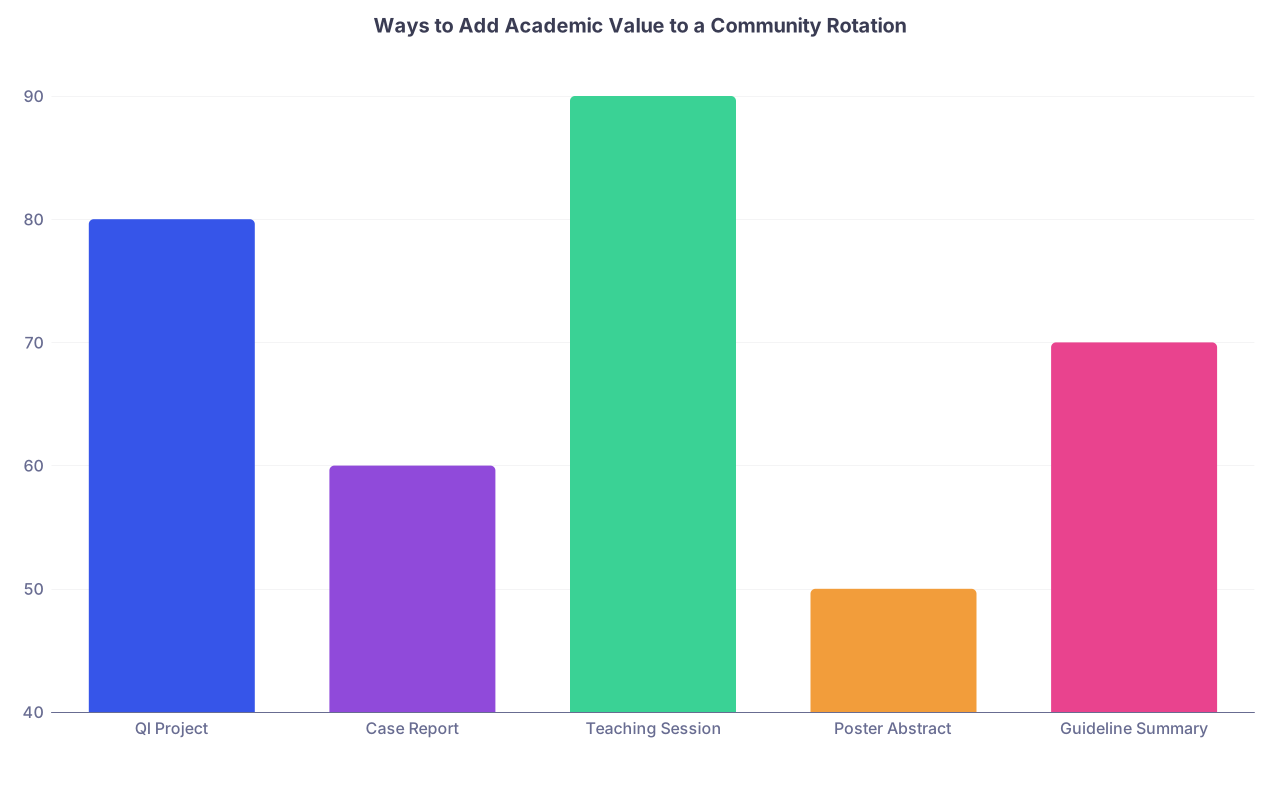
| Category | Value |
|---|---|
| QI Project | 80 |
| Case Report | 60 |
| Teaching Session | 90 |
| Poster Abstract | 50 |
| Guideline Summary | 70 |
The point is not to turn you into a full-time researcher in four weeks. The point is to flag to programs: this person will do well in an academic environment because they already act like it.
7. Avoiding Common Mistakes That Undercut Your Rotation
I have watched IMGs waste perfectly good community experiences by doing the same avoidable things.
Mistake 1: Acting Like a Passive Observer
- Only doing what is asked.
- Standing at the back of rounds.
- Not owning patients, not asking for feedback.
Fix: Pick a small number of patients. Own them. Make your senior’s life easier by tracking details better than anyone else.
Mistake 2: Chasing Volume Over Depth
- Trying to rotate at 6–8 different hospitals for one week each.
- Never staying long enough in any one place to build a deep relationship or complete a project.
Fix: It is better to have 1–2 month-long rotations with strong letters and clear output than 6 meaningless short visits.
Mistake 3: Not Understanding What “Strong Letter” Really Means
A letter from a “famous” name that barely knows you is worse than a detailed letter from a community attending who supervised you closely.
Strong letters contain:
- Specific patients or situations.
- Concrete comparisons to peers.
- Explicit statements like “I strongly recommend” and “would rank highly.”
Your job is to give your writer those stories through your behavior.
Mistake 4: Coming Across as Transactional
Do not walk in on day 1 talking about letters and ERAS. You are there to work and learn first. Letters and projects are a natural outcome if you are genuinely contributing.
Balance it:
- Week 1: integrate into team, work hard, learn system.
- Week 2: increase responsibility, ask for feedback, float project idea.
- Week 3: solidify project, continue strong clinical work.
- Week 4: finalize outputs, request letter.

| Step | Description |
|---|---|
| Step 1 | Week 1 - Join Team |
| Step 2 | Week 2 - Take Ownership |
| Step 3 | Week 3 - Build Output |
| Step 4 | Week 4 - Lock in Letter |
| Step 5 | Learn workflow |
| Step 6 | Own 3-4 patients |
| Step 7 | Finish QI/case/presentation |
| Step 8 | Request strong LOR |
8. Example: Before and After Transformation
To make this concrete, here is a real pattern I have seen.
Before
- 4-week community IM rotation.
- Student role: mostly shadowing, occasional presentation.
- No projects, no teaching, attends conferences passively.
- Letter: “X was pleasant, punctual, eager to learn, worked well with the team.”
Application impact: mediocre. Especially if scores are average.
After (Same Setting, Different Approach)
- 4-week community IM rotation.
- Student follows 4–5 patients daily, presents on rounds, writes thorough notes for team reference.
- Identifies frequent incomplete documentation of code status; conducts a 2-week chart review and brief education intervention for the team; presents results informally at resident conference.
- Prepares and delivers a 15-minute teaching session on management of upper GI bleeds based on a complex patient they followed.
- Letter: “X functioned at the level of a strong sub-intern, independently followed multiple complex patients, and led a focused QI project that improved our code status documentation rates. I would gladly welcome them as a resident.”
Same hospital. Same month. Completely different signal to academic programs.
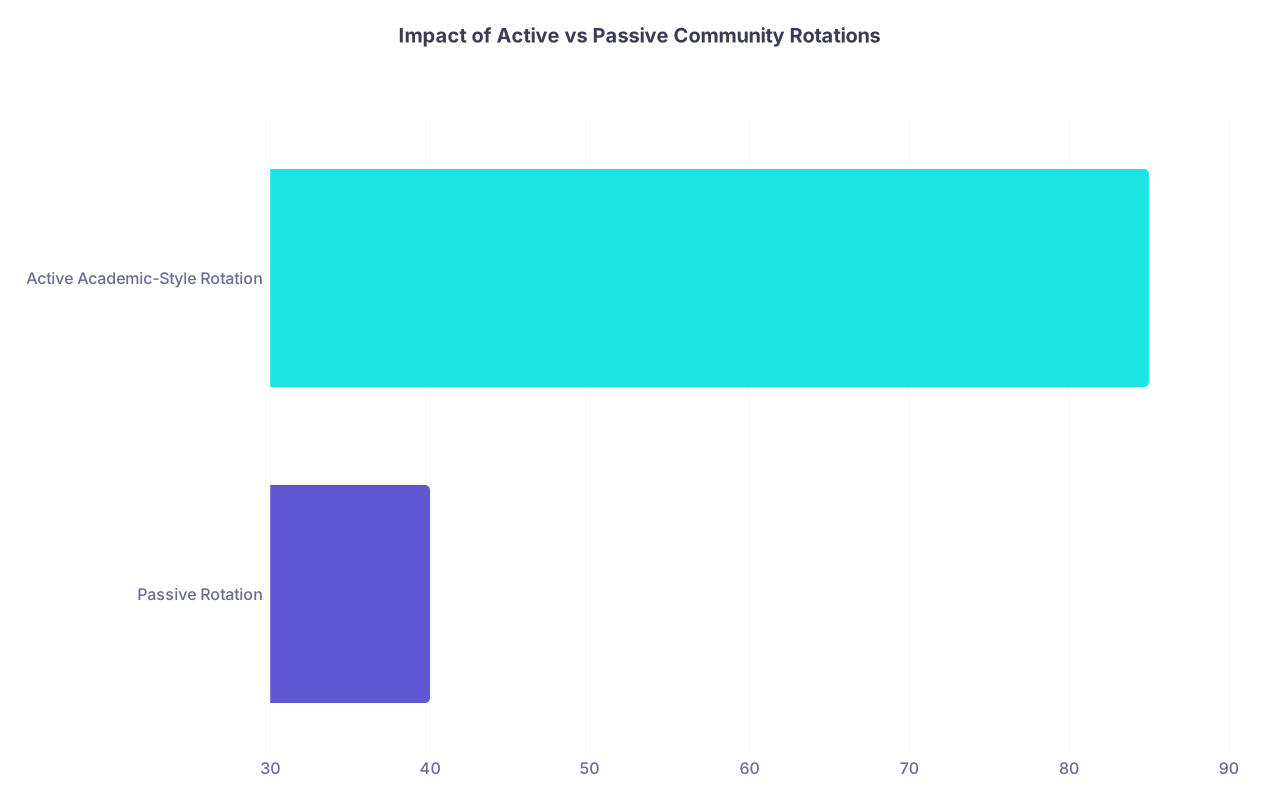
| Category | Value |
|---|---|
| Passive Rotation | 40 |
| Active Academic-Style Rotation | 85 |
9. Putting It All Together: Your 7-Step Checklist
Here is your distilled, no-excuses checklist.
Clarify your clinical role by end of week 1.
- Ask to fully follow a defined number of patients. Present daily.
Ask for mid-rotation feedback.
- Use it to correct course quickly.
Pick exactly one anchor project.
- QI, case report, or teaching session. Start planning by end of week 1–2.
Finish something visible.
- Deliver a talk, summarize your QI, or draft your case report before you leave.
Select and cultivate one main letter writer.
- Make sure they see your best work. Ask for a “strong” letter.
Package the rotation properly on ERAS.
- Emphasize responsibility, reasoning, and scholarly activity.
Link the experience to your specialty story.
- In your personal statement and interviews, reference concrete cases, your project, and what you learned about U.S. medicine.
Do this, and your “small” community rotation starts reading like serious academic preparation. Program directors care far more about the story you create around your experience than the name on the building.

FAQs
1. I have only community rotations and no academic hospital experience. Will academic IM programs still take me seriously?
Yes, if you stop presenting your experiences like background noise. Academic internal medicine programs are flooded with applicants who have generic “USCE” lines that all sound the same. What stands out is:
- Clear evidence of patient ownership and decision-making under supervision.
- Specific academic-style contributions (QI, teaching, case report).
- Detailed, enthusiastic letters that compare you favorably to U.S. students.
If you can show that your community rotations functioned like acting internships—with responsibility, feedback, and output—many academic PDs will treat that as sufficient. Pair that with solid Step scores and a consistent IM story, and you are absolutely in the game.
2. My community attending is busy and not very academic. How do I still get a strong letter?
You do not need a research superstar. You need someone who:
- Saw you work consistently.
- Can comment concretely on your behavior and growth.
- Is willing to spend 10–15 minutes writing specifics.
Your job is to make their life easy:
- Perform at a high level daily: own patients, follow through, ask good questions.
- Do one visible “extra” (QI, teaching, case, or even a great guideline summary).
- Provide a short, focused packet when asking for the letter: CV, rotation summary with bullet examples of your work, and your career goals.
Then ask explicitly for a “strong letter.” If they agree, they usually intend to put in some effort. If they hesitate, thank them and identify another attending or senior who knows your work better.
Open the notes app on your phone right now and create a new entry titled: “Community Rotation – Academic Outputs.” List three items: 1) patients I will own, 2) one project idea, 3) one potential letter writer. Tomorrow on rounds, take the first concrete step on each.