
It’s late October. You’re an IMG, ERAS is submitted, and you’ve done what everyone told you: passed your exams, got some US clinical experience, landed a few “strong LORs.”
Now you’re sitting there wondering why your interview invites are a trickle instead of a flood.
You re-open your letters in OASIS (the ones you peeked at before waiving—yes, people do that) and they look… fine.
“Hard‑working. Team player. Strong clinical skills.”
Let me tell you what actually happens once those letters hit a US program office—and why your US clinical experience letters matter far more than the average advisor ever tells you.
Because for IMGs, those letters are not just “supporting documents.”
They are your surrogate Step score, your personality test, your “can we trust this person with our patients?” all rolled into three PDFs that two or three people will read fast and judge hard.
What really happens to your letters inside a program
Here’s the part most applicants never see.
Your file lands in a program’s software. The coordinator pre-screens: Step scores, graduation year, visa, red flags. If you clear that, the file goes to one of a few readers: PD, APD, or a senior faculty reviewer.
They open your application in this rough order:
- USMLE scores and filters
- CV (do you look real or inflated?)
- Personal statement (quick skim for weirdness)
- US clinical experience and letters
For IMGs, there’s usually a mental split screen:
- Left: your objective metrics (scores, dates, school status)
- Right: “Do I believe you can function in a US hospital on Day 1?”
Your US clinical letters are what fill that right-hand screen. They’re not decoration; they’re how program directors answer three specific questions:
- Can you function safely and independently at an intern level in the US system?
- Will you be a problem—communication, professionalism, ego, or reliability?
- If I rank you, am I going to regret it in July?
If your letters don’t clearly answer those three, or worse, if they quietly hint “probably not,” you slide down the rank list or never reach the interview pile.
I’ve sat in those meetings. I’ve heard this exact line more times than I can count:
“Scores are okay. But none of these US letters actually tell me they’ve seen this applicant manage patients here. Hard pass.”
Why USCE letters matter more for IMGs than for AMGs
For US grads, programs already trust a lot of inputs: the school, the dean’s letter, the home rotation reputation. There’s context.
For you as an IMG? You’re an unknown quantity walking in from a system they don’t really understand, with cultural assumptions they don’t share, and training norms they only vaguely grasp.
That’s why your US clinical experience letters are weight‑adjusted. Internally, they count more than you think.
Let me break down how program directors silently rank what you bring:
| Factor | Relative Weight (IMG) |
|---|---|
| USMLE scores (Step 1/2) | Very High |
| US clinical experience letters | Very High |
| Personal statement | Moderate |
| Research | Low–Moderate |
| Home-country letters | Low |
Nobody will publish this table. But this is how the conversations go in selection meetings for IMGs:
- “Scores strong, but the US letters are generic. No one is sticking their neck out for them.”
- “Great US letter from our own faculty, I trust this. Let’s interview.”
- “Foreign letters only? I don’t know how to interpret those. Next.”
Even if they don’t articulate it, PDs subconsciously use US letters as a translation device:
- They translate: “good student in India/Nigeria/Eastern Europe”
into: “safe intern in a US community/academic hospital.”
Good USCE letters make that translation smooth. Mediocre ones? They leave too many question marks.
The hierarchy of USCE letters: all “US experience” is not equal
Not all US clinical letters are created even remotely equal. There’s an internal, unspoken ranking every experienced PD uses.
Here’s the rough order, from strongest to weakest, specifically for IMGs:
| Letter Type | Typical Strength |
|---|---|
| From PD / APD at an ACGME residency where you rotated | Very Strong |
| From core faculty at a solid teaching hospital | Strong |
| From community attending in active teaching environment | Moderate |
| Observer-only / shadowing letters | Weak |
| “Online externship” / tele-rotation letters | Very Weak |
Let me translate that into how people talk in rank meetings:
- PD/APD at their own program or similar: “If he says this IMG is solid, I believe him. Interview.”
- Core faculty at a teaching hospital: “They’ve supervised residents; they know the bar.”
- Community doc without teaching role: “Useful data point, but I don’t fully trust their intern-level judgment.”
- Shadowing-only letter: “So… they stood in the back of the room and watched?”
- Online externship letter: “No real patient care. I ignore this.”
If your USCE is all observerships and vague shadowing, the letters reflect that. The content doesn’t sound like, “I saw this person function like a sub‑I.” It sounds like, “They were eager and interested and asked good questions.”
Programs know exactly what that means: no real test of intern-level ability.
What strong USCE letters actually say (between the lines)
Here’s the ugly truth: attendings write in code. PDs read in code.
They’re all using the same bland adjectives, but the meaning under the surface is very different. Faculty who write letters for residency applicants all the time know the vocabulary that matters; PDs know which phrases are “green light” and which are disguised red flags.
The hidden “green flag” language
A strong US clinical letter for an IMG typically includes:
Specifics of your role:
“She functioned at the level of a subintern… independently pre-rounding, presenting concise assessments, and writing notes I could co-sign with minimal edits.”US-system competence:
“He quickly adapted to our EMR, followed ICU protocols, and communicated effectively with nursing, consultants, and case management.”Comparison language:
“On par with, or stronger than, our US medical students.”
“In the top 10% of students I’ve worked with in the past 5 years.”Direct residency endorsement:
“I would be happy to have him as an intern in our program.”
“I recommend her without reservation for an internal medicine residency in the US.”
That last category—direct, explicit endorsement—is gold. When a PD or senior faculty says “I would gladly take this person in our own program,” everyone understands the risk they’re taking by putting that on record. That’s why it carries so much weight.
The subtle “red flag” language
You won’t see “do not rank” written anywhere. That’s not how it works. The red flags are softer and coded:
Vague praise without specifics:
“He was polite and punctual.”
“She showed interest in learning.”
“He interacted well with patients and staff.”Missing comparison language:
No “top,” no “above average,” no “on par with our students.”Past tense with no forward projection:
“She completed her rotation successfully.”
Versus: “She will be an excellent resident.”Overemphasis on personality, silence on clinical ability:
“A very nice person with a positive attitude” and then… nothing detailed about actual clinical work.
I’ve been in rooms where the PD scrolls through a letter and says, “They’re trying not to say anything bad. That means there was something to say.”
You might think, “But the letter is positive!”
Programs think, “Is this as positive as this attending ever gets? Or is this their version of a soft ‘no’?”
How PDs actually compare IMGs with similar stats
Let’s take a real composite example. Two IMGs, similar profiles:
- Step 1: Pass
- Step 2: 236–240
- YOG: 3 years ago
- Both need visa support
On paper, they’re interchangeable. What breaks the tie? Their USCE letters.
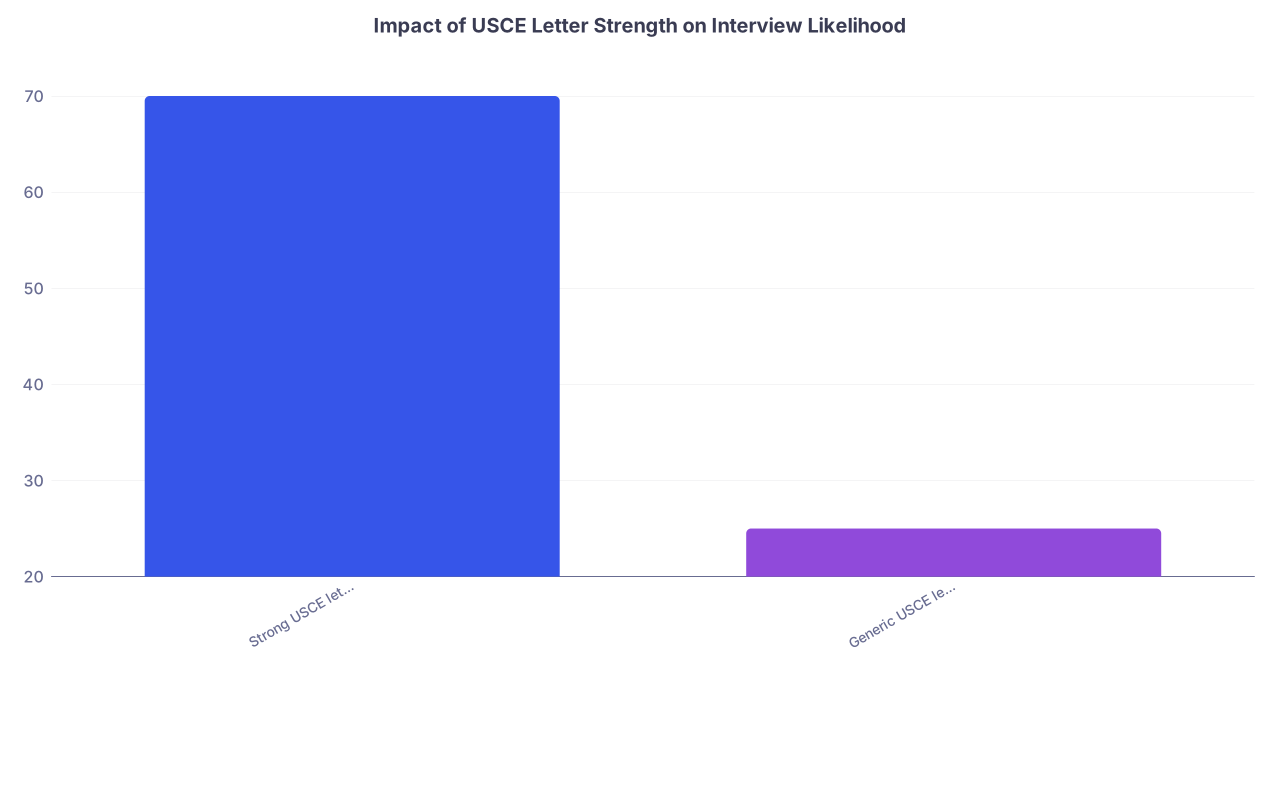
| Category | Value |
|---|---|
| Strong USCE letters | 70 |
| Generic USCE letters | 25 |
This is not official NRMP data. This is how a seasoned PD’s mental math looks.
Applicant A:
- 2 letters from IM program faculty at a mid‑tier academic US hospital
- Letters mention: “functioned at sub-I level,” “top 10%,” “I would be happy to have him as an intern”
Applicant B:
- 3 letters from community observerships
- Letters mention: “eager,” “professional,” “great enthusiasm,” no comparison language
Sitting at the selection table, it goes like this:
“Both need visas. Scores roughly equal. A has actual accountability letters; B is all from observers. Let’s invite A, not enough spots to take both.”
You never see that conversation. You just never get the email.
How your behavior on rotation shows up in the letter
You think the letter is about how smart you seemed. Programs know better. They read them looking for concrete evidence that you can function in a US system without drama.
Here’s what attendings quietly clock and later encode into letters:
- Do you show up early and stay engaged when everyone is tired?
- Do you follow through on tasks without needing to be chased?
- Do you own your mistakes or get defensive?
- Can you present a patient in under 90 seconds without losing the thread?
- Do you answer nursing pages appropriately or do you disappear?
- Do you understand when to escalate concern and how?

| Step | Description |
|---|---|
| Step 1 | On time and prepared |
| Step 2 | Trusted with real tasks |
| Step 3 | Stronger clinical comments in LOR |
| Step 4 | Passive or always shadowing |
| Step 5 | Only vague praise possible |
| Step 6 | Weak LOR impact |
| Step 7 | Asks for feedback and improves |
| Step 8 | Faculty remembers growth |
The mistake IMGs make all the time? Treating USCE like a box-checking exercise instead of a live audition for a letter that might decide your career.
The attending’s memory of you, 6 weeks later when they finally sit to write, is usually not your exact differential for hyponatremia. It’s: “Did I trust this person?” and “Would I be nervous if they were my intern?”
That’s what ends up in writing. Directly or in code.
The politics: why some letters move mountains and others do nothing
There’s another layer you’re rarely told: who writes the letter matters almost as much as what they write.
Two scenarios:
- Letter from Dr. Smith, Associate Program Director at a busy IM program that regularly interviews IMGs
- Letter from Dr. Jones, private cardiologist who lets observers round twice a week
Both say, “Excellent candidate, highly recommend.” Those two letters do not carry equal weight.
Program directors pay attention to:
- Is this faculty deeply involved in residency training?
- Do they understand what “good intern” actually means?
- Have they sent us good or bad previous residents? (Yes, people remember patterns.)
- Do they write everyone as “top 10%,” or do their strong letters truly mean something?
If you rotate at a site where faculty rarely write residency letters or have no idea how PDs read them, you lose this leverage. Their praise lands softer.
On the flip side, when a PD sees a name they recognize from previous strong residents, one line can move you from “maybe” to “interview now.”
“This letter is from the APD at St. Barnabas. The last two residents they recommended were excellent. Let’s bring this one in.”
This is why strategically choosing where you get USCE is as critical as the fact you did it at all.
Common IMG myths about USCE letters that will hurt you
I’ll call out a few false beliefs I see over and over:
Myth #1: More letters are always better.
No. Three mediocre USCE letters don’t add up to “strong letters.” They add up to “three people were unwilling to say this applicant is excellent.”
You’re better off with 2 truly powerful USCE letters than 4 paragraphs of generic fluff.
Myth #2: Home-country letters can “balance out” weak US letters.
They can’t. Programs don’t know the standards in your home country. They don’t know if “top 10%” there means “would survive here.” Home letters are garnish. US letters are the main course.
Myth #3: Any USCE is good USCE.
Rotations where you’re not allowed to write notes, not allowed to call consults, not allowed to present independently? That’s observership. Those letters will sound soft because the attending never saw you tested.
Myth #4: Asking for a “strong letter” is rude.
It’s standard. And honestly, it’s a kindness to both sides. When you ask, “Do you feel you can write me a strong letter for US residency?” you give the attending an exit ramp if their honest answer is “not really.” Better to know and adjust than to collect a lukewarm document that quietly tanks you.
How you should think about USCE if you care about matching
So what do you do with all this?
You treat every decent US clinical rotation as:
- A live audition
- A job interview spread over 4 weeks
- A high‑stakes test of whether someone will be willing to write:
“I would gladly have this IMG as an intern in our program.”
On day 1 of a rotation that could produce a letter, you should be thinking:
- How can I make it easy for this attending to trust me with real tasks?
- How can I demonstrate improvement over the month so they have a “growth” story to tell?
- How can I show them that I function at or above the level of their own students?
You’re not just collecting “USCE hours.” You’re writing the raw material that ends up on a PD’s screen months later, when they’re deciding who to interview.
And for IMGs, those few pages of text are sometimes the only real US‑based proof you exist beyond your exam scores.
FAQ (exactly 4 questions)
1. How many USCE letters do I actually need as an IMG?
Three is the standard sweet spot. Two very strong USCE letters plus one additional (USCE or home-country academic) is usually sufficient. Four is fine if all are strong and from different settings, but sending six watered‑down letters just dilutes the impact. Programs don’t have time to read a novel; they’ll skim, and weak letters can lower their overall impression.
2. Is an observership letter useless for my application?
Not useless, but limited. Observership letters rarely demonstrate intern‑level responsibility because you weren’t allowed to actually do much. If the writer is well known to programs and is explicit—“even in an observer role, she showed skills on par with our sub‑interns”—it can still help. But as a rule, observership letters are supplements, not anchors. You want at least one or two letters from settings where you were allowed hands‑on involvement.
3. Should I prioritize a letter from a famous institution or from someone who knows me well?
If you’re forced to choose: someone who knows you well, in a real teaching environment, beats a big‑name logo with a generic, two‑paragraph letter. The ideal is both: a solid teaching hospital, actively involved faculty, and enough face time that they can write detailed, specific examples. Programs care far more about concrete evidence of performance than brand names alone.
4. Can I reuse the same USCE letters if I have to reapply next year?
Yes, and many IMGs do. A strong USCE letter doesn’t expire in one cycle. That said, if you’re reapplying, programs will look for signs you’ve been clinically active and improving. If all your letters are 2–3 years old with no new USCE or clinical work, it raises questions. Ideally, keep your best older letters and add at least one more recent US‑based clinical or academic letter if you’re forced into another cycle.
To keep it simple:
- For IMGs, US clinical experience letters are not background noise; they’re your real audition tape.
- Who writes them and how specific they are matters more than how many you have.
- Every USCE month is a four-week interview for one thing: a faculty member willing to write, “I would trust this person as my intern.”