

Older graduates are not shut out of residency. They are shut out by bad strategy and lazy myths.
Let’s start with the sacred cow: “If you’re more than 5 years from graduation, US clinical experience (USCE) doesn’t matter. Programs will filter you out anyway.”
I hear this constantly from IMGs who’ve been told—by friends, random Telegram groups, and sometimes even attendings—that once you’re “old grad,” the game is over. Observerships, externships, hands-on rotations… “waste of time, just do research” or “just give up.”
That is wrong. Not slightly wrong. Completely backwards in a lot of specialties and a lot of programs.
The truth is harsher and more hopeful at the same time:
US clinical experience will not magically erase a big year-of-graduation gap—but it absolutely can rescue an “old grad” CV from the trash pile if it’s the right type, the right timing, and presented the right way.
Let’s kill the myth properly.
What Programs Actually Care About (And Where “Old Grad” Fits)
Programs don’t wake up in the morning thinking, “How do we exclude 2014 grads?” They think, “How do we avoid residents who will struggle, burn out, or fail boards?”
Year of graduation is a crude proxy. It’s their lazy filter for:
– Are your clinical skills rusted?
– Are you still exam-ready?
– Can you handle current US practice, documentation, EMR, team dynamics?
– Are you going to need remediation for basics that interns should already know?
US clinical experience is the only thing on your CV that can directly counter that fear.
I’ve been in rooms where coordinators literally say:
“Ok, 2013 grad. But two solid recent US IM rotations, strong letters, passed Step 2 last year. That’s different.”
Translation: old grad + stale CV = no.
Old grad + recent, credible, high-quality USCE = “let’s at least look.”
Programs don’t hate age. They hate risk. USCE de-risks you—if it’s done properly.
The Data: Old Grads Do Match – When They Look “Current”
There’s this fantasy that “no one more than 5 years out matches.” That’s just numerically false.
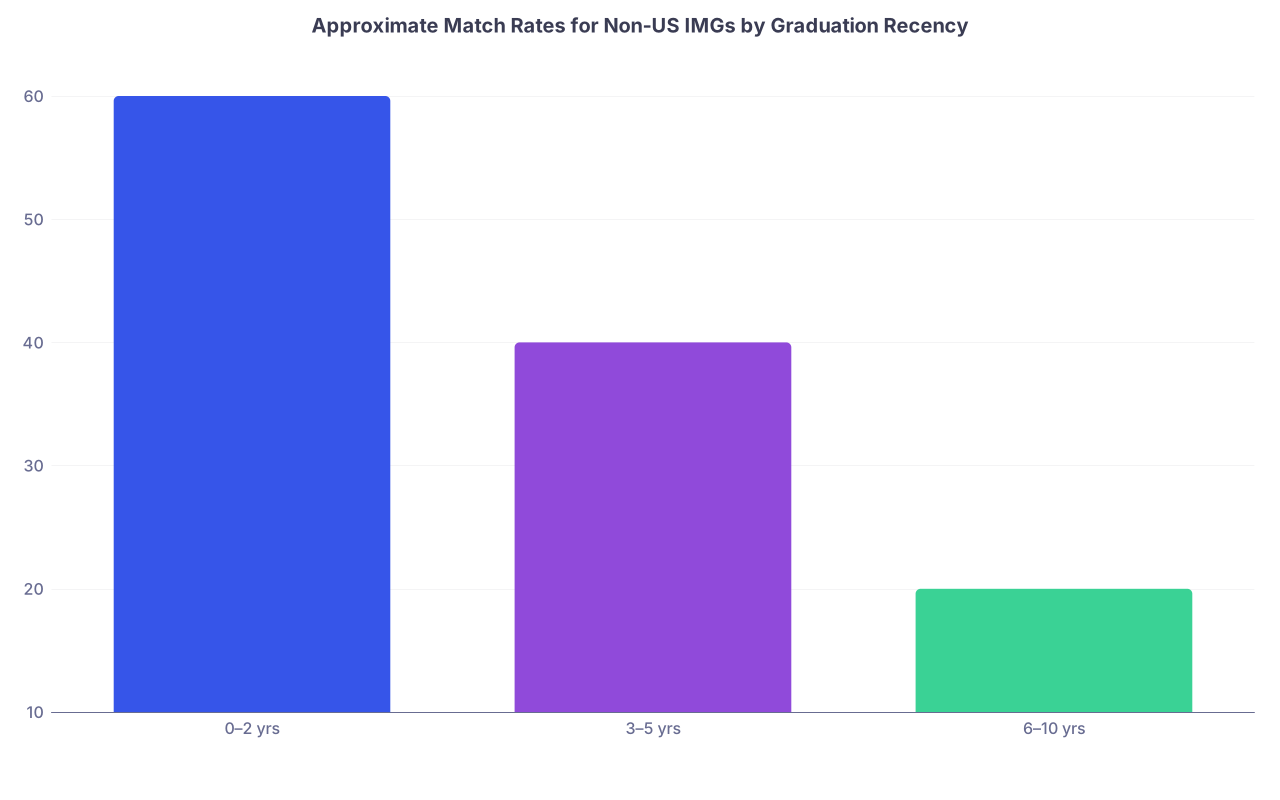
NRMP and ECFMG data consistently show that older-year-of-graduation IMGs have lower match rates. Yes. But lower ≠ zero. And when you actually look at profiles of those who do match late, a common theme appears: recent USCE plus recent exams.
Let me make this visually obvious.
| Category | Value |
|---|---|
| 0–2 yrs | 60 |
| 3–5 yrs | 40 |
| 6–10 yrs | 20 |
Are these exact NRMP numbers? No, I’m illustrating the shape, not giving you a legal contract. The real reports shift year-to-year, but the pattern stays: the farther out from graduation, the harder the match—but not impossible.
When you zoom in on those “6–10 years out” who do match, you keep seeing the same things on their CVs:
– Step 2 taken recently
– USCE within the last 12–24 months
– Letters from US attendings saying “clinical skills are current, works at intern level”
So the myth “USCE doesn’t fix anything for old grads” is backwards. For older grads, USCE is not a side dish. It’s the main course.
The Big Confusion: Not All USCE Is Created Equal
Most of the bitterness comes from people who did the wrong type of “US experience” and then decided “USCE doesn’t help.”
Let’s be exact about the hierarchy that programs actually use, because I’ve watched them rank this out loud during file review:
| Type of Experience | How Programs Usually View It |
|---|---|
| US hands-on clerkship/externship (direct patient care, notes, orders under supervision) | Strong |
| US observership in core specialty with clear teaching + strong letter | Moderate–Strong |
| US research with some clinical exposure and attending interaction | Moderate |
| Paid shadowing mills / virtual observerships with generic letters | Weak |
| “USCE” that is really a one-day visit or online course | Negligible |
The problem is not that USCE doesn’t help old grads. The problem is many old grads are sold garbage and call it USCE.
I’ve seen CVs where someone writes “US Clinical Experience – 6 months” and when you dig:
– Two months were virtual “tele-shadowing” group Zoom calls
– Two months were a pay-to-observe clinic where they weren’t allowed to touch a chart
– The last two were “research volunteering” where they entered data in Excel at home
Then they’re shocked this didn’t move the needle.
Programs are not idiots. They know the difference between:
“I saw 12–15 patients per day in continuity clinic, pre-rounded, wrote notes in Epic, presented to my attending, and discussed assessment and plan,”
versus
“I watched my uncle’s friend see patients and signed up for a certificate.”
For an older grad, that difference is the line between “ok, maybe” and an auto-reject.
What Older Grads Actually Need USCE To Prove
The whole point of USCE on an “old grad” CV is not just to show “I was in America.” You’re trying to answer three questions rattling around in every PD’s head:
Are you clinically current?
Not “were you good in med school.” Now. After the gap.
That means your USCE needs to show real patient contact, current guidelines, and recency (within 1–2 years of application).Can you function in a US team?
Nursing, case management, paging systems, EMR, handoffs, sign-out, HIPAA.
Observerships that involve just sitting quietly in the corner? Useless here.
Even as an observer, you should be embedded—present on rounds, in chart reviews, in case discussions.Can someone in the US medical system vouch for you?
Letters are where this shows up. Not template fluff. But specific:
– “She writes intern-level notes”
– “He calls consults professionally and knows when to escalate”
– “She’s up to date on current heart failure and diabetes guidelines”
If your USCE is not structured so an attending can truthfully write a letter like that, it’s not fixing your “old grad” problem.
Timing: When USCE Actually Helps vs When It’s Lipstick on a Corpse
If you graduated in 2014 and your last solid clinical work was in 2016, doing a four-week observership in 2020 and then not applying until 2024 is… almost pointless. Your “recency” evaporated.
What works for older grads is stacked recency.
A realistic comeback pattern I’ve seen work:
– Take/pass Step 2 within the last 1–2 years
– Do 2–4 months of relevant USCE within 12 months of the Match cycle
– Keep at least some documented clinical involvement (even part-time) up through application
The opposite—what people often do:
– Big gap
– Random old Step 2 score from 6 years ago
– One observership 3–4 years back
– Nothing clinical since
Then they blame age discrimination when they don’t get interviews.
USCE is like a fresh lab result. Programs want to see that “lab value” is recent. For old grads, clinical currency decays fast on paper. You keep it “fresh” through timing, continuity, and documentation.

| Step | Description |
|---|---|
| Step 1 | Old Grad with Gap |
| Step 2 | Study and Take Step 2 |
| Step 3 | Plan 2 to 4 months USCE |
| Step 4 | Obtain Strong US Letters |
| Step 5 | Apply Same or Next Cycle |
| Step 6 | Target Programs Open to IMGs and Old Grads |
Hands-On vs Observerships: How Picky Do Programs Really Get?
Here’s the nuance that gets fudged online.
Do many PDs prefer hands-on? Yes.
Do all PDs require it? No. And plenty know that true hands-on for foreign grads is hard to get.
I’ve seen plenty of old grads match with:
– 2–3 strong observerships in internal medicine
– Detailed letters that described them functioning like a sub-I (short of actual orders)
– Active role in presentations, progress note drafting, discharge summaries (even if not formally signed)
The key isn’t the billing code or malpractice arrangement. It’s scope of involvement.
If your observership is:
– You show up at 10
– Sit in the back of clinic
– Leave at 2
– No notes, no presentations, no case discussions
That will do nothing for you as an old grad. You need observerships where attendings expect you to behave like a trainee even if legally you’re not.
I’ve watched attendings tell program committees:
“Yes, technically it was an observership, but he did full H&Ps, drafted notes, and presented like an intern.”
That sentence alone is more powerful for an older grad than “6 months of USCE” written vaguely on a CV.
Specialty Reality Check: Where USCE Helps Old Grads the Most
No, you’re not matching neurosurgery at 9 years out with an observership and vibes. Let’s stay on planet Earth.
But for IMGs more than 5 years out, there are specialties and program types where USCE can shift the odds meaningfully:
– Internal Medicine (especially community and university-affiliated community programs)
– Family Medicine
– Pediatrics (select programs)
– Psychiatry (still competitive, but more open to nontraditional paths than surgery)
Where it usually won’t rescue you:
– Derm, ortho, neurosurgery, plastics
– Top-tier university programs obsessed with fresh grads and Step cult scores
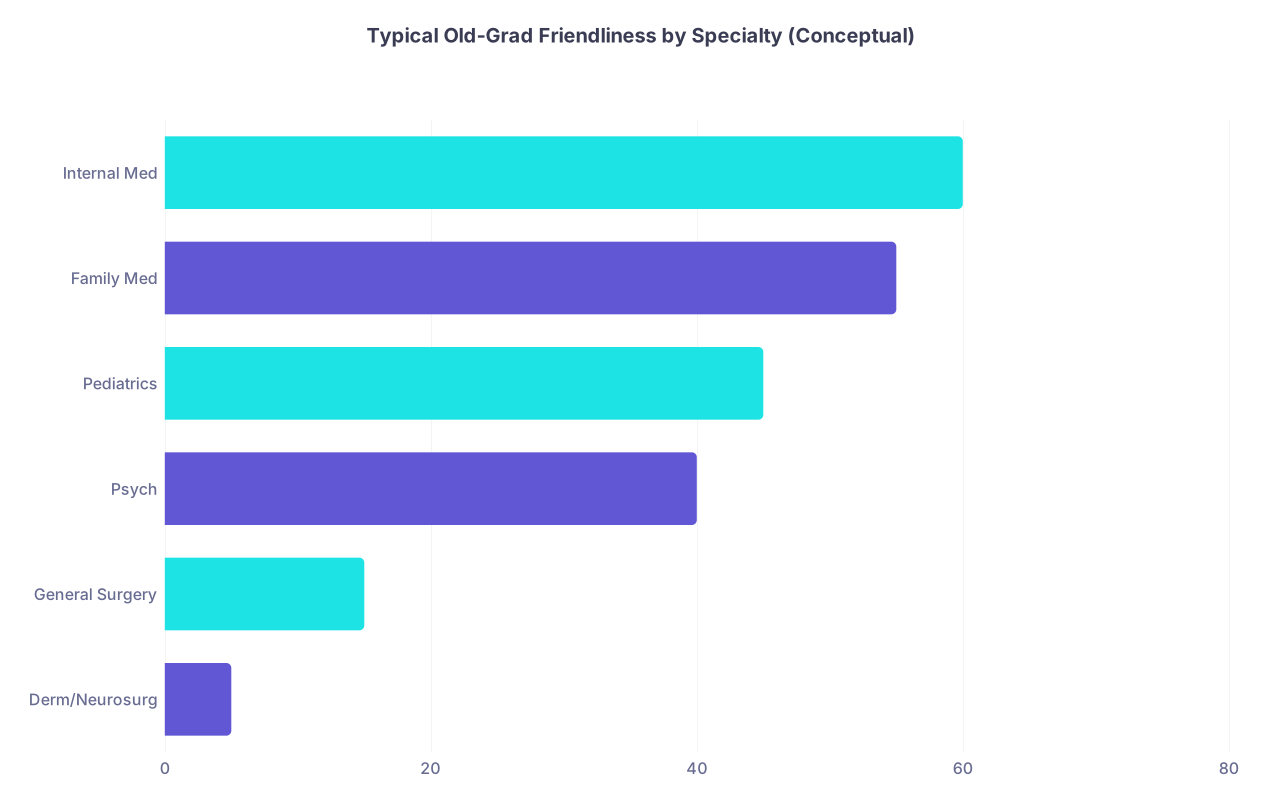
So yes, there’s a ceiling. But within realistic lanes, USCE can be the difference between 0 and 5–10 interviews for an older grad.
| Category | Value |
|---|---|
| Derm/Neurosurg | 5 |
| General Surgery | 15 |
| Psych | 40 |
| Pediatrics | 45 |
| Family Med | 55 |
| Internal Med | 60 |
Again, these numbers aren’t pulled from NRMP tables—they reflect practical reality: some fields simply use YOG more brutally as a filter.
Common Myths Old Grads Believe About USCE
Let’s call out a few particularly stubborn misconceptions.
“Any USCE is better than nothing.”
Wrong. Low-quality USCE clutters your CV and screams “I don’t know how this game works.”
A one-week “shadowing” in a private clinic? No impact.
A “virtual rotation” with no real patient contact and no individual evaluation? Almost no impact.
For an older grad, bad USCE is worse than none because it advertises that you don’t understand what programs are looking for.
“I did 12 months of non-US clinical work recently, that’s enough.”
Strong recent home-country clinical work helps. But it doesn’t fully silence the “can they function in the US system?” question. For a 2-year-old grad, sure, maybe. For an 8-year-old grad, usually not.
The pattern that works for truly old grads is:
recent non-US work plus at least 2–3 months of serious USCE.
“Research is more important than USCE for old grads.”
No. That’s the advice people give when they don’t know how to get real clinical exposure.
Research can help, particularly in university places, but if you’re more than 5 years out and trying to prove you’re clinically alive, substituting a bench or chart-review research year for all clinical activity is a bad trade.
Ideally:
– USCE in your target specialty, plus
– Some research or QI work tied to that USCE site or mentor
Not research instead of USCE.
How To Make USCE Actually Count If You’re an Old Grad
You don’t need 10 pages of tactics, but you do need to be deliberate.
– Choose fewer, higher-quality experiences over a dozen weak ones. Two strong 4-week rotations beat six random “certificates.”
– Push for responsibility: presentations, note drafting, case discussions, small QI projects.
– Tell attendings explicitly that you are an older grad trying to demonstrate current skills for residency applications. Many will shape your role accordingly.
– Time your USCE so at least some of it ends within 6–12 months of your ERAS submission.
– Get letters that highlight “current, intern-level performance,” not just “hard-working and polite.”

Done correctly, your USCE stops being a cosmetic line on your CV and becomes the argument for why your YOG should not matter.
The Harsh Truth and the Real Opportunity
Let me be blunt:
If you’re an older grad with no recent exams, no recent clinical work, and a couple of half-hearted US observerships from years ago, programs are not “discriminating” against you. They’re choosing people who look like they can safely carry a pager on July 1.
But if you’re willing to:
– Update your exams
– Rebuild clinical momentum
– Invest in real, recent, demanding USCE
Then the “old grad” label stops being a death sentence and becomes just another data point.
I’ve watched 8–10 years-out grads match IM, FM, even psych, because they were smart and intentional about USCE. And I’ve watched 3-year-out grads fail repeatedly because they treated USCE as a checkbox instead of a test-drive for residency.

Quick Reality Recap
You do not need slogans. You need the truth. Here it is in three lines:
- Being an old graduate hurts you, but it’s not what kills you; an outdated, clinically cold CV does.
- Proper, recent, high-quality US clinical experience can absolutely “reset” that perception and make programs take you seriously again.
- Not all USCE is equal—if you are an older grad, only the kind that proves current, intern-level function in the US system will actually fix anything.
Everything else you’ve heard is noise.


