
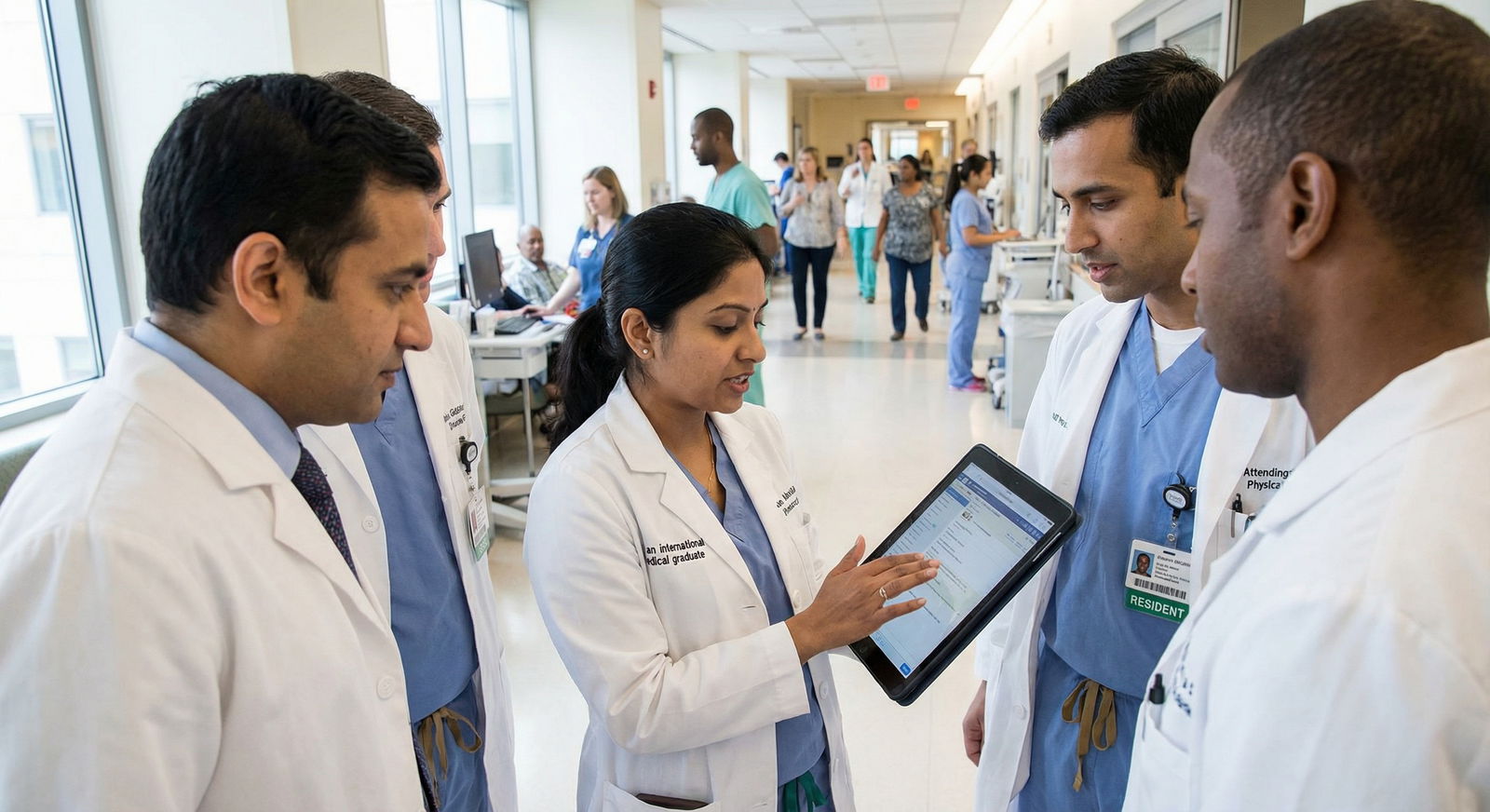
The belief that “telehealth counts as US clinical experience” for IMGs is mostly wrong — at least in the way most applicants are hoping it counts.
Programs are not sitting in committee saying, “Wow, look at all that Zoom clinic, they’re basically a US intern already.” That fantasy comes from marketing pages and Reddit threads, not from program directors’ actual behavior.
Let’s walk through what telehealth really does for an IMG application — what it can count as, what it definitely does not, and how it compares to traditional USCE based on the data we actually have.
What Programs Really Mean by “US Clinical Experience”
Residency programs are not vague about this. When they say “US clinical experience,” they usually mean one thing:
You, physically in the United States, doing hands-on or at least bedside-related work with US patients in a US healthcare setting, supervised by US-licensed physicians, with documentation and evaluations that program directors trust.
That typically includes:
- US sub-internships / acting internships
- Clinical electives in US hospitals or clinics
- Externships with real patient responsibility
- Observerships (for some programs, this only half-counts, but it’s still “US-based”)
Here’s the key: geography + context matter. US patients. US system. US attending. US charting. US team.
Telehealth muddies that picture. Many IMGs are doing “US telehealth” where:
- They’re sitting outside the US
- Logged into some EMR or platform
- “Shadowing” or pre-charting
- Sometimes never directly talking to patients at all
And then they ask: “Does this count as US clinical experience?”
The honest answer: not in the way you want it to.
What the Data and Policies Actually Show
We do not have a big randomized trial of “telehealth-only” vs “in-person USCE” and match outcomes. But we do have three things that matter more than the hype:
- NRMP and ERAS guidelines
- Program-specific policies and filters
- The pattern in what matched IMGs actually did
1. NRMP / ERAS and “Telehealth Experience”
NRMP and ERAS do not have a category called “US Telehealth Experience.” You’ll document it as:
- Clinical experience (with description)
- Research / quality improvement
- Or just “work experience”
Nothing in the official match data identifies telehealth as a unique, valued category. The NRMP Program Director Survey, which tells you exactly what PDs say they care about, lists:
- “US clinical experience”
- “Audition elective / subinternship”
- “Letters of recommendation in the specialty”
- “Evidence of teamwork, communication, professionalism”
It does not list “telehealth exposure” as its own signal. That’s your first clue.
2. Program Filters: What They Say, Not What Reddit Says
Look at actual program criteria — not blog posts, not random “IMG-friendly” lists.
You’ll see language like:
- “At least 3 months of hands-on US clinical experience required.”
- “US observerships are accepted; telehealth-only experiences are not considered USCE.”
- “We do not consider remote experiences equivalent to in-person US clinical exposure.”
Plenty of community programs are even more blunt in their FAQ pages. I’ve seen exact wording like:
“Tele-rotations or remote shadowing will not fulfill our US clinical experience requirement.”
So if you’re hoping telehealth alone will meet those “3 months USCE required” filters: it won’t.
3. What Matched IMGs Are Actually Doing
Look at ECFMG and NRMP data for matched IMGs:
- The majority of successfully matched IMGs, especially in internal medicine and family medicine, have in-person USCE: electives, observerships, or paid clinical roles like scribe or MA.
- Telehealth might be a bullet point in their application, but it’s not the anchor.
Programs are still anchored in a simple reality: they want to know if you can function in a US clinic or ward with real patients, real teams, and real chaos. That’s hard to prove with nothing but internet medicine on your CV.
The Telehealth Mirage: Common Myths vs Reality
Let’s kill off a few common myths one by one.
Myth 1: “Telehealth Counts as Full USCE”
No, it doesn’t. At best it counts as supplemental exposure.
Programs care about:
- Level of responsibility
- Direct patient interaction
- Reliability of evaluation
Most telehealth “experiences” sold to IMGs are:
- Short-term
- Light on responsibility
- Superficial in evaluation (“certificate of completion” instead of real narrative evaluations)
If your entire “US clinical experience” is 2–3 months of offshore telehealth, you will absolutely lose to a similar applicant who has 1–2 months of in-person US observerships.
Myth 2: “Telehealth Letters Are Just as Good as In-Person Letters”
Again, usually false.
Let me be blunt: a letter that reads like, “Dr. X participated in our telehealth rotation, logged into the EMR, observed visits, and showed enthusiasm” is weaker than a letter saying, “I supervised Dr. X in our inpatient service, watched them present on rounds, communicate with patients and nurses, and handle overnight cross-coverage calls.”
Program directors know which environments stress-test you. Telehealth is low-stakes. Nobody’s paging you at 3 a.m. from the ICU through Zoom.
Myth 3: “Telehealth Looks More Modern and Innovative, Programs Will Like It”
Programs like innovation on top of competence, not instead of it.
If you’ve got:
- Strong Step scores
- Solid in-person USCE
- A letter from inpatient medicine
…and then telehealth experience on top? Great. It makes you look engaged with current practice models.
But telehealth without inpatient or clinic time in the US? That just says: “Could not or did not get real USCE.”
The Nuanced Reality: When Telehealth Does Help You
Now the contrarian part: telehealth isn’t useless. The “all or nothing” crowd is also wrong.
Telehealth can be valuable in specific, limited ways — if you stop pretending it’s something it’s not.
1. It Can Strengthen a Narrative, Not Replace a Foundation
For competitive specialties or borderline applicants, telehealth can:
- Show sustained interest in a specific field (e.g., tele-psychiatry, tele-endocrinology)
- Provide concrete stories for interviews: difficult virtual conversations, cross-cultural care, technology barriers
- Demonstrate adaptability and communication skills in a different medium
But notice the verbs: show, provide, demonstrate. Not “satisfy,” “fulfill,” or “qualify.” That’s the difference.
2. It Can Bolster Research or QI Output
Some telehealth rotations plug you into:
- Quality improvement projects on virtual care
- Data collection on no-show rates or telehealth outcomes
- Patient satisfaction research
Those can turn into:
- Posters
- Abstracts
- Maybe even a publication
Programs do respect that — if it’s real work, not vanity “co-authorship” from a pay-to-play company.
3. It Can Build a Targeted Relationship (Rare, But Real)
If you’re doing structured telehealth work:
- With a US faculty who actually knows you
- Over several months
- With repeated case discussions and feedback
That person might write a meaningful letter. Not all telehealth is created equal. A six-month recurring tele-clinic with real discussion beats a two-week “online observership” every time.
Telehealth vs In-Person USCE: How They Really Compare
Let’s stop talking vague and stack them side by side.
| Factor | Telehealth Experience | In-Person USCE |
|---|---|---|
| Counts for USCE filters | Usually no | Yes |
| Letter strength potential | Moderate at best | High |
| Assesses teamwork | Weak | Strong |
| Shows system familiarity | Limited | Strong |
| Match impact (practical) | Supplemental | Foundational |
That’s the core truth: telehealth is a supplement, not a substitute.
To drive this home visually:
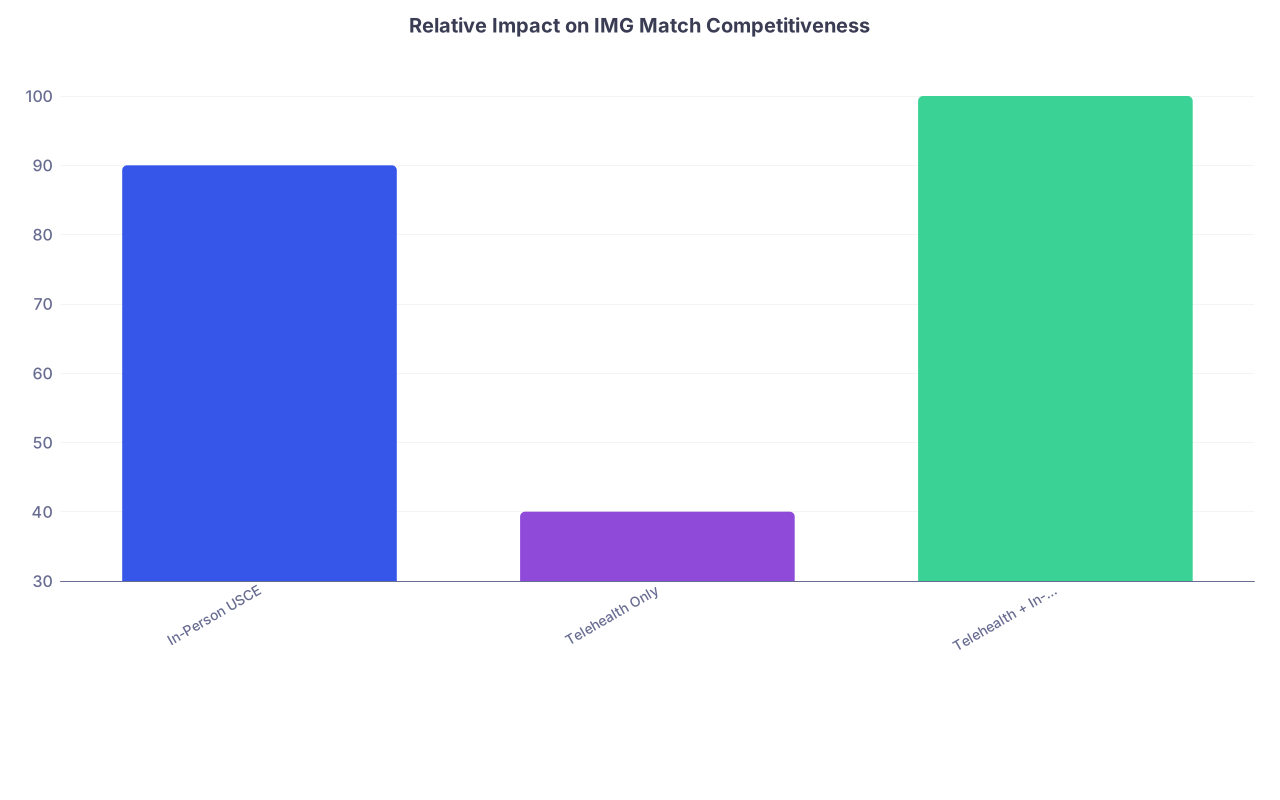
| Category | Value |
|---|---|
| In-Person USCE | 90 |
| Telehealth Only | 40 |
| Telehealth + In-Person | 100 |
Those numbers aren’t from a randomized trial. They’re an honest summary of how program directors behave: the combination beats either alone, and telehealth alone trails badly behind real USCE.
Where Telehealth Helps Different Types of IMGs
Not all IMGs are in the same boat. Telehealth means very different things for:
- Fresh grads
- Older grads with gaps
- High-score vs borderline-score applicants
- People with visa and travel barriers
Here’s how it actually plays out.
Fresh Graduates (0–2 Years Out)
You should treat telehealth as extra seasoning. Your priority is:
- At least 1–3 months of in-person USCE
- Strong Step scores
- Recent graduation
Telehealth can:
- Give you talking points for interviews
- Show ongoing engagement before your US rotations start
- Connect you with faculty willing to mentor or co-author
But if you’re a fresh grad and your only US exposure is telehealth, that’s a strategic mistake. Programs will assume you either did not try or could not secure real USCE.
Older Graduates (5+ Years Out) and Gap Years
Here telehealth can be more useful — not heroic, but relevant.
If you’ve got:
- A big time gap since last clinical work
- Or you’re working outside patient care (industry, non-clinical roles)
Telehealth can:
- Show you’re still active with patients in some capacity
- Help bridge the “What have you been doing clinically?” question
- Lead to a recent letter (dates matter a lot for older grads)
But again, if you can combine even 1–2 months of in-person USCE with telehealth, you look far more credible than telehealth alone.
Visa and Travel Barriers
Here’s the uncomfortable part nobody likes to say: US immigration doesn’t care that telehealth is easier. Many programs still want physical US experience even if it’s harder for you to get here.
Telehealth is helpful if:
- You literally cannot travel this year
- You’re planning for applications 1–2 years ahead
- You use telehealth to build relationships that may later turn into on-site opportunities
It is not a magic workaround for:
- Programs requiring “USCE in the last 2 years”
- Programs screening for “US inpatient experience required”
How to Use Telehealth Strategically (Instead of Being Sold a Fantasy)
If you’re going to do telehealth, at least use it intelligently.
1. Make Sure It’s Structured and Long Enough
Two-week tele-clinics are useless. Aim for:
- At least 8–12 weeks, even part-time
- Regular case discussions
- Some form of observable work (notes, presentations, follow-ups)
Short, generic tele-rotations scream checkbox, not commitment.
2. Target Programs and Faculty, Not Just “Experience”
The best-case scenario isn’t “I did telehealth in the US.”
The best-case is:
- “I did a 3-month longitudinal tele-IM clinic with Dr. X at Y University.”
- You then apply to Y University’s program
- Dr. X actually knows you and can email the PD and say, “This one is worth a closer look.”
That’s real leverage. Most IMGs never get past the generic, mass-market version.
3. Translate Telehealth into Concrete Skills on ERAS
When you describe telehealth:
- Mention EMR used
- Mention patient volume or types of cases
- Mention what you did (pre-charting, HPI, assessment discussions, follow-up planning)
Program directors hate fluff. They like seeing specifics like:
- “Participated in 15–20 telehealth primary care visits per week”
- “Pre-charted history and labs in Epic prior to attending visits”
- “Presented assessments and plans for complex chronic disease patients”
That at least makes telehealth feel like real work, not webinar attendance.
The Hard Truth: If You Have to Choose, In-Person Wins Every Time
If you’re staring at a budget and wondering:
- Two months in the US doing in-person observerships
vs - Six months of cheaper telehealth from abroad
Pick the in-person.
You will get:
- Stronger letters
- Better understanding of workflow
- More believable “fit” for US residency
To visualize the trade-off:
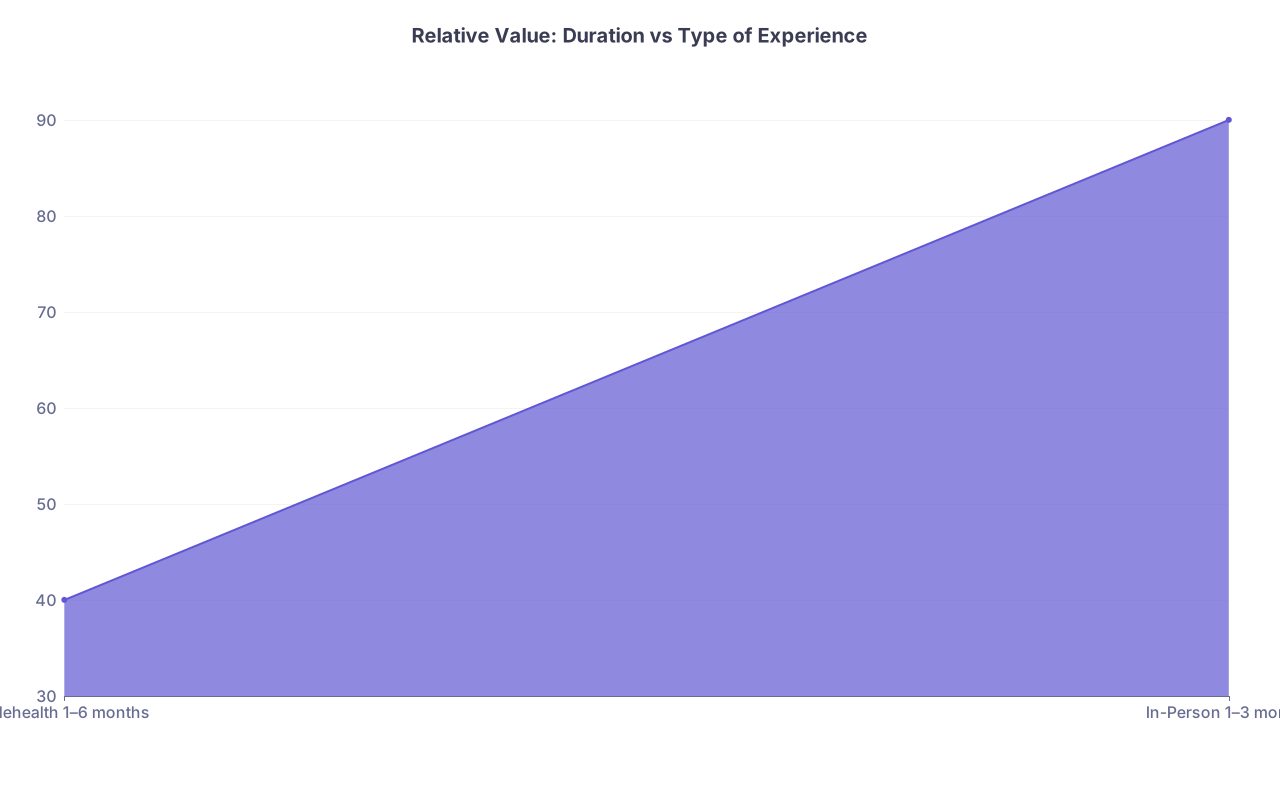
| Category | Value |
|---|---|
| Telehealth 1–6 months | 40 |
| In-Person 1–3 months | 90 |
Again, not a randomized trial. Just a realistic summary: more months of the wrong thing won’t outweigh fewer months of the right thing.
How Telehealth Can Backfire
There’s one more uncomfortable angle: overselling telehealth can hurt you.
I’ve seen applications where:
- 3–4 entries are variations of telehealth rotations
- Each with grandiose titles like “Telehealth Resident” or “Virtual Fellow”
- No actual in-person, team-based US work
Program directors are not fooled. At best they roll their eyes. At worst they assume you’re padding your CV and do not understand what residency demands.
Use telehealth honestly:
- As a learning experience
- As a supplement
- As a stepping stone to real USCE
Not as a replacement and not as costume jewelry to impress people who read applications for a living.
Practical Mix That Actually Works
For a typical IMG targeting internal medicine or family medicine, a realistic strong profile looks like:
| Component | Target Level |
|---|---|
| In-person USCE | 2–3 months (inpatient/clinic) |
| Telehealth experience | 2–3 months (longitudinal) |
| US letters | 2 in-person + 1 telehealth OK |
| Research/QI | 1–2 concrete projects, any setting |
Telehealth is the 10–20% bonus, not the 80% foundation.
To show how this mix typically evolves across a year of prep:
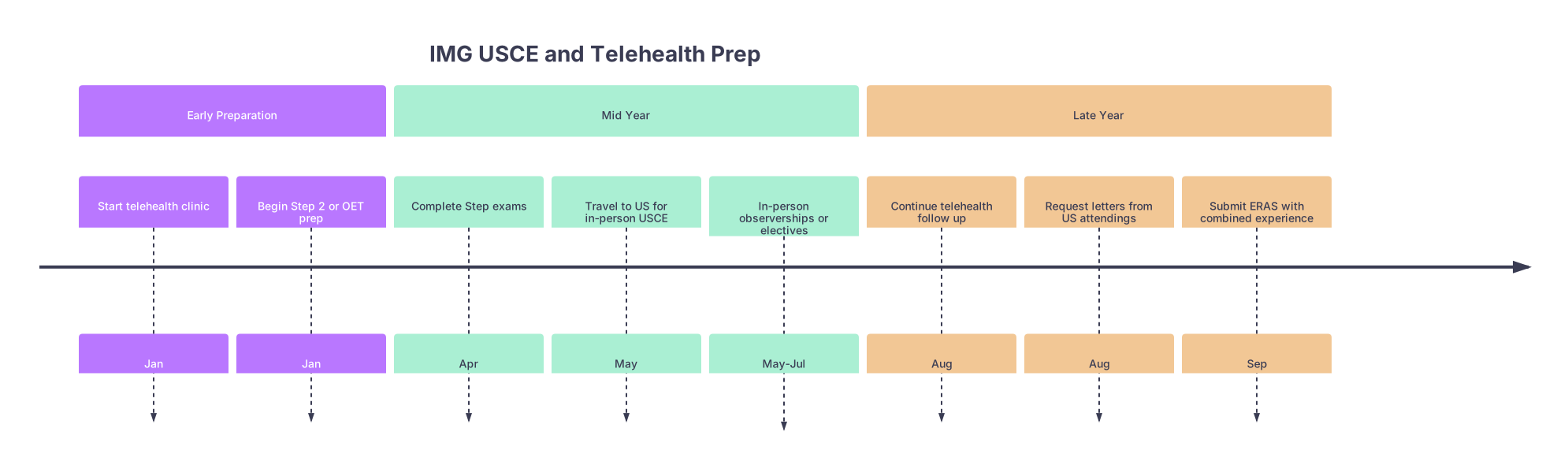
| Period | Event |
|---|---|
| Early Preparation - Start telehealth clinic | Jan |
| Early Preparation - Begin Step 2 or OET prep | Jan |
| Mid Year - Complete Step exams | Apr |
| Mid Year - Travel to US for in-person USCE | May |
| Mid Year - In-person observerships or electives | May-Jul |
| Late Year - Continue telehealth follow up | Aug |
| Late Year - Request letters from US attendings | Aug |
| Late Year - Submit ERAS with combined experience | Sep |
The Bottom Line: What Data and Behavior Actually Say
Strip away the marketing and here’s what’s left:
Telehealth alone does not count as US clinical experience for program requirements or filters. In-person USCE still carries most of the weight.
Telehealth is useful as an adjunct, especially for building a narrative, getting involved in QI/research, or earning one additional letter — but it’s not a credible substitute for being physically in a US hospital or clinic.
If you have limited time or money, prioritize in-person USCE. Telehealth is a nice add-on; it’s not the pillar of a strong IMG application.
Use telehealth strategically, not wishfully. Programs are choosing residents, not remote observers.


