
The blunt truth: for most IMGs, Step 2 CK is the single biggest filter, but meaningful US clinical experience is what gets you taken seriously once you’re past that filter. You almost never win with just one.
The real answer in one sentence
If you’re an IMG aiming for internal medicine, family, peds, psych, or similar:
- Below-average Step 2 CK = you must have strong US clinical experience to stay competitive.
- Solid or high Step 2 CK = you still need some USCE, but score carries more weight.
- Gunning for competitive specialties (neuro, EM, anesthesia, etc.) = you need both, and weak in either one hurts you.
So “Which counts more?” is the wrong question. The better one is: “Given my current Step 2 situation, how much US clinical experience do I need, and what kind?”
Let’s build that decision framework.
How programs actually use Step 2 CK vs USCE
Here’s how it works inside most program offices, whether they say it out loud or not.
Step 2 CK: the hard filter
Programs are drowning in applications. They need a fast way to cut the pile.
Step 2 CK usually does three jobs for them:
Basic competence check
“Can this person handle our board pass rates and exam-heavy residency?”
If your score is far below their historical average, many programs just won’t risk it.Screening threshold
A lot of programs set rough cutoffs for IMGs. Something like:- “We prefer 235+ for IMGs”
- “We don’t usually interview below 225 unless something is exceptional”
Relative ranking tool
Once you’re in the interview pool, a higher score:- Helps on rank list
- Competes against US grads with similar scores
- Offsets weaker parts of your app (older grad year, limited research, etc.)
Bottom line: Step 2 CK decides if many programs even see the rest of your file.
US Clinical Experience: the credibility builder
Once your score passes the sniff test, USCE becomes crucial for IMGs.
Program directors look at USCE for:
Proof you can function in a US hospital
- Understand US documentation, EMR, handoffs
- Basic knowledge of US systems (insurance, discharge planning, follow-up)
- Communication with nurses, patients, consultants
Letters of recommendation that actually matter
A strong letter from:- A US academic attending in your specialty
- Someone the PD knows or trusts
Often carries more weight than another 5–10 points on Step 2.
Red flag detection
During USCE, attendings see:- Work ethic
- Team behavior
- English/communication
- Professionalism
You’d be shocked how often a glowing letter vs a lukewarm one decides who gets an invite.
Programs are nervous about IMGs who’ve never touched a US system. Even with a 260.
Types of US Clinical Experience: what actually counts
Not all USCE is created equal. A 3‑month “observership” in a private clinic is not equal to a 4‑week inpatient elective in a teaching hospital.
Here’s the hierarchy.
| Experience Type | Typical Impact |
|---|---|
| US inpatient elective (final year) | Very High |
| Hands-on externship (US teaching) | Very High |
| Inpatient observership (academic) | Moderate–High |
| Outpatient clinic observership | Moderate |
| Research only, no clinical | Low (for USCE) |
Core point: the closer your role is to an actual US resident’s work, the more it counts.
So which should you prioritize? Use this decision framework
1. If you haven’t taken Step 2 CK yet
Your priority is simple: Step 2 CK first. But don’t ignore USCE planning.
Do this:
Commit to a target score. For IMGs:
- Competitive for IM/FM/Peds/Psych: 235+
- Safer: 240–245+
- Aiming higher or competitive specialties: 250+
While studying:
- Line up at least 1–2 months of USCE in your target field for after your exam date.
- Priority: hospital-based, teaching environment, specialty you’re applying into.
Don’t try to do full-time intense USCE and serious Step 2 prep simultaneously. I’ve watched too many IMGs tank their score trying to “do everything at once.”
2. If you already have Step 2 CK – and it’s strong
Let’s say:
- 245+ for core fields (IM/FM/Peds/Psych), or
- 255+ for more competitive ones (neuro, anesthesia, etc.)
Congrats. Step 2 is now a strength. Now USCE becomes how you convert that strength into interviews.
Your plan:
- Get at least 1 month of specialty‑aligned USCE (inpatient or strong academic clinic).
- Ideal: 2–3 months total, spread across:
- 1 month in your target specialty
- 1 month related (e.g., IM + Cardiology for internal medicine)
- Optional 1 month research in a US department
With a strong Step 2, 1–3 good US letters + focused USCE is usually enough for IM/FM/Peds/Psych.
For competitive specialties, you realistically need both:
- High Step 2
- Multiple months of high‑quality academic USCE and strong home‑institution advocates
3. If you already have Step 2 CK – and it’s average or weak
Let’s define rough bands (not gospel, but realistic for IMGs):
- 260+: Elite
- 245–259: Strong
- 230–244: Decent but not standout
- 220–229: Below average for many IMG-heavy IM programs
- <220: Tough territory unless you have major strengths elsewhere
If you’re in 230–239:
- You’re still absolutely viable, especially for IM/FM/Peds/Psych.
- USCE becomes more important to compensate.
- You should aim for:
- 2–3 months of USCE
- At least 2 strong US letters in your chosen field
If you’re in 220–229:
- Many university programs will silently filter you out.
- Community and smaller university‑affiliated programs are your main zone.
- Here, high‑quality, hands-on USCE and powerful letters are almost mandatory.
- You want:
- 3+ months USCE
- Letters that explicitly address: work ethic, knowledge, communication, “ready to be an intern”
If you’re <220:
- You need a serious strategy talk with someone honest (not just an agency that wants your money).
- Often, your only path is:
- Extensive USCE (4–6 months)
- Exceptional letters
- Very broad application strategy + possibly backup specialty
- Sometimes: consider a research year in the US
Here, USCE doesn’t magically erase a low score, but it’s one of the few levers you can still pull.
4. If you’re a non‑recent graduate (3+ years since medical school)
Older YOG and IMG is a double hit. PDs worry about:
- Knowledge decay
- Ability to restart clinical intensity
- Motivation
In that scenario:
- Step 2 CK matters, but
- Recent, solid USCE is absolutely critical.
An older grad with:
- 240 Step 2 and no recent USCE vs
- 228 Step 2 and 6 months of strong, recent USCE + excellent letters
That second person often looks safer to many community programs.
How PDs secretly “trade” Step 2 and USCE in their heads
Think like a PD for a second. You’ve got 2 IMG files:
Candidate A:
- Step 2: 252
- One month of US IM inpatient elective
- Good US letter, two home‑country letters
Candidate B:
- Step 2: 233
- Four months of USCE (IM inpatient + Cardiology + ICU observership)
- Three very strong US letters
Who gets the interview?
- At a mid‑tier university IM program: A, most of the time. They lean on the test score.
- At a strong community program that works with lots of IMGs: could be B, especially if the letters are glowing and say “this person performs at US grad level.”
That’s why there’s no universal formula. But the pattern is clear:
- Step 2 gets you in the door
- USCE + letters makes you a real person, not a risk
Practical strategy: how to balance both with limited time and money
You can’t do everything. So you prioritize.
General priority order for most IMGs (IM/FM/Peds/Psych)
- Get the best Step 2 CK score you realistically can
- Secure 1–3 months of relevant, high‑quality USCE
- Use that USCE to get 2–3 strong, specific US letters
- Apply smart (program list tailored to your stats + profile)
If your score is already fixed and not ideal:
- USCE moves from “nice boost” to “core lifeline.”
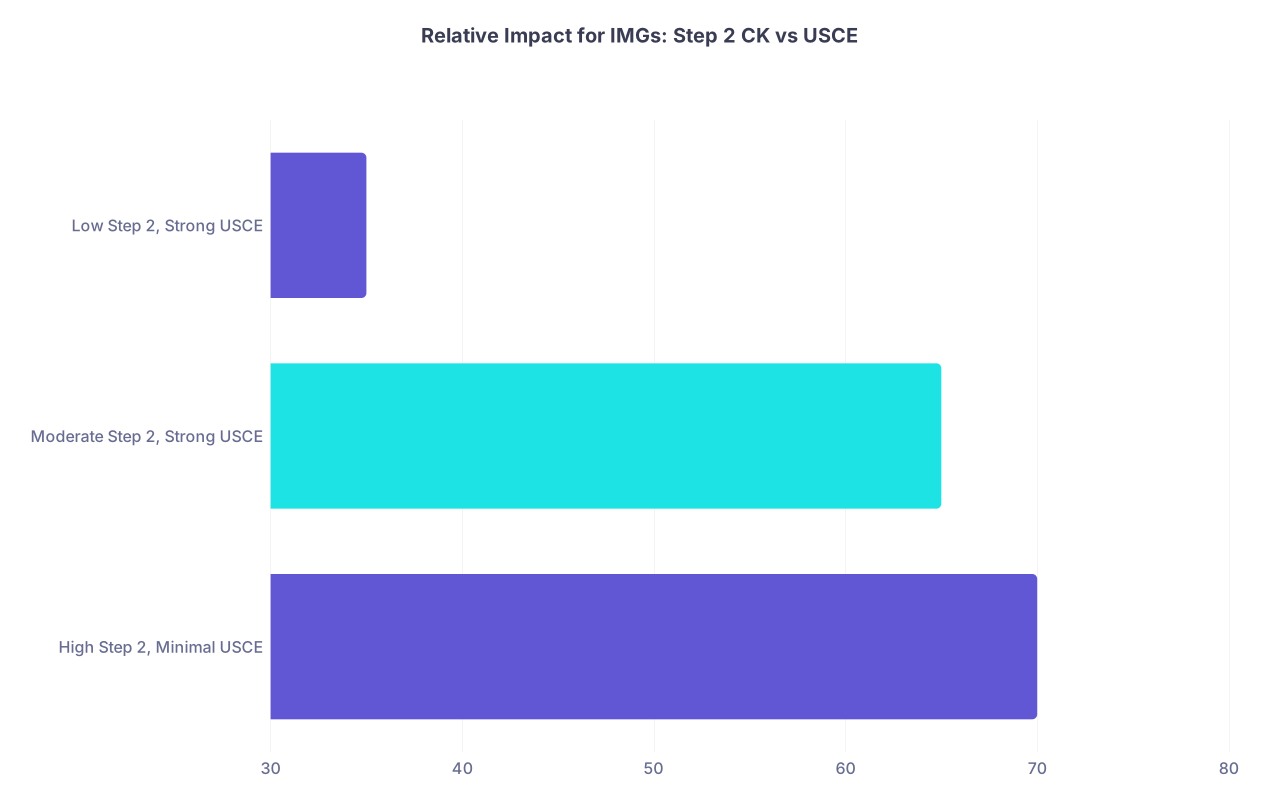
Visualizing impact: score vs USCE strength
| Category | Value |
|---|---|
| High Step 2, Minimal USCE | 70 |
| Moderate Step 2, Strong USCE | 65 |
| Low Step 2, Strong USCE | 35 |
Think of those numbers as “relative likelihood of being seriously considered” in IMG‑friendly IM/FM programs, not exact percentages. It’s directional: you want at least one strong pillar, ideally both.
Red flags you’re probably underestimating
A few patterns I see all the time that hurt IMGs:
260 Step 2, zero USCE, only home‑country letters
- Many PDs label you “unknown quantity in US system”
4–6 months of low‑quality observerships in random clinics, no teaching, no real letters
- Looks like busywork and sometimes like you don’t understand what matters
Strong USCE but letters are generic:
- “Hardworking and polite” with no specifics = faint praise
Aim for fewer, stronger experiences that generate real advocacy, not a huge list of weak entries.
Concrete plan you can build from today
Here’s how I’d map it if I were advising you one‑on‑one.

| Step | Description |
|---|---|
| Step 1 | Where are you now |
| Step 2 | Focus on Step 2 CK prep |
| Step 3 | Book USCE 1-3 months after exam |
| Step 4 | Plan 1-3 months focused USCE |
| Step 5 | Maximize USCE 3+ months |
| Step 6 | Secure 2-3 strong US letters |
| Step 7 | Build realistic program list |
| Step 8 | Step 2 CK taken |
| Step 9 | Score >= target |
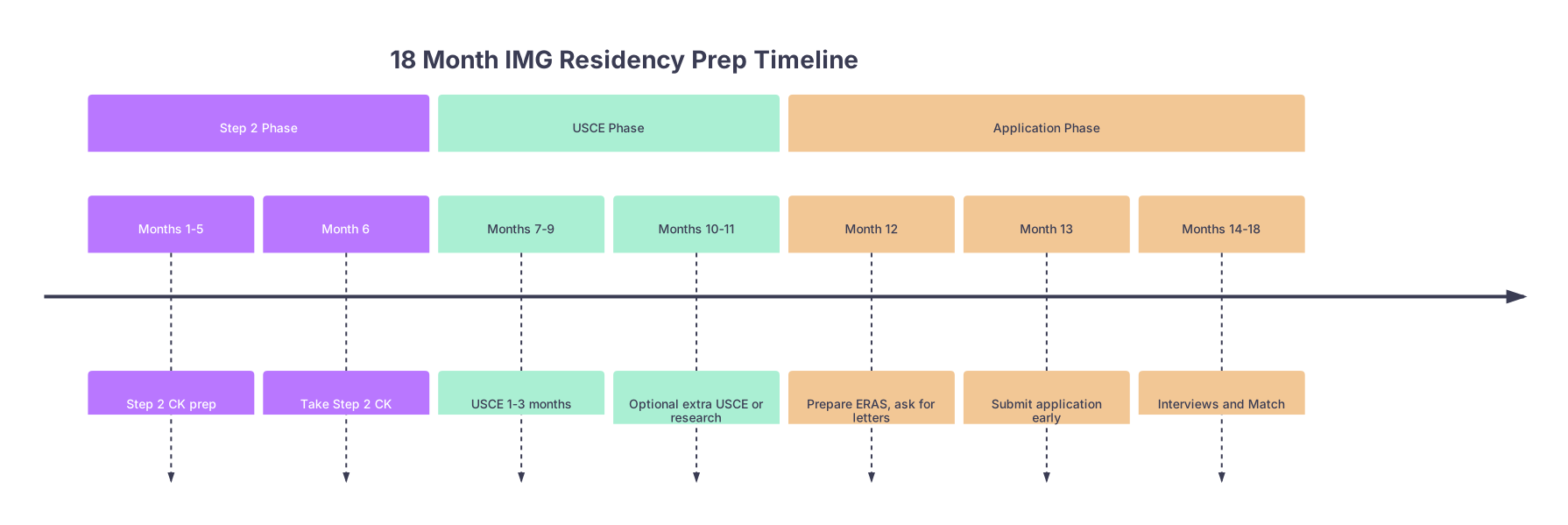
And for timing? Think like this:
| Period | Event |
|---|---|
| Step 2 Phase - Months 1-5 | Step 2 CK prep |
| Step 2 Phase - Month 6 | Take Step 2 CK |
| USCE Phase - Months 7-9 | USCE 1-3 months |
| USCE Phase - Months 10-11 | Optional extra USCE or research |
| Application Phase - Month 12 | Prepare ERAS, ask for letters |
| Application Phase - Month 13 | Submit application early |
| Application Phase - Months 14-18 | Interviews and Match |
Quick specialty-specific reality check
| Specialty | Step 2 Priority | USCE Priority |
|---|---|---|
| Internal Med | Very High | Very High |
| Family Med | High | Very High |
| Pediatrics | High | Very High |
| Psychiatry | High | Very High |
| Neurology | Very High | Very High |
| Anesthesia/EM | Extremely High | Extremely High |
For IM/FM/Peds/Psych, I’ve seen solid USCE and great letters save people with mid‑range scores. For anesthesia/EM, it’s brutal: you usually need top scores and strong USCE.
FAQ: USCE vs Step 2 CK for IMGs
1. If I can only afford one: USCE or higher Step 2 CK attempt?
If you haven’t taken Step 2 yet, invest in getting the highest score you can on the first attempt. A repeat attempt looks bad. One strong score plus at least 1 month of USCE (even if cheaper/shorter) usually beats mediocre score plus long USCE.
If you already scored low and can’t safely retake, then focus your money on high‑yield USCE (teaching hospital, inpatient, your specialty).
2. How many months of US clinical experience is “enough” for an IMG?
For IM/FM/Peds/Psych:
- Absolute minimum to be taken seriously: 1 month
- Competitive range: 2–3 months
- More than 4 months only helps if the quality and letters are excellent. Six months of mediocre observerships won’t save a weak application.
3. Does research in the US count as USCE?
Not really. It helps your research profile, can get you connections, and sometimes impresses academic programs. But for “Can they function day one as an intern?” research doesn’t replace clinical work. Best is research + at least 1–2 months clinical.
4. I have a 250+ Step 2 CK. Can I match without USCE?
Can you? Sometimes. Should you rely on that? No. Some very IMG‑friendly community programs might still interview you if everything else is strong, but many PDs are uncomfortable ranking IMGs with zero US experience. At least 1 month USCE with 1–2 letters is your insurance policy.
5. Are US observerships useless compared to externships?
Not useless, but weaker. A good observership in an academic hospital, where you:
- Present cases
- Attend rounds
- Build a relationship with an attending
And get a specific, detailed letter — that’s valuable. A “sit in the corner of clinic and watch” observership with a generic letter is almost worthless.
6. What should I do today to move this forward?
Today, do two things:
- Decide your realistic Step 2 CK target band (e.g., “I’m aiming for 240–245”).
- Open a spreadsheet and list 10–15 USCE options (electives, externships, observerships) in your desired specialty, with:
- Type (elective/externship/observership)
- Duration
- Cost
- Teaching vs private
Then pick the top 3 highest‑yield ones and send inquiry emails before the end of the day.
You don’t need a perfect plan. You need a Step 2 strategy and at least one real USCE slot on your calendar. Start there.