No – strong home-country clinical experience does not fully substitute for US clinical experience. But it can absolutely carry you if you understand where it helps, where it does not, and how to plug the gaps.
Let me be blunt: programs don’t “trust” what they don’t know. A glowing letter from the best hospital in your country often means less than a solid letter from a mid-tier US community program. Not because your experience is bad. Because they have no calibration for it.
Your job is to turn “good experience back home” into “proof you’ll function on day one in a US residency.” That means knowing exactly what home-country work can and cannot do for you.
1. How Program Directors Actually Think About Clinical Experience
Forget the romantic stories. Program directors are pragmatic. They’re asking three questions:
- Can this applicant function safely in my hospital on July 1?
- Will they understand US systems, culture, documentation, and team hierarchy?
- Can I defend this decision to my GME office and to my own residents?
Home-country clinical experience helps mainly with question 1: “Is this person clinically real, or just book-smart?” But it does almost nothing for question 2 unless it’s clearly tied to US-style practice, English-speaking environments, or comparable infrastructure.
What they prioritize for IMGs:
- US clinical experience (USCE) in an ACGME setting
- US letters of recommendation from attending physicians they trust
- Proof you can work in US teams (notes, sign-outs, EMR, pages, cross-cover)
- Communication skills with patients and staff in English
- Board scores and visa status, of course, but we’re talking clinical experience here
Home-country experience is your “baseline competency” proof. US experience is your “this person is already almost a US intern” proof.
2. What Home-Country Experience Can Do For You (When It’s Strong)
Now the good news: strong home-country clinical experience is not worthless. Far from it. When it’s real, long-term, and progressively responsible, it can be a major strength—especially for certain applicant types.
Home-country experience can:
Prove you’re clinically mature
If you’ve done 2–5 years as a resident, medical officer, MOI, SHO, GP, or equivalent, that looks much better than someone with just observerships and no hands-on history anywhere.Fill the “gap years” question
If your graduation was 6–8 years ago but you’ve been working full-time in clinical practice, that kills the “What have you been doing all this time?” concern.Show commitment to a specialty
Three years as an internal medicine resident back home is stronger commitment than 3 observerships in 3 different specialties in the US.Give real stories for your personal statement and interviews
Cases you managed independently, critical decisions, resource-limited environments—these make you sound like a real doctor instead of just a test-taker.Impress programs that value prior training
Some community IM, FM, psych, and even prelim programs like experienced physicians who can hit the ground running and take cross-cover without falling apart.
The leverage point: you must translate this experience into US-residency language. “Senior House Officer in Medicine with independent admission responsibility and overnight call” reads a lot better than “worked as a doctor in hospital.”
3. Where Home-Country Experience Fails to Replace US Experience
Here’s the part people try to avoid hearing: home-country clinical experience does not count as US clinical experience for match purposes. Period.
It cannot substitute for US time in at least four key ways:
It does not prove US system familiarity
Billing, EMR, resident roles, nursing expectations, documentation standards, autopopulated order sets—none of that is assumed from your home-country work.It does not create US-style, US-recognized letters
A PD in Ohio likely has no idea whether “XYZ National Hospital, Lahore” is elite, average, or mediocre. But they know exactly what a letter from “Community Hospital Internal Medicine Residency, PGY-3 clinic preceptor” means.It does not check the “USCE required” box
Many programs literally have a filter:- “US clinical experience required: Yes/No”
Your 4 years as an internal medicine physician in Egypt will not auto-fill that box in ERAS.
- “US clinical experience required: Yes/No”
It does not calm their fear about communication and culture
US medicine is extremely team-heavy and litigation-sensitive. PDs want to know you can:- Take a consult call from ED
- Present concisely
- Handle difficult patients without escalating conflicts
- Work with nurses and therapists without arrogance or miscommunication
Home-country experience may predict you can do these things. But US experience proves you already do them.
4. When Strong Home-Country Experience Can Partially Compensate
There are situations where great home-country experience can reduce the amount of US time you need, or make borderline US experience “enough.”
Here’s the pattern I’ve seen work in real matches:
Applicant A
- 3 years as internal medicine resident in India
- 2–3 good US observerships (not hands-on)
- Strong USMLE scores (say 235+ Step 2 CK)
- Good English, decent statement, no huge red flags
Result: Matches into community Internal Medicine or Family Medicine, especially in programs familiar with Indian grads.
Applicant B
- 5+ years as general practitioner in rural setting
- 1–2 months US externship/observership in FM/IM
- Solid scores
Result: Reasonable FM chance, maybe IM, especially if the US letters are strong.
In these cases, home experience did not “replace” US experience, but it allowed limited USCE (2–3 months) to be acceptable rather than “must have 6–12 months.”
Compare that to:
- Applicant C
- Same home experience, no USCE at all
- Strong scores
Result: Much harder. Will need to apply very broadly, focus on FM/psych/IM lower tier, and still has a question mark.
5. How Much US Experience Do You Actually Need?
You’re probably trying to answer a more practical question: “Can I get away with minimal USCE if my home experience is very strong?”
Rough ballpark, for a typical IMG with solid home-country clinical experience:
| Specialty Type | Competitive Level | Typical USCE That Works |
|---|---|---|
| Family Medicine | Less competitive | 1–3 months |
| Community Internal Med | Moderate | 2–4 months |
| Psychiatry | Moderate | 2–3 months |
| Pediatrics | Moderate+ | 3–4 months |
| Neurology | Moderate+ | 3–4 months |
This is not a rulebook. But it’s close to what I’ve seen across hundreds of applications.
If you have:
- 3+ years home-country training or work
- Strong, clearly described responsibilities
- Great scores
- AND 2–3 months of targeted USCE with solid letters
You’re in a workable range for many community programs. Especially in FM and IM.
If you have no USCE at all, you’re trying to win a game where many programs won’t even read you.
6. How To Make Home-Country Experience Work Harder For You
Since you can’t turn it into USCE, you need to squeeze all the value you can from it.
Here’s how:
Translate roles into US-residency terms
Instead of “Medical Officer,” explain in your CV/ERAS experience description:
“Equivalent to PGY-2 internal medicine resident with independent responsibility for admissions, daily rounds, and overnight calls under attending supervision.”Be specific with numbers and scope
- “Managed 15–20 inpatients per day on general medicine ward”
- “Performed ~200 lumbar punctures, 50 central lines…” (if appropriate)
- “Primary prescriber for a clinic panel of ~800 chronic disease patients”
Get the strongest possible narrative in your home letters
The letter itself is not as valuable as a US letter, but if it’s compelling, programs notice:- “She functioned at the level of our graduating residents.”
- “We offered him a faculty position when he completed his training.”
Use it to back up your specialty choice
Don’t say you love IM if your last 5 years were pure dermatology. Or vice versa. Align.Show progression
Intern → Resident → Senior → Junior consultant.
If your home country experience just looks like “random general doctor,” you’ve wasted real work.
7. Tactics If You Have Strong Home Experience but Little/No USCE
Let me give you a realistic blueprint.
Scenario 1: Strong home experience + 0 months USCE
You should:
- Prioritize getting some USCE before applying, even 4–8 weeks
- Consider virtual US rotations only as an add-on, not a replacement
- Target:
- Family Medicine
- Community Internal Medicine
- Psychiatry in IMG-friendly states
- Expect to apply very broadly (100+ programs)
- Lean heavily on:
- Personal statement with strong clinical stories
- Well-structured CV highlighting home work

| Step | Description |
|---|---|
| Step 1 | Strong Home Experience |
| Step 2 | High Priority - Get USCE |
| Step 3 | Apply Broadly |
| Step 4 | Competitive for Many Community Programs |
| Step 5 | Short Observerships or Externships |
| Step 6 | Focus on FM, IM, Psych |
| Step 7 | Target IMG Friendly Programs |
| Step 8 | Any USCE? |
Scenario 2: Strong home experience + 1–3 months USCE
Here, your home experience can meaningfully boost you.
You should:
Make sure your USCE is:
- Specialty-aligned
- In an ACGME or US hospital with residents
- Giving you at least 1–2 strong US letters
Apply to:
- FM, IM, Psych, Neuro, occasionally Peds depending on profile
Still apply broadly, but you’re now in a more respectable range
Scenario 3: Strong prior training (e.g., completed residency abroad) + 3–6 months USCE
This is where home experience really amplifies:
- Finished IM residency abroad + US rotations in IM clinic + letters from US IM attendings = very attractive to many community IM programs.
You sell yourself as: “Already a trained internist, now ready to convert that into US board eligibility.”
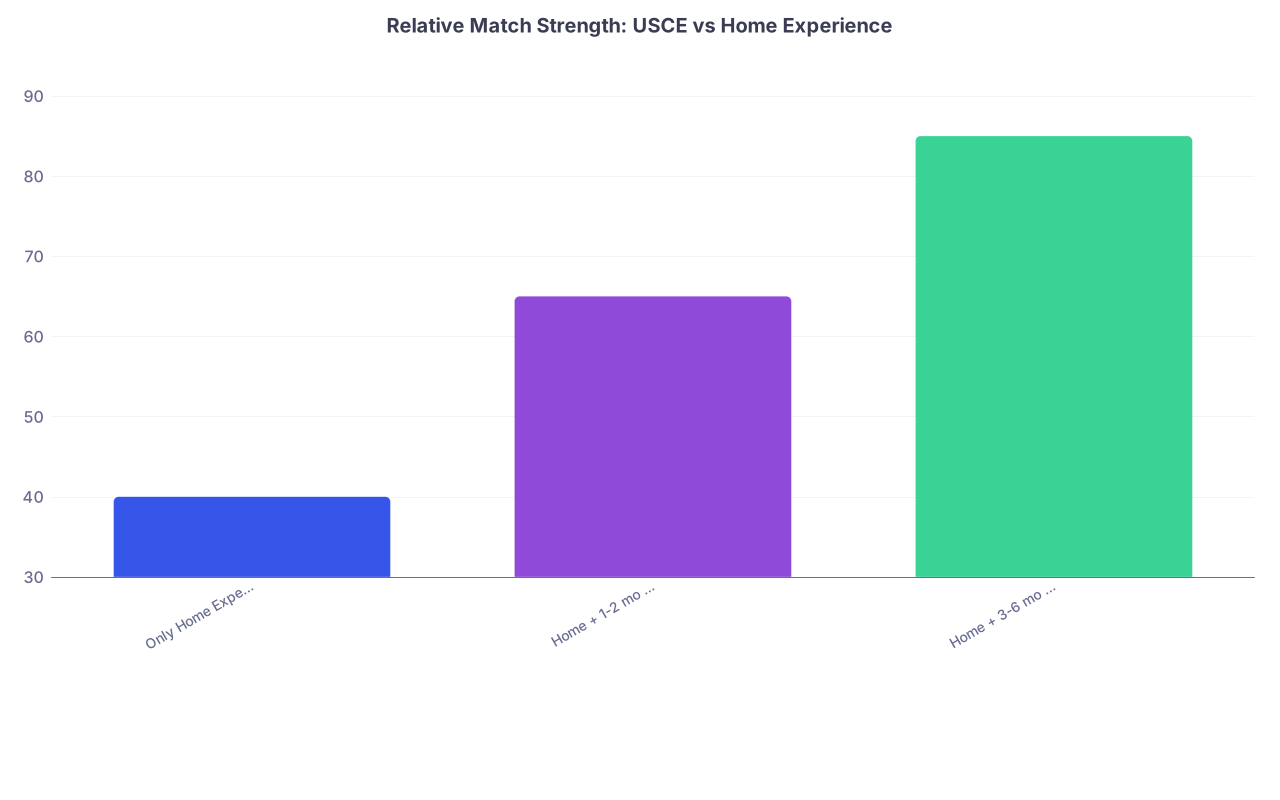
| Category | Value |
|---|---|
| Only Home Experience | 40 |
| Home + 1-2 mo USCE | 65 |
| Home + 3-6 mo USCE | 85 |
(Values are illustrative, but the curve is real: USCE multiplies the power of home experience.)
8. Special Cases: When Home Experience Might Matter More Than Usual
A few situations where home experience punches above its weight:
Research-heavy, academic home positions
If you were in a major teaching hospital, with publications, teaching roles, and named positions, that looks more like “equivalent to academic US setting” and can impress some PDs.Scarce-specialty exposure (e.g., neurology, psych, heme-onc)
Long-term work in a specialty with few US rotations available can be valuable—especially if programs know your institution.Programs with faculty from your country or region
If a PD or core faculty trained where you did, the calibration problem disappears. They know exactly what “Senior Registrar at X Hospital” means. I’ve seen this single factor swing decisions.
9. Practical Answer: Can Strong Home-Country Experience Substitute for US Time?
Let me answer your title question cleanly.
Can strong home-country clinical experience substitute for US time?
No, if by “substitute” you mean:
- You don’t need USCE at all
- Programs will treat it as the same thing
- It will satisfy “USCE required” filters
Yes, partially, if you mean:
- You might get by with fewer months of USCE
- Programs will overlook limited USCE if your home experience is deep, recent, and clearly described
- You’ll be chosen over weaker candidates who did 1–2 US observerships but have almost no genuine clinical maturity
If you force me to put it in one sentence:
Home-country experience is your foundation; US experience is your ticket in the door. You need both, but you can sometimes get away with a smaller ticket if your foundation is rock-solid.
FAQ: Strong Home-Country Experience vs US Clinical Experience
1. If I have 5+ years as an attending in my home country, do I still need USCE?
Yes. Even senior consultants from abroad need US exposure. Programs must see you work in the US system, with US documentation, EMR, and team dynamics. You may need less USCE than a fresh graduate, but “zero” is a bad idea.
2. Do observerships count as US clinical experience?
They’re the weakest form, but they’re still better than nothing. Externships and hands-on elective rotations (if done as a student) are stronger. Ideally you want at least 1–2 rotations where attendings can comment on your clinical reasoning and team behavior, not just that “you watched rounds.”
3. Are home-country letters useful at all if I already have US letters?
Yes. They’re secondary but still helpful. US letters go front and center. Strong home-country letters can back up your story of long-term clinical maturity, especially if they highlight your level being “equivalent to senior resident” or “junior consultant.”
4. How should I explain my home-country role on ERAS?
Spell out your responsibilities in US-style language: patient load, procedures, call schedule, level of supervision, any teaching roles. Don’t just write “resident” or “medical officer.” That’s not enough. You want: “Responsible for 15–20 inpatients daily; led rounds; supervised 2 interns; handled overnight admissions and cross-cover.”
5. Can I match with zero US clinical experience at all?
Possible but tough, and usually only in the most IMG-friendly settings, primarily in Family Medicine or some community Internal Medicine programs. You’ll need excellent scores, strong home experience, and a broad application strategy. But if you’re serious about maximizing your chances, aim for at least a couple of months of USCE.
Key takeaways:
- Strong home-country experience is valuable, but it’s not a true substitute for US clinical experience in the eyes of residency programs.
- Use your home experience to prove maturity and depth, then add enough targeted USCE to make programs comfortable trusting you on day one.