
The biggest mistake IMGs make on ERAS isn’t “not enough USCE.” It’s hiding the US clinical experience they do have in the wrong places so programs barely see it.
You don’t need more random observerships. You need to put the experience you already have where program directors actually look, in the format they expect, with descriptions that scream, “This person can function in a US hospital.”
Let’s walk through exactly where and how to list and describe US clinical experience on ERAS so it actually helps you match.
The 3 Places Your US Clinical Experience Must Appear
If your USCE is only in the Experiences section, you’re under-using it. For maximum impact, it should show up in three places:
- ERAS “Experience” section
- ERAS “Education” or “Training” section (for certain types)
- Personal statement and CV (to tie the story together)
Here’s the quick map:
| Type of USCE | Primary ERAS Section | Also Mention In |
|---|---|---|
| Hands-on externship | Experience | Personal statement, CV |
| Observership | Experience | Personal statement (brief) |
| Research with clinic time | Experience | Education/Training (if formal) |
| US sub-internship/elective | Education | Experience (optional) |
| Volunteer clinical work | Experience | Personal statement, CV |
Now let’s break each down and get specific.
1. ERAS Experience Section: Your Main USCE Real Estate
Think of the Experiences section as your “USCE storefront.” This is where most program directors look first for hands-on or at-the-bedside work.
What belongs here?
List each meaningful US clinical role as its own entry if:
- It lasted at least 2–4 weeks, and
- You had real, continuous involvement (not a 1‑day shadowing or a single lecture)
That includes:
- Hands-on externships
- Observerships (yes, list them, but don’t oversell)
- Clinical research with direct patient contact
- Long-term clinical volunteering (ED volunteer, clinic volunteer, medical assistant roles)
Exact field-by-field strategy
For each USCE entry in the Experience section:
Experience Type
- For externships/substantial hands-on roles: choose “Clinical” or “Work”
- For observerships: “Clinical” is fine, but make sure you clearly label as “Observer” in the position title
- For volunteering: choose “Volunteer”
Organization Name
Use the hospital/clinic name, not just the company that arranged it.
Good:
- “Cleveland Clinic – Department of Internal Medicine”
- “NYU Langone – Family Health Center at Sunset Park”
Weak:
- “AMO Opportunities – Internal Medicine Observership” (use that only in the Description if needed)
Position/Title
Be brutally accurate. Program directors spot exaggeration immediately.
Use phrases like:
- “Clinical Extern – Internal Medicine”
- “Observer – Cardiology”
- “Volunteer – Emergency Department”
- “Research Assistant – Oncology (with outpatient clinic exposure)”
Do not write:
- “Resident”
- “Subintern” (unless it truly functioned like one and is school-approved)
- “Physician” for non-licensed roles
Start/End Dates & Average Hours/Week
Be honest and consistent. If you did:
- 4-week observership, full-time → 40 hrs/week
- 3-month externship, 4 days/week → 32 hrs/week
- 1-year Saturday clinic volunteer → maybe 4–6 hrs/week
Programs use this to judge how substantial the experience was.
Detailed Description (this is where most IMGs blow it)
You have very little space. Use it well.
Your description needs to do three things:
- Prove you functioned in a US clinical environment
- Highlight US-relevant skills
- Hint that attendings could write strong LORs based on your work
Use a simple 3-part mini-structure:
- 1–2 lines on setting and role
- 2–4 bullets or short sentences on concrete tasks
- 1 line on what you gained that’s residency-relevant
Example for a hands-on externship (this is strong):
Supervised clinical externship in a busy academic internal medicine service (inpatient and outpatient).
- Pre-rounded on assigned patients, presented to attending and residents on daily rounds
- Performed focused histories and physical exams under supervision and documented in EMR (Epic)
- Assisted with admission workups, medication reconciliation, counseling on chronic disease management
Gained familiarity with US hospital workflow, interprofessional communication, and documentation standards.
Example for an observership (honest, but still useful):
Observed inpatient cardiology team in a tertiary care center.
- Attended daily rounds, case discussions, and cath lab procedures
- Reviewed imaging, EKGs, and labs with residents and fellows
- Participated in teaching conferences and journal clubs
Developed understanding of US team structure, clinical reasoning style, and guideline-based management.
Notice what I didn’t do: I didn’t pretend an observership was hands-on. Don’t say “managed patients” or “performed procedures” if you didn’t.
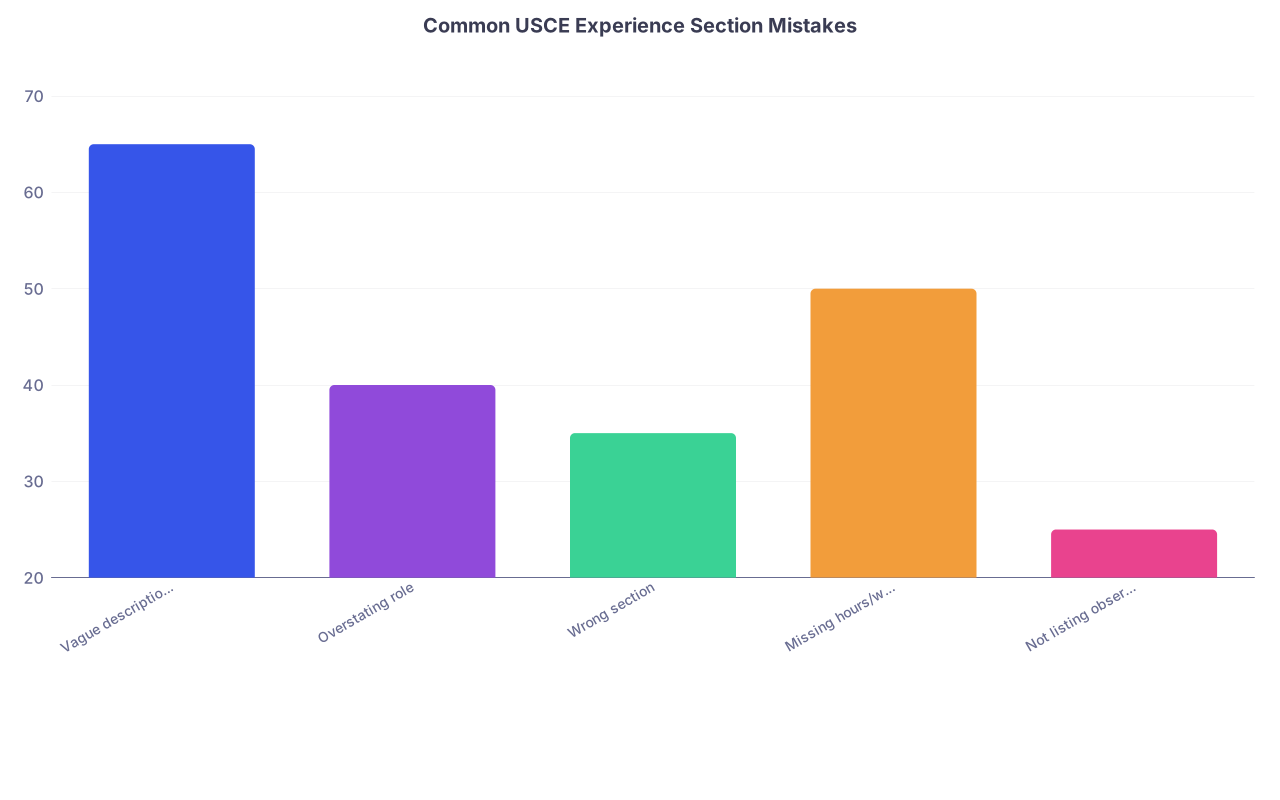
| Category | Value |
|---|---|
| Vague descriptions | 65 |
| Overstating role | 40 |
| Wrong section | 35 |
| Missing hours/week | 50 |
| Not listing observerships | 25 |
2. ERAS Education/Training Section: For Real Electives & Sub-Is
If you did official US clinical rotations through a medical school (especially 4th-year electives or sub-internships), those can live under Education or Training.
When to use Education for USCE
Use Education/Training when:
- The rotation appears on your medical school transcript
- It was part of your formal curriculum (e.g., 4th-year elective at a US med school)
- It’s labeled as “Clinical Elective,” “Subinternship,” or “Clerkship”
Example entry:
- Institution: “University of Miami Miller School of Medicine”
- Program Type: “Visiting Student – Clinical Elective”
- Description: “4-week subinternship in Internal Medicine at Jackson Memorial Hospital; functioned as part of ward team with supervised H&Ps, progress notes, patient presentations, and cross-coverage responsibilities.”
You can also add a short Experience entry pointing back to this if you want to highlight tasks more clearly, but don’t double-count or inflate.
If the elective was arranged privately, not school-sanctioned, and not on your transcript, it usually belongs in the Experience section as an “Externship,” not in Education.
3. Personal Statement & CV: Tie the USCE Into Your Story
Listing US clinical experience is step one. Making it mean something is step two.
How to reference USCE in your personal statement
You’re not writing a logbook. Name only the 1–2 most important USCE experiences and use them to:
- Show how you chose your specialty
- Prove you understand US practice style
- Demonstrate that attendings trusted you with real responsibility
Good examples:
- “During my externship at [Hospital], I followed a panel of complex heart failure patients over four weeks, which solidified my interest in internal medicine and taught me how continuity of care works in the US system.”
- “Observing the residency team at [Hospital] gave me a clear view of expectations for interns—pre-rounding, concise presentations, timely documentation—which I’ve tried to emulate in my subsequent rotations.”
Weak (and common) approach:
- “I did various observerships in the US where I learned a lot and saw how medicine is practiced here.”
Too vague. Useless.
CV strategy
If you’re sending a separate CV to programs (some still ask):
- Create a dedicated section: US Clinical Experience
- List each role with: institution, city/state, dates, title, and 1–2 bullet points
- Match the wording to ERAS for consistency
How to Prioritize and Organize Multiple USCE Entries
If you’ve collected a bunch of short rotations (common for IMGs using agencies), you need to make it easy for programs to see what actually matters.
Here’s how to think about weight:
- Highest impact:
- Hands-on externships with strong letters
- Subinternships / formal electives with real responsibility
- Medium:
- Longer observerships (>4 weeks) in your chosen specialty
- Long-term volunteer clinical roles
- Lowest:
- Multiple 1–2 week observerships that look like box-checking
If you have 6 minor observerships, don’t clutter your application with 6 nearly identical entries. You can:
- Combine similar ones:
“Internal Medicine Observerships – New York City hospitals (Multiple sites)” - Then in the description specify:
“Completed three 2-week observerships at community hospitals in NYC, attending daily rounds, clinics, and conferences in Internal Medicine.”
Programs care more about depth and continuity than sheer number.
What NOT To Do With US Clinical Experience on ERAS
Let me be blunt about the common missteps that quietly kill IMG applications:
Overstating your role
Writing “managed patients” or “provided independent care” when you were an observer. PDs read hundreds of these. You’re not fooling anyone.Leaving out hours/week
Makes your experience look like a one-off or purely symbolic.Hiding USCE under “Other Experience” with vague titles
If your title is “Intern” but you were really an observer, that’s a problem.Listing agency names instead of hospitals
“AMO” or “Chicago Clerkships Inc.” tells them nothing about your clinical environment.Writing fluff descriptions
“I learned teamwork and time management” with no actual clinical tasks listed. That’s what high schoolers write on resumes.Scattering USCE without a clear pattern
If your experiences are all over different specialties without explanation, your application looks unfocused. Use your personal statement to connect the dots.
Example: Strong vs Weak ERAS USCE Entry
Let’s compare quickly.
Weak Observership Entry
- Title: “Clinical Observer”
- Institution: “Hospital in New York”
- Description: “Observed doctors and learned about US healthcare system. Attended rounds and saw many patients. Improved communication and teamwork skills.”
Problems: too vague, generic, no tasks, no specialty, no sense of structure.
Strong Observership Entry
- Title: “Observer – Internal Medicine”
- Institution: “Mount Sinai Hospital – Internal Medicine”
- Description:
“Four-week observership on inpatient internal medicine service at academic center. Attended daily multidisciplinary rounds, case discussions, and teaching conferences. Reviewed patient charts, imaging, and labs with residents and discussed differential diagnoses and management plans.”
Better. Honest but concrete. Shows you understand how a US team functions.

Quick Decision Guide: Where Should Your USCE Go?
If you’re still unsure where a specific experience belongs, run it through this simple flow:

| Step | Description |
|---|---|
| Step 1 | US Clinical Experience |
| Step 2 | Education or Training section |
| Step 3 | Emphasize as subinternship or elective |
| Step 4 | List briefly, avoid exaggeration |
| Step 5 | Experience section as Clinical or Work |
| Step 6 | Detail tasks and EMR use |
| Step 7 | Experience section as Clinical |
| Step 8 | Short, honest, concrete description |
| Step 9 | On medical school transcript |
| Step 10 | Had real clinical responsibilities |
| Step 11 | Hands on or observer |
If you want, paste a couple of your actual USCE descriptions here (with identifying info removed), and you can tighten them using this exact framework.
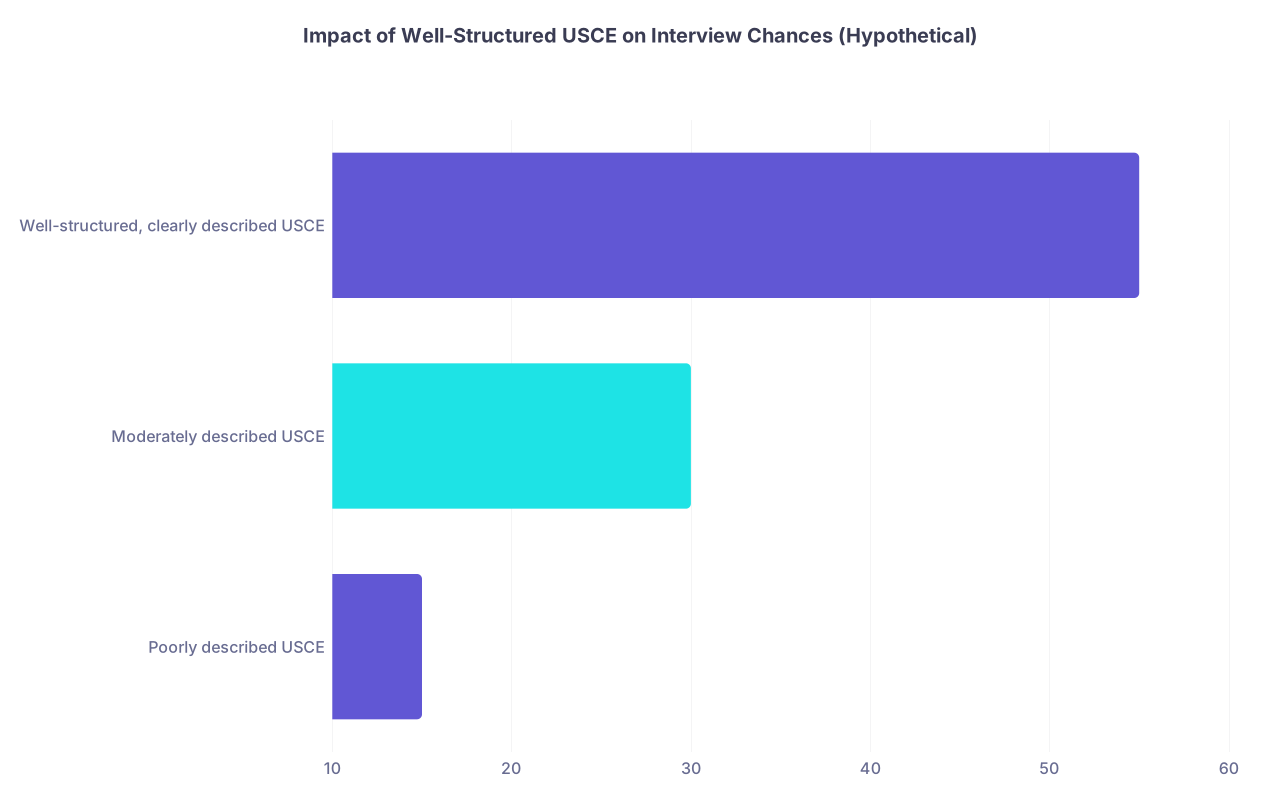
| Category | Value |
|---|---|
| Poorly described USCE | 15 |
| Moderately described USCE | 30 |
| Well-structured, clearly described USCE | 55 |
FAQs
1. Should I list observerships at all, or do they hurt my application?
List them. They don’t hurt you if you’re honest and concrete. They only hurt when you:
- Overstate your role
- List ten tiny, scattered observerships that look like desperation
- Fill the description with fluff and buzzwords instead of tasks
A couple of well-presented observerships in your target specialty is perfectly fine, especially for IMGs.
2. If I did a paid externship through an agency, do I say it was “hands-on”?
You describe exactly what you did. If you:
- Took histories and performed physical exams under supervision
- Wrote notes in the EMR
- Presented on rounds
…then yes, you can describe it as supervised, hands-on clinical experience. But still use modest wording: “performed focused histories and physical exams under attending supervision.” Don’t use “resident-level responsibilities” or anything that sounds inflated.
3. Should I group multiple short observerships together or separate them?
If they’re:
- Same city, similar setting, same specialty → grouping is often better
- Different specialties / hospitals / time frames → separate the most important ones and consider grouping the minor ones
Rule of thumb: If a single observership generated a strong letter of recommendation, give it its own entry.
4. My USCE was mostly telehealth. Do I still list it?
Yes, but be clear that it was telehealth and focus on what’s actually relevant:
- Reviewing charts and labs before virtual visits
- Participating in telehealth encounters with the supervising physician
- Learning US documentation and follow-up workflows
Don’t pretend it was in-person ward work. Programs understand telehealth is part of modern practice; they just don’t want to be misled.
5. How many USCE entries is “enough” for an IMG?
There’s no magic number, but here’s what I see work:
- 1–2 substantial, hands-on externships or electives in your chosen specialty
- 1–2 additional experiences (observerships or clinics) that show continuity or breadth
- 1 solid US letter (ideally 2) from those experiences
Six short observerships do not equal two deep, engaged experiences. Depth beats volume.
6. Should I repeat the same USCE details in Experiences, Education, and my personal statement?
You should align, not copy-paste. Keep:
- Same hospital name, dates, and title across sections
- Descriptions that are consistent but not identical
On ERAS: factual, task-focused descriptions.
In your personal statement: 1–2 short stories or reflections that show how those experiences shaped your path.
Now, open your ERAS Experience section and pick one USCE entry. Rewrite the description into 3–5 concrete lines: setting, your actual tasks, and what you learned that matters for residency. That one change alone will move you ahead of a big chunk of the IMG pool.