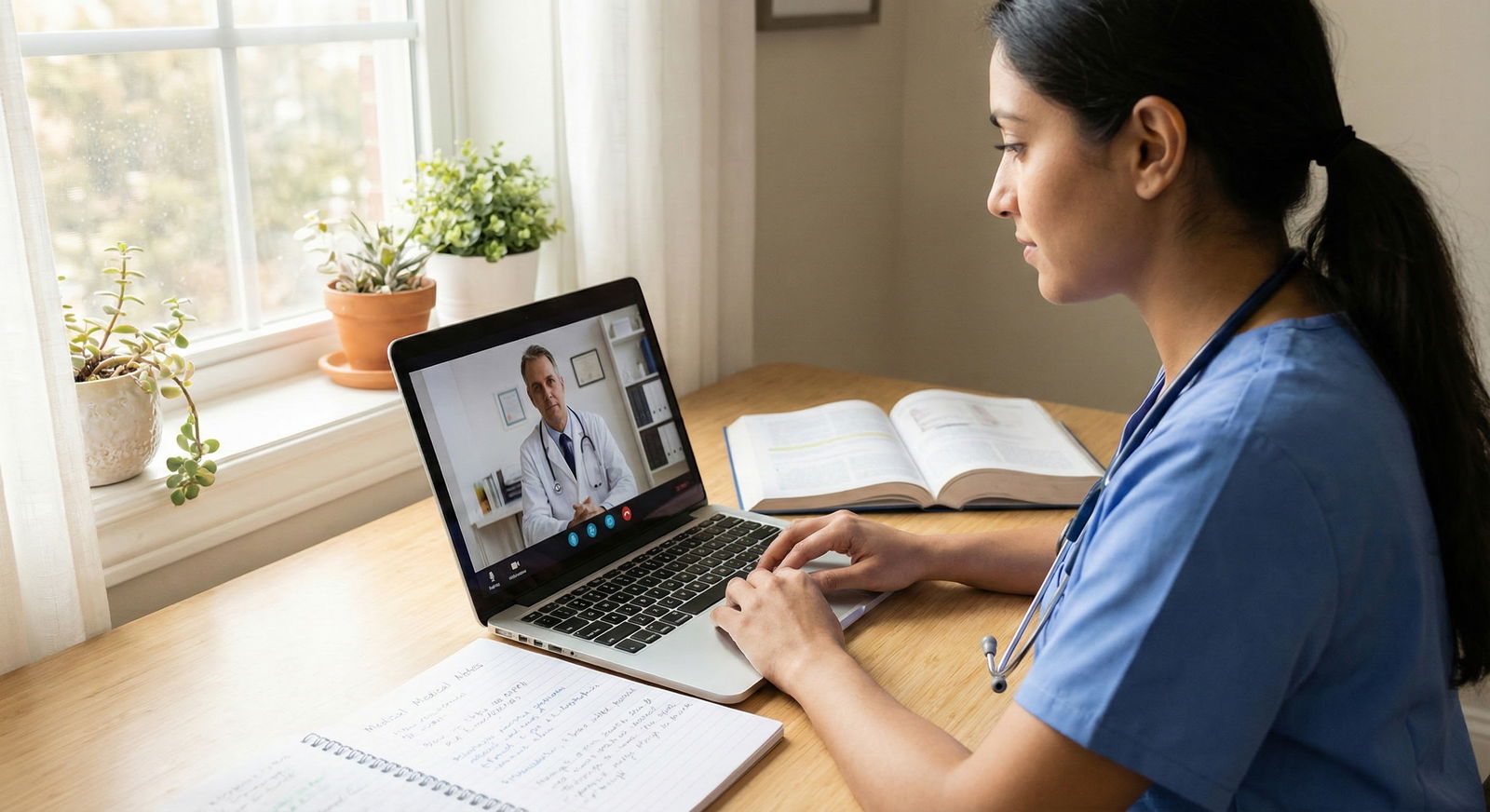
It’s August. You’re abroad, graduation is behind you, and ERAS season is coming fast. Every US program website keeps repeating the same phrase: “US clinical experience required or strongly preferred.”
You don’t have a visa yet. You’re not in the US. But your inbox is full of ads for “US Tele-Clinical Experience,” “Online Clerkships,” “Virtual Rotations – Guaranteed LORs.”
You’re asking the exact right question:
Do these online or tele-clinical experiences actually help IMGs with US residency programs, or are they mostly a waste of money?
Let me be blunt:
They can help a little, in a very specific way, but they are not a replacement for real, in-person US clinical experience. And if you treat them like they are, you’ll get burned.
Let’s break this down properly so you can decide whether to spend your time and money on them.
1. What Programs Actually Mean by “US Clinical Experience” (USCE)
Before you can judge online or tele-clinical stuff, you need to know what PDs (program directors) are talking about when they say “USCE.”
When most IM programs, FM programs, and many others say USCE, they mean:
- Hands-on, in-person clinical work
- In a US hospital or clinic
- With direct patient exposure (history, physical, note writing, etc.)
- Under the supervision of a US physician who can write a strong, specific LOR
That usually looks like:
- Observerships (for grads, non-hands-on but in-person)
- Externships (hands-on, usually for grads)
- Electives / sub-internships (for students, most valuable)
- Inpatient or outpatient rotations in the US
Tele-clinical and online rotations?
Most PDs put those in a different bucket: “supplemental experience” or “remote learning.” Not real USCE.
So the core answer:
If a program writes “US inpatient experience required” or “US hands-on experience strongly preferred,” online/tele-clinical will not meet that requirement.
But that doesn’t mean they’re useless. It just means you need to know what they are and are not doing for you.
2. Types of Online / Tele-Clinical Experiences (And How Programs See Them)
Let’s sort out the main formats, because they’re not all equal.
| Type | How Programs Usually View It |
|---|---|
| Telehealth shadowing (live) | Mildly positive, supplemental |
| Online case-based courses | Neutral, minor academic plus |
| Paid “virtual rotations” | Variable, often skeptical |
| Tele-research with US faculty | Positive if it produces output |
| Remote QI/project work | Positive if concrete results |
1. Telehealth Shadowing (Live, With Real Patients)
Example: You log onto a HIPAA-compliant platform, join a US clinician seeing real patients, observe the visit, maybe help with documentation or literature review.
How PDs view it:
- Better than nothing
- Shows some exposure to US-style clinical reasoning, documentation, and patient communication
- Still not equal to in-person rotations
Where it helps:
- Explaining in your personal statement that you understand US healthcare flow
- Slight boost if you have no other US connection
- Can support a letter if the preceptor is strong and actually worked with you closely
Where it doesn’t:
- It will not magically transform your application the way a strong in-person sub-I or observership does.
2. Online Case-Based Courses / Virtual “Clerkships”
These are structured Zoom sessions or LMS-based courses: case discussions, lectures, maybe “OSCE-style” videos.
How PDs see it:
- Academic enrichment, not clinical experience
- Similar to an online CME or course
Good for:
- Filling gaps in your CV if you’ve been inactive clinically
- Talking about “recent clinical engagement” when asked about gaps
Bad for:
- Trying to pass it off as direct clinical work
- Expecting it to satisfy “US clinical experience” checkboxes
3. Paid “Virtual Rotations” with Guaranteed LORs
These are the most controversial.
You pay a few thousand dollars to “rotate” via Zoom; they promise a letter of recommendation at the end.
I’ve seen PDs actively roll their eyes at these.
How they’re viewed:
- Often as glorified coursework, sometimes as “pay-to-play”
- If the LOR sounds generic (“worked hard, attended all sessions, good knowledge”), it carries very little weight
Risk:
- You spend serious money for something that’s maybe a marginal line on your CV and a weak letter.
If you ever consider one of these, vet them hard:
- Is the supervising physician actually academic or involved in residency selection?
- Are there current or recent residents from the program who used it and matched well?
- Do they let you see a sample LOR (redacted) to judge quality?
3. Where Online/Tele-Clinical Experience Actually Helps
Let me be clear: it’s not useless. It’s just limited.
Here’s where it can genuinely help an IMG applicant:
A. When You Have a Clinical Gap
If you’ve been out of clinical practice for 1–3+ years, programs will ask, “What have you been doing?”
Being able to say:
- “I completed a 3-month telehealth-based clinical observership with a US internal medicine physician, seeing X patients/week, documenting notes, and discussing management…”
is much better than:
- “I was at home studying and waiting.”
This can prevent instant rejections at places that auto-screen for “recent clinical activity.”
B. Building US-Specific Talking Points
Interviews are full of questions like:
- “Tell me about your exposure to US healthcare.”
- “What differences have you seen between your home system and the US?”
If you’ve done tele-clinical work, you can talk about:
- EMR use
- Insurance/prior auth issues
- Team-based care
- Shared decision-making with patients
This can make you sound much more “US-ready” than someone whose only experience is from abroad.
C. Soft Signaling of Commitment
Programs like IMGs who clearly want the US system specifically, not just “any residency anywhere.”
Tele-experience can show:
- You’re actively trying to engage with US practice norms
- You’ve made an effort despite geography/visa/financial constraints
Does this outweigh weak scores or no real USCE? No.
But between two otherwise similar IMGs, it can be a minor tie-breaker.
D. Occasionally, A Useful LOR
Most tele-based letters are weak. But not all.
If:
- The physician is serious about teaching and observes your work closely
- You’re active — you read before sessions, send notes, help with QI or charts
- You follow through and make yourself memorable
Then a tele-based letter can be decent, especially if it comments on:
- Clinical reasoning
- Communication
- Reliability and engagement
Still: this is behind a strong in-person LOR. But it can supplement, especially if your only other letters are from your home country.
4. Where Online/Tele-Clinical Experience Does Not Help (Much)
Let’s kill some myths.
Myth 1: “Tele-rotations count as USCE on ERAS”
Programs aren’t stupid. Many have seen these exact buzzwords a hundred times.
If you put “US Tele-Clinical Experience – 4 weeks” and nothing in-person:
- Some will treat it as “no true USCE”
- Some will still consider you, especially community FM/IM programs
- Competitive programs will likely not be impressed
Myth 2: “A tele-rotation LOR is as good as an in-person one”
No. Not even close.
In-person US LOR hierarchy, roughly:
- US academic IM/FM attending who worked with you closely in-person
- US community attending with meaningful in-person work
- Research PI with strong clinical or academic reputation
- Tele-rotation attending who interacted with you heavily for weeks
- Generic “attended virtual sessions and was engaged” letter
That bottom category is basically padding.
Myth 3: “Online experiences can replace Step scores / gaps / weak profile”
They’re not magic.
If your profile has:
- Low Step 1/2
- Big unexplained gaps
- No in-person USCE
- No research / publications
…a tele-clinical experience isn’t going to flip the script. It gives you a slightly stronger narrative. That’s it.
5. How to Decide if Tele-Clinical Is Worth It For You
Here’s a practical way to think about it.
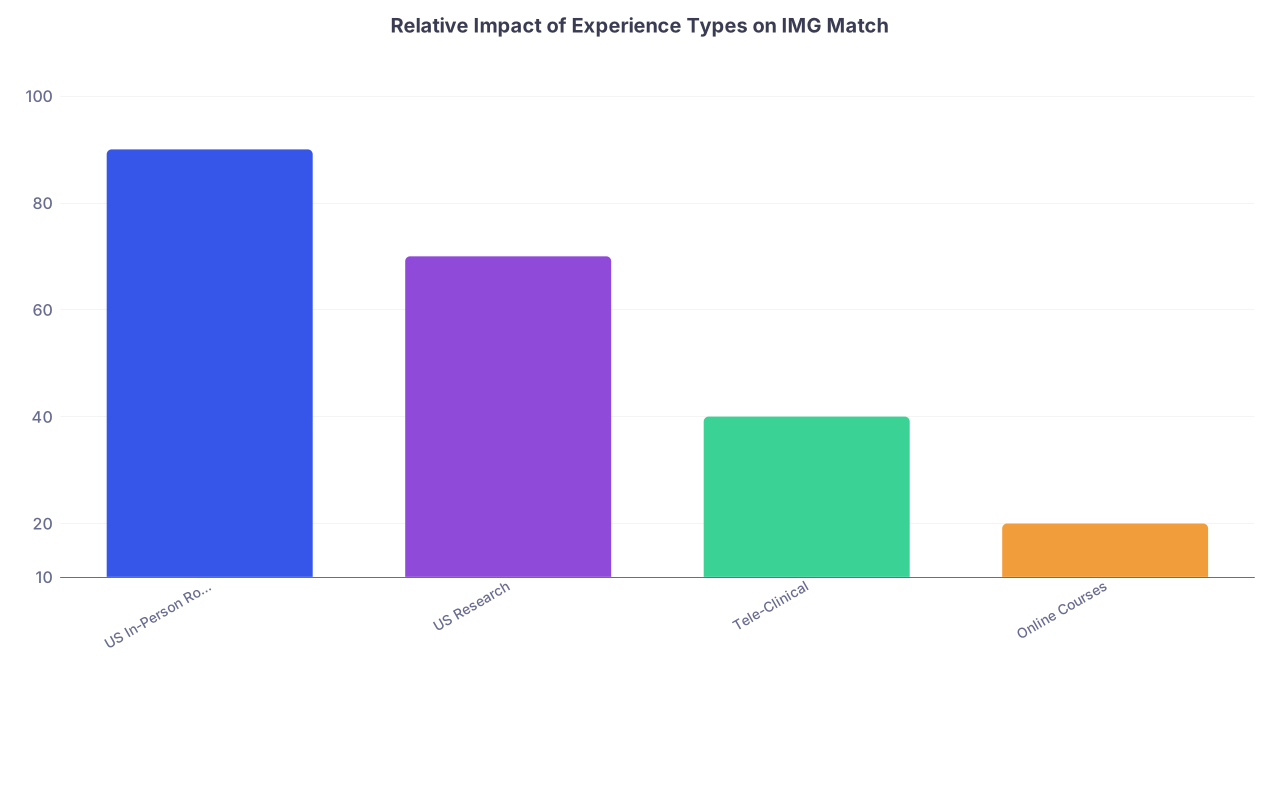
| Category | Value |
|---|---|
| US In-Person Rotation | 90 |
| US Research | 70 |
| Tele-Clinical | 40 |
| Online Courses | 20 |
Numbers are conceptual, not literal. But you get the idea.
Ask yourself three questions:
1. Do I Already Have In-Person USCE?
If yes, and it’s recent (last 1–2 years):
Tele-clinical is optional. It might add minor value, but it’s not critical.If no, and it’s impossible right now (visa, finances, etc.):
Then tele-clinical can be a reasonable stopgap. Not ideal, but better than a void.
2. What’s My Biggest Weakness?
- If your main weakness is no US exposure at all → tele-clinical can partially plug that gap.
- If your main weakness is low Steps or repeated attempts → tele-experience won’t fix that; your time may be better spent on research, publication, or targeted networking.
3. What Exactly Am I Buying?
Don’t ever buy “online experiences” blindly. Ask:
- Who is the supervising physician? Academic or purely private?
- Will I have live patient exposure, or just lectures/cases?
- Can I interact, ask questions, present cases, write notes?
- Is there a clear evaluation form or LOR structure?
- Can I contact past participants (who actually matched) and ask their honest opinion?
If they can’t answer these clearly, skip it.
6. How to Use Tele-Clinical Experience Strategically on Your Application
If you decide to do it, you need to present it correctly.
On ERAS – Experience Section
- Use clear titles: “Telehealth Observership in Internal Medicine – [Hospital/Clinic Name]”
- Describe concrete tasks:
- “Observed 10–15 live patient visits per week via telehealth”
- “Participated in case discussions and evidence-based management review”
- “Drafted sample notes and received feedback on documentation”
Avoid fluffy nonsense like “exposed to cutting-edge US medical practice.”
In Your Personal Statement
Tie it into a larger narrative:
- “Unable to travel to the US due to visa constraints, I sought alternative ways to understand US healthcare and completed a telehealth observership with Dr. X. Through weekly clinics, I learned how physicians integrated EMR-based documentation, addressed insurance barriers, and partnered with patients in shared decision making…”
That shows:
- Initiative
- Insight
- Some humility about its limitations
During Interviews
Be honest:
If they ask, “What US clinical experience do you have?”
You don’t say: “I’ve done a US rotation.”
You say:
- “I haven’t been able to complete in-person USCE yet because of [reason], but I did complete a telehealth-based observership with [institution/physician], where I [specific details]. I’m eager to transition that foundational understanding into hands-on work.”
That answer is honest, shows effort, and doesn’t pretend tele-experience is more than it is.
7. When You Should Skip Online/Tele-Clinical Experiences
I’d strongly question paying for tele-clinical if:
- You already have 2–3 solid US in-person rotations and decent LORs
- The program is vague, expensive, and marketed like an infomercial
- You’re diverting money from something higher-yield (actual US rotation, Step 3, visa fees)
You’re better off:
- Doing research with a US PI remotely
- Publishing a case report or review
- Taking on a structured QI project with outcome data
Those things often impress PDs more than a “virtual rotation certificate.”
FAQ (Exactly 7 Questions)
1. Do online or tele-clinical experiences count as “US clinical experience” for residency programs?
Usually no, not in the way programs mean it. Most PDs reserve “US clinical experience” for in-person work in US hospitals/clinics. Tele-clinical or virtual rotations are considered supplemental exposure or educational activities, not a substitute for hands-on or in-person observerships.
2. Can I get a useful letter of recommendation from a tele-clinical rotation?
Yes, but only if you actually worked closely and consistently with the physician. The letter needs to describe your reasoning, engagement, communication, and reliability in detail. Generic “attended online sessions and was attentive” letters carry very little weight. Always ask exactly how you’ll be evaluated before you sign up.
3. Is it better to do a tele-clinical experience or non-US in-person clinical work?
For pure residency value: a strong, active role in your home country (with responsibility, procedures, leadership) plus a good letter is usually more valuable than a weak tele-rotation. But if you have a big gap and zero current clinical work, tele-clinical can help show recent engagement and some US system familiarity.
4. Will tele-clinical experience help me if I have no in-person US rotations at all?
It won’t fully fix the problem, but it’s better than nothing. Programs that are flexible with IMGs may appreciate that you at least sought out US-style exposure. Competitive programs that strictly want in-person USCE will still see your application as incomplete.
5. Are paid virtual rotations a scam?
Not all, but many are overhyped. The problem isn’t that they’re fake; it’s that they often dramatically exaggerate how much weight PDs give them. Some provide okay teaching and a mild CV boost. Very few truly move the needle like a solid in-person rotation. If they promise “guaranteed LOR” and “huge advantage,” be skeptical.
6. How many weeks of tele-clinical experience is enough to list on ERAS?
You don’t get extra credit just for accumulating weeks. Four to eight weeks of meaningful, structured tele-experience with real patient contact and robust discussion is usually plenty. After that, marginal returns drop off. You’re better off adding research, QI, or exam prep than stretching it to 16–20 weeks.
7. I can’t travel to the US this year. What’s the best mix of things to do instead of only tele-clinical work?
Aim for a combination: one solid telehealth observership (preferably with potential for a good LOR), plus active clinical work in your home country, plus some US-linked research or QI with a US mentor if possible. Then use your personal statement and interviews to show you understand US practice and are ready to transition to in-person training when allowed.
Today, do one concrete thing:
Open a new document and list three specific questions you’ll ask any tele-clinical program before paying them (about supervision, evaluation, and real patient exposure). If a program can’t answer those clearly, it’s not worth your money.