
The hard truth: observerships and externships are not the same currency in the Match economy—and program directors know the difference instantly.
People love to blur this line in WhatsApp groups and consulting services because it’s convenient and profitable. “Any U.S. clinical experience is good,” they’ll tell you. Or, “An observership is basically like an externship without orders.” No. That’s like saying shadowing a pilot is “basically” flying the plane.
You’re an IMG. You do not have time, money, or visa flexibility to waste. So let’s kill the myths and look at what actually matters.
What Program Directors Really Mean by “U.S. Clinical Experience”
When a U.S. program director says, “We prefer applicants with U.S. clinical experience (USCE),” they are not thinking about the same thing you are.
You’re thinking:
“I saw patients in a U.S. hospital; that’s USCE.”
They’re thinking:
“Did this person function in a U.S.-style team where they actually did work I can evaluate and trust?”
That usually means at least one of:
- Wrote notes in the EMR (even if not official)
- Presented on rounds
- Formulated assessments and plans
- Gave sign-out
- Interacted with patients independently
- Called consults or discussed cases with other services
Observerships rarely allow any of this. Externships sometimes do.
Let’s define things the way PDs mentally categorize them, not the way agencies market them.
| Type of Experience | Typical Value for IMGs |
|---|---|
| U.S. Sub-internship / Acting Intern | Very High |
| Hands-on Externship w/ Documentation | High |
| Inpatient Paid Clinician Role (e.g., hospitalist scribe/associate in context) | Moderate–High |
| Shadowing / Observership (no orders, no notes) | Low–Moderate |
| Research Only (no clinical) | Low (for clinical readiness) |
If your “USCE” lives only in that bottom row, you’re playing on hard mode.
Observership vs Externship: What’s Actually Different?
Let me strip away the marketing language and give you the functional difference:
- Observership = You watch. You talk. You learn. You do not own patient tasks. You usually cannot write notes, place orders, or be responsible for anything that affects billing or liability.
- Externship = You participate. How much depends on the site. At the better ones you present patients, write draft notes, propose plans, and get grilled like a student or sub-intern.
Here’s the mismatch: many “externships” sold to IMGs are, functionally, dressed-up observerships.
If your day looks like this: you show up at 9, sit in clinic, listen, occasionally ask questions, no notes, no presentations, no call, you leave at 3–4 pm—congratulations, you’re in an observership, no matter what the certificate says.
If your day looks like this: you pre-round, see patients first, write draft H&Ps or progress notes (even if they don’t go in the official record), present on rounds, get assigned follow-ups, stay for sign-out—that’s approaching what PDs mean by meaningful USCE.
Does an Observership “Count”? Yes. But Not Equally.
Let me be blunt.
- Observerships do count as U.S. exposure on paper.
- They do not count the same as a strong externship, sub-internship, or hands-on rotation in the eyes of most PDs.
Where observerships actually help:
- Showing you’ve seen U.S. medicine from the inside: EMR, rounding style, documentation obsession, consult culture.
- Getting basic letters of recommendation from U.S. doctors.
- Filling a complete void of any U.S. anything on your CV.
Where they don’t help as much as people pretend:
- Proving you can function as an intern on Day 1.
- Convincing a PD you’re “ready for high-volume, fast-paced” residency just because you stood behind someone who was.
- Competing with someone who has real sub-I/externship level work documented.
Program directors aren’t stupid. They know the liability rules. They know that if your CV says “observership,” you probably didn’t write orders or sign notes.
And the data lines up with this reality.
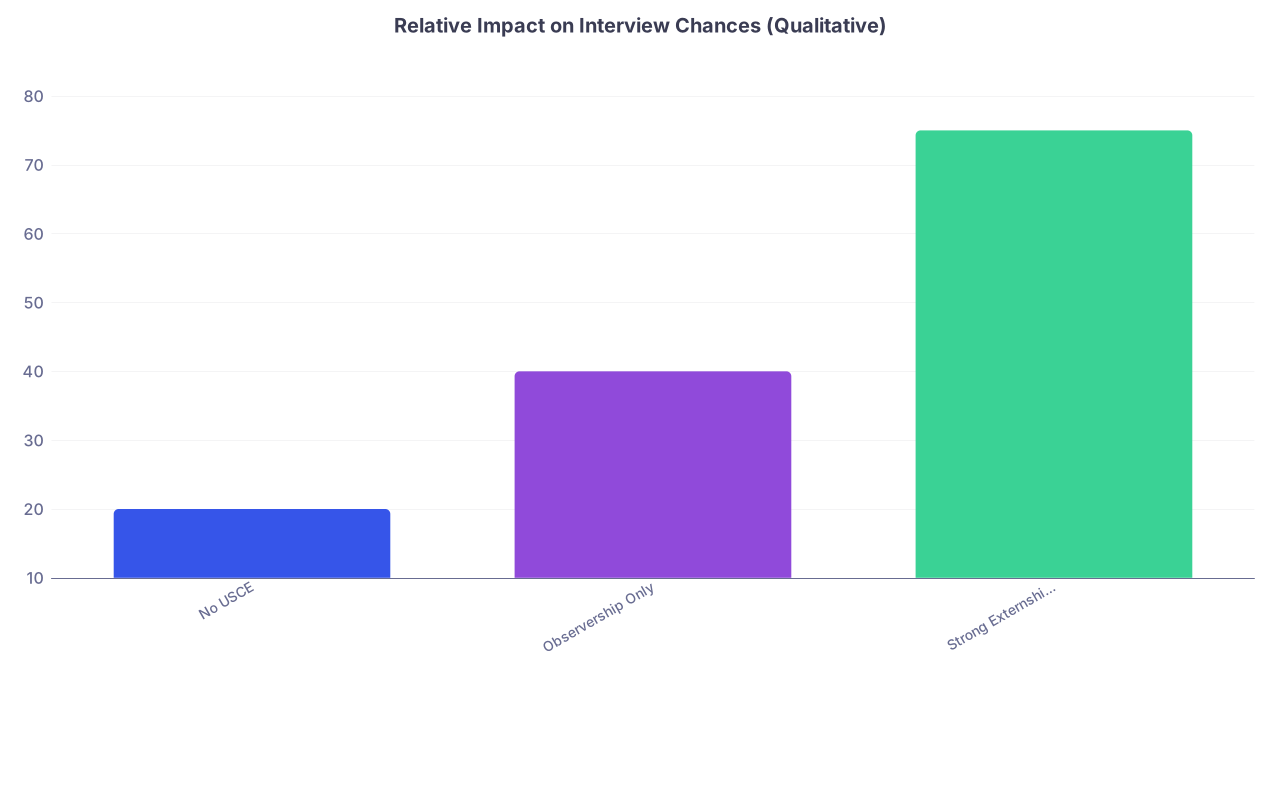
| Category | Value |
|---|---|
| No USCE | 20 |
| Observership Only | 40 |
| Strong Externship/Sub-I | 75 |
These numbers aren't from one perfect RCT—they’re a synthesis of NRMP PD survey responses, institutional preferences, and what actually happens when committees sort piles. They’re directional, not absolute. But the pattern is consistent: hands-on experience beats passive exposure every single time.
What the NRMP and PD Surveys Actually Show
You’ll hear this line: “NRMP doesn’t distinguish between observerships and externships, they just say ‘U.S. clinical experience.’ So it’s all the same.” That’s lazy.
Look at what PDs say they care about in the NRMP Program Director Survey:
- “Demonstrated ability to work in a U.S. clinical environment”
- “Strong letters of recommendation from U.S. faculty”
- “Experience with our health system”
That’s not observership language. That’s functioning on a team language.
When PDs rank factors, the big hitters are:
- Board scores
- MSPE / Dean’s letter (for AMGs)
- Letters of recommendation in the specialty
- Clerkship grades / clinical performance
For IMGs, those clinical performance signals come from your externships and sub-I-type experiences. Observerships can generate letters, but they’re often weak:
“Dr. X observed on my service and seemed enthusiastic and punctual.”
You know the type. Vague. No specific tasks. No statement like, “I would trust them as an intern in my program.”
Compare that to a letter from a real externship or sub-I:
“They saw their own panel of 4–6 patients daily, presented concise assessments, followed up labs and imaging, and consistently demonstrated clinical reasoning appropriate for an intern.”
That’s not the same category.
Common Myths About Observerships (And Why They’re Dangerous)
Myth 1: “Any U.S. clinical experience is better than none, so it doesn’t matter which.”
Partly true, but dangerously incomplete.
Sure, if your options are:
- Zero U.S. exposure
- One solid observership
Then yes, take the observership.
But if your options are:
- Two weak observerships
- One solid, hands-on externship
Then stacking more low-yield observership time is a bad trade. PDs will not be impressed that you watched more.
Think like a PD reading a CV:
- Candidate A: 4 months of observerships in random community clinics.
- Candidate B: 1 month of structured inpatient externship with presentations, notes, and a strong letter.
Candidate B looks more ready, despite fewer total months.
Myth 2: “If I collect enough observerships, it will look like serious U.S. experience.”
Quantity does not fix a quality problem.
Three or four observerships can actually backfire in discussions:
- “Why didn’t this person ever get a more hands-on role?”
- “Did they not impress enough to get invited for more responsibility?”
- “Why all these short, low-responsibility experiences?”
Hooks matter more than volume. One or two higher-quality, hands-on experiences beat six certificates of “Excellent Observer” where you basically shadowed all day.
Myth 3: “Programs don’t know the difference between observership and externship.”
They absolutely do. They live in this system. They know exactly what liability policies restrict students and observers from doing.
Even when an IMGs’ CV says “externship,” a lot of PDs read it and silently translate: “Let’s see what the letter actually says. Did they do real work or just sit there?”
If the letter describes only observation-type interaction, the fancy title changes nothing.
How to Make an Observership Actually Work for You
Now the part you actually need: if you’re stuck with observerships—which many IMGs are—how do you maximize the value?
You can’t turn an observership into a sub-I. But you can push it up the value chain.
Act like a sub-I, even if they call you an observer.
Show up early. Pre-read cases. Offer to present in a teaching context, even if you’re not allowed to officially present during rounds. Many attendings will let you do unofficial presentations at the end of rounds, or in a side room.Ask explicitly for responsibility—within policy.
“Would it be helpful if I drafted a note in Word for teaching purposes?”
“Can I create a problem list and assessment for this patient for us to review together?”
Some will say no. Some will say yes. The “yes” guys write better letters.Make it easy for them to evaluate you.
Don’t just stand in the back. Ask, “Can I follow 2–3 patients closely and update you daily?” You’re trying to give the attending real content: decision-making, reliability, follow-through.Extract a strong, narrative letter.
Near the end: “Would you feel comfortable writing a strong letter describing my clinical reasoning and work ethic? If not, I completely understand and would appreciate your honesty.”Force them—politely—to decide whether they saw enough to advocate for you. A lukewarm “observer” letter is almost as bad as no letter.
When an Observership Is Enough—and When It Isn’t
There are scenarios where an observership is honestly fine, or even optimal.
- You already matched at home, want U.S. exposure before fellowship.
- You’re applying to relatively IMG-friendly community programs where they just want to see some U.S. exposure plus decent scores and no red flags.
- Your Step scores are strong, your home-clinical performance is excellent, and you just need U.S. letters to round out your story.
But if any of the following are true:
- You have mediocre or marginal Step scores.
- You have gaps in training or a non-linear path.
- You’re aiming for semi-competitive internal medicine or any surgical field in the U.S.
- You’re more than 3–5 years from graduation.
Then leaning only on observerships is a risk. You’re asking PDs to take a chance based on passive exposure plus your word that you’ll “work hard.”
They’ve heard that line from hundreds of applicants who melted on wards.
How to Prioritize If You’re Limited by Visa, Money, or Time
Most IMGs are. So let’s be pragmatic.
If you can only afford one substantial U.S. experience:
- Choose the most hands-on, structured, teaching-focused program you can find, even if it’s shorter.
- One good month of real responsibility > three months of watching in random clinics.
If you already have:
- 1–2 decent observerships and
- No hands-on rotation
Your next priority should not be more observerships. It should be any way to get into a setting where you:
- Present
- Write draft notes
- Are explicitly evaluated on clinical skills
This might mean:
- A formal externship program (yes, some are worth the money; most aren’t—read the fine print).
- A “visiting student” elective if your school credentials allow it.
- A transitional program where you’re hired into some quasi-clinical role that lets attendings see you think.
One More Ugly Truth: Most Marketing Around IMGs Lies by Omission
If you’ve seen phrases like:
- “Hands-on observership!”
- “Clinically immersive shadowing!”
- “Externship/observership hybrid!”
That’s code for: “We know you care about hands-on, but we can’t legally give you what a U.S. fourth-year medical student gets, so we’re going to blur the line.”
Real hands-on roles don’t need this kind of linguistic gymnastics. They’ll spell out:
- “You will pre-round on your assigned patients.”
- “You will present to the attending daily.”
- “You will draft notes for feedback.”
If all you see is “observe, attend lectures, discuss cases,” that’s shadowing with extra steps.
The Bottom Line: What Actually Matters to Your Match Chances
Strip the noise away and you’re left with three facts.
Observerships and externships are not equivalent signals.
Observerships show exposure; externships (real ones) show function. PDs select for function under pressure, not polite interest.A small amount of high-quality, hands-on experience beats a large amount of passive watching.
One strong month with real tasks and a powerful letter will do more for you than six months of standing at the back of the room collecting certificates.If observerships are all you can get, you must make them behave more like externships.
Take initiative, ask for responsibility, and push for narrative, specific letters. Stop acting like a tourist. Start acting like a future colleague being test-driven.
You’re not just collecting “U.S. clinical experience.” You’re building proof that you can do the job they’re terrified of giving to the wrong person. Treat observerships, externships, and every day in a U.S. hospital through that lens—and you’ll make smarter, harder, but far more effective choices.