
Using US Clinical Experience to Target Specific Program Types as an IMG
Most IMGs waste their US clinical experience. They collect letters and lines on a CV, then apply to every program in a specialty and hope the Match algorithm saves them. That approach is lazy, expensive, and statistically brutal.
You should be using your US clinical experience (USCE) like a guided missile: to aim at specific program types where your profile actually fits.
Let me walk you through how to do that step by step.
Step 1: Understand What Different Program Types Actually Care About
You cannot target what you do not understand. “I want an academic IM program” is not a strategy; it is a wish. Different program types value different things from your USCE.
Here is the core reality:
- Academic university programs care about:
- Research or QI output from your USCE
- Strong letters from academic faculty with recognizable names
- Evidence you can function in a complex, teaching-heavy system
- Community hospital programs care about:
- Reliable work ethic and team fit
- Strong clinical performance and clear communication
- Letters that say “I would gladly work with this person again”
- Community programs with university affiliation sit in the middle:
- Some value for research/teaching
- High value on clinical productivity and independence
- “IMG-heavy” safety programs care about:
- Evidence you understand US hospital culture
- Clear documentation, reliability, and basic competency
- Proof that you will not require hand-holding
So if your USCE is:
- Research-heavy with minimal direct patient care → more leverage with academic programs
- Hands-on inpatient work with scut and call → great leverage with community and IMG-heavy programs
- A mix of both → you can and should target both lanes, but you need to present it differently in each application
To make this concrete:
| Program Type | What They Value Most From USCE |
|---|---|
| Big-name university | Research, academic letters, teaching |
| Mid-tier university-affil. | Clinical performance + some research |
| Pure community | Work ethic, reliability, efficiency |
| IMG-heavy community | US culture fit, basic competency |
| University prelim/TY | Strong performance, adaptability |
If you do not map your existing or planned USCE to this table, you are guessing. Stop guessing.
Step 2: Categorize the USCE You Already Have (Or Plan to Get)
Before you “target programs,” you need to know your ammunition.
Sit down and list every USCE you have or will have:
- Observerships
- Externships
- Hands-on electives
- Research months
- Visiting student rotations (VSLO/VISITING)
- Tele-rotations (usually weak, but we will handle them)
For each, answer these questions aggressively:
- Where?
- University hospital, community hospital, private clinic, VA, county hospital.
- Who supervised you?
- Assistant/associate/full professor, community doc, program leadership, chief residents.
- What did you actually do?
- Write notes? Present cases? Admit patients? Participate in QI? Do bedside procedures?
- What came out of it?
- Strong letter? Research poster? QI project? Nothing yet?
Now classify each one for its target power:
- Academic-heavy USCE
- University setting, research/QI output, faculty titles, teaching conferences.
- Clinical-heavy USCE
- Inpatient, high volume, direct patient care, cross-cover, weekend call.
- Clinic-heavy USCE
- Outpatient continuity, chronic disease management, lots of patient interaction.
- Weak/Neutral USCE
- Pure observerships with no real responsibilities, tele-rotations, shadow-only experiences.
Be honest. A 2-week observership where you “attended rounds and clinics” and no one remembers your name is not the same as a 4-week sub-internship writing notes and presenting on rounds.
Step 3: Match Your USCE Profile to Realistic Program Targets
Now you build a strategy, not a fantasy.
Scenario A: Your USCE is Primarily Academic-Heavy
Example: You did 2 months of research + 1 month of elective at a large university hospital. You have:
- 1–2 letters from academic faculty
- Possibly a poster or abstract
- Experience attending noon conferences, M&M, journal club
You should prioritize:
- University programs (especially mid-tier and newer ones, not just the Ivy-equivalents)
- University-affiliated community programs that list strong teaching/research focus
- Prelim/TY programs at academic centers
What you highlight in:
- Personal statement: your comfort in an academic environment, participation in case discussions, any QI or research
- CV: research, presentations, academic letters, complex case exposure
- Interviews: how you engaged in teaching, your interest in QI/education
Do not waste this experience pretending you are only suited for a small community program that does not care about posters or journal clubs.
Scenario B: Your USCE is Clinical-Heavy in Community Settings
Example: You did 3 months at a busy community hospital, wrote notes, presented, and helped with admissions.
You should target:
- Community programs (especially those with historically high IMG intake)
- University-affiliated community programs that emphasize hands-on training
- Transitional year programs at community hospitals
What you highlight:
- Personal statement: your work ethic, reliability, clinical independence, short learning curve
- CV: number of patients seen daily, cross-cover experience, on-call participation
- Interviews: stories about managing sick patients, time management, working with nurses and residents
This kind of USCE screams: “I will be functional on the floor from day one.” Community PDs love that.
Scenario C: Mixed Profile – Academic and Community USCE
This is ideal if you know how to use it.
You can:
- Build one narrative heavily academic for university programs
- Emphasize clinical grit for community/IMG-heavy programs
You do not need two separate CVs, but you absolutely can:
- Emphasize different rotations in different personal statement versions
- Ask specific letter writers to be uploaded for specific specialties/program tiers
- Mention different experiences in emails to PDs depending on program type
I have seen applicants get interviews at top-30 university programs and solid community programs in the same season using this dual positioning.
Step 4: Design USCE Intentionally to “Signal” the Right Programs
If you still have time to plan more USCE, you can manufacture a stronger fit.
If You Want Academic Programs
You need:
- At least 1–2 months at a university hospital
- Ideally 1 project (research or QI), even small:
- Case report
- Retrospective chart review
- QI on discharge summaries or readmissions
- Letters from faculty with academic titles
When setting up these rotations:
- Choose programs similar to those you want to apply to (size, case mix)
- Ask early: “Are there any projects I can help with during the month?”
- Offer to:
- Collect data
- Draft a case report
- Build a literature review table
Even if this never becomes a full paper, it tells an academic PD: this IMG did not just shadow; they behaved like an academic resident.
If You Want Community/IMG-Heavy Programs
You need:
- Hands-on, inpatient rotations where you:
- Pre-round
- Write daily notes
- Call consults (under supervision)
- Communicate results to patients and families
- Letters from attendings that say:
- “Functions at or above intern level”
- “Reliable, punctual, team player”
- “I would rank this applicant highly if I were a PD”
When setting these up:
- Prioritize community hospitals with residency programs (even if not your specialty)
- Stay longer in one place if possible (4–8 weeks beats 2 weeks scattered)
- Ask straightforwardly near the end:
- “Is there anything I can do better to be more like your interns?”
- Then fix it. Immediately.
Community PDs are practical people. They care more about how you worked at 2 a.m. than how many posters you have.
Step 5: Align Your Application Materials by Program Type
This is where most IMGs fail. They do good USCE, then send the exact same story to every program and wonder why the yield is terrible.
You need program-type-specific framing.
1. Personal Statements: Two Core Versions
You do not need 12 personal statements. You need 2 solid ones:
Academic-leaning statement
- Emphasize:
- Your university rotations
- Conferences, journal clubs, teaching moments
- Any research/QI/education work
- Show:
- Curiosity, interest in teaching or QI
- Comfort with complex, tertiary-care environments
- Emphasize:
Community-leaning statement
- Emphasize:
- Hands-on patient care
- Teamwork with nurses, residents, case managers
- Busy service, long days, continuity of care
- Show:
- Reliability, resilience, social skills
- Desire for broad clinical exposure, community impact
- Emphasize:
You then assign:
- Academic statement → University and university-affiliated programs
- Community statement → Community and IMG-heavy programs
2. Letters of Recommendation: Right Letters to Right Programs
Typical IMG mistake: upload all letters everywhere and hope one hits.
Better approach:
- Identify:
- Which letters are strongly academic (talk about research, teaching)
- Which are strongly clinical (talk about performance, reliability, work ethic)
- For academic programs:
- Prioritize letters from:
- University attendings
- Researchers
- Program leadership if you have it
- Prioritize letters from:
- For community/IMG-heavy programs:
- Prioritize letters that:
- Come from busy clinical settings
- Explicitly compare you to interns/residents
- Mention your adaptation to US hospital culture
- Prioritize letters that:
If your platform or country limitations prevent selective letter upload per program, at least make sure you have a balanced set of 3–4 letters showing both academic and clinical strengths.
Step 6: Use USCE to Build and Exploit Networks Intelligently
This part separates the people who “did rotations” from the ones who turn them into interviews.
During each USCE:
Identify who has power or influence
- Program director
- Associate PDs
- Chief residents
- Long-standing core faculty
Make yourself memorable (for the right reasons)
- Show up early every day
- Be the person who volunteers for unglamorous tasks
- Follow up on every patient you present
- Ask for feedback once mid-rotation, once near the end
Ask for specific support
- “Dr X, I am applying to internal medicine this cycle, mostly to mid-sized university programs similar to this one. Do you think my performance here would make you comfortable writing a strong letter?”
- “Dr Y, would you be willing to email or call the PD at [Program Z] if I apply there? I am very interested in their program and I know you trained there.”
You will be surprised how often a single email from a faculty member moves your application from the “maybe later” pile to the “interview” pile.
After the rotation:
- Send a short update email in September or October:
- Remind them who you are
- Tell them you applied broadly but especially to programs similar to theirs
- Politely ask: “If any programs contact you about me, I would be grateful if you could share your experience working together.”
People help those who worked hard for them. Not the random observer they barely remember.
Step 7: Special Case – Weak, Tele, or “Cosmetic” USCE
Let me be blunt. Pure observerships and tele-rotations are the junk food of USCE. They are better than nothing, but not by much.
You cannot magically turn a 2-week tele-rotation into the cornerstone of an academic application. But you can make it less weak:
- Extract 1–2 specific learning points you can talk about intelligently:
- Quality of documentation in US notes
- Use of multidisciplinary teams for discharge planning
- Approach to patient autonomy and shared decision-making
- Combine it with:
- Home-country clinical work where you had responsibility
- Any small QI initiatives you did based on what you learned
For programs that accept many IMGs with primarily observerships:
- Emphasize:
- Your understanding of US workflows
- How you adapted documentation, communication style, or patient education at home based on your US exposure
- Do not oversell:
- Avoid “I managed patients” or “I admitted patients” if you did not
- Your main use of program targeting is:
- Prioritize IMG-friendly programs that explicitly accept observerships
- Avoid high-end academic programs that clearly require strong, hands-on USCE
- And your next real step is:
- Try to secure at least one solid, hands-on rotation, even post-graduation
Step 8: Turn Rotation Data into a Target List, Not a Fantasy List
You should not choose programs based purely on geography or name. You should map your USCE against each program’s actual behavior.
Look at 3 things for each program:
- IMG percentage
- Setting (university vs community)
- Stated or obvious expectations for USCE
Then align:
- Academic-heavy USCE → programs with:
- University affiliation
- Significant research/QI presence on their website
- Residents with multiple posters/pubs
- Clinical-heavy USCE → programs that:
- Highlight “busy, hands-on training”
- Show residents doing lots of procedures (for IM/EM/FM)
- Have IMG alumni from similar backgrounds
A simple way to plan your spread:
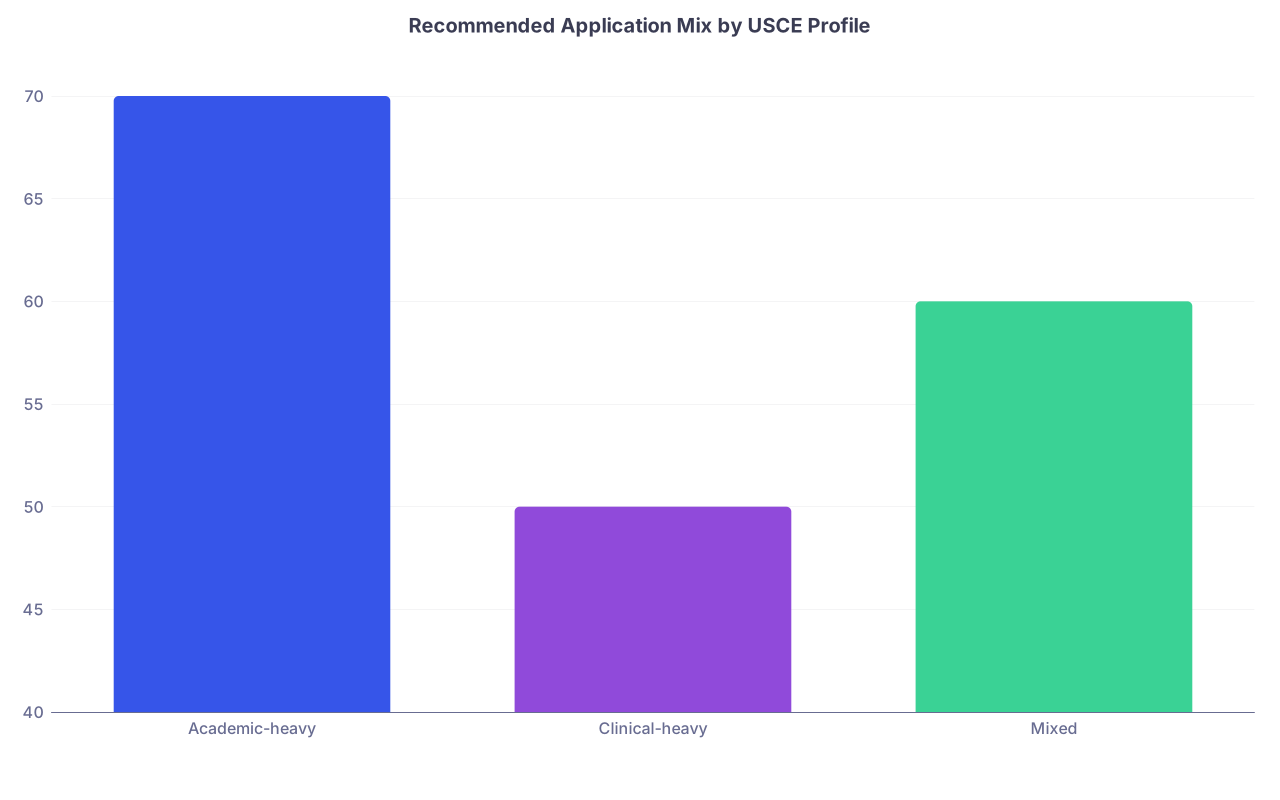
| Category | Value |
|---|---|
| Academic-heavy | 70 |
| Clinical-heavy | 50 |
| Mixed | 60 |
Interpretation (approximate interview focus out of 100 applications, not perfect math):
- Academic-heavy: ~70% university / university-affiliated, ~30% community/IMG-heavy
- Clinical-heavy: ~50% community, ~30% IMG-heavy, ~20% academic-affiliated
- Mixed: ~60% university-affiliated, ~40% community/IMG-heavy
You are not trying to guess a perfect number. You are trying to stop yourself from sending 80% of your apps to programs that will never value what you actually did on rotations.
Step 9: Present Your USCE Logically on ERAS and In Interviews
Listing “US Clinical Experience: 3 months” is a waste.
Instead, on your CV and ERAS description:
- Be concrete:
- “Inpatient internal medicine rotation at 350-bed community hospital; pre-rounded, wrote daily notes, presented to attending, followed 6–8 patients/day.”
- “Elective in cardiology at university hospital; attended cath lab, echo reading sessions, presented complex valve cases in weekly conference.”
- Tie it directly to residency skills:
- Time management
- Working in multidisciplinary teams
- Familiarity with EMR
- Patient-centered communication
In interviews, your answers must connect USCE to their program type:
For a community PD:
- “In my rotation at [Community Hospital], what I enjoyed most was the high volume and responsibility. I really like settings where residents are very hands-on and close to the community, and your program seems very similar.”
For a university PD:
- “During my month at [University Hospital], participating in M&M and journal club showed me how much I value a culture of critical thinking and teaching. Your program’s emphasis on QI and morning report fits very well with that experience.”
You are always signaling: “I have done something like what you offer, and I liked it.”
Step 10: Use Timelines So USCE Actually Impacts Your Match
Many IMGs do the right things at the wrong time. That kills their leverage.
Here is a simple structure if you are planning USCE around applications:
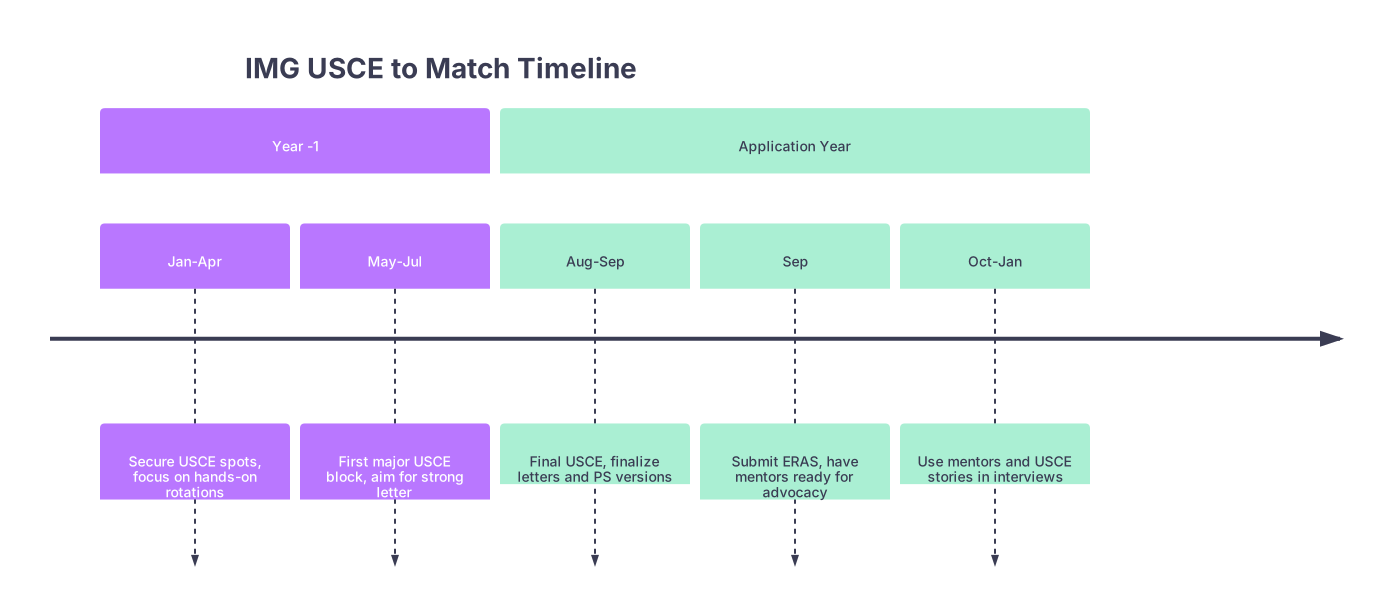
| Period | Event |
|---|---|
| Year -1 - Jan-Apr | Secure USCE spots, focus on hands-on rotations |
| Year -1 - May-Jul | First major USCE block, aim for strong letter |
| Application Year - Aug-Sep | Final USCE, finalize letters and PS versions |
| Application Year - Sep | Submit ERAS, have mentors ready for advocacy |
| Application Year - Oct-Jan | Use mentors and USCE stories in interviews |
Key rules:
- Your strongest USCE should be within 1–2 years of application
- Your best letter writers should know you well enough to remember you clearly during interview season
- Your stories from rotations must feel recent and detailed, not vague memory from 5 years ago
If you are already locked into a late rotation (like October–November of application year):
- Still do it, but:
- Email programs where you applied once the rotation and letter are complete
- Update them: “Since submitting my application, I completed a 4-week inpatient IM rotation at [Hospital], with [Attending]. They have kindly agreed to write a letter on my behalf. If possible, I would appreciate it if you could review this update when reconsidering my application.”
Does this guarantee interviews? No. Does it move some programs from “no” to “maybe” or “late invite”? Yes. I have seen that happen.
Your Move Today
Open a blank document and do three things right now:
List every US clinical experience you have, with:
- Setting (university/community)
- What you actually did
- Who supervised you
- What came out of it (letters, projects, skills)
Next to each, label it:
- Academic-heavy
- Clinical-heavy
- Mixed
- Weak/neutral
Then draft two short paragraphs:
- One that sells your academic side using your academic-heavy USCE
- One that sells your clinical side using your clinical-heavy USCE
Those two paragraphs will become the backbone of your targeted personal statements, interview answers, and emails to programs.
Do that today. Not after you “finish studying.” Not “closer to ERAS.” Your USCE is either a blunt instrument or a precision tool. You decide which.