

The belief that you need 6–12 months of US experience to match is garbage for most IMGs. What you actually need is to squeeze every drop of value out of the 4–12 weeks you can afford.
You told me your situation already without saying it: limited visa flexibility, tight money, family obligations, maybe already working as a physician back home. You can manage one or two short trips to the US, not a year of observership hopping. Perfect. Let’s make those short blocks hit as hard as possible on your application.
Step 1: Accept Your Constraint And Build Around It
If you cannot travel long‑term, stop planning like you can.
Your strategy is different from the “gap year in the US” crowd. They can brute-force with time. You have to win on focus and precision.
You are aiming for this combination:
- 4–12 total weeks of US clinical exposure
- Strong, specific clinical letters from US attendings
- Evidence you understand US systems and documentation
- A clear, believable story for programs: “I had limited time, but I used it extremely well.”
That’s enough. I’ve seen applicants with 8 weeks of USCE and 1–2 killer letters beat people with 8 months of random observerships and generic letters.
So first: decide how much realistically you can travel in the next 12 months.
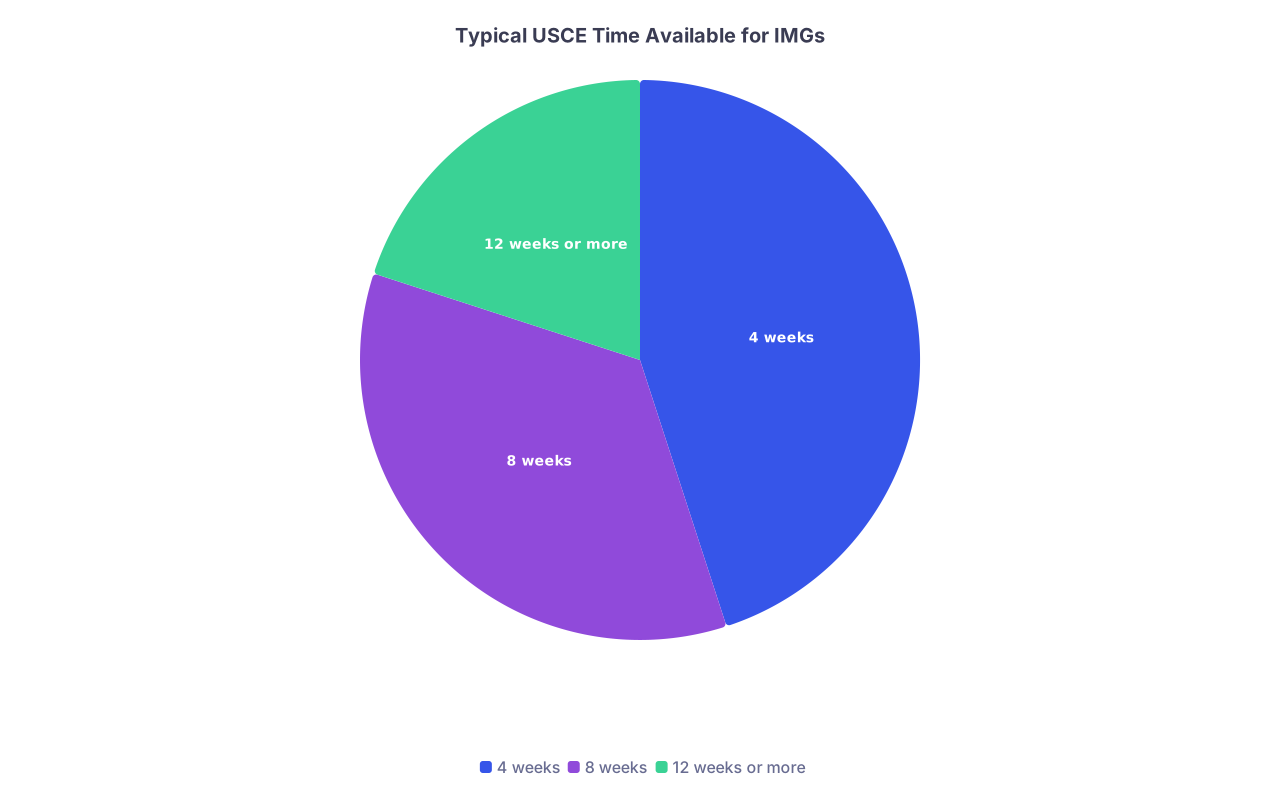
| Category | Value |
|---|---|
| 4 weeks | 45 |
| 8 weeks | 35 |
| 12 weeks or more | 20 |
Whatever that number is—4, 6, 8 weeks—we’re going to design backward from it.
Step 2: Choose The Right Kind Of Short Blocks
Not all short US experiences are equal. A 4‑week “stand in the corner and watch” observership is not worth a 4‑week hands‑on sub‑internship where you’re calling consults and writing notes.
Here’s how to prioritize when you’re limited on time:
Hands-on > Observership
If you can legally examine patients, write notes (even if they’re “for teaching only”), present on rounds, do it. Programs know the difference. Ask directly before you pay:
“Will I be allowed to see patients independently, write notes in the EMR (even as drafts), and present on rounds?”In your intended specialty > random specialty
If you want Internal Medicine, 8 weeks in US Internal Medicine beats 4 weeks IM + 4 weeks Radiology observership. Do not collect shiny experiences; collect relevant ones.Academic or teaching-heavy community program > private clinic
Private outpatient clinics can be fine, but for residency, they care more about inpatient experience, team-based care, and people who know how residency works.Fewer sites, longer per site > many 2‑week samples
Two solid 4-week blocks at places that know you and can write meaningful letters are better than four 2‑week “blink and you’re gone” visits.
If you only have 4–6 weeks total, aim for one place where you can embed yourself enough to be remembered.
| Option Type | Priority Level |
|---|---|
| 4-week hands-on IM at teaching hospital | Highest |
| 4-week sub-I in desired specialty | Highest |
| 4-week outpatient in same specialty | Medium |
| 2-week split blocks across sites | Low |
| Nonclinical observerships only | Lowest |
Step 3: Plan Your Blocks Around Application Timelines
You are in the residency application phase. Timing now matters almost as much as content.
If you’re targeting the upcoming ERAS cycle:
- Best-case: Do your key block(s) between March–July before you apply.
- Goal: Have at least one US letter uploaded to ERAS by early September.
- If your block is later (Sep–Dec): It can still help with mid-season interview decisions and rank lists, but you need earlier strengths (scores, home-country LORs, maybe tele-rotations) to get you in the door.
Here’s how the calendar typically plays:
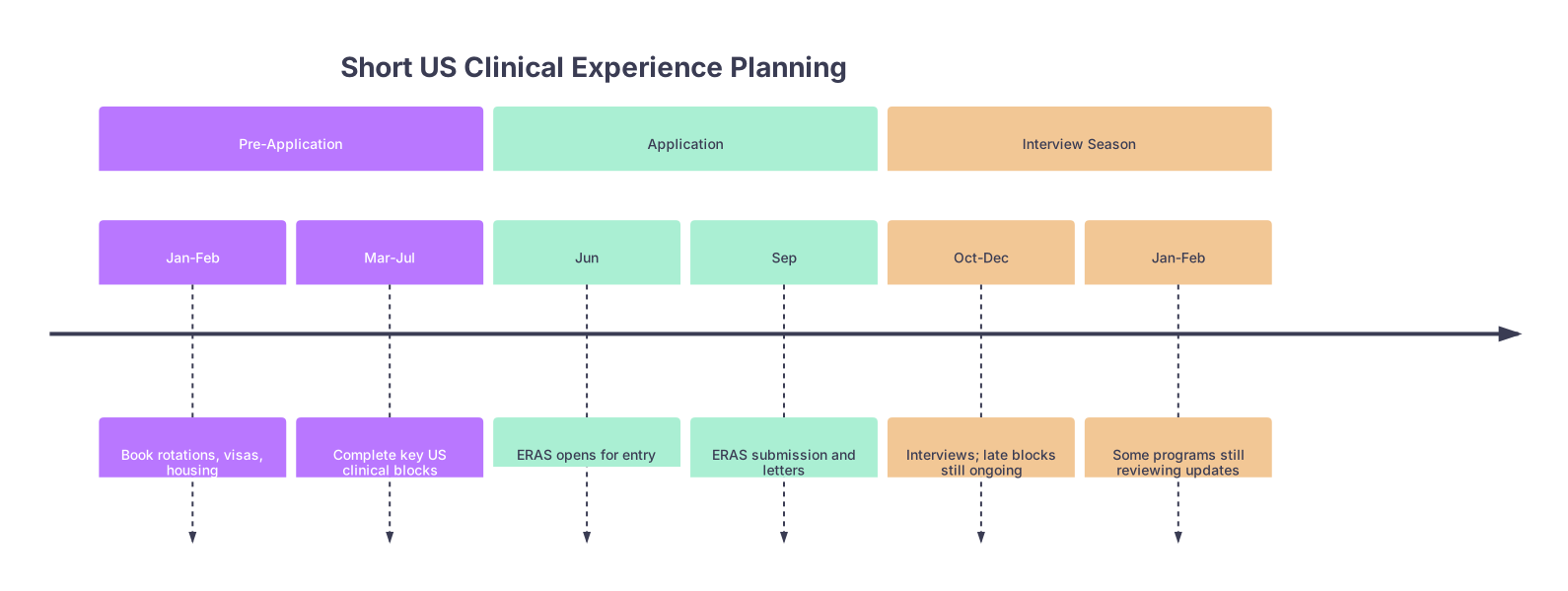
| Period | Event |
|---|---|
| Pre-Application - Jan-Feb | Book rotations, visas, housing |
| Pre-Application - Mar-Jul | Complete key US clinical blocks |
| Application - Jun | ERAS opens for entry |
| Application - Sep | ERAS submission and letters |
| Interview Season - Oct-Dec | Interviews; late blocks still ongoing |
| Interview Season - Jan-Feb | Some programs still reviewing updates |
If you can't come before September and your first block is in, say, November, then your strategy shifts:
- Use your application to clearly state: you already have this upcoming USCE confirmed, with dates and site.
- Email programs (targeted, not spam) mid-season with an updated CV when you’re in that block, especially if it’s at a well-known institution or in the same region.
Step 4: Before You Go – Prep Like You’re About To Take Another Exam
Your short block is not a vacation. You should arrive ready to function at 80–90% of a US sub‑intern, not a confused observer.
Two weeks before flying, you should:
Review US documentation style.
Learn SOAP notes and H&P structures the US way. Watch YouTube videos from US med schools. Read example notes if you can. The goal: on day 2, you’re already writing draft notes that your resident can actually use.Refresh high-yield clinical guidelines.
For Internal Medicine: chest pain, shortness of breath, sepsis, diabetes, hypertension, anticoagulation, heart failure, pneumonia. For FM: chronic disease management, vaccines, preventive care. For Surgery: peri-op management, fluids, pain control.Practice rapid oral presentations.
US residents present fast: “Mr. X is a 65‑year‑old man with a history of…” You should have the rhythm down before you get there. Time yourself: aim for 2–3 minutes per patient.Prepare a one-line intro and “story.”
Everyone will ask: “Where are you from?” and “Why this specialty?” Have a concise answer:
“I’m a final-year medical student/graduate from [Country]. I’m interested in [Specialty] and hoping to apply to US residency this cycle/next cycle.”
If you have to google “what is pre-rounding” on day 3, you already wasted time you did not have.
Step 5: Day 1 to Day Last – How To Behave So They Remember You
Here’s the core problem with short blocks: people forget you. It’s not malicious. US teams see dozens of rotators a year. If you want a letter, you can't be anonymous.
Your job in a 4‑week block:
- Be useful fast
- Be consistent
- Be easy to work with
- Make it obvious you’re serious about US training
Some concrete behaviors:
Show up early. Always.
If team meets at 7:00, you’re there at 6:30. Review labs and vitals for your assigned patients. Have a basic plan before rounds. I’ve literally heard attendings say: “She’s only been here a week but she functions like a sub‑intern because she pre‑rounds properly.”Own a small number of patients, thoroughly.
Don’t chase volume. If they let you follow 2–4 patients, know everything about them. Background, meds, imaging, overnight events, pending tests, discharge barriers. You want your resident to think, “If I forget something about this patient, I’ll just ask them.”Ask focused questions. Not constant questions.
Bad: interrupting rounds with basic “what’s an echo?” questions.
Good: “I read that we usually start ACE inhibitors for HFrEF—would we consider that today given his creatinine?” That shows you read, you think, you’re engaged.Write draft notes when allowed.
Offer gently: “Would it be helpful if I wrote a draft progress note for [patient] that you can review and edit?” If they say yes and you do it well twice, your value just shot up.Be the one who follows through.
Resident: “We need to check when his last colonoscopy was.”
You: “I’ll call the outside facility and get the report faxed.”
Do that a few times, and your name is locked in their memory.

Step 6: Engineering Strong Letters From Short Rotations
This is the part everybody messes up. You can’t just “hope” someone will be impressed enough to write you a good LOR from a 4‑week block. You need to manage this deliberately.
Here’s the sequence that works:
Week 1: Signal Your Goals
By the end of the first week, have a short 1‑on‑1 with your attending or primary supervising physician.
Say something like:
“Dr. Smith, I wanted to briefly share my goals for this rotation. I’m an IMG planning to apply to Internal Medicine this coming ERAS cycle. I know I have limited time in the US, so I really want to get as much feedback and growth as possible. If there are specific things I can do to be more helpful to the team or to improve, I’d really appreciate your guidance.”
Why this matters:
Now they know you’re serious. They’re watching you with that lens.
Week 2–3: Ask For Feedback, Then Actually Change
Example:
“I’d like to be sure I’m progressing well. Are there 1–2 things I could do differently with my presentations or patient follow-up to function more like a sub‑intern?”
Then do exactly what they say. Visibly. Quickly. If they tell you to tighten presentations, by next week you should be 30 seconds shorter and more organized. People remember learners who respond to feedback.
Week 3–4: The Letter Ask
Do not wait until the last day with a panicked email.
In the last week (ideally after you’ve had some positive feedback), ask like this:
“Dr. Smith, I’ve really appreciated working with you. I’m applying to Internal Medicine this coming cycle and US letters are very important for me as an IMG. Would you feel comfortable writing me a strong and specific letter of recommendation based on my performance here?”
Two key words: strong and specific. This politely gives them an out if they cannot be enthusiastic. If they hesitate or say something non-committal like, “Sure, I can write something if you need,” you probably don’t want that letter.
Once they agree:
- Send them your CV, ERAS personal statement draft (if ready), and a short bullet list of things you did on the rotation (patients followed, presentations given, any praise you received).
- Remind them of your timeline: “Letters can be uploaded to ERAS anytime before mid‑September, but earlier is better.”
If your block is after ERAS opens, still get the letter. Programs do look at letters added later in the season.
Step 7: Document And Translate Your Short Experience Into Application Gold
Your 4–8 week block is not just a line under “Experience.” It should show up in multiple parts of your application like a theme.
Places to leverage it:
CV / ERAS Experience Section
Do not just write: “Observership, XYZ Hospital.”
Use 2–3 specific bullet points on what you did:- “Pre-rounded and followed 3–4 inpatients daily under resident supervision, presenting on rounds and proposing management plans.”
- “Drafted daily progress notes and discharge summaries in EMR for teaching purposes, integrating US guidelines for sepsis, heart failure, and diabetes.”
- “Coordinated with case management and social work for discharge planning in a safety-net hospital serving predominantly uninsured patients.”
Personal Statement
Very short, but concrete reference. Not “this experience changed my life” fluff. Something like:“During a 4‑week Internal Medicine rotation at a busy county hospital in [City], I saw how multidisciplinary teams manage complex, uninsured patients. Following a patient with decompensated heart failure from admission to discharge, I learned how evidence-based changes in diuretics and afterload reduction directly improved his breathing and allowed him to walk again before leaving.”
Interview Answers
When they ask, “What US clinical experience do you have?” you should not answer with dates. You answer with impact:- Where it was
- What your role was
- What you learned about US practice
- One or two vivid patient stories that show you weren’t just standing there
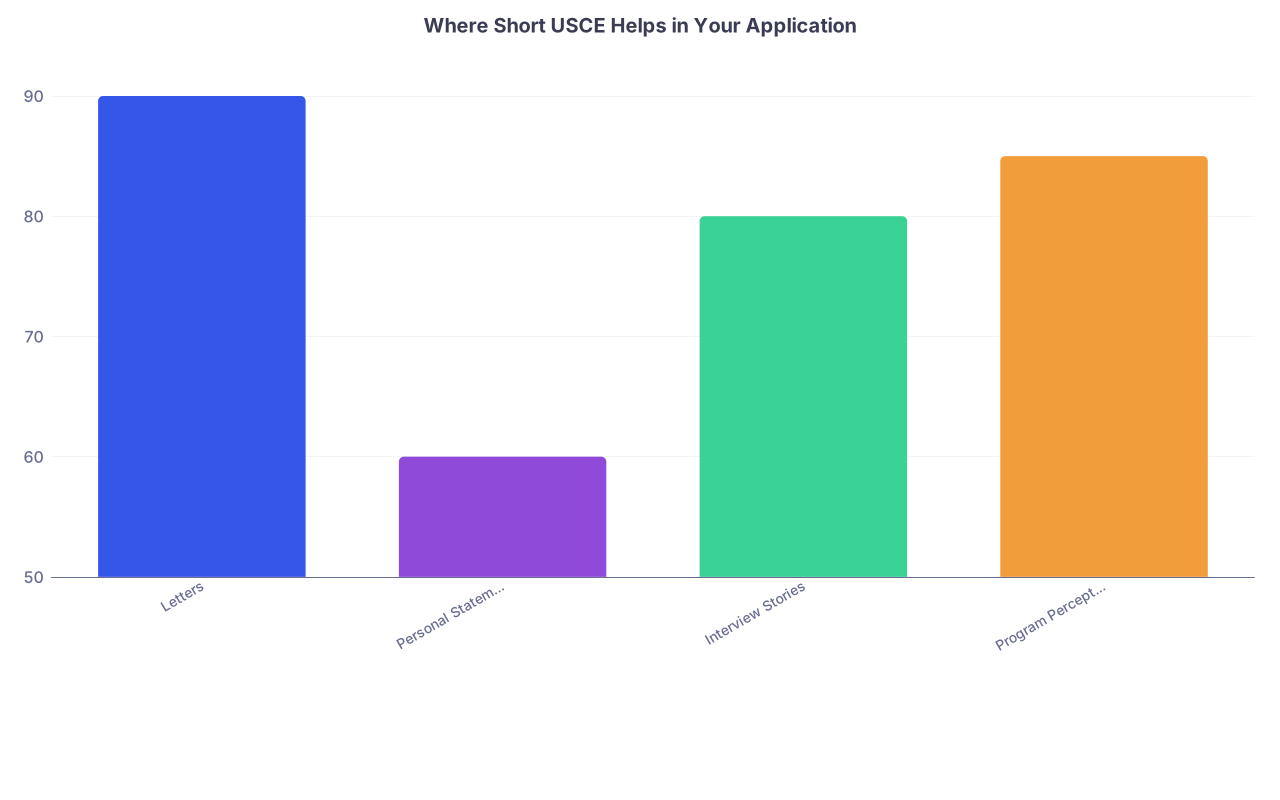
| Category | Value |
|---|---|
| Letters | 90 |
| Personal Statement | 60 |
| Interview Stories | 80 |
| Program Perception of US Readiness | 85 |
Step 8: If You Truly Can Only Do One Short Trip
Some of you are thinking: “I can’t come twice. One trip, 4 weeks, that’s it.”
Fine. Then you run a very tight plan:
Before The Trip
- Apply for rotations that:
- Are in your specialty
- Allow hands-on or at least note writing / direct presentations
- Are at a site that has residents and attendings (not just private solo clinic)
- Get your Step scores, OET, and ECFMG stuff as strong as possible. Those become even more important with limited USCE.
During The Trip
- Live close to the hospital. Don’t waste an hour each way commuting.
- Treat every day as an audition. No “jet lag days.”
- Tell both your attending and at least one senior resident about your situation: limited time, serious interest, need for US letter.
After The Trip
- Stay in touch 2–3 times a year. Short emails: update them on exams, applications, and say how their teaching helped.
- When ERAS season comes, email them with a polite reminder about the letter if it’s not uploaded.
- If you apply to that hospital’s residency, send a targeted email to the program coordinator or PD referencing your rotation and letter writers there.
I’ve seen this exact path work: 4 weeks in one strong IM program, 1–2 very good letters, solid Step 2, clear story → matched community IM in the same state.
Step 9: Combine Short In‑Person Blocks With Remote/Local Work
You can strengthen short USCE by stacking it with other smart moves you can do without being in the US long-term.
Options:
Tele-rotations with US faculty.
Not a replacement for in-person, but can show continuity of interest. And sometimes those faculty know PDs or will at least vouch for your engagement and clinical reasoning.Research or QI projects with US teams (even remote).
If your short block site likes you, ask at the end:
“Is there any ongoing quality improvement project or chart review I could help with remotely after I return home?”
That turns 4 weeks into 6–12 months of ongoing affiliation.Local clinical work at home that mirrors US residency work.
On interviews, program directors often care less about the passport and more about: Are you clinically active? Seeing real patients now? Responsible for decisions? Use that to offset limited US time.

Step 10: Common Mistakes IMGs With Short Time Make (And How Not To Be That Person)
Let me be blunt. These are the ways people waste their only 4–8 weeks:
- Treating the rotation like shadowing: stand at the back, never lead a presentation, never volunteer to do anything.
- Not asking for feedback until the last day, then acting surprised that no one “got to know them enough” to write a letter.
- Splitting an already short trip into multiple random observerships: 1 week cardiology, 1 week GI, 2 weeks outpatient FM. Result: no one knows you well enough.
- Spending money on a “prestige brand name” observership where you’re essentially invisible, instead of a smaller teaching hospital where you can actually participate.
Don’t do this. If you feel invisible by the end of week 2, you need to change your behavior immediately: pick up more responsibility, speak with your resident, ask your attending for a specific role to own.
Quick Reality Check: Is Short USCE Enough To Match?
For many IMGs—yes, if the rest of the application is solid.
Not for all specialties. Let’s not pretend.
| Specialty Type | Short USCE Impact |
|---|---|
| Internal Medicine / FM | High |
| Pediatrics / Psych | High |
| Neurology / Pathology | Moderate |
| Surgery / Surgical subs | Low–Moderate |
| Derm, Plastics, etc. | Very Low |
If you’re aiming for IM, FM, peds, psych, neuro, path—4–12 weeks of good USCE with strong letters can absolutely do the job when combined with good exams and a coherent story.
If you’re chasing Ortho or Derm with no long-term US presence… you’re playing on “hard mode” and need other extraordinary strengths.


