

The idea that you must quit your full‑time job abroad to get US clinical experience is nonsense—and dangerous for most IMGs.
You’re not a trust fund applicant. You have a job, a visa, family expectations, and a clock ticking on your graduation year. You still need US clinical experience (USCE) to be taken seriously for residency. So the real question is: how do you get enough USCE to be competitive, without blowing up your financial and personal life?
That’s the situation I’m going to handle.
1. Get Clear on What “Counts” as US Clinical Experience
Before you start sacrificing vacation days and begging for unpaid leave, you need to know what actually matters.
Here’s the hierarchy. Programs will never spell it out this bluntly, but I will.
| Type of Experience | Competitiveness Value | Patient Contact | Typical Duration |
|---|---|---|---|
| US Residency (prelim/transition) | Very High | Full | 1 year |
| US Hands-On Externship | High | Direct | 4–12 weeks |
| US Subinternship/Clerkship | High | Direct | 4–8 weeks |
| US Observership (inpatient) | Moderate | Indirect | 2–8 weeks |
| US Observership (outpatient/private) | Low–Moderate | Indirect | 2–12 weeks |
What programs usually mean by “US clinical experience preferred/required”:
- Direct patient care in a US hospital or clinic
- Documented on a letterhead, with dates and role
- Ideally with an attending who can comment on:
- Reliability
- Clinical reasoning
- Teamwork
- Communication with patients in English
What does not really move the needle by itself:
- Random “shadowing” days you collected during a vacation
- A single 1-week observership
- Online telehealth “experience” with no clear supervision or letter
- Research only, with zero clinical exposure (good, but not a replacement)
You’re working full‑time abroad. That means you’re not playing for perfection. You’re playing for minimum viable competitiveness:
- 8–12 weeks total of relevant USCE
- At least 1–2 strong US letters of recommendation from that experience
- Preferably in your intended specialty or at least internal medicine/family med if unsure
That’s your target. Not 6 months. Not a full year. Enough to answer the question: “Has this person functioned in a US healthcare environment, with US patients and teams?”
2. Map Your Reality: Time, Money, and Risk
You can’t copy someone else’s path if your constraints are different. Start by being brutally honest about these three:
A. Time
Ask yourself:
- How many total weeks off can you get in the next 12–18 months?
- Annual leave?
- Unpaid leave?
- Gaps between contracts?
- When are your busiest periods at work when leave is impossible?
- Can you stack leave (e.g., carry over vacation to create a 4–6 week block)?
For most working IMGs I’ve seen:
- 2–4 weeks paid vacation per year
- Maybe 2–4 more weeks of unpaid leave without getting fired, if you plan and negotiate
- One natural break if your contract ends
If you can realistically get 6–8 weeks in the US total before applications, that’s usable. If you can get 10–12 weeks, you’re in strong shape.
B. Money
Bare minimum costs per 4‑week USCE block, very rough:
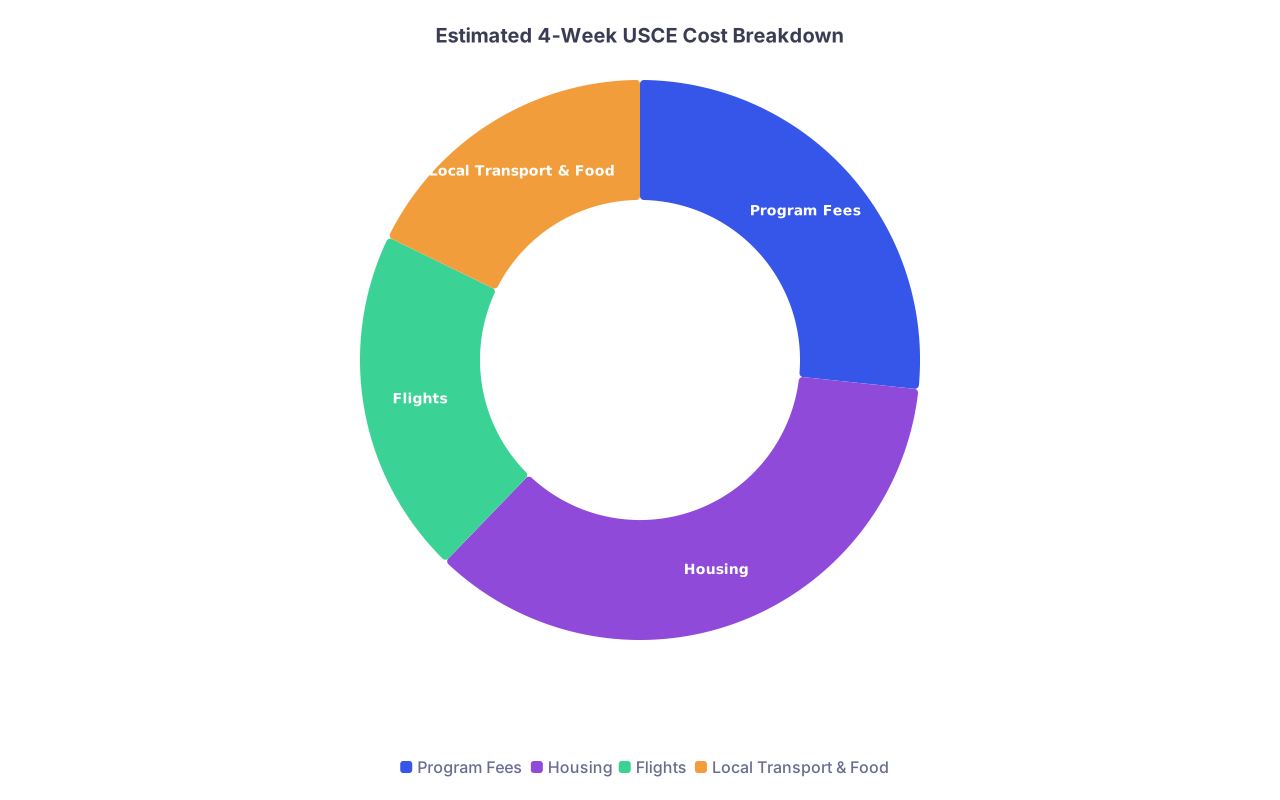
| Category | Value |
|---|---|
| Program Fees | 1200 |
| Housing | 1600 |
| Flights | 900 |
| Local Transport & Food | 800 |
If you are working full‑time, do not pretend you can finance multiple 3‑month stints in the US by “being frugal.” You need:
- A savings target per USCE block (e.g., $4–6k)
- A timeline to reach it (e.g., 8–12 months of aggressive saving)
- A hard rule: no credit card debt to fund observerships. That’s how people torch their financial future for a CV line that doesn’t match the price.
C. Risk to Your Current Job
Ask yourself:
- If I request unpaid leave, is my job secure when I return?
- Does my boss secretly know I’m planning to leave medicine locally? (Some get petty.)
- Can I frame this as “professional development” instead of “I’m abandoning you”?
If your job is fragile—contract-based, easily replaceable—then you plan shorter, safer blocks and avoid overly ambitious multi-month absences.
3. Choose the Right USCE Strategy for Full-Time Workers
Here’s where people mess up: they apply to whatever USCE they see first, then try to bend their life around it. Backwards.
You start with: What blocks of time can I actually free? Then you pick the USCE types that fit those blocks.
Strategy 1: The “Stacked Short Blocks” Plan (Most Common)
Who this is for:
Working full-time with standard vacation + possible unpaid leave. Can get 2–4 weeks at a time.
Plan:
- Year 1:
- 2–4 weeks USCE (observership or externship) in your target specialty
- Year 2 (application year):
- Another 4–6 weeks in the same or related specialty, ideally at a stronger site
Goal: build continuity with at least one attending or department so they can write a substantial letter.
This is more realistic than trying one enormous 12-week block that your employer will probably reject.
Strategy 2: The “One Big Push” Plan
Who this is for:
People who can negotiate 6–8 weeks off at once (between contracts, sabbatical, or a lenient boss).
Plan:
- Save aggressively for 12–18 months
- Book 6–8 continuous weeks in the US:
- First 4 weeks: hospital-based observership/externship
- Next 2–4 weeks: same site or related site, same specialty
- Focus on:
- Learning workflow quickly
- Showing up early, leaving late
- Getting at least 2 strong LoRs
This can be your entire USCE portfolio. If done well, you do not “need” more.
Strategy 3: The “Bridge Then Bail” Plan
Who this is for:
People ready to leave their job in 12–24 months, but want a soft landing.
Plan:
- Work full full‑time now, build savings, take 1–2 small USCE blocks
- Once you’re 6–9 months before Match:
- Leave job
- Do a longer USCE (8–12 weeks) + observership + maybe research
- This is riskier but can dramatically enhance your application because you’re physically in the US for interviews, networking, etc.
Don’t attempt this without a financial buffer and a realistic view of your chances.
4. Finding USCE That Actually Fits Your Life
You do not have time to apply wildly to every “USCE program” on Google. Many are overpriced, low-yield, or impossible to schedule flexibly.
Focus on three main categories:
1. University-Affiliated Observerships
Pros:
- Better credibility on your CV
- Sometimes free or low cost (administrative fees only)
- Higher chance of meaningful LoRs
Cons:
- Fixed dates, less flexibility
- Competitive; long application lead-times (3–9 months)
- Some require Step scores or ECFMG certification
Good targets:
- Internal medicine departments at mid-tier universities
- Community hospitals affiliated with med schools
- Programs explicitly mentioning IMGs on their websites
2. Paid Private Programs (Cautious Use)
Pros:
- More flexible start dates and durations (2–12 weeks)
- Easier to get an acceptance
- Some include letter-writing as part of the structure (though quality varies)
Cons:
- Expensive
- Variable reputation
- Some are glorified shadowing with fancy marketing
If you go this route, choose:
- Direct patient contact (externship style) over pure shadowing
- Settings where you’ll see US-style documentation, EMR, and team huddles
- Programs that cap number of observers per preceptor (you don’t want to be #5 in a pack)
3. Networking-Based Opportunities
This is underused by IMGs abroad.
Sources:
- Alumni from your medical school now in US residency
- US-trained attendings at your hospital who can email contacts
- National or specialty WhatsApp/Telegram groups for IMGs
- LinkedIn (used well, not spammy “Dear Sir/Madam” messages)
You write something like:
“I am an internal medicine physician working full-time in [country], applying for US residency for the 202X cycle. I’ll be in the US during [Month, Year] and seeking 2–4 weeks of structured observership or hands-on experience. I can share my CV if you’re open to it.”
You don’t beg. You don’t write essays. You’re clear, polite, and concrete about time windows.
5. Timing USCE Around the Match Calendar
USCE timing matters more than people admit. Programs care who wrote your letters and how recent the experience is.
Ideal structure if you’re working abroad:
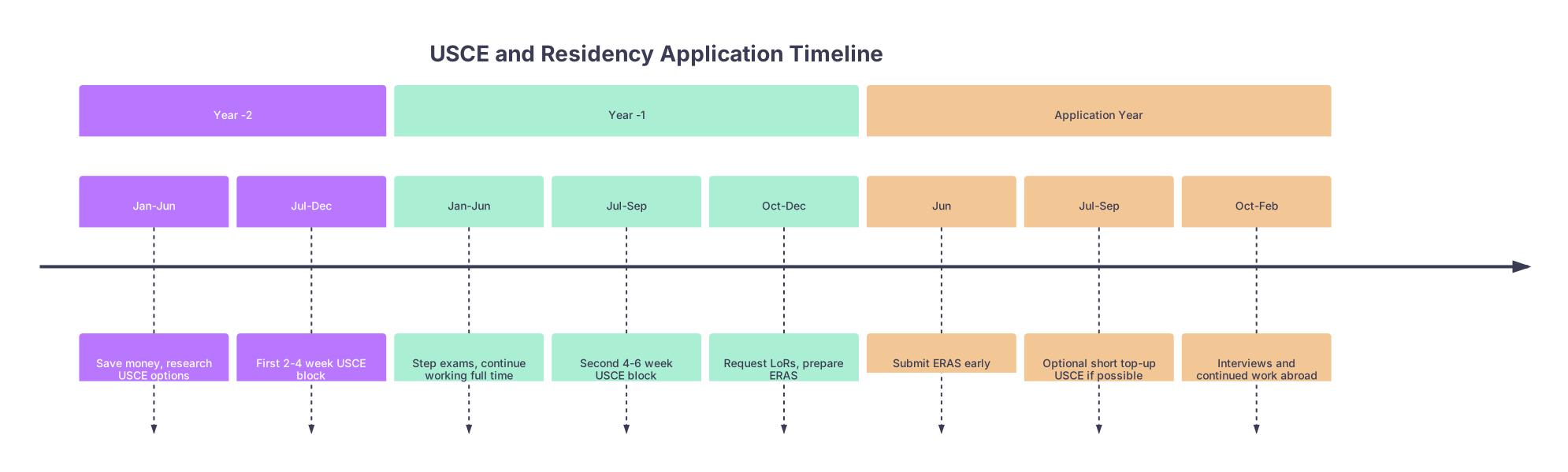
| Period | Event |
|---|---|
| Year -2 - Jan-Jun | Save money, research USCE options |
| Year -2 - Jul-Dec | First 2-4 week USCE block |
| Year -1 - Jan-Jun | Step exams, continue working full time |
| Year -1 - Jul-Sep | Second 4-6 week USCE block |
| Year -1 - Oct-Dec | Request LoRs, prepare ERAS |
| Application Year - Jun | Submit ERAS early |
| Application Year - Jul-Sep | Optional short top-up USCE if possible |
| Application Year - Oct-Feb | Interviews and continued work abroad |
Key points:
- Last 12 months before ERAS submission: try to have at least one USCE experience in this window.
- If you did USCE 3–4 years ago but nothing recent, programs wonder if you’re still clinically sharp and current.
- Don’t cram USCE during the core of interview season (Oct–Jan) if you’re hoping to travel for interviews. That’s chaos.
If you truly cannot get time in the 12 months before applying, then:
- Aim for the strongest possible letters from earlier USCE
- Make your current full-time work look substantial (responsibility, teaching, procedures, etc.)
- Address recency briefly in your personal statement if needed.
6. Maximizing Every Single Day You’re in the US
You’re not a US med student who can afford to be passive. Your time in the US is expensive and limited. Behave like it.
Here’s how to turn 4 weeks into something that actually moves your application.
On Day 1–3
Your goals:
- Learn the workflow and EMR basics
- Learn names of team members
- Show you’re competent and safe, not eager and reckless
You say things like:
- “I’m used to [local system]. I want to adapt to your workflow. What’s the best way for me to help the team without getting in the way?”
- “Is there anything previous observers/externs did that you found especially useful—or annoying? I want to be in the first category.”
On Week 1–2
You:
- Arrive early, leave when the team leaves (not 3 hours after them “to impress,” that’s weird)
- Keep a running list of interesting cases, notes on guidelines used, differences from your home system
- Ask for brief feedback:
“I’m trying to build my skills in presenting patients in the US format. Could you give me feedback on one of my presentations this week?”
You are gently but clearly signaling:
“I am here to learn, to work, and to improve fast.”
On Week 3–4
Now you start thinking about letters.
You do not ambush your attending on the last day with: “Please write me a strong letter.” That’s amateur-level.
Instead, around the middle of week 3:
“Dr. X, I’m planning to apply for internal medicine residency in the upcoming Match, and your evaluation would be very meaningful. If you feel you know my work well enough, would you be comfortable writing a strong letter of recommendation for me?”
If they hesitate, or say something like “I can write a standard letter,” thank them and understand: that’s a no. Find someone else at the site who worked more closely with you.
You also request:
- Concrete comments on:
- Clinical reasoning
- Communication with patients
- Adaptation to US system
- Reliability and professionalism
The strongest LoRs for IMGs answer one question in the program director’s head:
“Would I trust this person on my team at 3 a.m.?”
Make every interaction build toward that answer.
7. Keeping Your Full-Time Job From Imploding
This part is not glamorous, but it’s how you survive until Match.
Talk to Your Employer Like an Adult, Not a Student
Your boss does not care that you “need USCE to match.” They care about coverage, staffing, and not being abandoned last minute.
You frame it like this:
- “I’d like to pursue a short professional development opportunity in the US that will strengthen my clinical skills and bring back useful perspectives to our department.”
- “I’m requesting [X weeks] of annual leave + [Y weeks] unpaid leave from [Date] to [Date]. I will ensure coverage for my responsibilities and complete all required handoffs.”
You propose solutions:
- Swapping shifts ahead of time
- Taking less popular rotations afterward
- Agreeing not to ask again for another extended leave for a set period
If you walk in with “I need 8 weeks off because of my career,” you’ll get pushback. If you walk in with “Here’s my exact plan, coverage, and minimal disruption,” your odds improve.
Don’t Lie, But Don’t Overshare
You don’t need to announce to the whole department that you’re emigrating. Say you’re exploring training opportunities, building skills, etc. Your close colleagues will figure it out; that’s fine.
What you avoid:
- Threatening to quit if they say no
- Emotional appeals (“This is my dream”)—your boss is not a residency program
- Last-minute requests
Plan 6–9 months ahead for every USCE block if possible.
8. When You Truly Can’t Get Much USCE
Some of you work in systems where long leave is impossible. Or you’ve got family obligations that lock you locally. Then you play a slightly different game.
Your moves:
Get at least something:
- 2-week observership is still better than zero
- If you can visit relatives in the US, bolt a short observership onto that trip
Make your non-US experience look like gold:
- Emphasize volume, acuity, and independence in your current job
- Highlight any Western-trained supervisors at your current site
- Get excellent local letters that emphasize maturity, clinical judgment, and work ethic
Double down on:
- Strong Step scores (especially Step 2 if Step 1 is pass/fail already)
- Research, QI projects, teaching roles
Some community programs and underserved areas will still seriously consider you with limited USCE if the rest of your profile is impressive and your story is coherent.
FAQ (Exactly 3 Questions)
1. How many weeks of US clinical experience do I really need as an IMG working full-time abroad?
For most specialties (especially internal medicine, family medicine, pediatrics), a realistic and competitive target is 8–12 total weeks of USCE before or during your application cycle. You can get there through two or three shorter blocks (e.g., 4 weeks one year, 4–8 weeks the next). More than 3–4 months is nice but not essential if your time and money are limited. Less than 4 weeks starts to look weak unless you have exceptional Step scores and unique experience.
2. Do observerships without hands-on duties actually help, or are they a waste of money?
Good observerships help; bad ones are expensive tourism. A useful observership gives you: consistent attendance on a team, exposure to US workflows and EMR, and face time with attendings who are willing to write detailed letters about your professionalism, clinical thinking, and communication. If you’re just standing in a corner with five other observers and no one knows your name, that is almost useless. When you evaluate programs, ask directly: “How many observers per attending?” and “Do attendings routinely write letters for observers?”
3. What should I prioritize if I can’t afford both multiple USCE blocks and lots of interview travel?
If resources are tight, I’d prioritize:
- One strong 4–8 week USCE block that yields at least 1–2 solid US LoRs, and
- Targeted interview travel to the best-fitting programs that actually invite you. There’s no point having six observerships if you can’t afford to show up to interviews. Build one or two good experiences, apply strategically (more community and IMG-friendly programs), and reserve money for being physically present to interview well.
Key points to walk away with:
- You do not need to destroy your job to build credible US clinical experience; you need 8–12 smartly planned weeks, not fantasy-level exposure.
- Timing, quality of letters, and your behavior during USCE matter far more than raw total weeks.
- Protect your income, be strategic about leave, and treat every US day like it’s costing you $200—because it probably is.


